
Insights and Resources
Top Edge Compute Platforms: What to Evaluate
A practical checklist for comparing edge platforms for real production workloads.

By Eli Mogul
Edge computing has moved from pilots to production. Buyers now need a defensible shortlist and criteria that map to real latency, data residency, and uptime requirements, especially for real-time voice and conversational AI, where sub-second response times determine whether an interaction feels human or robotic.
This guide walks through the leading edge compute platforms in 2026, the criteria that matter most when evaluating them, and where buyers tend to get tripped up. We’ll also look at how full-stack platforms like Telnyx differ from hyperscaler edge offerings when the workload is real-time voice.
Why edge platforms matter now
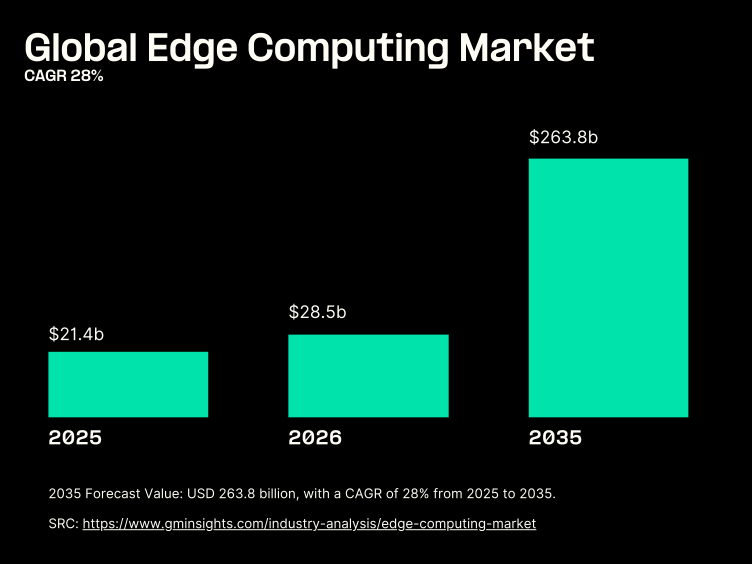
The market is scaling fast. According to Global Market Insights, the global edge computing market was estimated at $21.4B in 2025 and is projected to reach $28.5B in 2026, with strong growth projected through 2035. IDC’s Worldwide Edge Spending Guide places combined spend (services, infrastructure, and software) even higher, projecting roughly $380B globally by 2028. In the United States, IMARC anticipates the market will reach $7.2B in 2025 and $46.2B by 2033.
Adoption is maturing, too. Gartner forecasts that by 2028, at least 60% of edge deployments will use composite AI, up from less than 5% in 2023. North America continues to lead deployments, supported by mature 5G coverage and a dense vendor ecosystem, according to Markets and Markets. Edge is no longer a side experiment; it’s where AI inference, voice, and real-time decisioning increasingly live.
For voice AI specifically, the case is even sharper. Conversational latency under ~300 ms is widely cited as the threshold for natural-feeling interactions. AWS engineers note that placing foundation-model inference closer to users through Local Zones reduces time-to-first-token significantly compared to regional deployments. Distance to compute isn’t abstract, it directly determines whether a voice agent sounds responsive or stilted.
For more on how voice AI providers compare, see our review of the top voice AI providers in 2026.
What to evaluate in an edge compute platform
Before comparing vendors, lock in your criteria. These five categories cover most production buyer concerns.
1. Geographic footprint and PoP density
How many regions, availability zones, or points of presence (PoPs) does the platform run and where? Density near your users matters more than total count. A provider with 12 PoPs concentrated near your traffic will often outperform one with 40 PoPs spread across regions you don’t serve. For multinational deployments, check coverage in Europe/Middle East/Africa (EMEA), Asia-Pacific (APAC), and Latin America (LATAM), since data residency rules often require local processing.
2. Latency and proximity to users
Real-time voice, AR/VR, and industrial control workloads need consistent sub-50 ms round trips. Multi-access edge computing (MEC) can deliver <10 ms when GPU and inference resources sit alongside radio base stations or telephony PoPs (see research on telco edge architectures). The farther inference sits from where calls originate, the worse the experience gets. TechTarget’s overview of 5G in edge computing explains why combining 5G connectivity with edge compute has become foundational for latency-sensitive workloads.
3. Integrations with the rest of your stack
An edge platform that doesn’t integrate with your telephony, CRM, observability, or AI tooling will create friction at every step. Look for native SDKs, container runtime support, Kubernetes orchestration, and APIs for the services you already use. Teams running multi-model voice pipelines should also evaluate orchestration capabilities. See our guide to AI orchestration platforms and best practices.
4. Pricing model and predictability
Per-minute, per-request, and egress-based pricing models scale very differently. A platform that looks inexpensive for pilot traffic can become punishing at production volume, especially when egress fees compound across regions. Ask for transparent pricing, capped overage scenarios, and committed-use discounts. For voice AI at scale, per-minute economics decide viability: Telnyx orchestration starts at $0.05/min with STT and Telnyx-native TTS included, versus stitched multi-vendor stacks that run far higher.
5. Compliance, security, and enterprise support
For regulated industries, SOC 2, PCI, HIPAA, and GDPR are table stakes. Many enterprises also need dedicated infrastructure or sovereign deployments in specific regions. As IBM notes on data residency, stricter localization laws make it critical to know exactly where data resides. On the support side, response-time SLAs and access to engineering (not just tier-one queues) often matter more than feature lists at 2 a.m.
How the leading edge compute platforms compare
The market includes hyperscaler edge services, telecom-anchored MEC providers, and full-stack platforms purpose-built for real-time communications. Here’s how major options stack up across the criteria above.
| Platform | Strengths | Best fit for | Considerations |
|---|---|---|---|
| AWS (Local Zones, Wavelength, Greengrass) | Deep AWS integration; broad geographic coverage; mature IoT tooling | AWS-native enterprises extending cloud workloads or running IoT fleets | Egress costs add up; native telephony requires third-party carrier integration |
| Microsoft Azure (Edge Zones, IoT Edge, Stack Edge) | Strong hybrid story; Microsoft security stack; regulated-industry focus | Azure-first enterprises in retail, manufacturing, or government | Voice AI requires assembling multiple services and external carriers |
| Google Distributed Cloud Edge | GKE-based orchestration; strong ML/analytics; sovereignty options | Kubernetes-native teams; ML-heavy workloads; data sovereignty use cases | Smaller global footprint than AWS/Azure; telephony is not native |
| NVIDIA Fleet Command | Purpose-built for GPU inference at the edge; vision and generative AI | AI-first enterprises running model fleets across distributed sites | Not a full communications stack; pair with connectivity platforms |
| Telnyx | Colocated GPU and telephony PoPs; full-stack voice AI control; global carrier network with coverage in 100+ countries | Real-time voice AI, contact centers, conversational agents needing PSTN access | Best fit when communications and AI inference need to live on the same infrastructure. Purpose-built for AI agents; may be more than needed for simple IoT workloads |
For a deeper comparison of the CPaaS players in this space, see our breakdown of Telnyx vs. Twilio, Plivo, and other cloud communications platforms.
Where hyperscalers fall short for real-time voice
Hyperscaler edge shines for IoT, content delivery, and extending cloud workloads closer to users. It wasn’t built primarily for real-time voice. A voice AI call enters via the public switched telephone network (PSTN), runs STT → LLM → TTS, and returns audio, all ideally in under one second.
This is what AI Agent Infrastructure looks like in practice. Hyperscalers have compute. They don't have the telecom edge, the carrier infrastructure that lets inference run where calls actually originate. That's the gap Telnyx fills. Telnyx colocates GPU infrastructure adjacent to its global telephony PoPs: edge compute, agent platform, and global communications operating as one system. By keeping the carrier network, the inference workload, and the call-control plane on the same infrastructure, the physical distance data travels shrinks dramatically. The economics follow from the architecture. Telnyx TTS starts at $0.000003/char, 10x less than ElevenLabs. SIP trunking at $0.005/min, half Twilio's rate. Voice AI agents start at $0.05/min for orchestration, with STT and Telnyx-native TTS included; open-source LLM inference billed separately. These aren't discounts; they're structural, the result of owning infrastructure instead of renting it from four vendors. For a closer look, see our coverage of the best AI tools available on Telnyx.
Edge platforms by use case
Different workloads favor different platforms. A few rules of thumb:
- For IoT and industrial automation: AWS Greengrass and Azure IoT Edge dominate, with strong device management and local inference tooling.
- For computer vision and generative AI fleets: NVIDIA Fleet Command is purpose-built and integrates with the broader NVIDIA AI stack.
- For sovereign and regulated workloads: Google Distributed Cloud Edge offers a strong data-residency story, with on-premises GKE clusters that satisfy strict compliance requirements.
- For real-time voice AI and contact centers: Telnyx combines carrier-grade PSTN access with colocated AI inference, reducing the third-party integration tax that hyperscalers impose on voice workloads. Teams building conversational agents in regulated industries can find a deeper review in our guide to the best voice AI agents for banking in 2026.
- For multi-model AI orchestration with PSTN access: Full-stack platforms outperform piecemeal stacks. Our overview of the best voice AI platforms for enterprise in 2026 walks through how leading enterprises are making this call.
How to shortlist in three steps
- Define your latency budget. Map every hop in your call flow, from PSTN ingress to inference and back, and set a target round-trip time. If your target is under ~300 ms, MEC-style colocated platforms often become essential.
- Inventory your existing stack. If most of your tooling is already on Azure, Azure Edge Zones may win on integration alone, even if a competitor posts better raw latency. If you have no preexisting cloud commitment, you have more freedom to optimize for the workload.
- Test with production traffic. Vendor benchmarks rarely reflect real call patterns. Run a 30‑day pilot with representative call volumes, geographic distribution, and concurrent session loads before signing a multi‑year contract.
The bottom line
Edge compute is no longer one market, it's three: hyperscaler extensions, AI inference platforms, and full-stack communications infrastructure. Each solves a different version of the latency and data-residency problem. For real-time voice AI, the deciding factor is usually whether the platform owns both the network and the inference layer, or whether you'll be stitching them together yourself.
If voice is core to your roadmap, evaluate platforms on what happens at the seams between telephony and AI, not just on raw compute specs. Platforms that own both layers tend to deliver better latency, simpler operations, and more predictable economics at scale.
To go deeper on related vendor comparisons, see our analyses of ElevenLabs alternatives and Vapi alternatives for scalable voice AI.
Build voice AI on infrastructure that's built for it
Telnyx colocates GPU infrastructure with global telephony PoPs, so your voice AI workloads run on the same network that carries the call. That means lower latency, simpler operations, and pricing that scales with you instead of against you. Talk to our team to see how Telnyx can support your voice AI roadmap, or sign up to start building today.
Build voice AI on infrastructure that's built for it
Telnyx colocates GPU infrastructure with global telephony PoPs, so your voice AI workloads run on the same network that carries the call. That means lower latency, simpler operations, and pricing that scales with you instead of against you. Talk to our team to see how Telnyx can support your voice AI roadmap, or sign up to start building today.
Share on Social