
How Teletext Holidays Modernised Its Contact Centre with Voice AI on Carrier-Grade Infrastructure
Aug 18, 2026•4 min read

Teletext Holidays is one of the UK's best-known holiday brands. Behind their holiday deals is a contact centre operation that handles the volume: calls about availability, booking changes, departure details, and every question a holidaymaker might have before, during, or after a trip.
Their Contact Center operation runs out of India, mainly serving the UK market, which means voice infrastructure has to bridge geography without adding latency or reliability overhead. When the calls stop flowing, the bookings stop too.
Outgrowing a Provider That Could Not Keep Up
Teletext Holidays was running its contact centre on a platform handled basic telephony, but as the business scaled, the cracks became structural, and without a Voice AI offering, their existing provider wasn't a fit for their next stage of growth.
Teletext Holidays wanted to deploy AI agents to handle routine inbound queries and outbound engagement, and it wanted standalone speech-to-text on every call for real-time quality monitoring. For a contact centre that handles high call volume across time zones, transcription is not a nice-to-have. It is how you quality-check interactions, train agents, and maintain compliance without replaying every call manually. Without it, Teletext Holidays was operating blind on a growing share of its conversations.
They had 2 options: start stitching together separate AI vendors alongside a telephony provider they were already outgrowing, or looking for a platform to deliver SIP trunking, programmable voice, and Voice AI on the same infrastructure.
A Single Stack for SIP, Voice, and AI Agents
Teletext Holidays migrated to Telnyx on the strength of an integrated platform that covers the full stack: SIP Trunking and routing for carrier-grade connectivity, programmable voice inbound and outbound for call control, and Voice AI integration for deploying AI assistants that can handle customer conversations end to end.
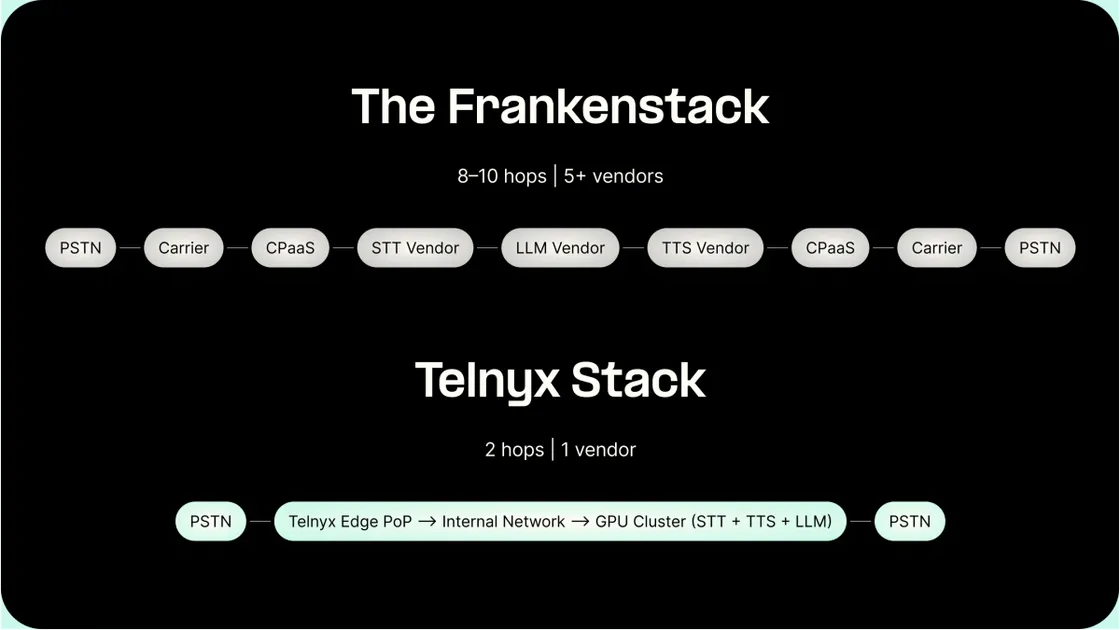
The migration replaced a fragmented setup with one operational domain. SIP Trunking runs on Telnyx's private carrier network, which means calls between the India-based contact centre and UK customers route over infrastructure Telnyx owns, not the public internet. Programmable voice inbound handles customer calls into the contact centre; programmable voice outbound supports proactive engagement like booking confirmations and follow-ups. Voice AI Agents sit on the same network, giving Teletext Holidays AI-powered call handling without wiring a separate vendor into the call path.
The integrated stack matters because it solves a big problem: latency. Adding vendor hops between telephony and AI components on top of the distance would result in broken communications. With Telnyx, audio enters the network and stays on it through transcription, AI inference, and synthesis. No inter-provider handoffs. No stacked margins. One provider accountable for the call from start to finish.
Real-time speech-to-text now runs on every call, giving operations teams visibility they did not have before. AI assistants handle routine queries, freeing human agents for complex interactions that require judgement. The platform's developer experience and API-first design meant the team could integrate and deploy without months of engineering overhead.
Scaling What Works
Teletext Holidays is growing month over month, Telnyx infrastructure was built to support that trajectory. Adding capacity does not require provisioning new trunks or negotiating new contracts, with the ability to scale up and down SIP Trunks on demand. Voice AI agents can scale to handle more inbound volume as demand increases, and the carrier-owned network means call quality and delivery rates hold as volume grows, because the infrastructure underneath is not resold capacity that degrades under load.
The next phase is expanding Voice AI across more of the customer journey: outbound engagement for booking reminders, post-trip follow-ups, and proactive service calls. The architecture supports it without re-integration, because the AI, the voice, and the telephony are already on the same stack.
CUSTOMER STORIES
Explore other customer stories

Trioteca
Barcelona-based Trioteca uses Telnyx Voice AI Agents and SIP Trunking to run seven AI agents that doubled annual revenue.
READ CASE STUDY
Helia
Helia uses Telnyx Voice AI, SIP, and PBX integration to run low-latency support agents.
READ CASE STUDY
AudioCodes
AudioCodes partners with Telnyx for carrier-grade voice and SIP trunking.
READ CASE STUDY


