
Helia, built by Italy-based LAIF, is a resolution engine for B2B customer support. It is designed for mid-market companies where the phone is still the primary support channel and the best answers often live in scattered places: senior technicians' heads, old tickets, manuals, product docs, and past customer conversations. Helia's premise is simple: customer support AI should answer calls and learn from the calls it cannot resolve. When an AI assistant escalates to a human, Helia captures what the human knows, turns that into a proposed knowledge base update, and sends it through a human review loop before it goes live.
To make that work in production, Helia needed more than realistic speech. It needed low-latency voice, control over transfers, recordings at the infrastructure layer, and the ability to fit into each customer's existing PBX environment. That is why the team moved its voice and telephony stack to Telnyx. Helia first came to Telnyx through the Telnyx for Startups program, which gives early-stage voice AI teams credits and technical support to get production agents live.
Telnyx became our core voice AI provider because in voice AI, the telephony layer is not a commodity. Controlling it is a competitive advantage.Andrea Mordenti, Helia / LAIF
The challenge was production voice AI inside real phone systems
Helia started with a composable architecture that paired voice synthesis with a separate telephony layer. That approach helped the team move quickly through early pilots, but as deployments moved closer to production, the limits became clear. Every handoff between providers added round-trip time. For live Voice AI, that delay affects the whole experience. A caller may forgive a slightly imperfect voice. They are less likely to tolerate a conversation where every turn feels late.
Helia also needed more advanced routing behavior. Some customers needed warm transfers to a human agent over SIP, with fallback to the AI assistant if that endpoint did not answer. Others needed Helia to connect into existing PBX systems with old equipment, vendor-specific behavior, ring groups, internal extensions, and established call flows.
For Helia's target customer, replacing the phone system was not an option. The AI agent had to work inside the phone system the customer already trusted.
Why Helia chose Telnyx
Telnyx gave Helia a single voice and telephony layer for production AI support. Instead of managing a split path across separate providers, Helia could bring Voice API, SIP, number handling, call routing, recordings, and PBX interoperability onto one platform.
That mattered most in three areas.
- Latency. Helia reports sub-second response times in many cases, which makes calls feel more natural for Italian customers.
- Telephony control. Telnyx supports the SIP and PBX patterns Helia needs for warm transfers, fallback routing, trunk registration, and customer-specific call flows.
- Deployment fit. Helia can connect into customer phone systems instead of asking mid-market teams to replace infrastructure before they see value.
Helia is also using Telnyx's European infrastructure to keep latency low for its Italian customer base. For support calls, that performance shows up immediately: the faster the assistant responds, the more likely the caller is to keep engaging instead of asking for a human. Ultra Voice has become another important part of the story. Helia says Italian-language support has improved in recent months, and voice quality is now strong enough to support production customer conversations where credibility matters from the first few seconds.
How Telnyx fits into Helia's architecture
Helia uses Telnyx across the voice path: SIP trunking, PBX interoperability, call recordings, Ultra Voice, and testing around UAC through SIP Attach.
For PBX deployments, Telnyx helps Helia register trunks with credentials or IP-based access, manage SIP REFER and SIP transfers, and preserve existing customer call flows. That means customers can keep the same numbers, extensions, routing patterns, and handoff behavior while adding AI support. Helia is also testing UAC through SIP Attach, where the AI agent can register directly as a SIP endpoint inside the customer's voice infrastructure, like another extension. Internal users could reach the AI agent by dialing an extension, with no PSTN leg and no extra routing rules.
For Helia, this could open a new category of internal support workflows, including IT helpdesk, HR support, and operations use cases where employees need fast answers from company knowledge.
Escalations become knowledge base improvements
The most distinctive part of Helia is what happens after the assistant cannot resolve a request.
Every human escalation becomes a signal. The AI either did not have the right information, or the information it had was not precise enough to handle the request on its own. Helia records and transcribes the human leg of the call, analyzes what the operator said that the AI assistant did not know, and generates a proposed update to the customer's knowledge base. A human reviews and approves the change before it goes live. The next time a similar question comes in, the assistant has a better chance of resolving it without escalation.
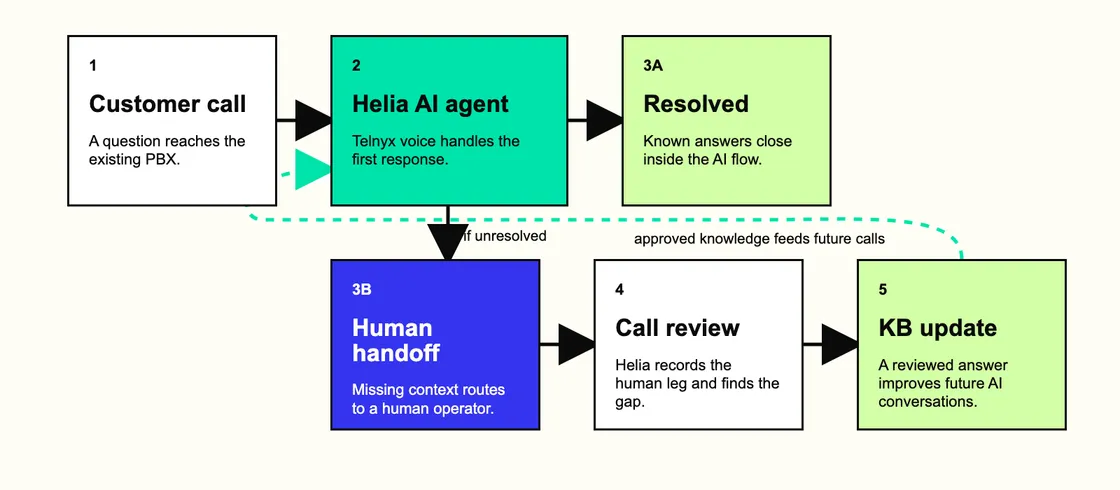
That loop turns support calls into institutional memory. For a manufacturing company where a handful of senior technicians hold most of the product knowledge, Helia helps capture that knowledge in a structured system the company owns.
Early impact
Helia's customers care most about 24/7 coverage and autonomous resolution rate. They want fewer interruptions for human operators, faster answers for customers, and better coverage across languages and after-hours support.
Before Helia, support teams were often interrupted by repetitive calls that pulled senior people away from higher-value work. With Helia, those routine requests can be handled by the AI assistant, while complex cases are routed to a human and used to improve the knowledge base. The strongest story for Helia's first Telnyx case study is a complex manufacturing deployment with an existing PBX environment, multi-level call routing, and a technical product knowledge base built from product documentation. It is the kind of deployment that shows why the telephony layer matters.
Looking ahead
Voice is Helia's first focus because it is the hardest customer support channel to automate well. The mid-market B2B companies Helia serves still resolve many of their most complex questions by phone. Once Helia has built credibility and a richer knowledge layer through voice, the team plans to expand into additional channels, including WhatsApp and SMS. Telnyx gives Helia a path to add those channels without rebuilding the communications layer from scratch.
For Helia, Telnyx is not only a voice provider. It is the infrastructure layer that lets the company bring AI support into real customer phone systems and turn every escalation into a better answer next time.
ABOUT HELIA
Helia is a B2B customer support resolution engine built by Italy-based LAIF. Helia helps mid-market companies automate phone support, reduce repetitive escalations, and turn customer interactions into a knowledge base that improves over time.
CUSTOMER STORIES
Explore other customer stories

IvoryLab
IvoryLab uses Telnyx voice and phone number APIs for healthcare communications.
READ CASE STUDY
AudioCodes
AudioCodes partners with Telnyx for carrier-grade voice and SIP trunking.
READ CASE STUDY
AppYogi
AppYogi consolidated voice, messaging, SIP trunking, and phone number management onto Telnyx.
READ CASE STUDY


