
General
How to Build a Communications Stack That Scales After a Funding Round
How to build a communications stack that scales with your startup after funding. Covers voice APIs, SIP trunking, messaging, phone numbers, and Voice AI on one platform.
%20(1).png?width=400&format=webp)
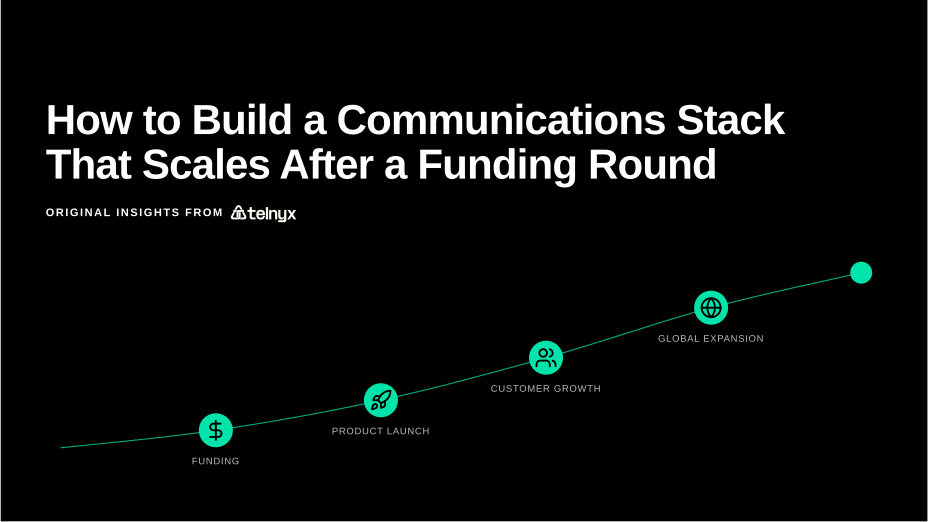
Whether you've just closed a funding round or are preparing to expand into new markets, growth introduces a different set of engineering challenges. Product roadmaps become more ambitious, customer expectations rise, and teams are expected to deliver new capabilities at a much faster pace.
At this stage, conversations often focus on hiring, infrastructure, and AI. Founders think about expanding engineering teams, adopting new models, and accelerating product development. What receives far less attention is the communications infrastructure that connects those products to customers.
That oversight doesn't usually create problems immediately. It becomes apparent later, when customer conversations increase, new markets introduce regulatory requirements, and product teams begin adding voice, messaging, or AI experiences that weren't part of the original roadmap.
The communications decisions made at this stage can shape how easily a company scales over the next several years.
Growth changes the role of communications
Communications is no longer just a support function. For many software companies, it has become part of the product experience itself.
Healthcare platforms schedule appointments and automate patient reminders. Financial platforms verify customer identities and deliver fraud alerts. SaaS companies embed calling directly into their applications, while marketplaces rely on voice and messaging to connect users in real time. Even businesses without communications as a core feature increasingly use voice and messaging to improve onboarding, customer support, notifications, and operational workflows.
As products evolve, customer conversations become another product surface that requires the same level of reliability and scalability as the application itself.
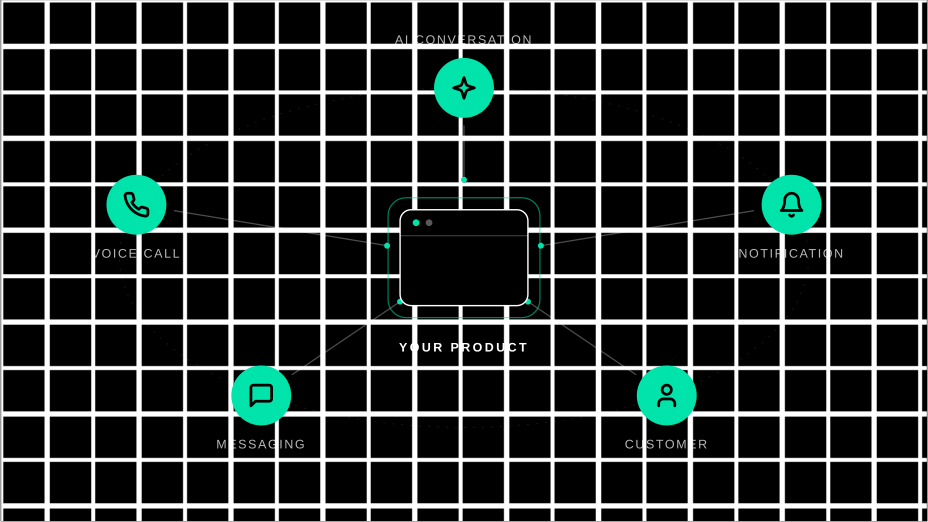
Building a modern communications stack
A startup's communications requirements rarely stay the same.
Early on, the priority might be embedding programmable voice into a product or enabling customer support. As the business grows, enterprise customers introduce existing telephony systems, expansion creates demand for local phone numbers and messaging, and AI becomes another layer that powers customer conversations.
Rather than adopting a new vendor every time those requirements evolve, it's worth thinking about communications as a connected stack. Each capability solves a different challenge, but together they create the foundation that supports future growth.
Voice APIs often become the first building block. They allow developers to embed calling directly into applications, whether that's enabling click-to-call, outbound notifications, customer support, or AI-powered conversations. Instead of treating voice as a separate system, it becomes another feature within the product.
SIP trunking becomes increasingly important as startups move upmarket. Enterprise customers often have existing telephony environments that aren't going away overnight. SIP provides a bridge between those systems and modern cloud applications, making it easier to support both new and existing communications workflows.
Global phone numbers become essential as companies expand into new markets. Supporting local customer experiences often means provisioning local numbers, meeting regional regulatory requirements, and working with carrier networks across multiple countries. Managing those through separate providers quickly adds operational complexity.
Messaging supports much more than notifications. From authentication and appointment reminders to customer engagement and operational updates, messaging complements voice across the customer journey and gives businesses more ways to communicate through the channels customers already use.
Voice AI is the newest layer in this evolution. Companies are deploying AI agents to answer calls, qualify leads, schedule appointments, automate support, and handle routine conversations around the clock.
While AI models receive much of the attention, production-ready Voice AI depends on everything underneath it, including reliable telephony, speech-to-text, text-to-speech, phone numbers, and low-latency infrastructure. Without those foundations, even the best AI models struggle to deliver a reliable customer experience.
Individually, these capabilities solve different problems. Together, they create the communications foundation that supports future product growth.
The hidden cost of adding vendors
It's common for startups to solve immediate challenges by adopting the best point solution available at the time. Twilio for call control. Vonage for SIP trunking and phone numbers. ElevenLabs for text-to-speech. A separate carrier for termination.
Initially, this approach feels flexible.
Over time, each additional platform introduces new APIs, operational overhead, reporting systems, contracts, and integrations. Engineering teams spend more time maintaining infrastructure than building customer-facing features, while introducing new capabilities often means integrating yet another vendor into an already fragmented stack.
This is the "Frankenstack" pattern, and it plays out the same way for most teams. Each vendor in the chain adds a network hop and a processing delay. By the time a caller's speech is transcribed, sent to the AI, routed to a separate TTS provider, sent back through a SIP trunk, and delivered through a call control API, round-trip latency can push toward 1200ms. Callers hear dead air. Conversations feel robotic and halting. Debugging becomes a blame game across multiple vendors, each pointing at the others.
The challenge isn't simply managing multiple providers. It's making sure they continue working together as products, markets, and customer expectations evolve. Beside, an AI receptionist company, ran into exactly this problem with Twilio, Vonage, and ElevenLabs before consolidating onto a single platform and cutting round-trip latency to 180ms.
Communications decisions become harder to change later
One of the biggest mistakes growing startups make is treating communications infrastructure as something they can revisit later.
Unlike replacing a project management tool or analytics platform, communications become deeply embedded in customer journeys, product workflows, backend systems, and business operations. Migrating providers often means updating integrations, testing call flows, reconfiguring phone numbers, and retraining internal teams.
Choosing the right foundation early gives engineering teams more flexibility as products evolve and helps avoid costly migrations later.
Planning for the next stage of growth
When evaluating communications infrastructure, it's worth thinking beyond the immediate use case.
The platform that supports outbound calling today may also need to power AI voice agents next year. A business operating in one market today may require local phone numbers and regulatory compliance across multiple countries tomorrow. Customer support workflows may eventually become embedded directly into the product itself.
Choosing infrastructure with that evolution in mind reduces future migrations and gives engineering teams greater flexibility as priorities change.
Questions worth asking include:
- Can this platform support programmable voice, messaging, SIP, and Voice AI together?
- Does it simplify global expansion through local phone numbers and carrier connectivity?
- Will developers be able to introduce new communications capabilities without rebuilding existing architecture?
- Can the platform scale alongside both customer growth and product complexity?
- Does it reduce operational complexity instead of introducing more vendors?
These questions become increasingly important as companies transition from building an initial product to building a long-term platform.
How Telnyx supports a scalable communications stack
As communications requirements become more complex, many growing companies reach a point where managing separate providers for voice, messaging, AI, telephony, and global connectivity creates unnecessary operational overhead.
Rather than adding another vendor every time a new requirement appears, many teams are looking for a single platform that can support today's roadmap while giving them the flexibility to build what's next.
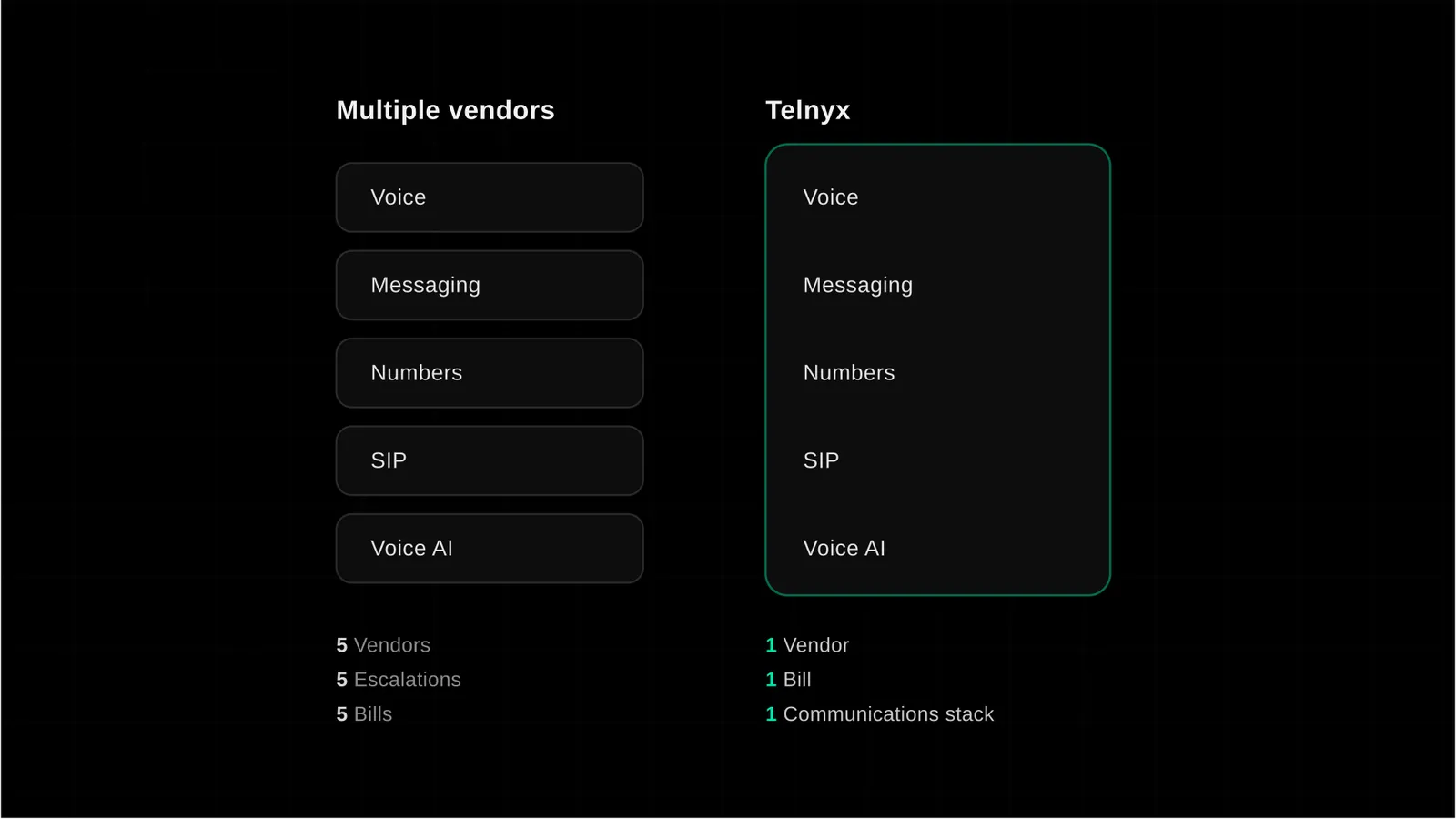
Telnyx brings carrier-grade voice infrastructure, SIP trunking, programmable Voice APIs, global numbers, messaging, speech, inference, and Voice AI together on one platform. Teams can build, connect, automate, and scale communications without stitching together separate vendors for every new use case.
For startups building AI-powered experiences, Telnyx helps reduce the complexity of the traditional Voice AI Frankenstack. Telephony, STT, TTS, orchestration, inference, and global numbers run from one platform on a privately owned global network. That helps reduce integration work, minimize vendor handoffs, and support low-latency conversations that feel natural in production. Conversational AI starts at $0.05 per minute for orchestration, with STT and Telnyx-native TTS included.
For teams modernizing voice infrastructure, Telnyx SIP trunking provides reliable PSTN connectivity on a carrier-owned network. That matters for teams looking to improve call quality, reduce cost, support global voice calling, and avoid the accountability gaps that come from layers of resold infrastructure.
For developers embedding voice into products, Telnyx Voice API provides programmable call control, real-time media streaming, speech-to-text, text-to-speech, AI call flows, and WebRTC support. That gives engineering teams the flexibility to build customer calling, AI-powered workflows, in-app voice, and real-time call experiences without needing deep telecom expertise. Outbound calls start at $0.002 per minute plus the SIP trunking fee for the destination.
For teams expanding into new markets, Telnyx global numbers and messaging help support local presence, customer notifications, authentication, and multi-channel engagement from the same platform. This gives growing companies more room to adapt as customer needs change.
The result is a communications stack that can grow with the business. A startup may begin with phone numbers or SIP trunking, then add programmable voice, messaging, transcription, Voice AI, or inference as its product evolves.
Build what comes next with Telnyx
The communications stack you choose today will influence every customer conversation your business has tomorrow.
Whether you're embedding voice into your product, modernizing existing telephony, launching Voice AI experiences, or expanding into new markets, the right foundation makes it easier to keep building without adding complexity.
Telnyx brings Voice API, SIP trunking, messaging, global numbers, speech, inference, and Voice AI together on one platform, giving engineering teams the flexibility to scale with confidence.
Ready to build a communications stack that grows with your business? Talk to an expert or start building with Telnyx.
Share on Social
Megha is a Dubai-based product marketing manager from India. She has a master's degree in Innovation Management and Entrepreneurship from the University of Manchester, with 8 years of experience in tech marketing, having previously worked as head of marketing at Vantheon Technolo


