
Email API
Best email marketing service providers compared for 2026
Compare 11 email marketing service providers on editor, automation, deliverability, integrations, support and pricing, plus high-volume sender rules and a trial checklist.

Takeaways
Mailchimp and MailerLite suit small teams, ActiveCampaign suits complex automation, Klaviyo and Omnisend suit ecommerce, HubSpot suits CRM-led teams, beehiiv suits newsletter publishers, and the Telnyx Email API suits application-driven sending.
- Judge each provider on its editor, automation, segmentation, deliverability controls, integrations, reporting, support and cost as your list grows, not on entry price alone.
- Providers bill on different units: most on contacts, Brevo on monthly email volume, and the Telnyx Email API on each email accepted for delivery.
- Bulk senders to personal Gmail accounts need SPF, DKIM and DMARC, and their marketing mail also needs one-click unsubscribe.
Best email marketing service providers compared
A strong email marketing platform lets a marketer build a good-looking campaign without code, automate follow-ups in a visual builder, segment contacts on real behavior, and protect inbox placement with domain authentication and list hygiene. It also connects to your store or CRM, reports on what each email earned, answers support requests quickly and keeps its price predictable as the list grows. No single provider leads on all of these, so the right choice depends on what you send and who sends it.
How we evaluated the providers
We assessed each provider against the same eight criteria, using its own pricing pages, feature pages and help-center articles, checked in September 2026. We did not run inbox-placement tests, so deliverability is judged on the controls each provider documents, and support on the channels and hours each plan includes.
Evaluation criteria
| Criterion | What we checked | Why it matters |
|---|---|---|
| Editor and templates | Drag-and-drop and HTML editing, template library, plan limits on templates | Decides how fast a non-developer can ship a campaign |
| Automation | Visual builder, branching, steps or actions per workflow, prebuilt recipes | Runs welcome, cart and re-engagement sequences without manual sends |
| Segmentation and personalization | Behavioral and ecommerce segments, dynamic content, plan gating | Lets you target messages on recipient behavior and preferences |
| Deliverability controls | SPF, DKIM and DMARC setup, dedicated IP terms, deliverability help | Authentication is now required by Gmail and Yahoo for bulk senders |
| Integrations | Size of the catalog, named store and CRM connectors, API access | Customer data has to reach the platform for segments and flows to work |
| Reporting and testing | Campaign and revenue reports, A/B and multivariate testing by plan | Shows which emails work and which to stop sending |
| Support and community | Email, chat and phone by plan, onboarding, academy and community | Setup and deliverability problems need a fast answer |
| Pricing and scalability | Billing unit, entry price, send allowance, what happens at the limit | The cheapest plan today can be the most expensive one at twice the list size |
The providers at a glance
Prices are USD list prices for monthly billing, excluding introductory offers.
Email marketing service providers compared
| Provider | Best for | Free plan and paid entry price |
|---|---|---|
| Mailchimp | Small teams that want a large template library and integration catalog | Free plan, Essentials from $13/month |
| Brevo | Marketing and transactional email in one account | Free plan, Starter from $9/month |
| MailerLite | Newsletters and small teams on a tight budget | Free plan, Comfort from $12/month |
| Constant Contact | Small businesses that want phone support on every plan | 30-day free trial, Lite from $12/month |
| ActiveCampaign | Multi-step, branching automation | 14-day free trial, Starter from $19/month |
| HubSpot Marketing Hub | Teams that run sales and marketing on HubSpot's CRM | Free plan, Starter from $20/month per seat |
| Klaviyo | Online stores that drive email from store data | Free plan, Email from $20/month |
| Omnisend | Ecommerce stores on Shopify or Wix | Free plan, Standard from $16/month |
| GetResponse | Frequent senders who want unlimited sends at a fixed list size | Free plan, Starter from $19/month |
| beehiiv | Newsletter publishers who want growth and monetization tools | Free plan, Scale from $49/month |
| Telnyx Email API | Email triggered by your own application, alongside SMS and voice | No free plan or subscription, pay per use from $0.30 per 1,000 emails |
Marketing platforms and email APIs
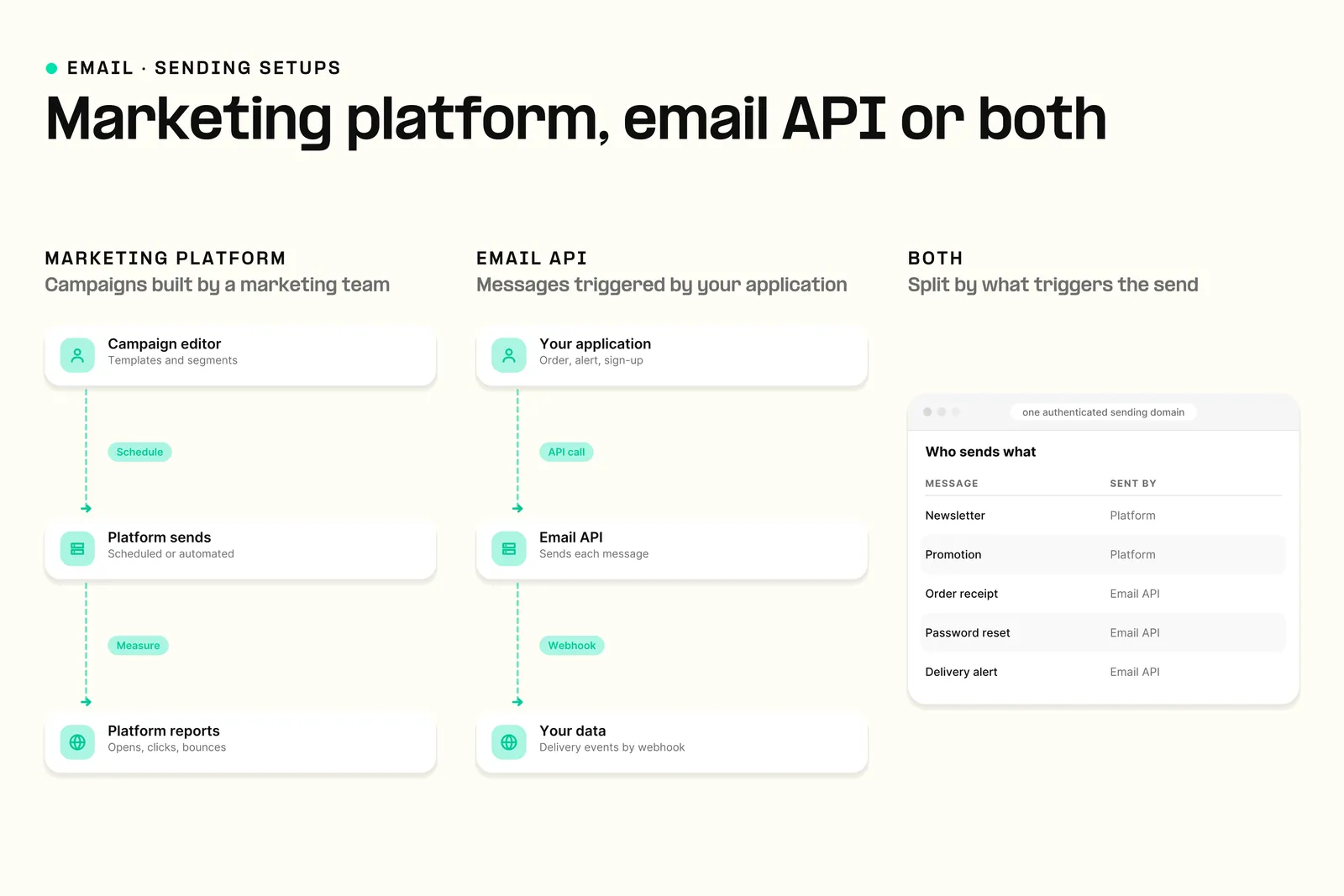
The first ten providers are marketing platforms: they give marketers an interface to design campaigns, build segments, schedule sends and automate follow-ups. An email API lets your application send individual messages or larger batches in code and receive delivery events back by webhook. Some marketing platforms also offer an API, and the two can run side by side from one authenticated domain, with newsletters and promotions sent from the platform and receipts, password resets and alerts from the API. Choose the combination that fits who builds and operates your email.
Email marketing service providers by use case
Each profile covers what the provider does well, the limitation to check before buying, and its published prices.
Mailchimp
Mailchimp offers an email builder and a library of more than 100 templates, with limited templates on Free. Its 300+ integrations, including Shopify, WordPress and Canva, are available on every plan. Essentials adds A/B testing and 24/7 email and chat support. Standard adds automation flows of up to 200 steps with branching, predictive segmentation, dynamic content, custom reports and an onboarding session. Domain authentication with DKIM and DMARC records is guided in the app.
Brevo
Brevo prices by monthly email volume, and the volume tier you buy also sets how many contacts you can store. All plans include the drag-and-drop editor, 40+ templates, multi-step automation and advanced segmentation. Brevo lists 500+ integrations, some restricted by plan, and transactional email through its API and SMTP draws on the same monthly volume. Standard adds A/B testing and advanced reporting such as click heatmaps. Professional adds phone support, a dedicated IP for $251 a year and three hours a year with a deliverability specialist.
MailerLite
MailerLite gives every plan, including Free, three editors (drag and drop, custom HTML and a simple text editor), a drag-and-drop automation builder, unlimited dynamic segments and email A/B testing. Its 100+ integrations include Stripe, Shopify and WooCommerce. Comfort adds 24/7 email support and 50 active automations of up to 100 steps each, and Power adds live chat, unlimited seats and multiple automation triggers.
Constant Contact
Constant Contact includes live phone and chat support on every plan, Lite included. Its drag-and-drop editor comes with a gallery of 600+ templates, and 300+ integrations cover Google, Microsoft, Shopify, Eventbrite and Zapier. Standard adds subject-line A/B testing and reports on who opened and clicked, and Premium adds custom automation paths, ecommerce templates and dynamic content.
ActiveCampaign
ActiveCampaign is built around automation: a drag-and-drop builder, more than 900 prebuilt automation recipes and unlimited actions per automation from Plus up. Segmentation deepens with each tier, and Pro adds predictive and conditional content plus A/B testing inside automations. The email designer has 250+ templates, and 1,000+ integrations include Shopify, WooCommerce, Salesforce and Stripe.
HubSpot Marketing Hub
HubSpot's advantage is its CRM: marketing email, forms, contact records and sales activity share one database, and non-marketing contacts are stored free. The editor offers drag-and-drop design and prebuilt templates, and 2,000+ apps connect through its marketplace. Starter covers email with up to 10 automated actions. Visual workflows, A/B testing, smart content and phone support start on Professional.
Klaviyo
Klaviyo connects to 350+ apps, including Shopify, WooCommerce and Wix, and uses customer data to trigger flows and update segments in real time. It offers 160+ email templates, a drag-and-drop flow builder with 60+ prebuilt flows, and standard campaign, flow and audience reporting on every account. Paid plans get email and live chat support.
Omnisend
Omnisend is built for ecommerce, with Shopify and Wix integrations, a visual automation editor with 15+ preset workflows such as welcome, abandoned cart and post-purchase, and segments based on shopping history. A/B testing is on every plan, including Free, and so is 24/7 live chat and email support. Pro adds unlimited email under a fair-use policy, conditional content and product recommendations.
GetResponse
GetResponse prices by list size and includes unlimited sends on every paid plan, which suits teams that email several times a week. The drag-and-drop editor comes with 200+ templates, custom DKIM is on the paid plans, and integrations with WordPress, Shopify, WooCommerce, Salesforce and Zapier start on Starter. Marketer adds unlimited automation workflows, advanced segmentation, A/B testing and ecommerce reports. Email and chat support come with every paid plan.
beehiiv
beehiiv is a newsletter platform first, with growth and monetization tools built in. Scale adds a referral program, an ad network, paid subscriptions with no beehiiv revenue share, automations and webhooks. Every plan includes unlimited sends, a custom builder and email templates, and beehiiv creates the SPF and DKIM records for a custom domain. Human support and a Slack community start on Scale.
Telnyx Email API
The Telnyx Email API sends transactional and marketing email from your application through a REST API, on the same account, API key and invoice as Telnyx SMS, voice and WhatsApp. Telnyx generates the DKIM, SPF and DMARC records for your domain and verifies them once you publish them, suppresses hard bounces, complaints and unsubscribes automatically, and adds one-click unsubscribe headers by default. Delivery, bounce and complaint events arrive by signed webhook, and open and click events do too once tracking is on. Templates use Liquid variables, sends can be scheduled, and one API call can send up to 1,000 messages. The guide to sending email with an API walks through a first send.
Compare email marketing services on pricing
List prices only compare fairly once you know what each provider bills for. Most charge by contacts and attach a monthly send allowance to each contact tier. GetResponse's paid plans and every beehiiv plan include unlimited sends, with prices that scale by list size. Brevo and the Telnyx Email API charge by volume sent.
Cost at 1,000 contacts and 10,000 sends
Every price below is for the same list: 1,000 contacts receiving 10,000 emails a month, billed monthly. Each row is the cheapest plan that covers both numbers. Where a provider has no 1,000-contact tier, or ties sends to a larger contact tier, the plan is sized up to the tier that does.
Monthly cost at 1,000 contacts and 10,000 sends
| Provider | Plan that covers it | Price per month |
|---|---|---|
| Mailchimp | Essentials, 1,500-contact tier with 15,000 sends | $26.50 |
| Brevo | Starter, 10,000 emails and up to 1,500 contacts | $17 |
| MailerLite | Comfort, 1,000 subscribers and 10,000 emails | $19 |
| Constant Contact | Lite, 501 to 1,000 contacts and 10,000 sends | $30 |
| ActiveCampaign | Starter, 1,000 contacts and 10,000 sends | $19 |
| HubSpot Marketing Hub | Starter, one seat and a 2,000 marketing-contact tier for 10,000 sends | $70 |
| Klaviyo | Email, 501 to 1,000 profiles and 10,000 sends | $30 |
| Omnisend | Standard, 1,000 contacts and 12,000 emails | $20 |
| GetResponse | Starter, 1,000 contacts and unlimited sends | $19 |
| beehiiv | Scale, 1,000 subscribers and unlimited sends | $49 |
| Telnyx Email API | Pay per use, sending only: 10,000 emails at $0.30 per 1,000 | $3 in usage |
The Telnyx figure covers sending only. The contact list, campaign editor and segmentation come from your own product or a platform alongside it, so add that tooling before counting the difference as a saving.
Email marketing service providers for high-volume and enterprise senders
At high volume, compare peak sending capacity, how a new domain is warmed up, support for mailbox providers' sender rules, message-level reporting you can export or stream into your own systems, and the operating cost at your real volume.
Sender rules from Gmail and Yahoo
Since February 2024, Gmail and Yahoo reject or filter mail from bulk senders that skip authentication or make unsubscribing hard, and Gmail ramped up enforcement in November 2025. Google treats a sender that reaches close to 5,000 messages to personal Gmail accounts in 24 hours as a bulk sender. Messages from the same primary domain count together, and the status is permanent once reached. Yahoo does not publish a threshold. The email authentication guide explains how to set up each record.
Bulk sender requirements
| Requirement | Gmail | Yahoo |
|---|---|---|
| Authentication | SPF and DKIM, plus DMARC of at least p=none, with the From domain aligned to SPF or DKIM | SPF and DKIM, plus a passing DMARC policy of at least p=none, with From-domain alignment |
| Unsubscribe | RFC 8058 one-click unsubscribe for marketing and subscribed mail, plus a visible link in the body | One-click unsubscribe for marketing and subscribed mail, plus a visible link, RFC 8058 POST recommended |
| Unsubscribe processing | Within 48 hours | Within 2 days |
| Spam complaint rate | Below 0.10%, never 0.30% or higher | Below 0.3% |
The rules sit on top of the law. The FTC's CAN-SPAM guide requires a valid postal address in every commercial email and opt-outs honored within 10 business days. Full details are in Google's sender guidelines and Yahoo's sender best practices.
What to ask a provider before a high-volume contract
High-volume evaluation checklist
| Requirement | Evidence to request | Why it matters |
|---|---|---|
| Sending capacity | Peak messages per hour and per API call, rate limits, warm-up schedule for a new domain | A launch or breaking-news send has to go out in minutes |
| Dedicated IP | Eligibility threshold, price, warm-up support | Worth it only when your volume is steady enough to keep the IP warm |
| Suppression handling | Automatic suppression of bounces, complaints and unsubscribes, import of existing lists | Mailing suppressed addresses raises complaint rates |
| Event data | Delivery, deferral, bounce, complaint and unsubscribe events by webhook or export, retention period | Your own systems need to know what happened to each message |
| Access and governance | User roles, single sign-on, audit logs, data export on exit | Large teams need control over who sends to whom |
| Support | Named contact, response times, deliverability help included in the plan | Blocklistings and filtering problems cannot wait for a ticket queue |
What an email API leaves to your team
Check which operational features an API supplies and which your team must build. Telnyx includes templates, scheduled sends and suppression handling, while subscriber management, consent records, segmentation, campaign creation and consolidated reporting still need your own tools or a marketing platform. That trade suits companies that already hold customer data in their own product and want email alongside SMS on one account.
How to choose among email marketing service providers
Shortlist the providers that meet your workflow, integration, support and volume needs. During the trial, test the features included in the plan you intend to buy, since trials often unlock a higher tier.
Test your workflow during the trial
- Build one newsletter from a template and check how it renders on mobile and in dark mode.
- If you need automation, build the journey you will actually use, with its triggers and branches, and confirm it is on your intended plan. The email automation best practices guide lists the flows worth testing.
- Connect your store, CRM or signup form and confirm the data arrives in segments.
- Authenticate your sending domain and check that SPF, DKIM and DMARC pass.
- Unsubscribe from a test email and confirm the contact is suppressed.
- Open the campaign report and check it shows the metrics you report on.
- Contact the support channel your intended plan includes and check its hours.
- Price the plan you will need at your projected list size and send volume a year from now.
If text messages are part of the plan, compare SMS marketing platforms on the same criteria, since several email providers sell SMS as an add-on. Stores planning high-volume promotional texts can also read how SMS short codes work for retail and ecommerce.
Check migration and exit options
Before you sign, confirm you can export contacts with their consent status and custom fields, your suppression list, templates and campaign history, and ask which automations can be exported or must be rebuilt. Import the suppression list before the first send from the new platform.
FAQ
Send application email on the account that runs your SMSReceipts, alerts and password resets go out through the Telnyx Email API with pay-as-you-go pricing, signed delivery webhooks and automatic suppression. Pair it with the marketing platform your team already likes, and put email, SMS and voice on one invoice.
Explore the Telnyx Email APIShare on Social
Deniz is a Senior Product Marketing Manager at Telnyx with 10 years of experience in technology and healthtech marketing. She previously led go-to-market initiatives at Philips Healthcare, Vodafone, and The Coca-Cola Company. Originally from Türkiye and based in Amsterdam, she ho


