
Networking
What is inference engineering and why it matters
Inference engineering optimizes how a model serves predictions, not what the model says.

By Eli Mogul
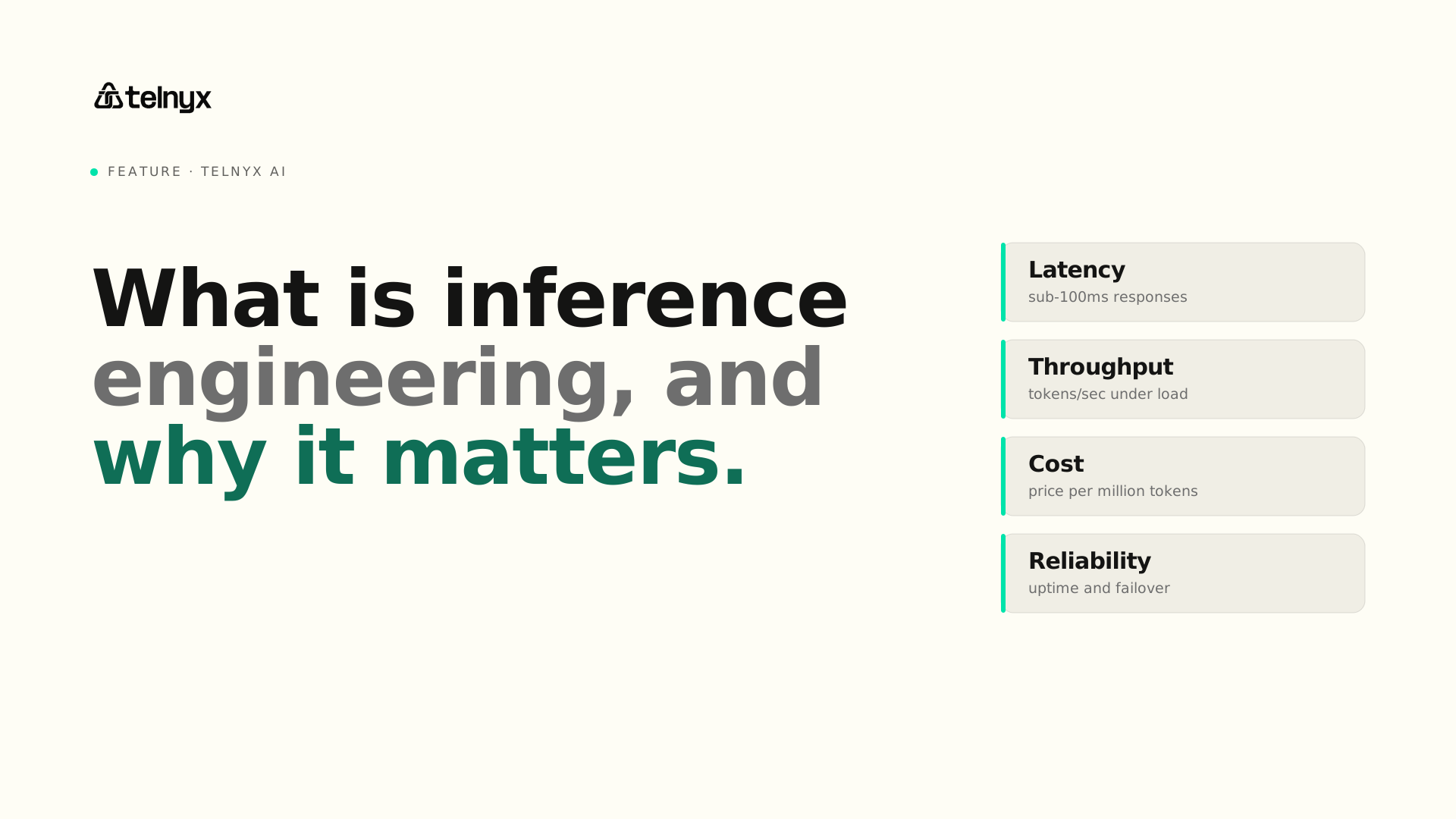
Inference engineering is the discipline of making AI models run fast, reliably, and cheaply in production. Training teaches a model what it knows. Inference is the act of running that trained model to answer a question, transcribe a call, or hold a conversation, and inference engineering is the work of optimizing that step across three layers: the runtime that serves a single model on a GPU, the infrastructure that scales serving across clusters, and the tooling that gives engineers a usable interface to it all. As open-weight models proliferate, inference engineering has become the difference between a working demo and a product that holds up under real traffic without a runaway bill.
This guide defines the discipline, breaks down what an inference engineer actually does, walks through the core optimization techniques, and explains how a co-located inference platform removes most of the infrastructure burden.
What is inference engineering
Inference engineering optimizes how a model serves predictions, not what the model says. It sits one layer below the model and one layer above the hardware.
The cleanest way to picture the field is as a three-layer stack, a framing popularized in the Pragmatic Engineer breakdown of the discipline. The runtime layer runs a single model on a single GPU or node, and this is where CUDA kernels, PyTorch, and serving engines like vLLM, SGLang, and TensorRT-LLM live. The infrastructure layer scales that runtime across many GPUs and regions using autoscaling, Kubernetes, and multi-cloud routing. The tooling layer wraps both in APIs, dashboards, and frameworks so application engineers can call a model without managing any of the machinery underneath.
Inference engineering is frequently confused with prompt engineering, but they operate on opposite ends of the request. Prompt engineering optimizes the input you send to a model to get a better answer. Inference engineering optimizes the system that serves the answer, including latency, throughput, memory use, and cost per token. A good prompt and a poorly served model still produce a slow, expensive product. The two disciplines are complementary, not interchangeable.
For a deeper definition of the engine that executes a model at runtime, see the related explainer on the inference engine, and for why the cost of running a model now outweighs the cost of training it, see the breakdown of AI training vs inference.
Why inference engineering matters
Inference, not training, is where ongoing AI spend concentrates. Training is a one-time capital event. Inference is a recurring operational cost that grows with every user, every call, and every token generated, which is why owning and optimizing the serving stack increasingly decides a product's unit economics.
The economics are also under genuine strain. In a January 2026 paper, Google researchers Xiaoyu Ma and David Patterson argued that LLM inference has become a fundamental hardware problem, opening with the blunt assessment that LLM inference is a crisis. Their case is that the autoregressive decode phase of a transformer is memory-bound rather than compute-bound, so the industry's habit of optimizing for raw FLOPS leaves the real bottleneck, memory bandwidth and interconnect latency, unaddressed. Per-token prices have fallen sharply over the past two years even as total enterprise AI bills have climbed, a paradox that inference engineering exists to manage.
At the same time, the supply of models has exploded. Hugging Face now hosts more than two million public models, up from roughly eighty thousand a few years ago, a milestone its own Spring 2026 state-of-open-source report documents alongside more than thirteen million users. That means almost any company can deploy its own open-weight intelligence. The catch is that open models are cheap to download and expensive to serve well. Closed-model APIs are tuned for general throughput, not for the latency profile of a specific real-time use case, so teams that want both control and speed end up doing inference engineering themselves. Latency is the clearest example of why this matters, since even small delays make a real-time voice agent feel robotic. Because the bottleneck is rooted in the hardware itself, the problem is structural rather than a software bug a clever engineer can patch.
What an inference engineer does
An inference engineer turns a model that works in a notebook into one that serves thousands of concurrent users within a latency budget. The day-to-day work clusters around a few recurring problems.
Latency optimization means tracking and tuning the metrics users actually feel: time to first token (TTFT), tokens per second (TPS), and inter-token latency (ITL). Batching strategy keeps the GPU busy by grouping requests without making any single user wait, which is harder than it sounds when request lengths vary wildly. Caching, especially reuse of the key-value (KV) cache, avoids recomputing attention for tokens the system has already processed. GPU memory management prevents the crashes and fragmentation that come from packing large models and growing caches into fixed VRAM. Underpinning all of it is a constant stream of trade-off decisions: how aggressively to quantize before quality slips, which runtime to pick, and how to route requests across models and regions.
None of these has a single correct answer. The job is finding the configuration that fits a given workload's latency target, concurrency level, and budget.
Inference engineering techniques
Five techniques do most of the heavy lifting in production inference. They are independent and can be stacked.
Quantization reduces the numerical precision of model weights, for example from 16-bit floats to 8-bit integers or lower. As one LLM quantization guide explains, INT8 roughly halves per-weight storage, and FP8 on recent NVIDIA hardware can deliver materially faster inference with near-zero quality loss for many models. Speculative decoding pairs a small fast draft model with the larger target model: the draft proposes several tokens, the target verifies them in parallel, and accepted tokens are committed, which raises throughput without changing the output the target would have produced on its own. KV cache reuse stores attention results so shared prefixes, like a common system prompt, are computed once rather than per request. Model parallelism splits a model across GPUs through tensor parallelism or, for mixture-of-experts models, expert parallelism. Disaggregation separates the compute-bound prefill phase from the memory-bound decode phase onto different workers so each can be tuned independently.
The table below summarizes how each technique earns its place.
| Technique | What it does | Primary benefit | Main trade-off |
|---|---|---|---|
| Quantization | Lowers weight and activation precision | Less memory, faster compute | Possible quality loss if too aggressive |
| Speculative decoding | Draft model proposes, target verifies | Lower inter-token latency | Needs a well-aligned draft model |
| KV cache reuse | Caches attention across requests | Avoids redundant computation | Cache memory management overhead |
| Model parallelism | Splits a model across GPUs | Serves models too big for one GPU | Communication overhead between GPUs |
| Disaggregation | Separates prefill and decode workers | Tunes each phase independently | More complex orchestration |
Serving engines bundle several of these automatically. vLLM's PagedAttention manages the KV cache like an operating system manages virtual memory, and combined with continuous batching it can serve roughly three to five times the throughput of a naive serving loop on the same hardware. For the mechanics of these scheduling and memory techniques, see the practical walkthrough on continuous batching and PagedAttention.
Inference engineering infrastructure
Technique only goes as far as the hardware and software stack underneath it. The infrastructure layer is where serving choices become real costs.
On hardware, most production inference runs on datacenter GPUs such as NVIDIA's H100 and B200 class, with on-premises and air-gapped deployments reserved for sovereignty or security needs. The software stack typically combines CUDA and PyTorch at the base with a serving engine like vLLM, SGLang, or TensorRT-LLM on top, and engines such as TensorRT-LLM add hardware-specific kernel optimizations for the latest GPU architectures. Scaling that stack means autoscaling and Kubernetes to match GPU capacity to fluctuating demand, and often multi-cloud routing for the highest-volume workloads. Edge inference, which runs models physically close to where data is generated, addresses both latency and compliance by keeping data in-region.
The recurring lesson across all of this is that geography matters. Where inference physically runs increasingly drives both latency and regulatory exposure, and the same is true of precision choices: a detailed quantization guide shows how INT8 and INT4 trade memory for accuracy, another design decision that should be made deliberately rather than by default.
Inference engineering for voice and multimodal
Voice and multimodal workloads inherit the same techniques as text, plus their own constraints. A real-time voice agent runs a pipeline of speech-to-text, an LLM, and text-to-speech, and each stage adds latency that compounds across the round trip. Optimizing voice inference means optimizing the whole chain rather than the language model alone.
Vision-language models and embedding models largely adapt transformer architectures, so quantization, batching, and caching transfer directly. Automatic speech recognition and speech synthesis models use the same families of tools. Image and video generation diverge more sharply, since diffusion-style architectures generate in iterative denoising steps rather than autoregressively, which shifts the optimization target toward compute throughput rather than memory bandwidth. The practical takeaway is that the inference engineering toolkit is broadly portable across modalities, but the bottleneck moves depending on the architecture.
How Telnyx simplifies inference engineering
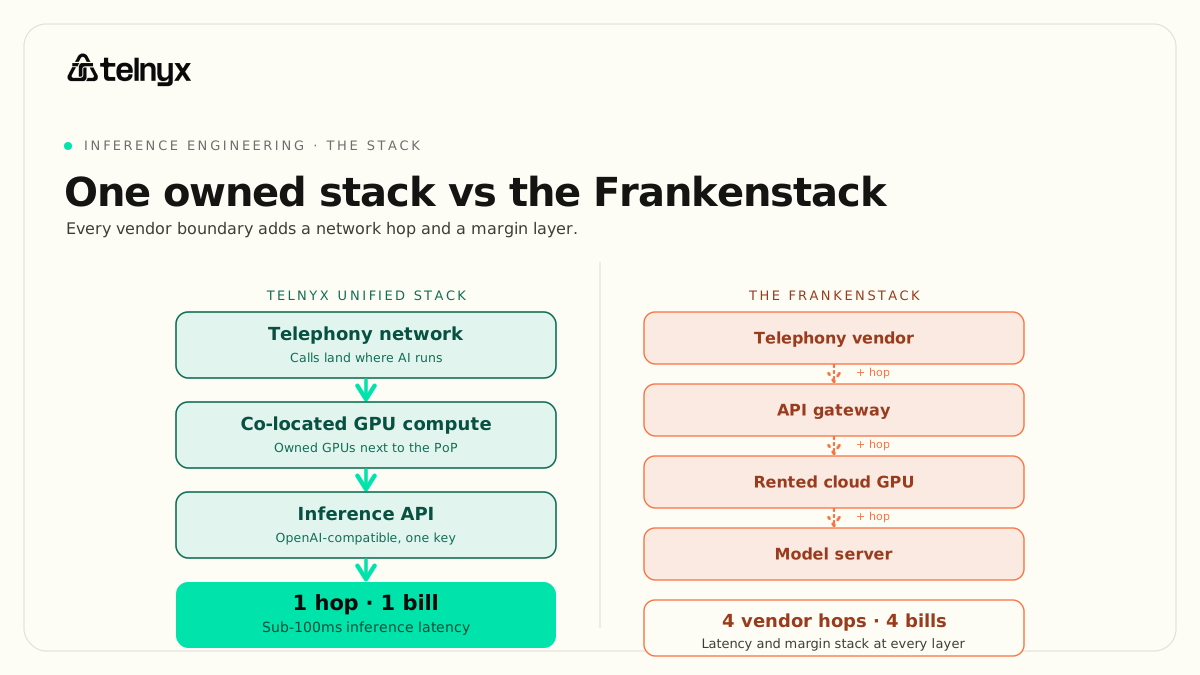
Most teams assemble inference from rented cloud GPUs, a third-party model API, and a separate telephony or messaging vendor. That assembled stack, which Telnyx calls the Frankenstack, taxes every request with a vendor hop and a margin layer. The AI Inference API takes the opposite approach by running open-weight models on GPUs Telnyx owns and operates, co-located directly alongside its global points of presence.
The interface is deliberately familiar. The API is OpenAI-compatible, so adopting it is largely a matter of changing the base URL to https://api.telnyx.com/v2/ai/inference and pointing requests at /v2/ai/chat/completions. From there you get multi-model access through a single key, including Kimi K2.6, DeepSeek, GLM, and other open-weight models, with pricing that starts at $0.21 per million tokens because there is no cloud-reseller markup in the per-token price. The simplest inference engineering pattern, calling a managed endpoint rather than running your own server, is demonstrated in the run-llm-inference-python and run-llm-inference-nodejs examples, with build-rag-with-telnyx-inference-python showing a retrieval-augmented pipeline. Full details live in the Inference API docs.
The co-location is what makes this more than a cheaper API. By placing GPU compute next to its telephony network, Telnyx removes the external hops that push assembled stacks past acceptable latency, with the product targeting sub-100ms inference latency and the Sydney deployment delivering round-trip times under 200ms for APAC voice traffic. That same architecture keeps data in-region across the Americas, Europe, and APAC, so sovereignty becomes a property of where the GPUs physically sit rather than a contractual promise. The fleet behind it runs more than 4,000 GPUs that Telnyx bought and operates directly rather than renting.
As Ian Reither, COO at Telnyx, put it, "We often obsess over LLM inference speeds, but in Voice AI, the network is often the silent killer." The platform's answer is to own the network and the compute together, so Voice AI, speech-to-text, and text-to-speech all run on the same infrastructure, behind the same API key, on the same bill.
Frequently asked questions
What is inference engineering in AI? Inference engineering is the discipline of making trained AI models run fast, reliably, and cheaply in production. It spans runtime optimization on a single GPU, infrastructure for scaling across clusters, and tooling that exposes the model through a usable API.
How does inference engineering differ from prompt engineering? Prompt engineering optimizes the input you send to a model to improve its output. Inference engineering optimizes the serving system around the model, including latency, throughput, memory use, and cost. They address different parts of the same request and are complementary.
What techniques do inference engineers use? The core techniques are quantization, speculative decoding, KV cache reuse, model parallelism, and disaggregation of the prefill and decode phases. Serving engines like vLLM bundle several of these, combining PagedAttention with continuous batching for higher throughput.
What hardware is needed for inference engineering? Production inference typically runs on datacenter GPUs such as NVIDIA H100 or B200 class hardware, orchestrated with autoscaling and Kubernetes. On-premises, air-gapped, or edge deployments are used when latency or data sovereignty requirements demand local processing.
How does Telnyx support inference engineering? Telnyx provides an OpenAI-compatible inference API running open-weight models on owned GPUs co-located with its telephony network. That co-location removes vendor hops, keeps data in-region, and puts inference, voice, and messaging behind one API key and one bill.
Build inference on owned infrastructure
Inference engineering is complex because the stack underneath it is usually rented, fragmented, and far from your users. Telnyx removes that burden with a co-located, OpenAI-compatible inference API on a private global network, giving you multi-model access and low-latency serving without managing GPUs yourself. Sign up for a Telnyx account to send your first request, or talk to the team about production voice and inference workloads.
Share on Social


