
Insights and Resources
Key value store definition, examples, and uses
Learn what a key value store is, how it works, and see examples like Redis and DynamoDB. Understand when a key-value database beats relational options.

By Eli Mogul
Takeaways
- A key value store is a NoSQL database that saves data as simple key-value pairs and retrieves values through direct lookups instead of queries.
- It differs from a relational database by dropping schemas, joins, and SQL. You trade query flexibility for speed and horizontal scale.
- The most widely used examples are Redis, Amazon DynamoDB, etcd, and Memcached, each built for a different balance of speed, durability, and consistency.
- Primary use cases are caching, session storage, configuration, feature flags, and real-time leaderboards. All of them are latency-sensitive.
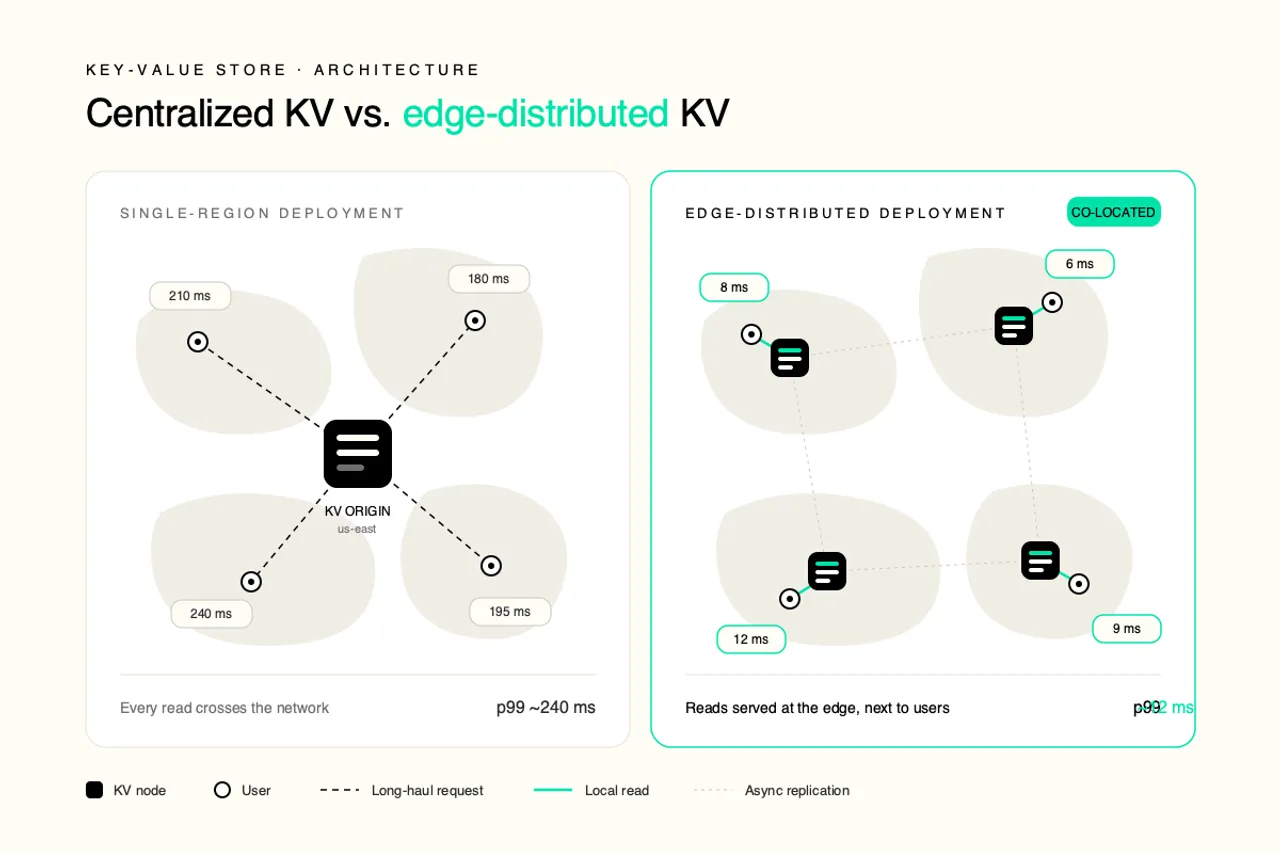
- Where the store runs matters as much as which one you pick. A fast database in one distant region still adds round-trip latency for every user outside it.
What is a key-value store?
A key value store is a NoSQL database that maps a unique key to a value and retrieves that value through a direct lookup rather than a query. The application sends a key, the store returns the value, and that is the entire interaction. There is no query language to parse, no execution plan to build, and no tables to join.
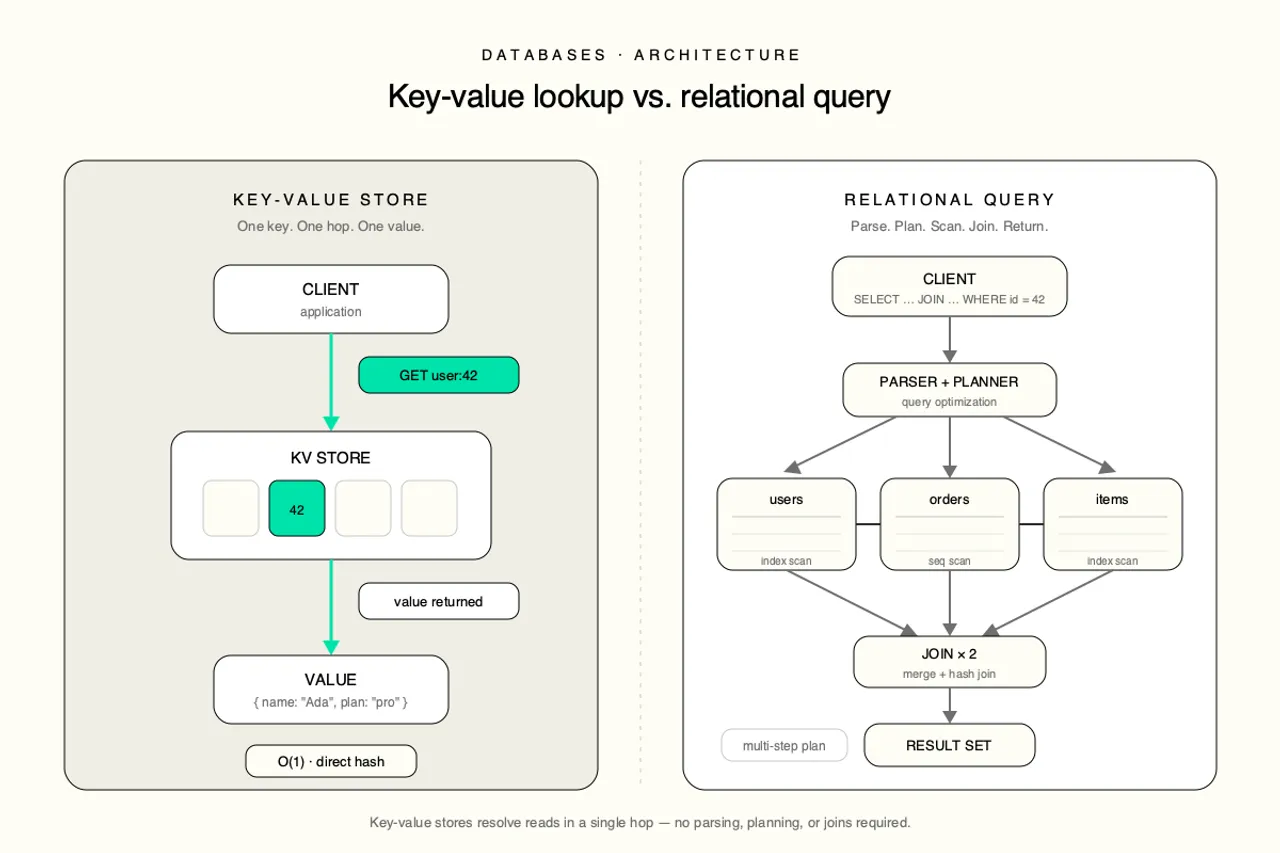
This simplicity is the whole point. Because the store only ever answers one question, "what is the value for this key," it can answer that question in microseconds and scale horizontally by spreading keys across as many nodes as you need. Relational databases spend their time on flexibility. A key-value store database spends its time returning data.
Key-value lookup path
Key in → hash to location → value out. One hop, one operation, sub-millisecond in memory.
Relational query path
Parse SQL → build plan → scan indexes → join tables → return rows. Multiple steps, each adding latency.
How key-value pairs work
The key is a unique string, often built from a namespace and an identifier, such as a session ID or a user ID. The value is opaque to the store. It can be a string, a JSON document, a serialized object, or raw binary. The store does not inspect the value or index its contents. It hashes the key, finds the location, and returns whatever sits there.
That hashing step is what gives key-value stores their O(1) average lookup time. The cost of a read stays flat whether the store holds a thousand pairs or a billion. A typical operation looks like this:
GET session:user:84721 → {"cart": ["sku-2214"], "authenticated": true, "locale": "en-AU"}
Storage happens in one of two places. In-memory stores like Redis and Memcached keep every pair in RAM for the fastest possible reads. Disk-backed stores like DynamoDB persist pairs to durable storage and accept slightly higher latency in exchange for durability and capacity beyond what memory allows.
Key-value stores vs. relational databases
A relational database organizes data into tables with fixed schemas and lets you ask arbitrary questions with SQL. A key-value store database organizes nothing. It holds pairs, and it answers exactly one question per request. That constraint is a feature when your access pattern is known in advance, because the store skips all the machinery a relational engine needs to support ad hoc queries.
| Aspect | Key-value store | Relational database |
|---|---|---|
| Data model | Key mapped to opaque value | Tables, rows, fixed schema |
| Access | Direct lookup by key | SQL queries, joins, filters |
| Scaling | Horizontal, partition by key | Mostly vertical, sharding is hard |
The trade-off cuts both ways. If you need to find every order above $500 placed last week, a key-value store cannot help you without scanning everything. If your workload genuinely needs relational queries but still demands low latency, running SQL at the edge is a better answer than forcing a key-value model onto relational data.
Advantages and limitations
The practical case for key-value stores comes down to three properties, and the case against them comes down to what the simple model gives up.
Advantages
Sub-millisecond reads in memory. A simple API any developer learns in minutes. Horizontal scaling by partitioning keys across nodes with no schema migrations.
Limitations
No relationships between records. No querying by value contents. The store cannot filter, aggregate, or join, so multi-record questions belong elsewhere.
Key-value storage without the cluster babysittingTelnyx KV Storage runs on the Telnyx-owned global network, co-located with compute, so lookups resolve milliseconds from your users. See how it works.
Explore Telnyx KV StorageKey-value store examples
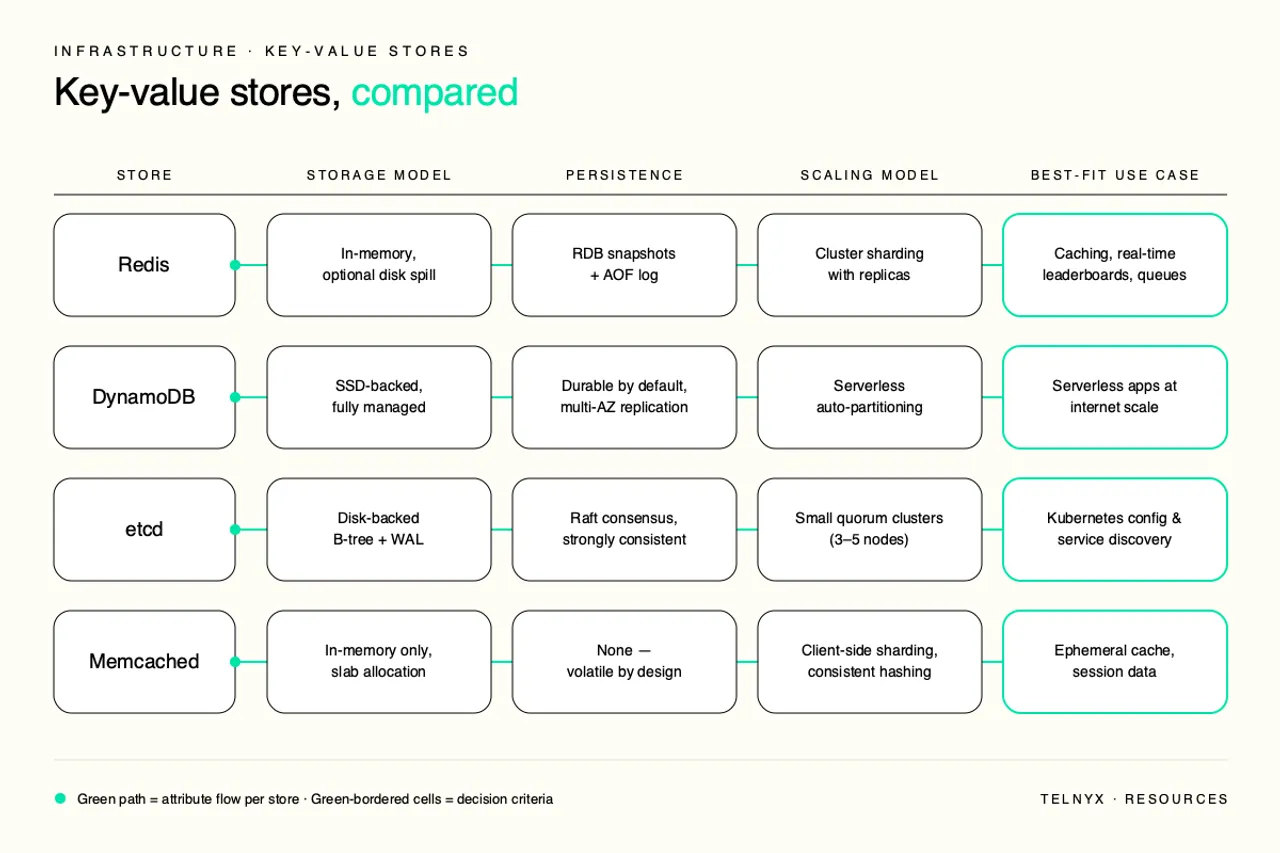
The category spans everything from pure caches to globally replicated managed services. These key-value database examples cover the four you will encounter most often, with an honest look at where each one fits and where it does not. Redis gets its own section below, because it dominates the category enough to deserve one.
Amazon DynamoDB
Amazon DynamoDB is AWS's fully managed key-value and document database. You define a table, pick a partition key, and AWS handles replication, scaling, and failover. It follows the serverless database model, so you pay per request rather than provisioning servers, and it holds up under enormous write volumes without operational work on your side.
The trade-offs are lock-in and cost. DynamoDB only runs on AWS, its query patterns must be designed around the partition key up front, and per-request pricing that looks cheap at low volume gets expensive at sustained high throughput. Teams that outgrow the free tier often discover the bill scales faster than the traffic.
Note: DynamoDB rewards access patterns designed before the first table exists. Retrofitting a new query pattern onto a live table usually means a global secondary index and a higher bill.
etcd
etcd is a distributed key-value store built for one job: holding the configuration and coordination state that distributed systems depend on. It uses the Raft consensus algorithm to guarantee strong consistency across nodes, which is why Kubernetes uses it as the source of truth for every cluster. When you need every node to agree on a value, etcd is the standard answer.
That consistency comes at the cost of throughput. Every write must be acknowledged by a quorum of nodes, so etcd is deliberately slow compared to a cache. It is the right store for service discovery, leader election, and cluster config. It is the wrong store for session data, user records, or anything high-volume.
Memcached
Memcached is the simplest key value store example on this list. It is a pure in-memory cache with a flat keyspace, multithreaded performance, and nothing else. No persistence, no replication, no data structures beyond strings. That minimalism makes it easy to reason about and cheap to run, and it still powers caching layers at some of the largest sites on the internet.
The drawback is the flip side of the design. When a Memcached node restarts, its data is gone, and your database absorbs the full read load until the cache warms back up. Treat it strictly as a disposable read accelerator, never as a system of record.
| Store | Storage model | Best fit |
|---|---|---|
| Redis | In-memory, optional persistence | Caching, sessions, real-time data |
| DynamoDB | Disk-backed, managed | Serverless apps at scale on AWS |
| etcd | Disk-backed, consensus-replicated | Cluster config and coordination |
| Memcached | In-memory, no persistence | Disposable read caching |
Common use cases for key-value databases
Look at where key-value stores actually run in production and a pattern emerges. Caching database query results. Holding session state and shopping carts. Serving user preferences and feature flags. Powering real-time leaderboards with sorted sets. Acting as a fast metadata layer beside an embeddings database in AI retrieval pipelines, where the vector search finds candidates and the key-value lookup fetches the full records.
Nearly every workload on that list shares one trait: it sits in the hot path of a user request. A session lookup happens on every page load. A feature flag check happens on every API call. These reads are measured in milliseconds, which means the network distance between the user and the store often costs more than the lookup itself. That fact matters more than most database comparisons admit, and it is where this article ends up.
Redis as a key-value store
Why Redis dominates the key-value category
Redis is the default answer when developers reach for a key value store, and the reasons are concrete. It keeps everything in memory, so reads and writes complete in well under a millisecond. It goes beyond plain key-value pairs with native data structures, including lists, sets, sorted sets, and hashes, which means a leaderboard or a rate limiter is a single command instead of application logic. It adds pub/sub messaging on top, so the same process that caches your data can also fan out events.
Unlike Memcached, Redis can also survive a restart. It offers two persistence modes, RDB snapshots for point-in-time backups and AOF logging for replaying every write, and you can combine them. The Redis documentation covers both in detail. The result is a store fast enough to be a cache and durable enough to hold data you would rather not lose.
Warning: Persistence is not a substitute for a system of record. AOF replay protects against a crash, not against operator error or a corrupted volume. Keep critical data in a durable primary store.
Redis limitations to consider
Memory is the first constraint. RAM costs far more per gigabyte than disk, so a Redis dataset that grows into the hundreds of gigabytes gets expensive quickly. The second is the single-threaded core. One Redis process executes commands on one thread, which keeps the model simple but caps throughput per instance and turns one slow command into a queue of blocked requests. Scaling past either limit means Redis Cluster, and self-hosting a cluster brings sharding, failover testing, and version upgrades onto your team's plate.
There is a quieter limitation that benchmarks never show. A self-managed Redis deployment lives in one region, and its sub-millisecond reads only apply to users near that region. Every user on another continent pays the full network round trip before Redis even sees the key. The store is fast. The path to it is not.
Run your key-value store at the edge with Telnyx
Picking the right key value store solves half the latency problem. The other half is geography. A lookup that resolves in 500 microseconds inside the datacenter still arrives slowly if the request crossed an ocean to get there, because no database can optimize away the speed of light. For global applications, where the data lives determines what users actually feel.
What distance costs a single lookup
Typical network round-trip time before the database does any work. The lookup itself is under a millisecond in every case.
Same region
~1 ms
Coast to coast, US
~60-70 ms
US to Europe
~80-90 ms
US to Australia
~200 ms
Telnyx KV Storage addresses the geography directly. It runs on the Telnyx-owned global network, co-located with compute at the edge, so key-value lookups resolve milliseconds from the end user instead of routing back to a single home region. It follows the same principle as an edge database: move the data to the request instead of the request to the data.
Choose Telnyx KV Storage if:
- Your users are spread across regions and a single-region cache leaves most of them paying for distance.
- You want managed key-value storage without running, sharding, and upgrading your own cluster.
- Your lookups sit beside compute, so the data and the code that reads it belong in the same places.
- You would rather consolidate storage, compute, and communications on one API and one bill than add another vendor.
Note: The DIY alternative is multi-region Redis, which means running clusters in every region, managing replication between them, and paying for the RAM everywhere. Co-located edge storage removes that operational load entirely.
The comparison worth making is not Redis versus DynamoDB. It is a single-region deployment you maintain versus a distributed one you do not. One platform, one API, and zero cluster management puts your session state, feature flags, and cached lookups next to your users without adding a vendor or an ops rotation to get there.
FAQ
Put your data milliseconds from your usersTelnyx KV Storage is deployed across the Telnyx-managednetwork alongside compute, so lookups resolve close to your users instead of routing back to a single home region. Talk to our team about your workload, or start building today.
Start buildingShare on Social