

Takeaways
- An edge database runs where data is generated and where compute lives, not in a remote cloud region. The proximity principle is simple: every millisecond of round-trip is a millisecond of edge advantage lost.
- Edge databases differ from traditional databases (centralized and self-hosted) and from serverless databases (managed, but still centralized). The architectural distinction is where the data sits, not who administers it.
- The workloads that benefit most are real-time AI inference, gaming, IoT telemetry, and communications infrastructure. Any request path where a centralized database round-trip breaks the latency budget is a candidate.
- Edge databases are not a universal upgrade. If your application already sits in the same region as your data, or your workload is batch-oriented, you have no distance to eliminate and no reason to add one.
- Telnyx SQLDB is the edge database for latency-sensitive workloads. It runs co-located with carrier infrastructure and edge compute, on the same network plane as the calls it serves.
If you are building voice AI, real-time games, IoT fleets, or communications infrastructure, this guide is written for the architecture decision in front of you. If your application runs in one region and stays there, skip to when not to use an edge database.
What is an edge database?
An edge database is a database system designed to run close to where data is generated and where applications consume it, rather than in a centralized cloud region or an on-premises data center. Three properties define it: local data storage, query response times in the single-digit to low double-digit millisecond range, and co-location with the compute that issues those queries.
The category covers several distinct architectures, and conflating them causes most of the confusion around the term. On-device embedded databases run on phones, gateways, and industrial sensors, optimized for small footprints and offline operation. CDN-edge databases run on content delivery points of presence and serve web applications deployed alongside them. Carrier-network-adjacent databases run where telephony and compute infrastructure meet, which is the layer that matters for voice, messaging, and real-time AI.
The LF Edge taxonomy splits these into the user edge, meaning resources adjacent to end users and physical processes, and the service provider edge, meaning equipment placed in or beside carrier networks in a metropolitan region and typically capable of sub-100ms latencies (LF Edge, "Sharpening the Edge II"). An edge database can live at either tier. What makes it one is not the hardware class. It is the distance between the query and the answer.
Build on an edge database that sits inside the network.SQLDB runs on the same network plane as Telnyx edge compute and telephony, so a lookup in the call path never leaves the local network.
Edge database vs. traditional database
Traditional relational databases assume a stable, high-bandwidth link between the application and the data. PostgreSQL, MySQL, and Oracle deployments were designed for a world where the application server and the database server sat in the same rack, room, or at worst region. Under that assumption, query complexity dominates query time, so you optimize indexes, connection pools, and execution plans.
Move the application to the edge and the assumption breaks. Query time is now dominated by network distance, and no amount of index tuning changes it. Light travels through fiber at roughly 203,000 km/s, about two thirds of its speed through a vacuum, and TeleGeography's rule of thumb is that 1,000 km of route equates to roughly 10ms of round-trip delay (TeleGeography). Working the same physics in one direction puts propagation delay near 5ms per 1,000 km before anything else happens (M2 Optics). Real routes run longer than the great-circle distance, since terrestrial fiber follows railways and highways and submarine cables route around fishing grounds and seismic zones, so every added kilometer is latency you did not choose.
That is the whole story behind the 50ms to 200ms penalty engineers see when an edge application queries a centralized database. It is not a software problem, and faster hardware does not fix it.
Edge database vs. serverless database
Serverless databases solved a real problem. They removed capacity planning, patching, connection management, and idle cost from the operator's plate, and replaced per-instance pricing with something closer to per-use pricing. For teams spending engineering hours on database administration rather than on their product, that was a meaningful improvement.
What serverless did not change is where the bytes sit. A serverless database provisioned in a US East region is still a US East database. An application running at an edge location in Sydney still pays the full trans-Pacific round-trip to read a row, and public measurements of inter-region latency put that path in the 190ms to 220ms range (CloudPing). The serverless model is an operational abstraction. The edge model is a topological one.
The two categories answer different questions. If database operations consume too much of your team's time, serverless helps. If your request path crosses an ocean, it does not. Our guide to the serverless database model covers the managed-database tradeoffs in more depth.
The proximity principle
Data locality equals latency advantage. Every millisecond spent on a round-trip is a millisecond removed from the budget you had for actual work.
The effect compounds in two directions. It compounds across queries: a path with one remote query pays the penalty once, while a path that does authentication, then a session lookup, then a context fetch pays it three times. It also compounds across the tail. Dean and Barroso showed that in systems built from many dependent components, the slow tail of each component dominates the response time of the whole, because a request is only as fast as its slowest dependency (Dean and Barroso, "The Tail at Scale," Communications of the ACM). A long-haul hop does not only raise the median. It widens the tail.
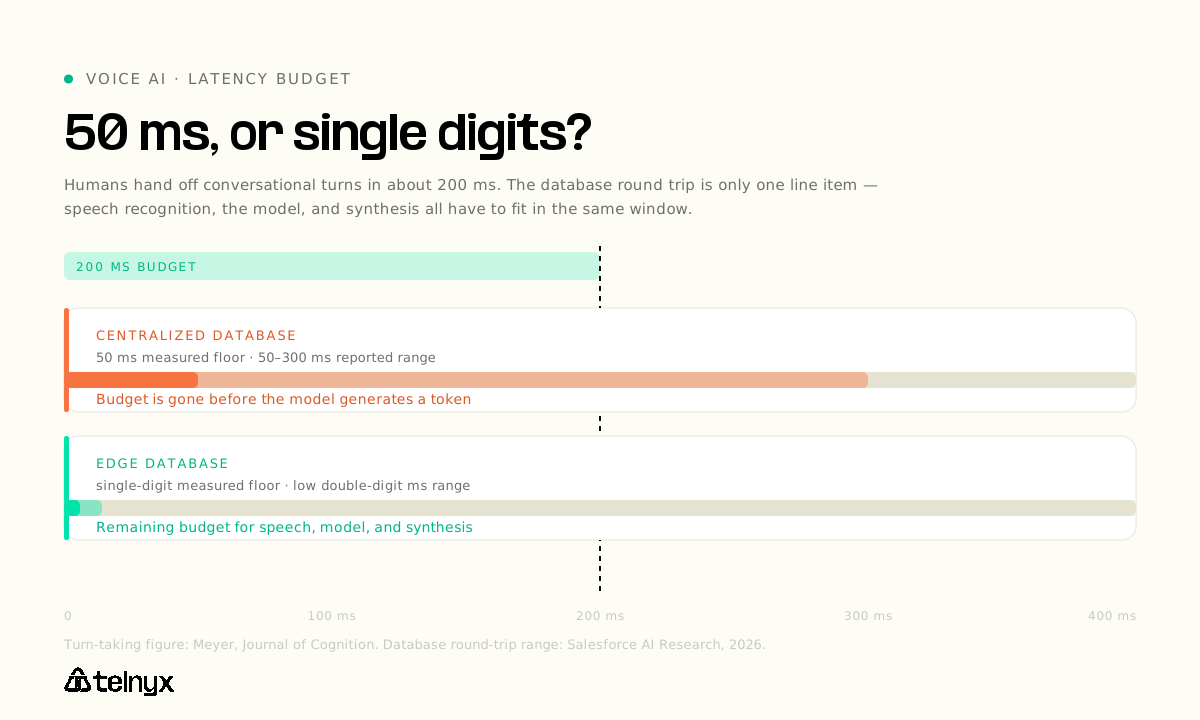
For conversational systems, the budget is unforgiving. In everyday conversation, the most common gap between turns is only around 200ms, and median latencies in conversational speech corpora are typically reported under 300ms (Meyer, "Timing in Conversation," Journal of Cognition). That is the bar a voice agent has to clear to sound natural, and those 200ms have to cover speech recognition, retrieval, generation, and speech synthesis. A 150ms database lookup inside that path is not a tuning problem. It is a topology problem, and you cannot tune your way out of a topology problem. We go deeper on the full pipeline in our breakdown of inference latency.
Every millisecond of round-trip is a millisecond of edge advantage lost. A single database query between Sydney and a US East region adds roughly 200ms. Three sequential queries add roughly 600ms. That number is physics, not software.
Architecture comparison
Three deployment models cover almost every real system. The difference between them is not feature depth. It is how many network boundaries sit between a request and the row it needs.
| Architecture | Where the data lives | Typical query round-trip | In-region data residency | Vendor boundaries in the request path |
|---|---|---|---|---|
| Edge database, co-located with compute | At the edge site, on the same network plane as the application | Single-digit to low double-digit ms | Yes, by construction | One |
| Serverless database, remote region | In one cloud region, managed by the provider | 50ms to 200ms from a distant edge | Region-selectable, but fixed per deployment | Two or more |
| Traditional database, centralized | In a data center or cloud region you operate | 50ms to 200ms from a distant edge, plus operational variance | Yes, if you build for it | One, but you own the operations |
The vendor boundary column is the one teams underestimate. Assembling a real-time application from a database vendor, a separate compute platform, and a separate telephony provider produces a stack held together by integrations rather than architecture. Each boundary is a network hop, a set of credentials, a rate limit, a status page, and a support queue. When latency spikes, you are the one correlating three sets of logs to find out whose problem it is. Collapsing those boundaries is not only a latency win. It reduces the number of things that can independently fail.
Use cases where edge databases win
Real-time AI inference. Voice and agent workloads read from a database inside the inference path: session state, conversation memory, retrieved context, and tool results. Salesforce AI Research, introducing its VoiceAgentRAG architecture, frames the problem directly: voice agents work against roughly a 200ms budget, while production vector database queries typically add 50ms to 300ms of network latency, consuming that budget before the model generates a token (Salesforce AI Research, 2026). Moving the store next to the inference engine is the difference between an agent that answers naturally and one that pauses.
Gaming. Leaderboards, matchmaking state, inventory, and player profiles are read and written continuously during play. A 36-person study of competitive Counter-Strike players found that network latency measurably degrades score, accuracy, and quality of experience, and that it penalizes higher-skill players more than lower-skill ones (Claypool et al., Worcester Polytechnic Institute). Your most engaged players are the ones who notice a slow round-trip first.
IoT and telemetry. Sensor fleets generate volumes that are uneconomical to ship wholesale to a central region. IDC projected in 2018 that the global datasphere would reach 175 zettabytes by 2025, with the fastest growth happening at the edge and the core (IDC, "The Digitization of the World From Edge to Core"). Directionally, the forecast held. An edge database lets you filter, aggregate, and act locally, then send summaries upstream instead of raw streams.
Communications infrastructure. Call control, routing tables, number lookups, and session state all sit in the path of a live call. A routing decision that waits on a cross-region query is a routing decision that arrives after the caller has noticed. This is the workload edge databases were made for, and it is where stateful edge functions and edge storage stop being separate concerns.
"In the agent era, latency, reliability, and compliance aren't nice-to-haves, they are the product." Ian Reither, COO at Telnyx
Telnyx SQLDB as the edge database
Telnyx SQLDB is a managed SQL database that runs inside the Telnyx network, co-located with the GPU infrastructure and edge compute adjacent to our global points of presence. That placement is the product. In a standard Telnyx deployment, a query from a voice agent, a call control application, or an inference workload stays on the Telnyx network rather than crossing a VPC peering connection, a public internet hop, or a third-party API boundary. It stays on the same network plane as the call.
We took the same architectural approach to voice AI generally, documented in our write-up on co-located infrastructure. Proximity powers performance, and the only durable answer to physical distance is to remove it.
SQLDB gives you a full SQL surface rather than a key-value store with a query dialect bolted on, which matters when your edge data has relations in it. Because Telnyx AI Inference runs on the same infrastructure, you can also put a natural language layer in front of it. The AI SQL natural language example in our open-source Telnyx code examples repository uses schema context to turn plain-English questions into validated SQL and runs them against a sample dataset.
To be precise about what SQLDB is not: it is not an on-device embedded database for constrained hardware, and it does not run on web CDN edges. It runs at the carrier edge, which is a different place serving different workloads.
Put your data where your calls landStop paying the latency tax on every query in your request path. Provision an edge database on the same network as your voice, messaging, and inference.
Explore Telnyx SQLDBChoosing an edge database
Six questions separate a genuine edge database from a centrally hosted database with edge marketing.
Where does the data physically live? Ask for the deployment topology, not the feature list. Edge read replicas with writes routed to a primary region are a legitimate architecture, but your write latency will still be centralized. Know which operations are local before you build on them.
What is the query latency profile, not the throughput number? Vendors publish throughput because it is flattering. Ask for p50, p95, and p99 response times measured from an application at the edge, since the tail is what your users experience.
Is the database on the same network plane as your compute? Being in the same city is not the same as being on the same network. If the path crosses a public network segment or a vendor boundary, you have not eliminated the hop.
Can data stay in the region where it was generated? Regional placement matters for EU, APAC, and LATAM workloads with residency obligations. Confirm it is a guarantee, not a default that can be quietly relocated.
What is the operational model? Self-managed gives you control and gives you pager duty. Managed removes the toil and constrains your tuning. Pick deliberately.
What is the cost model? Per-query pricing is efficient at low volume and punishing at high volume. Per-instance pricing is the reverse. Model your query pattern at your expected scale, not your current one.
Data synchronization and consistency at the edge
The short version: decide whether your edge database is the system of record or a fast local layer in front of one. That single choice determines your synchronization pattern. The rest of this section is the detail behind it.
Write-through synchronization keeps the edge and the central store aligned on every write, preserving a single source of truth at the cost of putting the remote write back in your path. Asynchronous replication acknowledges the local write immediately and propagates upstream in the background, which keeps writes fast but lets the central store lag. Conflict-free replicated data types use merge semantics that guarantee convergence without coordination, so multiple edge sites can accept concurrent writes and still arrive at the same state (Shapiro et al.).
The practical rule: use strong consistency where a stale read causes a correctness failure, such as billing, entitlements, or number allocation. Use eventual consistency where a stale read is merely cosmetic, such as counters, presence, or recent-activity feeds. Most applications need both, in different tables.
When not to use an edge database
Edge databases are a targeted solution, and there are architectures where they add complexity without adding value.
Skip the edge database if your application already runs in the same region as your data, since you have no distance to eliminate. Skip it if your workload is batch-oriented and measured in throughput rather than response time, because analytics pipelines and nightly jobs do not care about a 150ms hop. Skip it if every read in your system requires cross-region strong consistency, because coordination across sites reintroduces the latency you were trying to remove. And skip it if your working set exceeds what edge storage can hold, in which case the honest architecture is a central store with an edge cache in front of it.
Edge databases are not a universal replacement. They are a targeted solution for proximity-bound workloads.
Frequently asked questions
Move your data to where your calls land
Your compute is at the edge. Your database should be too. Telnyx SQLDB runs inside the same network as your voice, messaging, and inference workloads, so the last hop in your request path is the one you never have to make.
Get started with Telnyx SQLDB or talk to our team about your latency budget.
Get started with Telnyx SQLDBTalk to our teamLatency figures cited in this article are typical ranges drawn from the sources linked above. Actual performance depends on deployment configuration, network conditions, route selection, and workload characteristics.
Share on Social