
Voice
What is a VoIP API? How programmable voice works and why carrier-grade matters
At its core, a VoIP API abstracts the public switched telephone network (PSTN) and IP voice infrastructure behind a developer-friendly interface...

By Eli Mogul
A VoIP API lets developers place, receive, and control phone calls with code instead of hardware. Where traditional telephony meant provisioning physical lines and on-premise PBX systems, a VoIP (Voice over Internet Protocol) API exposes that same calling capability as a set of programmable endpoints. You send a request, and a call connects. You listen for an event, and your application reacts in real time.
That shift matters more now than it did even two years ago. Voice is graduating from prototype to production AI-agent traffic, and the gap between an API that rides on someone else's network and one that owns the underlying carrier infrastructure has become the difference between a demo and a deployment. This guide defines the term, walks through how VoIP APIs actually work at the protocol level, and explains the carrier-grade versus application-layer distinction that determines call quality, latency, and fraud exposure at scale.
What a VoIP API does
At its core, a VoIP API abstracts the public switched telephone network (PSTN) and IP voice infrastructure behind a developer-friendly interface. Instead of managing SIP stacks, media servers, and codec negotiation by hand, you call methods like "dial," "answer," "transfer," "record," and "stream" through REST requests and webhook events.
A few capabilities define a modern programmable voice API:
- Call control: Initiate outbound calls, answer inbound ones, transfer, hold, and hang up programmatically.
- Media handling: Record calls, play audio, and stream live media to and from your application.
- Real-time interfaces: Stream audio over WebSockets so an AI agent can listen and respond mid-call.
- Number provisioning: Acquire local, national, and toll-free numbers through the same API surface.
- Speech services: Convert speech to text and text to speech inline, without bolting on a separate vendor.
The developer experience looks like any other web API. A single HTTP POST to a calls endpoint, with a destination number and a connection ID, places a call across the network and returns an identifier your app can use to track everything that happens next.
How a VoIP API works under the hood
Two protocols do the heavy lifting in any VoIP call, and understanding the split clarifies why some APIs perform better than others.
Session Initiation Protocol (SIP) is the control plane. It handles registration, call setup, session negotiation, and teardown. When you dial, SIP locates the recipient, checks availability, and negotiates which codecs and media types both endpoints will use. It is the administrative layer of the call, comparable to the way DNS and the initial handshake set up a web request before any content moves.
Real-time Transport Protocol (RTP) is the media plane. Once SIP completes the setup, RTP carries the actual voice packets between endpoints as a continuous stream, typically running independently of and in parallel to the SIP session. As TeleDynamics describes, SIP establishes the connection while RTP transports the actual voice packets over it, with the Session Description Protocol (SDP) riding inside SIP to negotiate media formats. Most calls involve two RTP streams, one in each direction. Because RTP carries the audio you actually hear, it is acutely sensitive to latency, jitter, and packet loss. Every millisecond of delay and every dropped packet degrades the conversation.
A VoIP API wraps both planes. The REST and WebSocket interfaces you write against translate your commands into SIP signaling and route the RTP media, so you never touch the raw protocols. That abstraction is convenient, but it also hides a critical variable: where the signaling and media physically travel. The further data has to move between your code, the inference layer, and the PSTN, the worse latency and quality become. This is why infrastructure ownership, not just API design, shapes real-world performance.
Carrier-grade versus application-layer APIs
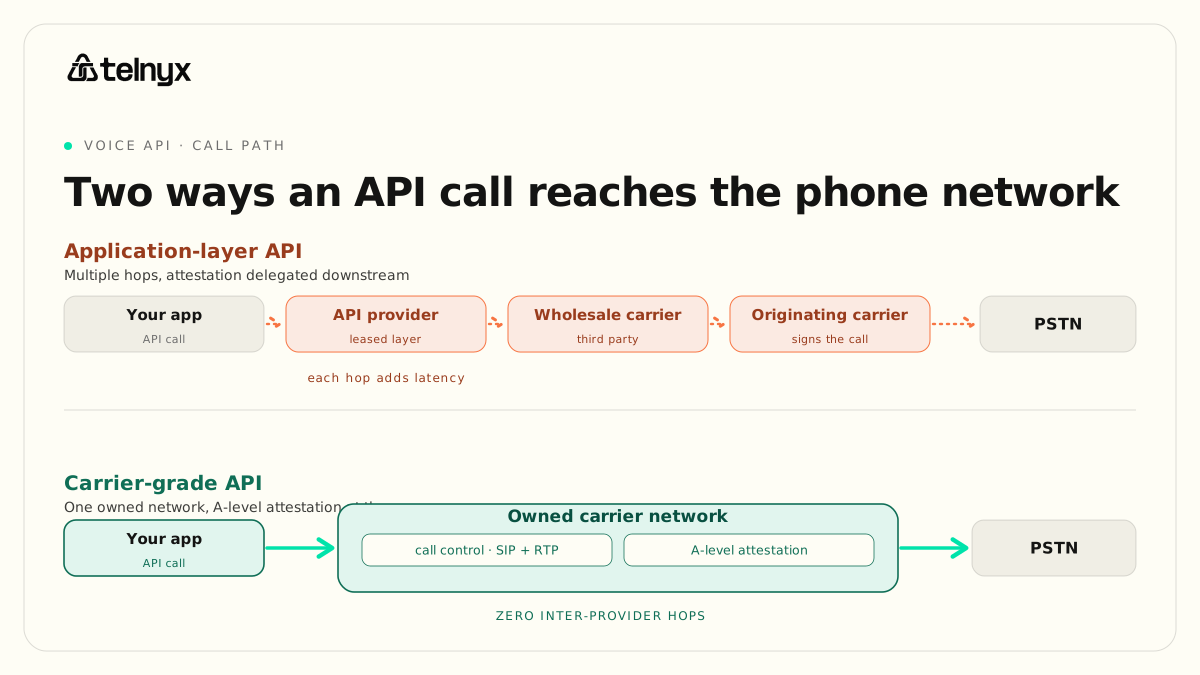
Not every VoIP API sits at the same layer of the stack, and the distinction is the single most important thing to evaluate.
An application-layer API runs on top of leased or resold network infrastructure. The provider builds a clean developer interface but depends on third-party carriers to actually connect calls to the PSTN and to sign them for caller ID authentication. Every inter-provider hop adds latency, and every dependency adds a point where call quality or trust can break down.
A carrier-grade API is built by a provider that owns the underlying network. The same company that exposes the API also operates the points of presence, holds the telecom licenses, and signs the calls. Numbers and SIP trunking live on the same platform as the call-control APIs, so there are no inter-provider hops to add delay, and authentication happens at the source rather than being delegated downstream.
That difference shows up most clearly in two places: fraud protection and caller ID trust.
Why carrier-grade matters for fraud
International Revenue Share Fraud (IRSF) is the clearest reason buyers should weigh the network layer, not just the interface. In an IRSF attack, fraudsters artificially inflate traffic to premium-rate numbers they control, profiting from inter-carrier revenue-sharing agreements while the originating business absorbs the bill. Europol notes that the scheme is attractive to criminals precisely because of its low risk: it can be carried out at a distance, and the redirected money moves from the victim's carrier to the attacker's complicit carrier in a way that can be withdrawn quickly. The losses are substantial. According to Telesign, IRSF has grown 6x since 2013, with total losses multiplying from $1.8 billion to $10.76 billion, and as Akamai documents, the fraud is hard to detect because it blends in with legitimate international calls to high-cost destinations. A carrier that owns its network and monitors routing in real time can flag and block this traffic in ways an application-layer reseller, sitting one or more hops removed from the actual call path, structurally cannot.
Why carrier-grade matters for caller ID trust
The same logic applies to STIR/SHAKEN, the FCC-mandated framework for authenticating caller ID on IP networks. Under the framework, the originating provider signs each call with a digital certificate and assigns an attestation level. As TransUnion explains, an A-level (full) attestation indicates the lowest level of risk: the provider has verified that the caller is authorized to use the number in the caller ID, which gives a call the best chance of connecting cleanly rather than being flagged as spam. Per the FCC's rules, the provider with the implementation obligation must make the attestation-level decision and sign the call with its own certificate. A provider that originates calls on its own network can deliver A-level attestation directly. One that depends on an upstream carrier is making that trust decision at arm's length.
The standards backdrop: network APIs are converging
For most of their history, telecom network capabilities were exposed through provider-specific interfaces. Each operator published its own proprietary APIs, and developers wrote custom integrations for every market. That is changing fast.
The GSMA Open Gateway initiative has standardized network capabilities behind a common framework of CAMARA APIs, the open-source project run under the Linux Foundation that defines telecom APIs such as SIM Swap, Number Verification, Device Location, and Quality on Demand. As of early 2026, 86 operator groups, representing more than 300 networks and 80% of global mobile connections, are aligned around a common API framework. The portfolio has grown quickly: what started with eight CAMARA APIs in 2023 has expanded to more than 300 instances of 20 different CAMARA APIs commercially launched in 65 markets.
That standardization turns once-fragmented network APIs into a consistent, cross-operator surface, and it explains why the use cases are expanding well beyond basic calling. As the GSMA documents, multi-operator API launches are now enabling banks and retailers to verify identity, detect SIM-swap fraud, and secure transactions in real time, while quality-on-demand capabilities let applications request enhanced network performance for payments, streaming, gaming, and other latency-sensitive operations. The momentum is now feeding directly into AI: TelecomTV reports that operators and vendors are exploring how agentic AI systems can automatically discover, select, and chain network APIs without manual intervention. These CAMARA APIs sit at the mobile-network capability layer rather than the VoIP call-control layer, so they complement a voice API more than they replace it. The broader signal for anyone choosing a VoIP API is the same either way: the industry is moving toward carrier capabilities exposed as clean, standardized, programmable interfaces, and the providers closest to the network are best positioned to deliver them.
VoIP API selection criteria
When you evaluate programmable voice API, the interface is the easy part to compare. The harder, more consequential questions are about what sits beneath it.
| Criterion | Application-layer API | Carrier-grade API |
|---|---|---|
| Network ownership | Leases or resells infrastructure | Owns the carrier network |
| Inter-provider hops | One or more, adding latency | Zero on-net |
| STIR/SHAKEN attestation | Delegated to upstream carrier | A-level at the source |
| Real-time fraud control | Limited visibility into routing | Direct, network-level monitoring |
| Latency for AI voice | Variable, depends on third parties | Lower via owned points of presence |
For real-time voice AI specifically, latency is the constraint that matters most, and latency is largely a function of physical distance. Co-locating inference infrastructure adjacent to network points of presence shortens the path that audio and AI processing have to travel, which is exactly the kind of architectural decision that an application-layer API cannot make on infrastructure it does not own. If you are building agents that need to respond at human conversational speed, how that infrastructure is laid out determines whether the experience feels natural or noticeably delayed.
Where VoIP APIs are headed
The trajectory is clear. Voice APIs are becoming the connective tissue between the PSTN and AI agents, and the bar for what counts as production-ready is rising. Standardization through frameworks like Open Gateway is making cross-operator deployment realistic, while the move toward AI-agent traffic is putting unprecedented pressure on latency, fraud resistance, and caller ID trust.
The providers positioned to win are the ones that control the full path, from carrier network to inference to the voice itself. As Ian Reither, COO at Telnyx, frames the unified approach to speech infrastructure: one API can tap best-in-class speech from multiple providers through a single surface running on global GPU infrastructure, delivering quality, variety, and real speed without juggling separate integrations. That consolidation, owning the network rather than renting it, is what separates a VoIP API that demos well from one that holds up under real production load.
Build voice AI on infrastructure you control
Telnyx is the carrier-owned platform for programmable voice, built on a network we operate rather than lease. With colocated GPU infrastructure adjacent to our global points of presence and A-level STIR/SHAKEN attestation at the source, Telnyx gives developers the latency, fraud protection, and caller ID trust that production voice AI demands. Sign up for a free account and start building on the carrier network today.
Share on Social


