
WhatsApp Business API
WhatsApp Business API Cost in 2026 After October 1
WhatsApp Business API cost in 2026: Meta's per-message rates after October 1, the 1,000 free service messages, BSP markup and a worked Telnyx example.
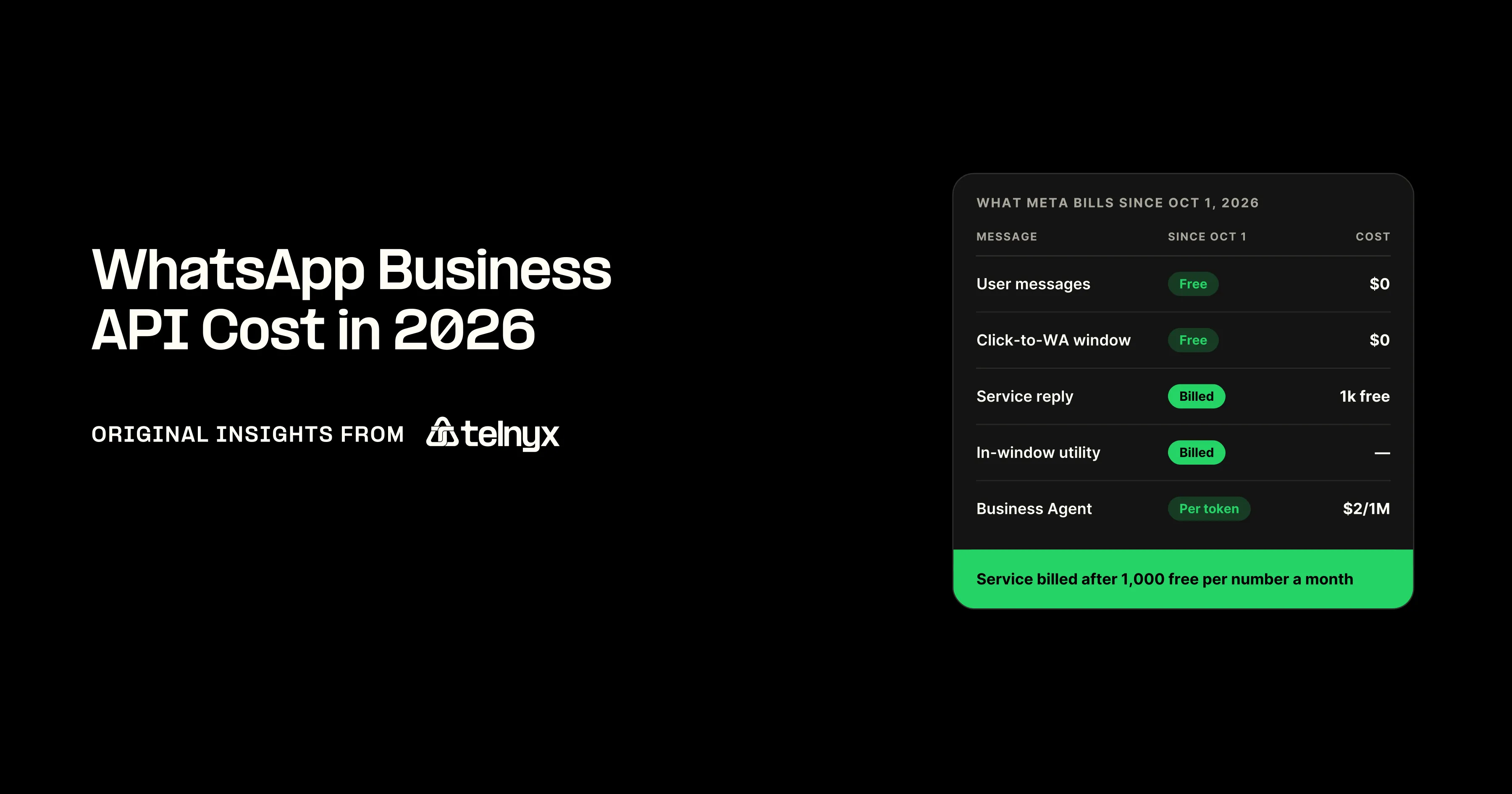
Takeaways
WhatsApp Business API cost is Meta's per-message rate, set by message category and the recipient's market, plus your provider's fee. Since October 1, 2026 service messages are billed after 1,000 free per phone number per month, so every message on your bill now has a price you can look up and add to the provider's fee.
- In-window utility messages are also billed since October 1, and Meta Business Agent messages are billed per token at $2.00 per 1M tokens, roughly 4-5 cents a message.
- Meta's rate drops in two cases only: the free entry point window opened by a Click to WhatsApp ad, and volume tiers on utility and authentication. Marketing and service never get cheaper with scale.
- Meta's fee is the same with every BSP. The provider fee is what differs, and Telnyx publishes it, starting at $0.004 per message, on one invoice with Meta's fees.
How much does the WhatsApp Business API cost in 2026?
The WhatsApp Business API cost has no licence fee. You pay Meta per delivered business-to-user message, priced by message category and the recipient's phone-number market. Messages a user sends you are free. On top of Meta's rate sits whatever your Business Solution Provider (BSP) charges.
Service messages, free since November 1, 2024, are now billed once a business phone number passes 1,000 in a calendar month. In-window utility messages, free since July 1, 2025, are billed at the utility rate. Meta Business Agent messages are billed per token. Meta's WhatsApp pricing documentation, updated September 30, 2026, carries the rules.
What changed on October 1, 2026
Today's rules differ from anything published before October 1.
Timeline of Meta pricing changes
| Date | What changed | Effect on your bill |
|---|---|---|
| Nov 1, 2024 | In-window non-template messages free | Service replies free |
| July 1, 2025 | Per-message billing by category and market, in-window utility free | Templates priced per message, utility replies free |
| July 1, 2026 | Current rate cards, Meta Business Agent category added | Meta's artificial intelligence (AI) billed per token |
| Oct 1, 2026 | Service billed after 1,000 free per number, in-window utility billed, 40 rate updates across 9 markets | Both become bill lines |
| Dec 31, 2026 | India accounts must bill in Indian rupees (INR) | Non-INR India accounts stop delivering Jan 1, 2027 |
| June 30, 2027 | Brazil accounts must bill in Brazilian reais (BRL) | Same cutoff for Brazil |
The 1,000 free service messages are counted per business phone number per month. They do not roll over, the counter resets monthly at midnight in the Messaging account's timezone, and Meta charges from the 1,001st at the market's service rate.
Payment method warning: with no payment method on file, a Messaging account gets service messages delivered only inside the 1,000 free tier. Charged messages are not delivered until a payment method is added.
Meta's fee and your provider's fee are two separate lines
Meta's fee is identical whichever BSP sends the message, as the Telnyx WhatsApp Business API FAQ states, so switching between Twilio and Telnyx does not change Meta's half of the bill. Telnyx bills Meta's fees and its own platform cost on a single invoice, with the fee published at Telnyx WhatsApp pricing.
Try the Telnyx WhatsApp Business API, add a payment method before a number passes 1,000 service messages, and pay $0.004 per message on top of Meta's rate.
WhatsApp Business API cost per message, by category and market
Each delivered message carries one charge, and the category sets the rate. Marketing, utility and authentication are template categories: Meta approves the template, and you can send it at any time. Service and Meta Business Agent are non-template categories, and non-template messages can only be sent inside the 24-hour customer service window, which opens and resets every time the user messages or calls you. Service covers replies written by people or a third-party AI, Meta Business Agent replies written by Meta's own AI. Order confirmations and booking updates are the usual utility templates, as in the WhatsApp API for restaurants traffic mix.
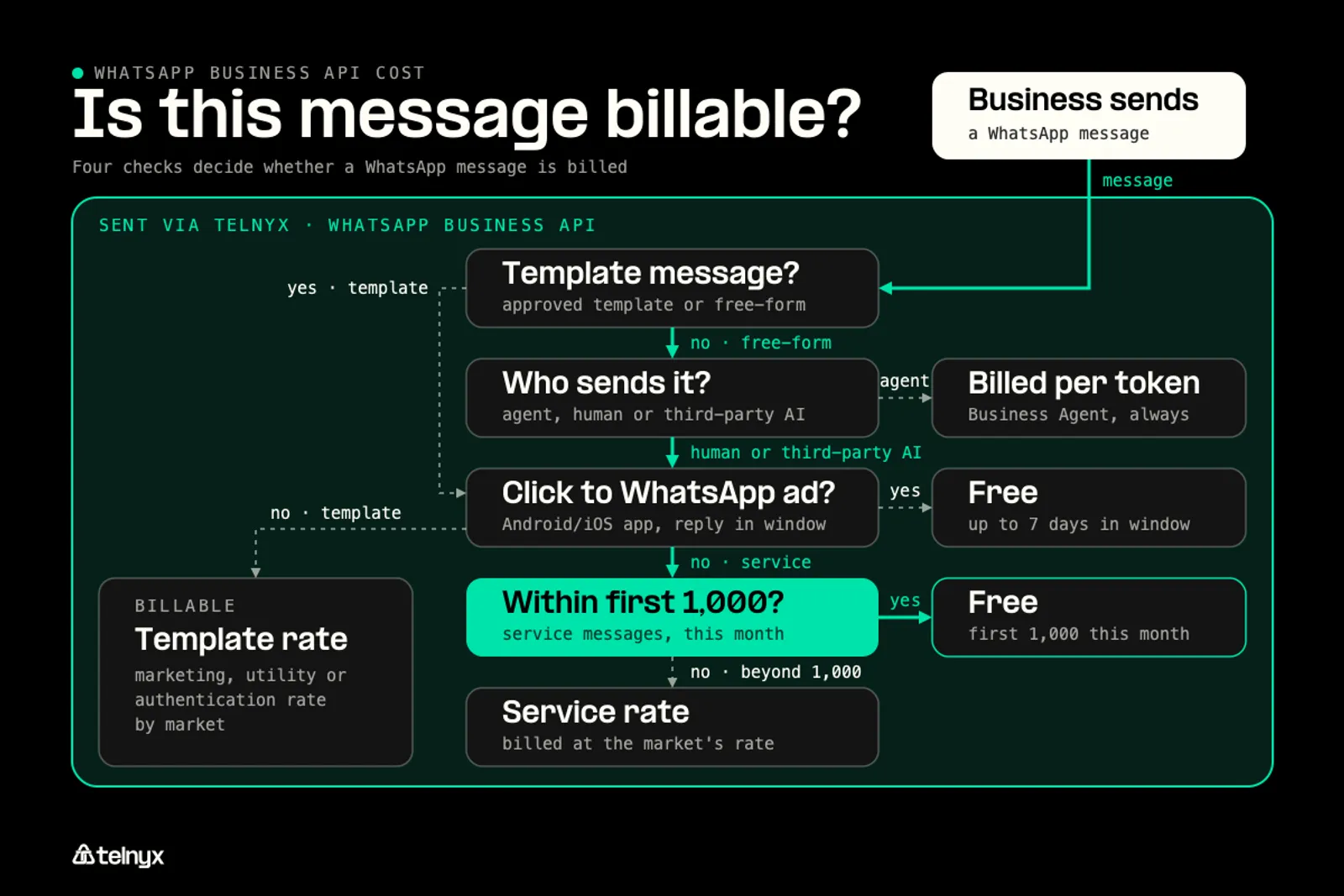
After October 1, only a mobile ad-click conversation or the first 1,000 service messages per number are free.
Meta's rate card has 47 markets, 39 countries plus 8 "Rest of" regions, with the US and Canada under North America. The figures below are read from Meta's July 1, 2026 rate card. None of these five markets is on Meta's October 1 change list. Authentication-international rates exist in specific markets and sit above the local utility and authentication rate. Marketing rates across European markets are covered in WhatsApp Business in Europe.
Meta Business Agent pricing per message
Meta Business Agent is billed on tokens rather than messages, at $2.00 per 1M tokens. A typical message runs 20,000-25,000 tokens, about 4-5 cents, with no volume tiers, no free messages and a charge even inside the free entry point window. Meta's Brazil comparison: service replies produced by a third-party AI run about 9-10 cents a message and about $968 per 10,000 messages once the free tier is spent, against about 4-5 cents and $400-$500 per 10,000 with Meta Business Agent.
Meta Business Agent cost by conversation length: a "what time do you open?" exchange of 4 messages and about 80,000 tokens costs about 16-20 cents. A 10-message assembly walkthrough at about 250,000 tokens costs about 40-50 cents. Token billing scales with how much the AI reads and writes.
When Meta does not charge for messages
The free entry point window opens only when a user taps a Click to WhatsApp ad in the Android or iOS app, and only if the business replies inside the customer service window. Four conditions follow:
- Every message in the window is free except Meta Business Agent messages, still billed per token.
- The window can stay open up to 7 days from the user's first message.
- It is shared across Messaging accounts on the same phone number.
- Desktop ad clicks and Facebook Page call-to-action buttons do not open it.
The second case is the 1,000 free service messages per business phone number per month. Templates and Meta Business Agent messages never qualify for it.
Volume tiers for utility and authentication
Volume tiers apply to utility and authentication only. They aggregate at business portfolio level per market and category, count only charged messages, and reset monthly. Marketing and service volume never gets cheaper with scale. Meta's UK bands show the drop.
UK utility and authentication volume bands, USD per message
| Band (messages per month) | Rate | Discount |
|---|---|---|
| 0-100,000 | $0.0220 | 0% |
| 100,001-1,000,000 | $0.0209 | 5% |
| 1,000,001-4,500,000 | $0.0198 | 10% |
| 4,500,001-40,000,000 | $0.0187 | 15% |
| 40,000,001-80,000,000 | $0.0176 | 20% |
| 80,000,001+ | $0.0165 | 25% |
WhatsApp Business app vs API pricing
Searches for WhatsApp Business pricing mix two products. The WhatsApp Business app is free and manual. The WhatsApp Business API, reached through a BSP, bills per message and is programmable. With Telnyx, Bring Your Own Number imports an existing WhatsApp number and keeps it.
WhatsApp Business app vs WhatsApp Business API
| App | API via a BSP | |
|---|---|---|
| Cost | Free | Meta per-message rate plus provider fee |
| How you send | Phone or desktop app | API call |
| Templates | Not needed | Meta-approved, by category |
| Messaging outside 24-hour window | No | Templates only |
| Automation and AI | No | Yes |
| Number | Your own phone number | BSP-connected, Bring Your Own Number with Telnyx phone numbers |
Coexistence caveat: one BSP page claims app-sent messages stay free on a number also connected to the API, with only API-sent messages billed. Meta's pricing documentation does not state this. Get your BSP to confirm it in writing before budgeting on it.
The API is worth paying for in three situations. Volume, because nobody sends 50,000 order updates a month by hand. Templates, because anything outside the 24-hour window must be a Meta-approved template. Automation, because free-form replies inside the window can come from your system or an AI. Embedded Signup starts in Mission Control and completes Meta business verification without switching tools. The same per-message logic applies to Rich Communication Services (RCS), covered in RCS business messaging pricing.
How to find the cheapest WhatsApp API provider
Three provider fee models and how to compare them
No BSP gets a cheaper Meta rate, so comparing Meta rate cards between providers measures nothing. The cheapest WhatsApp API provider is the one with the lowest provider fee and the fewest costs hiding around it. Providers charge in one of three ways, and the only fair comparison puts all three on the same message. The best WhatsApp API provider comparison covers the feature side of that choice.
Which BSP fee model costs you least?
- Under 10,000 messages a month, small team: pick a flat seat fee if you need only a few seats. Meta's rate is identical at every BSP, so seat count decides.
- High volume, only a handful of agents: choose a per-message fee with volume discounts. A few agents need few seats, and the per-message rate falls as monthly volume climbs.
- One-time passwords (OTP) and notifications only, no agents: pay per message with no seats. Authentication and utility are the categories where Meta's volume tiers lower the rate as you scale.
- SMS, voice and WhatsApp on one account: consolidate on Telnyx and compare total platform fees across channels. WhatsApp from $0.004, plus Meta's fees, lands on one invoice with SMS and voice.
BSP fee models compared
| Model | What you pay | Example on a North America utility message (Meta $0.0034) |
|---|---|---|
| Per-message platform fee | Meta's rate plus a fixed fee per message | Telnyx: $0.0034 + $0.004 = $0.0074, with automatic volume discounts as volume grows |
| Flat per-seat or monthly fee | Meta's rate plus a monthly amount divided by your messages | Drag publishes $12 to $24 per seat per month, so the per-message cost depends on how many messages each seat sends |
| Bundled or marked-up rate | One blended number per message | Meta's $0.0034 share is not shown, so markup cannot be measured |
The per-message model is the only one of the three where the provider's number can be read straight off the invoice. The flat model gets cheaper per message as volume rises and more expensive as it falls. The bundled model makes a volume forecast impossible, because the two components move independently and you cannot see either. The other cost lines belong in the same comparison: setup fees, number rental, integration time, and whether SMS and voice sit on the same bill or on a second provider's.
Questions to ask any BSP before signing
Six questions settle the comparison, and the answers can go straight into a request for proposal (RFP):
- Is Meta's fee shown separately on the invoice, line by line?
- Is there any markup on Meta's rate, in any market or category?
- What is the platform fee per message at my monthly volume, and where do the discounts start?
- Are there number, setup or minimum monthly fees?
- Does the platform fee apply to service messages and to Meta Business Agent messages?
- Can SMS, voice and WhatsApp run on one number and one bill?
Telnyx vs Twilio WhatsApp pricing in a worked example
The full per-message cost is Meta's rate plus the provider's fee, which starts at $0.004 per message with Telnyx. Meta rates below are from the July 1, 2026 rate card. Twilio's fee is read from Twilio WhatsApp pricing. $0.005/message (twilio.com/en-us/whatsapp/pricing, read 2026-10-07)
Full per-message cost, Telnyx vs Twilio
| Market and category | Telnyx total (Meta rate + Telnyx fee) | Twilio total (Meta rate + Twilio fee) |
|---|---|---|
| North America utility | $0.0034 + $0.004 = $0.0074 | $0.0034 + $0.005 per message |
| North America marketing | $0.0250 + $0.004 = $0.0290 | $0.0250 + $0.005/message |
| UK utility | $0.0220 + $0.004 = $0.0260 | $0.0220 + $0.005 per message (plus Meta fees), per Twilio's own site |
| India authentication | $0.0014 + $0.004 = $0.0054 | $0.0014 + $0.005 per message |
100,000 North America utility messages at Meta's $0.0034 is $340 of Meta fees, and that $340 is the same with either provider. Telnyx adds $400 of platform fee at the starting rate, before automatic volume discounts, for $740 in total. Twilio adds 100,000 times its published fee. $500
One invoice: Telnyx bills its platform fee and Meta's per-message fees together. The same Telnyx number and connection also carry SMS, public switched telephone network (PSTN) voice, WhatsApp messages and WhatsApp calls, with per-minute pricing on business-initiated WhatsApp calls and no monthly subscription for calling.
The non-rate differences matter to a team consolidating Session Initiation Protocol (SIP) trunking, SMS and WhatsApp. Telnyx SMS API traffic shares that number, a Telnyx AI Assistant answers inbound WhatsApp voice calls today, and the whole channel set lands on the invoice that already carries your voice minutes. The Telnyx vs Twilio voice comparison covers the voice side of the same decision. The table uses the starting rate, so see Telnyx WhatsApp pricing for the platform fee at your volume.
FAQ
Price every WhatsApp message on your bill
Meta's post-October rate plus a Telnyx platform fee starting at $0.004 per message, billed together on one invoice, with SMS, voice and WhatsApp calls on the same number. The full per-message cost, with nothing hidden in a blended rate.
Start with WhatsApp on TelnyxShare on Social

Serhii Omelchenko
Global AEO/SEO Manager
Serhii is Global AEO/SEO Manager at Telnyx, based in Amsterdam, he is focused on making communications infrastructure findable and credible across both traditional search and AI-driven discovery. He previously led SEO and GEO strategy for some of the world’s most recognized consu


