
Photon is the company behind Spectrum, an open-source framework with more than 1,500 GitHub stars and over 333,000 npm downloads a month. It connects AI agents to the messaging channels people already use every day: iMessage, WhatsApp, Telegram, SMS, RCS, voice, and more. Developers build an agent on the framework they like, and Photon puts it where its users already are.
"An AI agent that lives in a browser tab has a reach problem. An AI agent with a phone number does not. When you build an agent, the easiest way to let your family, your friends, or your customers use it is not 'here's an app, download it,'" says Daniel Tian at Photon. "It's 'here's the number, you can text it.'"
When agents need a number and telecom gets in the way
Photon's users are agent developers, and they face the same wall: consumers do not want another app. They want to message an agent the way they message a friend, on iMessage, WhatsApp, or plain SMS.
Getting there means working with carriers. It means provisioning real phone numbers, registering messaging campaigns, and navigating the rules of a network built for human-to-human communication. Photon's answer was to absorb that complexity: developers ship agents, Photon handles the channel plumbing.
That only works if the infrastructure underneath is something Photon can program against.
Why Telnyx
Photon evaluated providers across the space, from Bandwidth to Twilio, and chose Telnyx for two reasons.
The first was API design. "The really developer-friendly, API-forward design within Telnyx allows us to pass down many flexibilities and different settings to our end users," Daniel says. "That's really important for us, because that's kind of the service we're providing to developers."
The second was developer experience, and it came from word of mouth. Feedback from other teams building on Telnyx was consistent: the team ships fast and keeps improving DX. "That's been very important for us," Daniel says.
His one-word description of Telnyx: accessibility. "Everything is API-forward, API-supported, and so programmable. That makes it accessible for us as developers, and for the people actually using it, because they can trigger all the customization and personalization through the API."
His advice for anyone evaluating infrastructure, in one line: "You should use Telnyx if you care about developers."
How it works
A developer brings an agent to Photon, say a restaurant-reservation agent. Photon provisions a phone number in near real time, and Telnyx powers the messaging and voice underneath it.
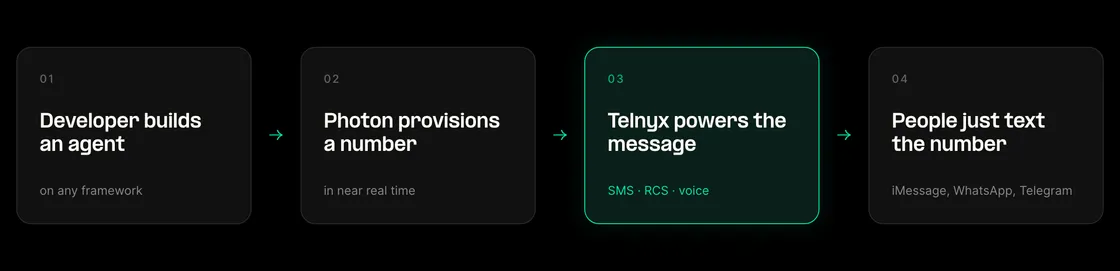
"Telnyx comes in right there to provide the RCS and SMS capabilities, which basically allows us to not worry about the carriers and how to tap into the network," Daniel says. "It's been super easy to integrate into our product offering, and it makes it super easy for developers to get started."
The near-real-time number provisioning is not a nice-to-have. Daniel says more and more of Photon's users onboard through CLI and agent instructions rather than clicking through a dashboard, and nobody wants their code polling an endpoint that takes minutes to respond.
"We want the number provisioning to be real-time," Daniel says. "We want people to onboard with no additional wait time." And today, he says, provisioning lands "within almost the real-time territory."
The difference: 1:1, not blast
Here is the number that makes Photon unusual. Daniel says industry SMS traffic tends to be 90% or more outbound, one-way campaigns and OTPs. Photon's traffic is close to a 1:1 inbound-to-outbound ratio.
"On average, we are very close to a 1-to-1 inbound-outbound conversational rate, and I know that's pretty rare in the SMS or RCS industry," Daniel says.
That ratio is the whole point. Photon is not running marketing blasts through a pipe. It is giving AI agents real two-way conversations with real people, on the same phone numbers those people already text.
Daniel's framing for other technical founders choosing telecom infrastructure: "Telecom is the backbone. It's the foundation for everything people are building on top of. And it has to be API-forward. It has to be developer-focused."
What's next for Photon
Photon started with iMessage and has been expanding outward: WhatsApp and Telegram recently launched, with more social channels on the roadmap. On the Telnyx side, Photon is exploring voice, especially call forwarding, through the Voice API.
The thesis does not change with the channel. "People have different preferences, spend time on different platforms, live in different regions," Daniel says. "We want developers to build their agent once and have everyone, everywhere, able to use it."
Or as Daniel puts it when someone asks why they should use Photon: "Build your agents and let people use them. If no one is using your agent, that's the end of the game."
Photon built its messaging infrastructure on Telnyx. If you're shipping agents that need to reach real people on real channels, the same messaging APIs Photon runs on are available to you.


