
TELNYX DECISION MODELS (BETA)
Decision Models for AI agents
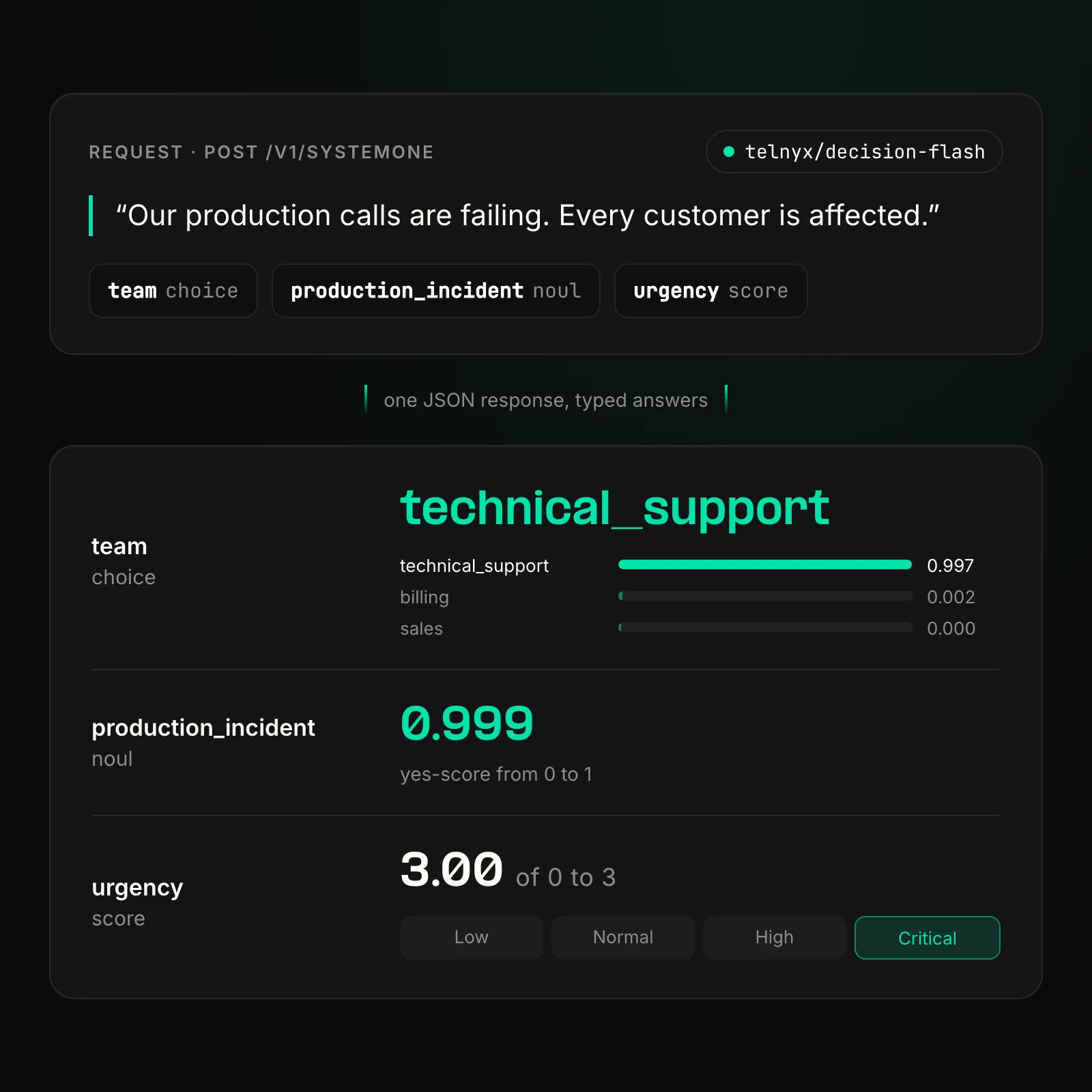
Send shared context and up to 64 typed questions in one request. Get back a choice, a yes/no score, or a rating for each one, and branch in code on the answer. Works with the TypeSafe SDK.
$0.035per 1M input tokens on Flash
$0for output tokens on Flash and Pro
64typed questions per request
USE CASES
Built for the decisions agents make on every run.
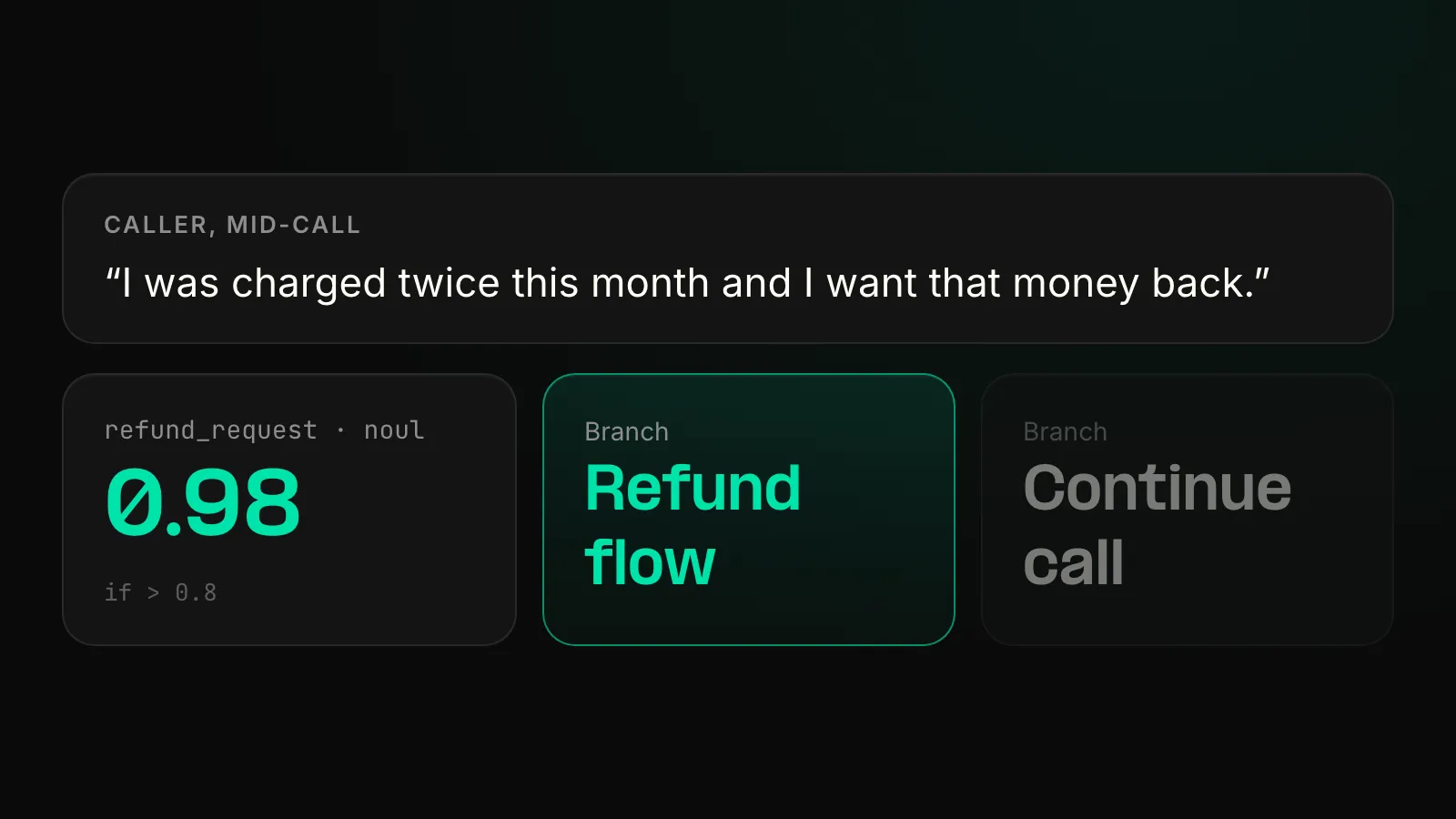
Voice AI branching
Score a live transcript for a refund request or a reported fault, then branch the call on the number.
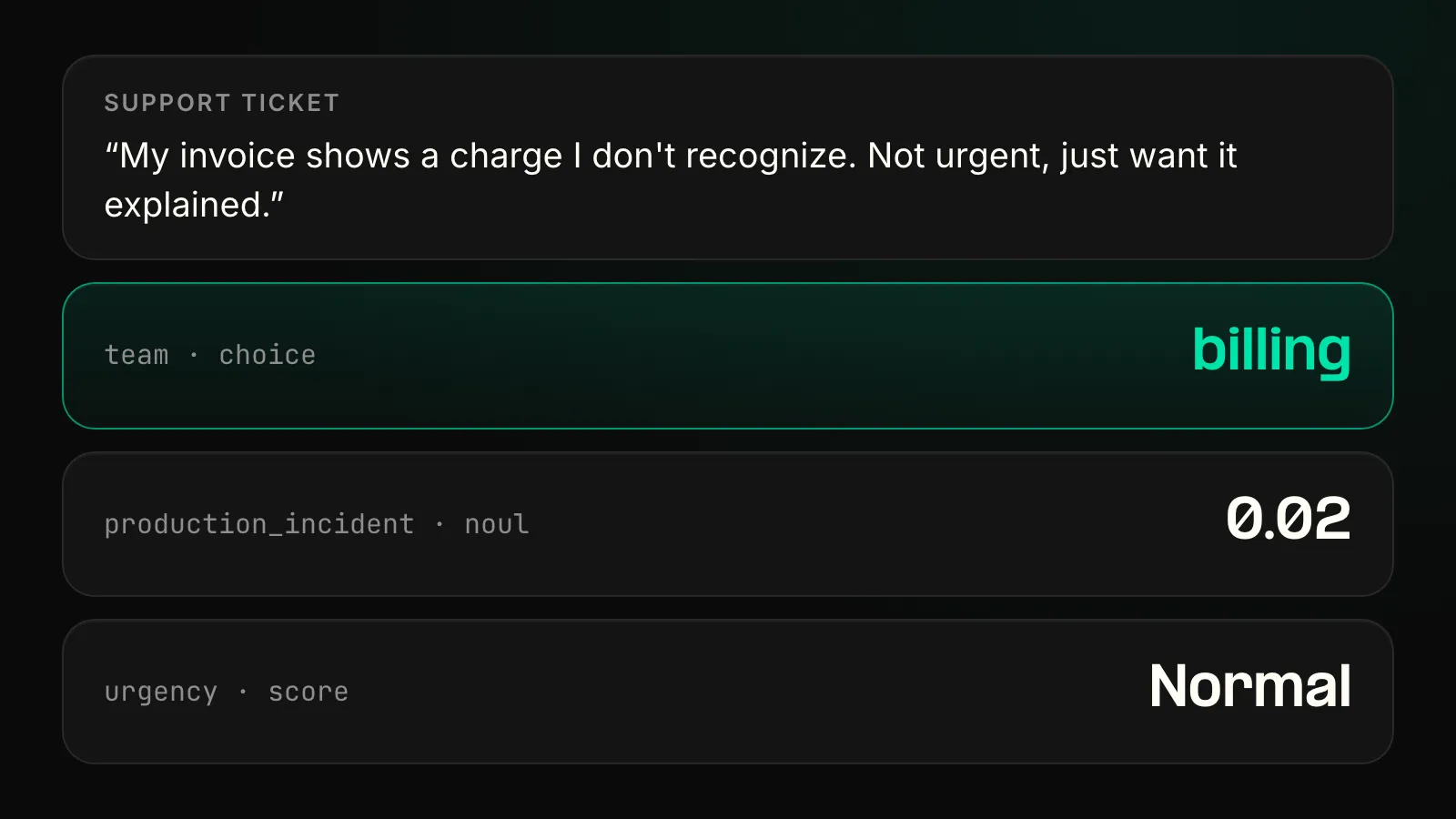
Support triage
Pick the owning team, flag production incidents, and rate urgency in a single request.
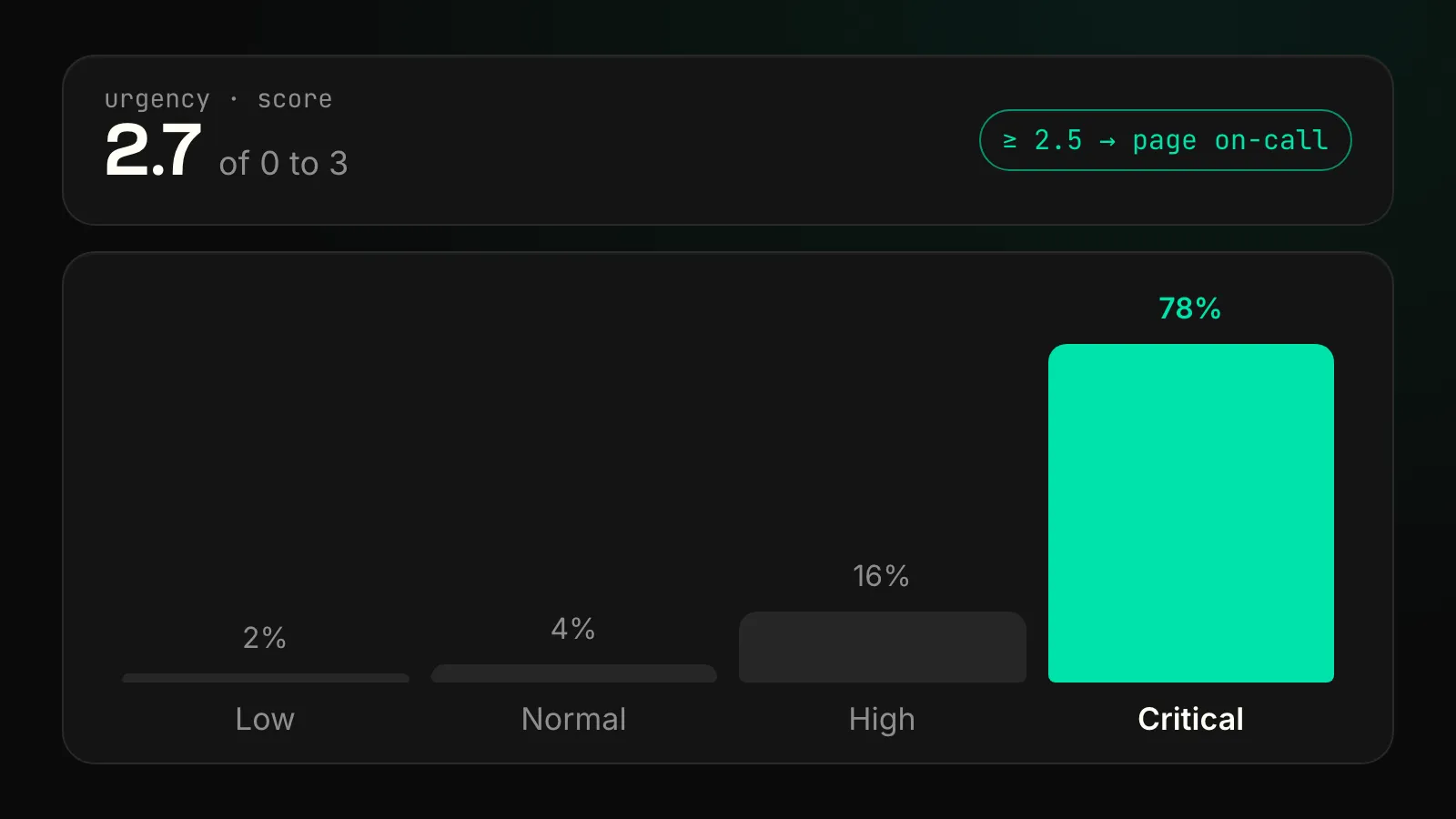
On-call escalation
Rate urgency on an ordered rubric and page on-call when the score crosses your threshold.
WHERE DECISION MODELS FIT
Keep your LLM for work that produces text. Send the bounded judgment calls to a decision model and branch in code on a typed answer.
Keep on your LLM
Open-ended work
- Writing replies, summaries, and reports
- Tool calls with open-ended parameters
- Multi-step reasoning and planning
- Choices you can't list in advance
Send to Decision Models
Bounded decisions
- Routing to a known team, queue, or agent
- Yes/no gates such as refund or incident checks
- Urgency and quality ratings on a fixed scale
- Intent classification across up to 64 options
QUESTION TYPES
Three question types, one shared state.
Every question needs a type and instructions. State and instructions accept strings, JSON objects, or arrays. Inputs are text only.
state: one shared context
Send the transcript, the message, or the incident report once. Every question in the request evaluates against the same state.
choice: pick from options
Route a ticket, classify intent, select a category. 2 to 64 options, with probabilities on every option and a confidence score on the answer.
noul: answer yes or no
Is this a refund request? Is this an active production incident? Returns a 0 to 1 score for the positive outcome. Ask separate noul questions when several conditions can be true at once.
score: rate on a scale
Rate urgency on an ordered rubric of 2 to 64 levels. The score is the expected zero-based index, fractional values included, with a legend and per-level probabilities.
HOW IT WORKS
One request. Typed answers back.
Pick a model, send shared state and named questions, and read typed answers from the response. Existing TypeSafe SDK code needs the Telnyx base URL and a Telnyx model alias.
PRICING
Two models, priced per input token.
Set model to telnyx/decision-flash or telnyx/decision-pro on each request. Requests without a model use Flash. Beta pricing can change.
Flash: $0.035 per 1M input tokens
The default model. Lowest cost and latency for high-volume routing, triage, and intent classification. Output tokens are free, and cached input is billed at the same rate.
Pro: $0.20 per 1M input tokens
For decisions that need long context. Keep a full support history, a policy and its amendments, or a long transcript in one request, past Jev's 32k-token per-decision limit. Output tokens are free.
PRODUCTS
One API key. Every primitive your agent needs.
Voice AI Agents
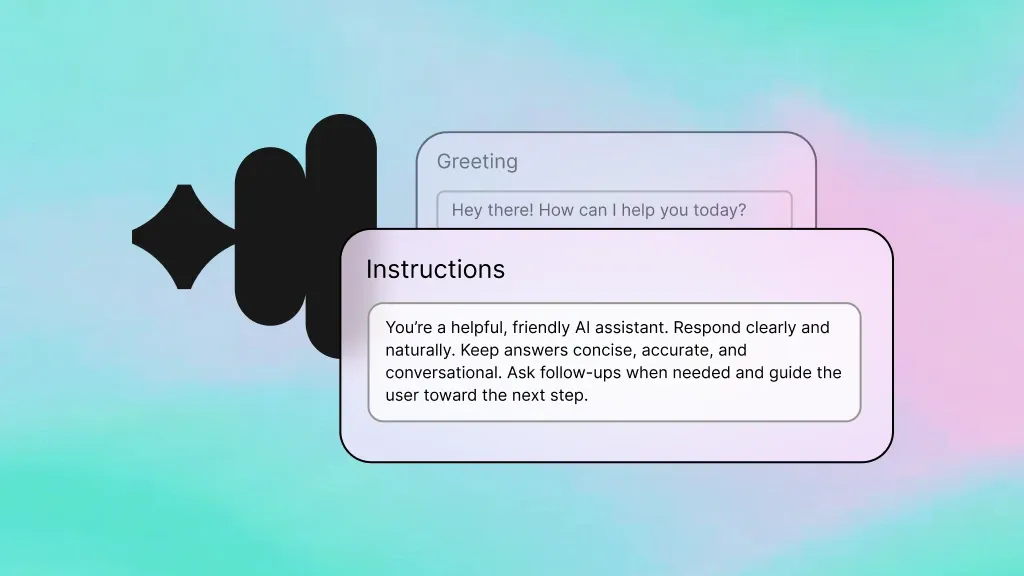
Programmable voice agents for inbound and outbound calls. Branch the conversation on a decision call mid-call.
Inference
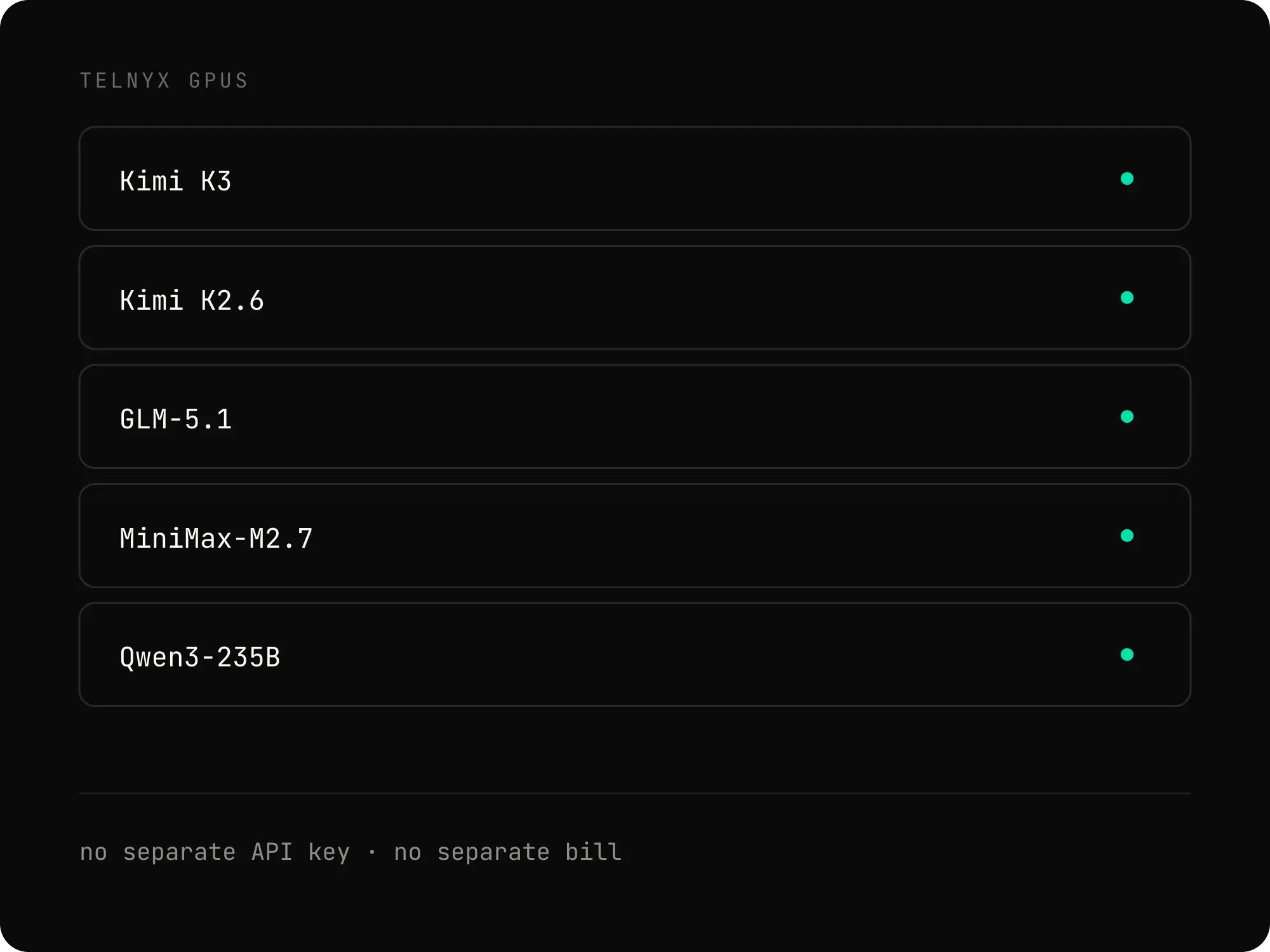
Open-weight and frontier models on edge-deployed GPUs, on the same API key as Decision Models.
Text-to-Speech
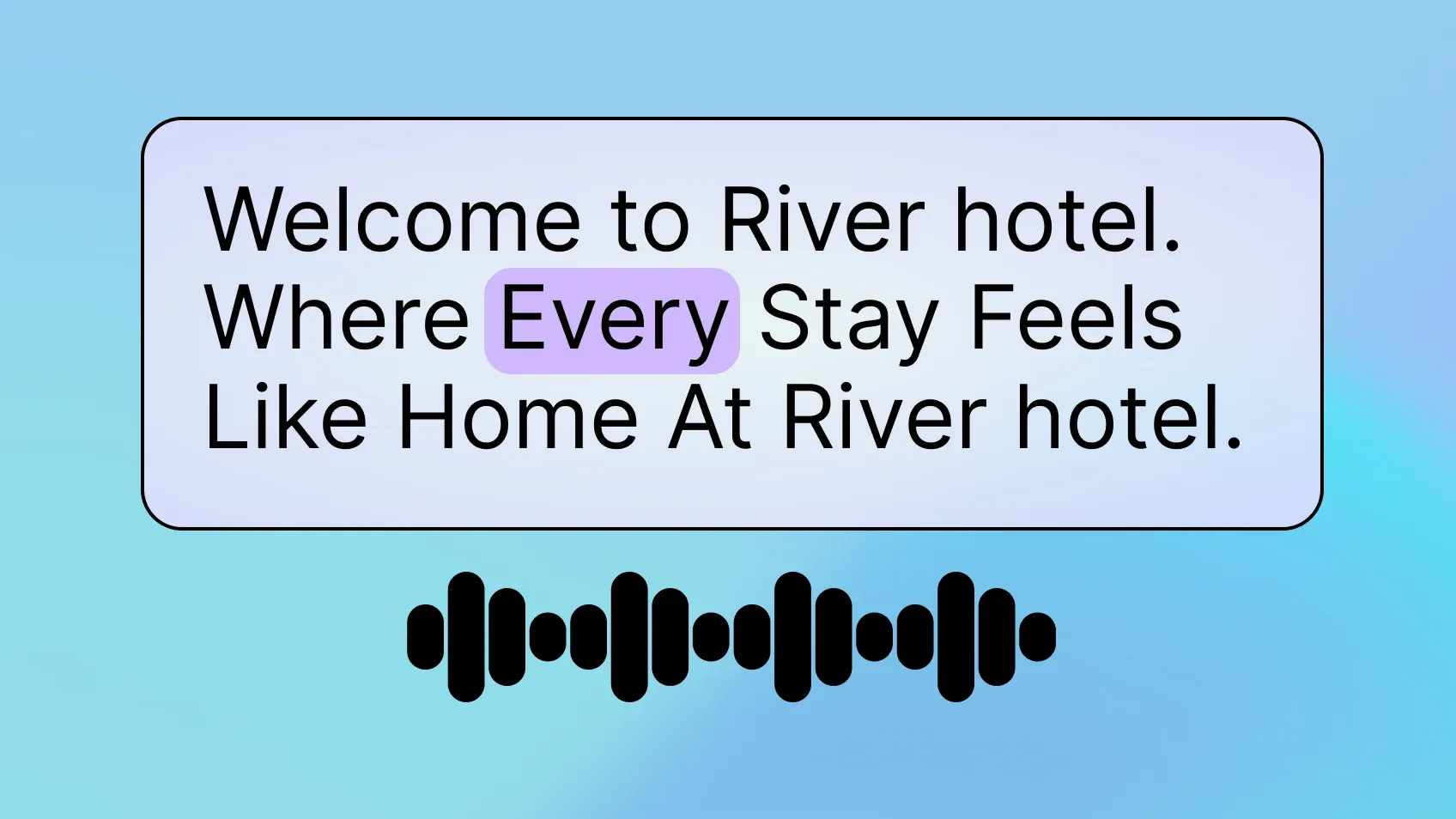
Hosted voices from Telnyx and third-party providers for your agent's speech.

Speech-to-Text
Real-time and batch transcription. Feed the transcript straight into a decision request.