
Voice
Voice AI that never leaves the EU
Most enterprises deploying Voice AI in Europe have a data residency strategy. Far fewer have a data sovereignty strategy. Sovereignty is not a setting you select. It is a property of the call path.

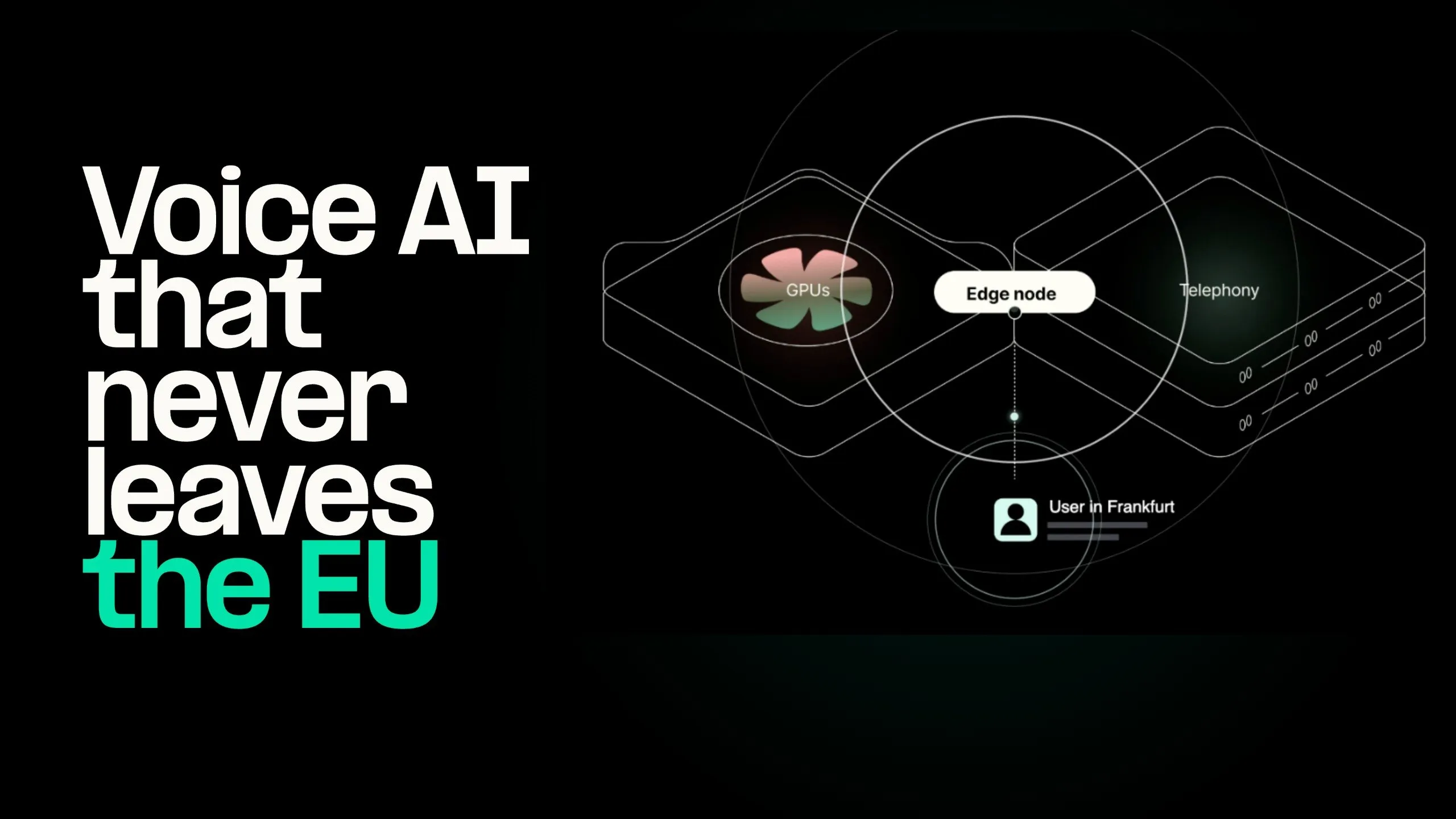
Most enterprises deploying Voice AI in Europe have a data residency strategy. Far fewer have a data sovereignty strategy. Residency answers a narrow question: where does the data sit? Sovereignty answers a broader one: how many hands does the data pass through, and who controls them?
A model endpoint can carry an EU label while the compute underneath is rented from a hyperscaler and orchestrated across three sub-processors you never contracted with.
The four paths to Voice AI in Europe
When teams evaluate Voice AI for European markets, the build vs buy decision shapes everything downstream: latency, compliance exposure, how many DPAs you sign, and how many failure modes you inherit.
| Path | Sovereignty | Time to production |
|---|---|---|
| Full build | Full, if hardware is EU-based | 12 to 18 months |
| Hybrid build | Broken at every external hop | 3 to 6 months |
| Frankenstack | Not guaranteed at any point | 2 to 4 weeks (prototype) |
| Integrated platform | Enforced by architecture | Days |
Full build gives you control. It also gives you 18 months of hiring for telephony, GPU operations, and ML engineering before you reach production quality. Hybrid and frankenstack trade that control for speed, and pay for it in latency, data exposure, and vendor complexity. The Frankenstack problem is where most teams end up: four to six vendors, five margins, and audio bouncing between data centers before the caller hears a response.
An integrated platform is the only path where sovereignty is not a promise you have to audit. It is a property of the infrastructure.
What sovereign Voice AI looks like, stage by stage
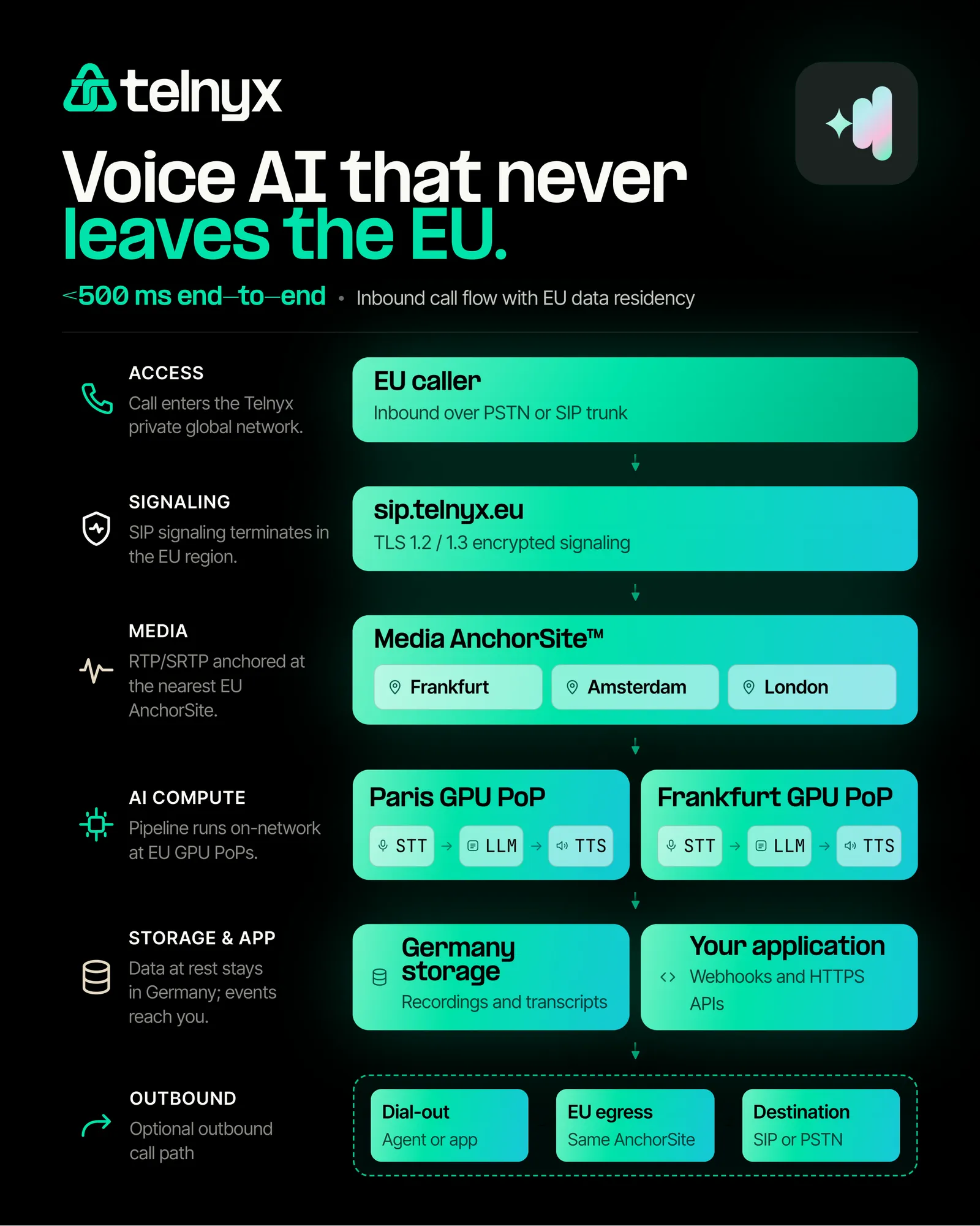
Here is how a Voice AI call moves through Telnyx European infrastructure, from ingress to egress. Every stage runs on hardware Telnyx owns and operates inside the EU.
1. Access
The call enters on Telnyx-licensed carrier infrastructure, not a rented third-party SIP trunk. Telnyx holds telecom licenses in 30+ countries and operates its own switches. A leased first hop means a third party's switch processes your call metadata in a jurisdiction you didn't choose, before it ever reaches your infrastructure. Sovereignty starts at ingress, because a leased first hop is a hop you cannot account for.
2. Signaling
SIP terminates in the EU at sip.telnyx.eu over TLS 1.2/1.3. The setup handshake happens in Europe rather than round-tripping to a US signaling server, so call metadata, who called whom and when, never leaves the region either.
3. Media
RTP/SRTP anchors at the nearest EU AnchorSite across Frankfurt, Amsterdam, Paris, and London. Audio packets do not cross the Atlantic at any point in the conversation.
4. AI compute
This is where most European deployments quietly break. STT, LLM, and TTS run on-network at EU GPU PoPs, co-located with the telephony PoPs on the same private MPLS backbone that carries the call. Media anchor to inference is a single network hop. Telnyx owns the GPU hardware rather than renting capacity, which means no hyperscaler appears as a sub-processor of your voice data at all.
Frontier open-weight models, including GLM-5.2 and Kimi K2.6, run in-region at sub-100ms time to first token on Telnyx Inference.
5. Storage and application
Data at rest stays in Germany, encrypted, with retention and deletion configurable per data category. Events reach your application over webhooks and HTTPS APIs; raw audio and transcripts stay in region.
6. Outbound
If the agent dials out, egress uses the same EU AnchorSite as the inbound leg.
End to end: under 500ms round-trip. Data at rest: Germany. Data in motion: EU private network. Processing: European GPUs.
Why the architecture is the argument
Fewer hands. A five-vendor pipeline means five DPAs, five retention policies, and five separate parties that can be compelled, audited, or breached independently. One network collapses that to one. Reducing the number of entities that ever hold your audio is a concrete reduction in exposure, and it holds regardless of how the jurisdictional debate resolves.
Less data. No provider can produce what it did not retain. Configurable per-category retention and deletion is not a compliance nicety; it is the practical answer to compelled access, and the only one that does not depend on someone else's legal posture.
Lower latency. Under 500ms end to end is a consequence of the diagram, not a target bolted onto it. Splitting the pipeline adds 150 to 400ms of pure network overhead per conversational turn before any model does any work. Callers read anything above 500ms as lag. Past 700ms, it stops feeling like a conversation.
Fewer failure modes. Five vendors each running at 99.9% compound to 99.5%, roughly four and a half hours of downtime a month. One network, one SLA, one contract removes that math.
Latency, reliability, and compliance get treated as three separate procurement conversations. They are one conversation, and all three are settled by the call path, before you write a line of application code.
Everything stays in Europe. The caller never knows. The regulator never asks.
Share on Social
Deniz is a Senior Product Marketing Manager at Telnyx with 10 years of experience in technology and healthtech marketing. She previously led go-to-market initiatives at Philips Healthcare, Vodafone, and The Coca-Cola Company. Originally from Türkiye and based in Amsterdam, she ho


