
Voice
GCC Contact Centers Are Going AI-First
More than 200 nationalities live in the Gulf. Most contact centers operate in two languages. The gap between those two facts is where voice AI earns its place in the GCC.

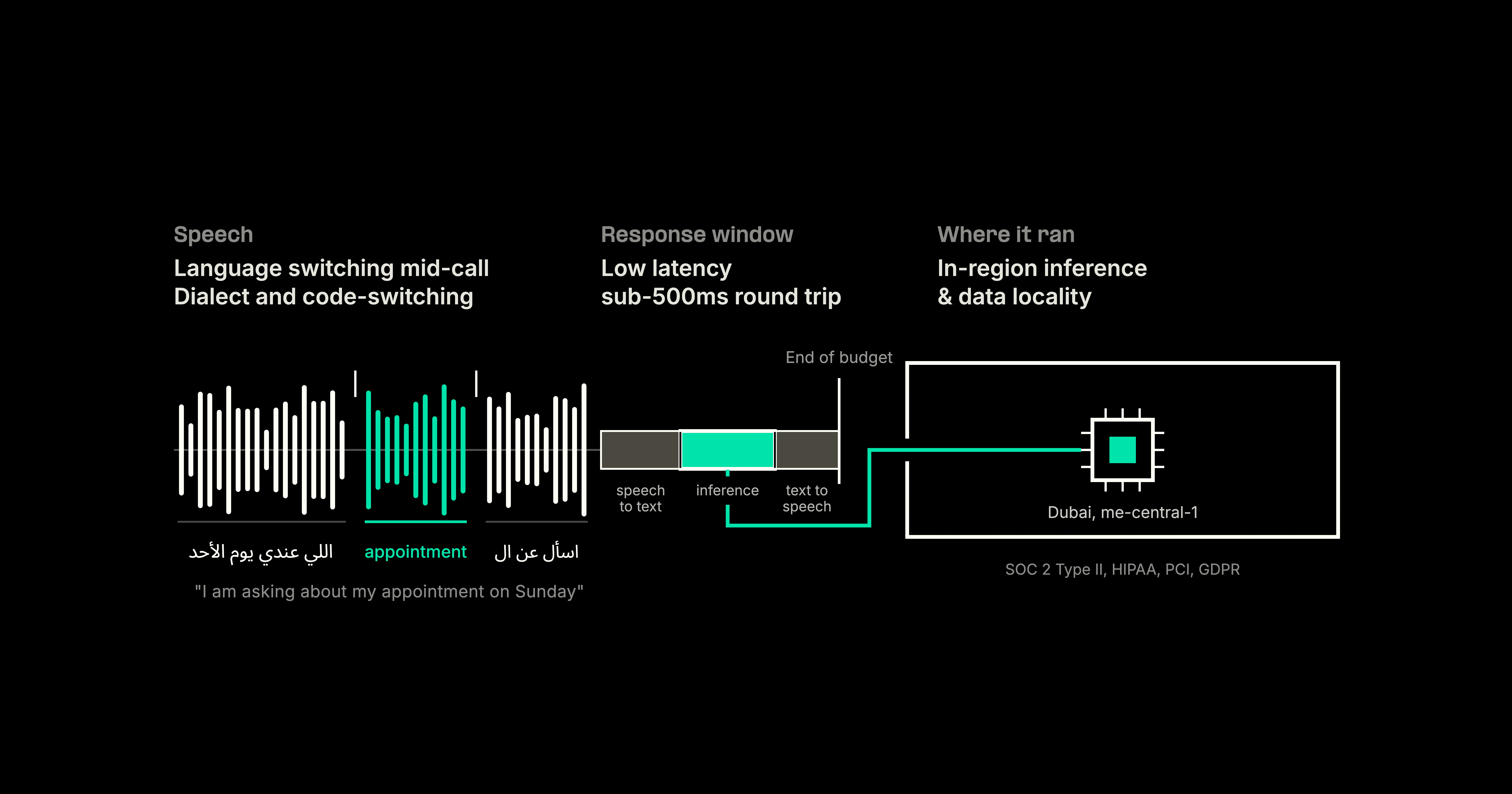
If you work in the Gulf, you already know the pattern. A caller switches from Arabic to English mid-sentence to name a medication, then back to Arabic for the rest of the explanation. All in the same breath. It happens on every call, every day, in every contact center from Dubai to Riyadh.
For most contact centers in the Gulf, the response is one of two things. The human agent does their best to keep up, and the transcript is incomplete. Or the voice bot gets lost at the first switch, and the call escalates to a transfer.
Neither outcome is good enough when the call is a parent describing symptoms, a worker reporting an injury, or a nurse disputing a transaction at 2am.
The Gulf is home to 31 million foreign nationals across six states, close to 55 percent of a population of nearly 60 million. The UAE hosts residents from more than 200 nationalities. Saudi Arabia's 2022 census counted 13.4 million foreign residents, 41.6 percent of the total. Business runs on Arabic and English, and for most interactions that works. But the calls where fluency degrades are the ones with the highest stakes. Under stress, people fall back to the language they think in.
A voice AI agent that can detect, switch, and respond across Arabic dialects, English, and South Asian languages is not a convenience in this environment. It is the difference between a call that resolves and a call that escalates.
Why the cost argument does not travel
Most voice AI content leads with cost per interaction: agents are expensive, AI is cheaper. That argument does its own work in North America and Western Europe. It does not here. Arabic and South Asian language capacity is already offshored at scale to Cairo, Amman, Casablanca, Manila, and Bengaluru, so labor is already inexpensive.
What a voice AI agent does that a distributed human workforce structurally cannot is serve any language at any hour, maintain consistent quality at 3am, and keep regulated data in the country.
What it takes to handle sensitive calls across languages
The caller should experience nothing. They speak, the agent responds in their language, no menu. Underneath there are five problems the agent has to solve in real time.
| Problem | What the agent does | What happens when it fails |
|---|---|---|
| Language detection on first utterance | Classifies language from 1–3 seconds of noisy, emotional audio. Confidence threshold with silent fallback to the dialed number's default. | Caller fights the system before stating the problem. Wrong language detected = call starts with friction on the most sensitive calls. |
| Dialect within Arabic | Handles Najdi, Khaleeji, Egyptian, Levantine, Maghrebi as distinct acoustic inputs, not interchangeable with MSA. | WER doubles on real dialect audio. For a parent describing symptoms, that doubling is the difference between correct triage and a wrong one. |
| Code-switching mid-sentence | Detects language continuously across the stream, not locked at call start. Handles Arabic grammar with English technical nouns in the same sentence. | Every code-switched utterance is mis-transcribed. "The transaction on my Visa" inside an Arabic sentence is lost. |
| Endpointing (VAD calibration) | Per-language voice activity detection. Knows when the caller has stopped speaking, tuned to language-specific pause patterns. | Aggressive tuning cuts people off mid-sentence. On a sensitive call, an interruption feels like being dismissed. |
| Barge-in (full duplex) | Streams both directions simultaneously with echo cancellation. Caller can interrupt and be heard in real time. | Half-duplex architectures miss interruptions. On an emergency call, the ability to correct is not a feature, it is the conversation. |
The latency budget, and why geography sits inside it
Sub-500ms round trip, covering speech to text, inference, and text to speech, is where a call feels like a conversation. Past that, callers start talking over the agent.
That budget is tighter than it sounds. Streaming ASR needs enough audio to emit a stable partial. Time to first token is what the caller perceives, so total generation time matters less than the first chunk. TTS has to render and stream its first frame.
Geographic distance is where most architectures overspend. A Dubai call routed to inference in Frankfurt or Northern Virginia pays that distance twice, in each direction, before a single frame is processed. Add continuous detection and mid-call switching on top, and the compute budget is whatever geography did not already consume. Where inference physically runs is a latency question first, and a compliance question second.
Why sensitive calls need data residency
A voice AI agent handling a healthcare triage or a financial dispute generates more regulated data than a human call.
One call produces the raw audio, the streaming transcript, the final transcript, extracted entities including names, national ID numbers, account numbers and medical details, vector embeddings, inference logs, and the analytics record. Seven artifacts, and they do not automatically live in the same place. A vendor can hold audio in-country while transcripts route to US logging and embeddings sit in Ireland. Each is a separate transfer under a separate legal basis.
| UAE | Saudi Arabia | |
|---|---|---|
| Primary law | Federal Law No. 2 of 2019 (health data) | PDPL, enforced by SDAIA |
| Regulators | NABIDH (Dubai), Malaffi & ADHICS (Abu Dhabi), MOHAP & Riayati (federal) | SDAIA |
| Key restriction | Health data cannot leave the country. Financial data subject to UAE Central Bank data localization rules | Personal data (including financial) transfer governed by SDAIA SCCs or BCRs (no adequacy list published) |
| Extraterritorial? | No | Yes: a BPO in Cairo or Manila handling Saudi calls falls in scope |
| Risk assessment | Required for health data processing | Required for continuous/large-scale sensitive data transfers (i.e., every contact center) |
| National interest test | No | Yes, transfers must not prejudice the Kingdom's national interests |
| GDPR overlap | Applies to EU expats' data alongside UAE law | Applies alongside PDPL for EU expats' data |
A contact center touches all of these simultaneously: every call, every day, carrying health details, national ID numbers, and financial data.
In-region inference is what makes residency real. If the GPU is inside the UAE, audio and derived data never leave to be processed. If it is not, residency covers storage only, and the processing step, the one that reads a patient's history word by word, happened somewhere else.
One stack, one agreement
In a multi-vendor setup, every artifact a call produces lives under a separate data processing agreement. Audio with the telephony provider, transcripts with the STT vendor, embeddings with the inference vendor, logs with the orchestrator. Each is a separate transfer under a separate legal basis, and each vendor boundary is a compliance gap.
Telnyx runs the full pipeline on one infrastructure. One DPA covers telephony, transcription, inference, and synthesis. One compliance boundary, one audit trail, one entity accountable. For a regulated contact center, that is the difference between managing five vendor relationships and managing one.
How agents and humans work together
Containment and routing. The voice AI agent contains tier one: balance checks, scheduling, order and claim status, delivery windows, policy details. Everything else gets triaged in the caller's own language, captured through function calls into the CRM or core system, and routed to a human with a translated summary attached, so the caller explains the problem once. Human agents move up into retention, complex claims, complaints, and sales.
The framing that lands with a GCC board: the AI agent extends the languages and hours you can serve without extending payroll into languages you cannot realistically recruit for, and it does it on the calls where getting the language right is a safety issue. Convenience is the wrong frame.
Ten questions for any voice AI vendor
- Which Arabic dialects can you demonstrate on our recordings, not your demo audio, and at what word error rate?
- How does the agent handle Arabic and English code-switching within a single sentence?
- Is language detection continuous, or single-shot at call start?
- Is endpointing calibrated per language?
- Is the media path full duplex, and how is barge-in handled?
- What is the round trip latency measured in-region, decomposed by stage?
- Where does inference physically run?
- Map every artifact a call produces and where each one lives at rest.
- Is our audio used to train your models, and can we opt out contractually?
- What is your per-minute cost at scale, and what is priced separately versus included in the platform rate?
Seven, eight, and ten are where most evaluations get vague answers. They are also the ones compliance will ask after you have signed.
Where Telnyx fits
Real-time AI requires three layers working together: edge compute to run inference close to the user, a voice AI platform to turn models into live conversations, and global communications to deliver interactions over the carrier network. Telnyx is the only company that owns all three. Most voice AI platforms were built for US-centric traffic and bolted on international support later. Telnyx started from a different premise.
| Typical voice AI platform | Telnyx | |
|---|---|---|
| Inference location | Virginia or Frankfurt | Dubai (me-central-1), Saudi cluster on roadmap |
| Latency to GCC | 400–600ms+ round trip (inference in US/EU) | Sub-500ms round trip (inference in Dubai) |
| Data processing agreements | Separate DPAs for transcription, inference, TTS | One DPA covering the full pipeline: one stack |
| Compliance frameworks | GDPR-focused, SDAIA often not addressed | SOC 2 Type II, HIPAA, PCI, GDPR + SDAIA-aware |
| Arabic voice coverage | 1–5 MSA voices typically | 59 Arabic voices: Gulf, Egyptian, Levantine, Palestinian, MSA across 8 TTS providers |
| Total voice library | Focused on English + top 5 languages | 1,300+ voices across 80+ languages and dialects |
| Custom voice cloning | Limited or unavailable | Available across languages for consistent brand voice |
| Saudi PDPL residency | Storage-only residency (processing happens abroad) | In-country roadmap so processing stays in-Kingdom |
The difference that matters for a Gulf contact center: in-region inference means audio and derived data never leave to be processed. No SCC negotiation, no transfer assessment, no cross-border logging. The data stays where the call originated.
A residency certificate covering storage does not cover the inference step that reads patient data word by word. That is the gap Telnyx closes.
Visit us at LEAP 2026 in Riyadh (31 Aug - 3 Sep), Hall 5, Booth H48. Come try the live voice agent demo and talk to our team about Voice AI for regulated industries. Explore Telnyx for UAE.
Share on Social
Habiba joined Telnyx's Dubai team as a product marketing manager in 2026. Originally from Cairo, she has a Bachelor's in Business Administration from Ain Shams University and is currently pursuing her MBA in Data Science and AI from the University of Liverpool. Before joining Tel


