
Voice
Voice Call API Basics Every Builder Should Know
A voice call API lets you programmatically make, receive, and control phone calls. Learn how voice call APIs work, what to look for, and compare top providers.
Takeaways
- A voice call API lets your application make, receive, and control phone calls over the internet using code instead of physical phone infrastructure.
- Call control commands like answer, transfer, record, and play audio are sent as API requests, and call events come back as webhooks or WebSocket messages.
- Voice APIs connect your software to the PSTN through carrier networks, so calls reach real phone numbers anywhere in the world.
- Developers use voice call APIs to build IVR systems, contact center platforms, voice AI agents, call tracking, and phone verification.
- Pricing is typically per minute, and quality depends on the provider's carrier network, codec support, and global points of presence.
What Is a Voice Call API
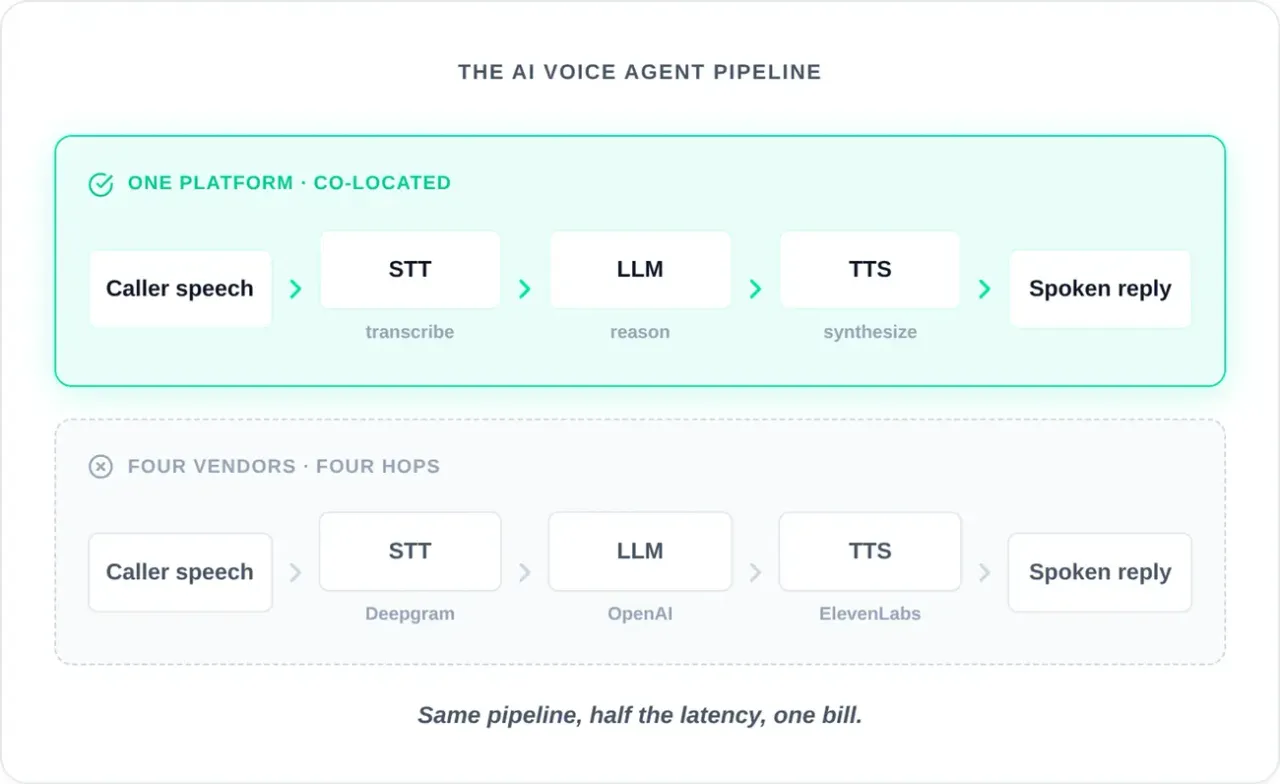
A voice call API is a programmatic interface that lets software applications make, receive, and control phone calls over PSTN and IP networks without dealing with telephony hardware. Developers send commands to originate calls, play audio, gather input, transfer, and hang up, all through API requests. For teams building AI voice agents, the challenge compounds fast. You stitch together telephony, speech-to-text, an LLM, and text-to-speech from separate vendors. Each boundary adds latency, a failure point, and another invoice. This guide covers how voice call APIs work, what separates a good one from a bad one, and how to evaluate providers for production workloads.
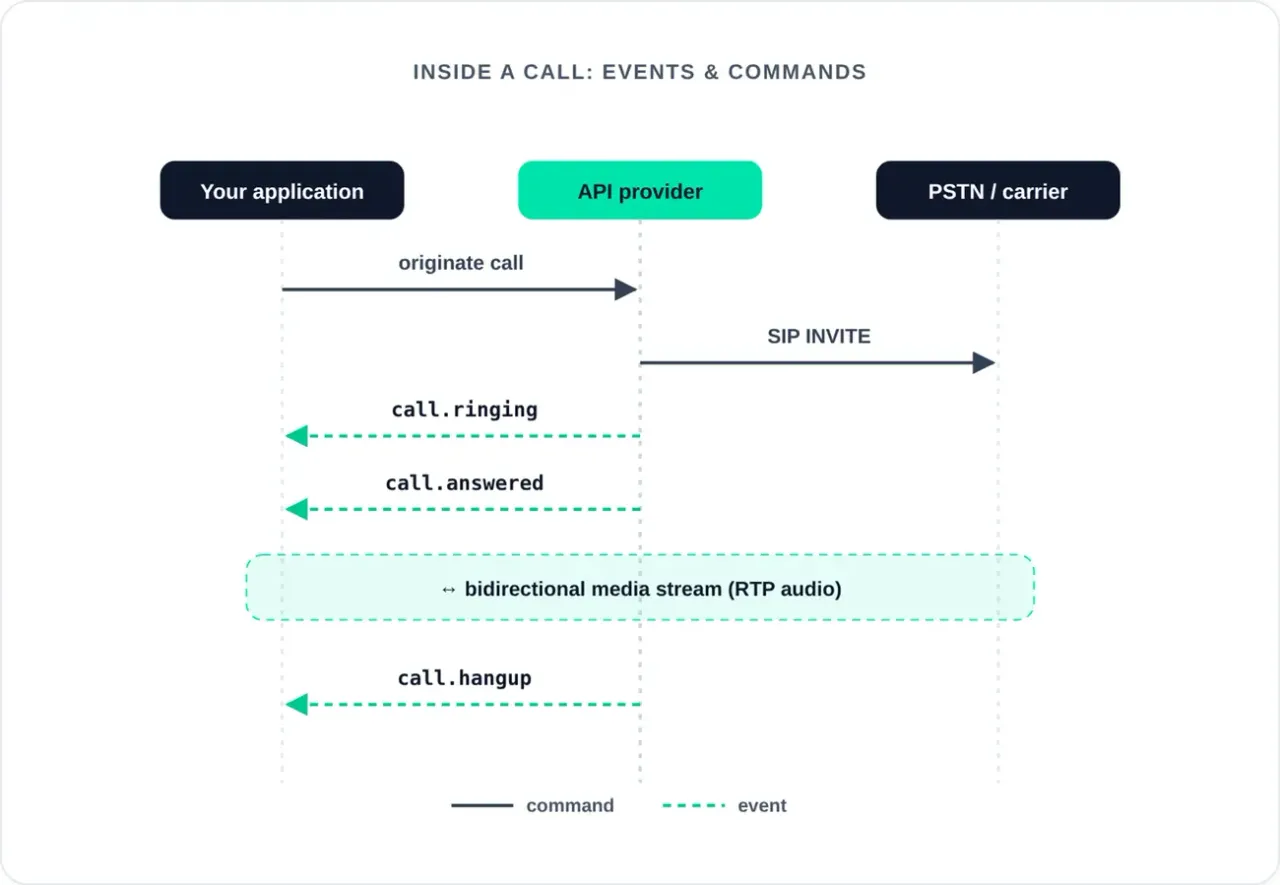
Most modern voice call APIs follow an event-driven architecture. When something happens on a call, the provider sends an event to your server: the call rang, the caller answered, digits were pressed, the call ended. Your application responds with commands: play this audio, gather input for five seconds, transfer to another number. This model replaces the older polling approach, where your code had to repeatedly ask the server for status updates. Events arrive in real time, and your application reacts immediately.
Two transport patterns dominate. HTTP callbacks (webhooks) send events as POST requests to your server and wait for a response with the next command. WebSockets maintain a persistent bidirectional connection, which removes the round-trip overhead of repeated HTTP handshakes. For real-time applications like conversational AI, WebSocket-based Voice API delivery is the practical choice because every millisecond of added latency degrades the caller experience.
Under the hood, these APIs speak SIP to the PSTN and negotiate media over RTP. A provider that owns its SIP Trunking infrastructure and carrier relationships can route calls directly rather than reselling capacity from another network. That distinction matters for latency, reliability, and cost. For a deeper look at the underlying telephony layer, see what VoIP is and how SIP trunking costs break down by pricing model.
Build voice into your app in minutesThe Telnyx Voice API runs on a private global network with direct carrier connections. Make and control calls with a few lines of code. Pay per minute with no contracts.
Start building for freeHow a Voice Call API Works
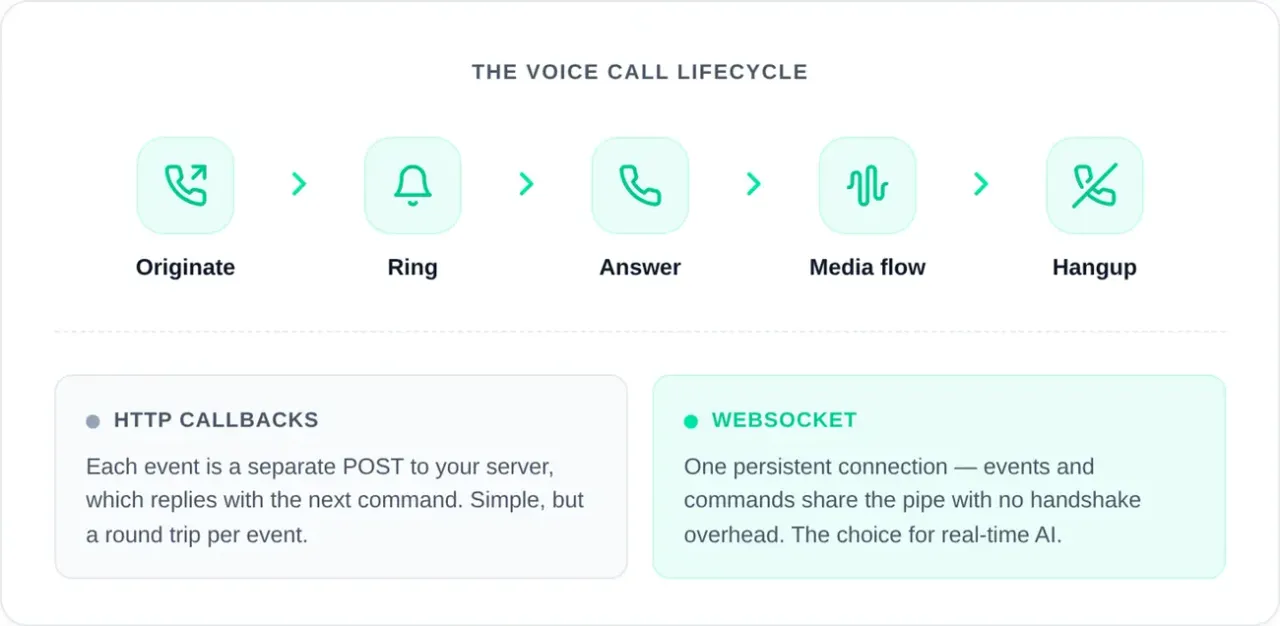
Every voice call follows a lifecycle. Understanding the stages helps you evaluate which API model fits your application.
Originate. Your application sends an API request to place an outbound call. The provider resolves the destination number, selects a carrier route, and sends a SIP INVITE toward the PSTN.
Ring. The destination phone rings. The provider sends your application a call.ringing event. You can play early media, such as a ringback tone, to the caller.
Answer. The called party picks up. The provider sends a call.answered event and opens a bidirectional media stream. Audio flows between the two endpoints.
Media flow. This is where the API earns its keep. During an active call, your application can issue commands in response to events. Play an audio file. Gather DTMF digits. Start speech recognition. Stream audio from a Speech-to-Text API pipeline. Send audio to a Text-to-Speech API engine and play the result back. Each command executes on the media stream in real time.
Hangup. Either party ends the call. The provider sends a call.hangup event with the cause and duration. Your application logs the call record and releases resources.
The central architectural question is how commands and events travel between your application and the provider. With HTTP callbacks, every event triggers a new HTTP request to your server, and your server responds with the next command. The latency of that round trip adds up, especially when you chain multiple commands: gather speech, send to an LLM, convert the response to audio, play it back. With WebSocket delivery, the connection stays open. Events and commands flow over the same pipe with no HTTP overhead. For AI voice agents where sub-500ms round-trip latency is the target, the transport choice is not optional. It is structural. For more on real-time transport alternatives, see WebRTC vs SIP.
Call control commands vary by provider but generally include dial, transfer, hangup, play audio, gather input (DTMF or speech), start recording, stop recording, and send digits. Some providers also support advanced operations like SIP refer, custom SIP headers, and media bypass for bringing your own RTP endpoint.
Here is how to place an outbound call with the Telnyx Python SDK.
Try it yourself with the call forwarding example from the Telnyx code examples repo.
What to Look for in a Voice Call API
Choosing a voice call API means evaluating the provider against the demands of your production workload. Generic feature checklists miss the point. Here is what matters when calls are live and customers are listening.
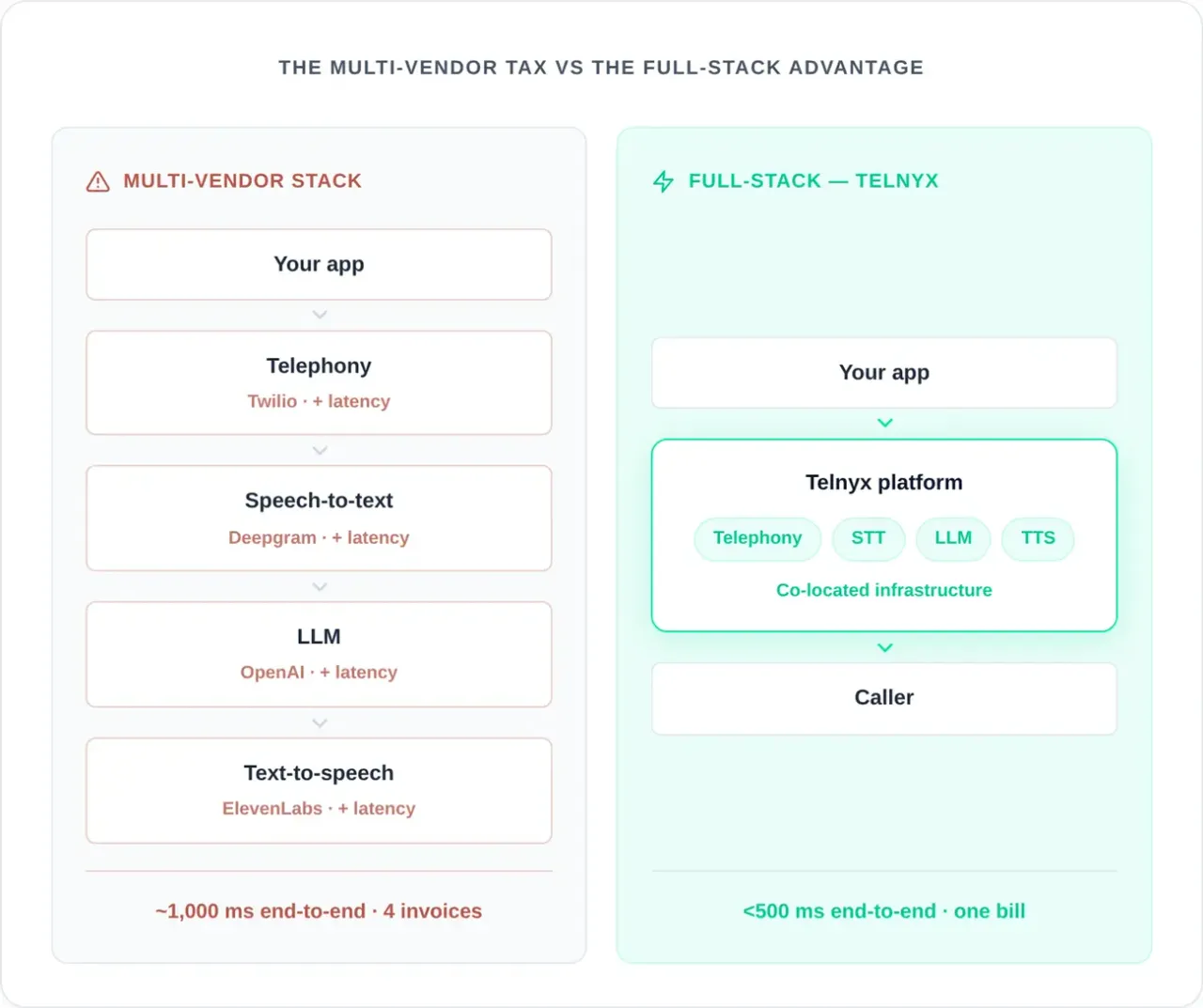
Latency. For conversational voice applications, latency is the difference between a natural exchange and an awkward pause. Ask where the provider's media servers sit relative to your callers and your AI inference. A provider that co-locates telephony PoPs with compute infrastructure can deliver sub-500ms end-to-end latency. A provider that routes audio across data centers and through third-party APIs cannot, no matter what the marketing page claims. Multi-vendor setups typically hit around 1,000ms because audio crosses network boundaries at each handoff.
Reliability. Look for a concrete uptime SLA backed by carrier-grade infrastructure. A 99.999% uptime SLA on carrier infrastructure means the provider owns the network and stands behind it. Providers that resell capacity from other carriers cannot guarantee the same because they do not control the underlying infrastructure. Ask whether the provider operates its own switches and SBCs or rents them.
Global coverage. If your callers are in one country, most providers work. If they are across continents, coverage matters. Check the number of countries where the provider offers local Phone Numbers, direct carrier connections, and in-region media servers. Numbers in 140+ countries with instant activation is a practical benchmark.
Developer experience. Read the documentation before you commit. Does the API follow consistent conventions? Are SDKs available in your language? Can you test calls in a sandbox before going live? Does the provider offer WebSocket support, or are you locked into HTTP callbacks? The difference between a well-documented event-driven API and a confusing one is measured in weeks of engineering time.
Pricing model. Per-minute pricing is standard, but the details vary. Do you pay for call legs separately? Are there minimums or commitments? Does the provider charge for SIP signaling separately from media? A provider that owns its network can offer usage-based pricing without markup layers. A reseller marks up each carrier hop, and you pay for that margin. For a breakdown of how SIP providers compare, check this guide.
AI integration readiness. If you are building AI voice agents, this criterion overrides almost everything else. Can the platform handle speech-to-text, LLM inference, and text-to-speech on the same infrastructure, or do you wire those together yourself? A provider with built-in Voice AI capabilities means audio enters the platform and never leaves until the response is ready. No cross-region hops. No stitching. No finger-pointing between vendors when latency spikes. For a production-ready launch, follow this AI voice agents checklist.
Infrastructure and Latency
| Provider | Voice network model | Media and AI deployment |
|---|---|---|
| Telnyx | Operates its own carrier-grade voice network | Media services co-located with telephony PoPs |
| Twilio | CPaaS platform using carrier partners and interconnects | AI services generally separate from carrier network |
| Vonage | CPaaS platform using carrier relationships and interconnects | Co-located voice/AI inference not a core feature |
AI Integration
| Provider | Native voice AI capabilities | Real-time AI integration |
|---|---|---|
| Telnyx | On-platform STT, TTS, and LLM workflows | Real-time AI within the platform, inference close to the voice network |
| Twilio | Speech recognition, TTS, Media Streams, Voice Intelligence | Real-time AI agents typically built by streaming audio to external providers |
| Vonage | TTS/ASR, AI tooling and integrations | Real-time AI workflows typically use external AI services |
Pricing and Support
| Provider | Pricing model | Support model |
|---|---|---|
| Telnyx | Usage-based. Published voice rates reflecting network-operator pricing | Self-service docs and support, with dedicated account support available |
| Twilio | Usage-based per-minute. Rates vary by destination, number type, and features | Self-service and ticket support, with paid plans for production and enterprise |
| Vonage | Usage-based per-minute. Rates vary by destination, number type, and features | Standard support options, with enhanced support on higher tiers |
Voice Call API Use Cases
AI voice agents
An AI agent answers inbound calls, transcribes speech, reasons with an LLM, and responds with synthesized speech. The voice call API handles telephony while the AI pipeline handles conversation. With a full-stack provider, the entire pipeline runs on co-located infrastructure. Route calls to AI.
IVR systems
Play menus, gather DTMF input, and route callers. Modern IVR replaces rigid menu trees with natural language understanding, where callers speak their request and the system routes accordingly.
Call routing and forwarding
Distribute inbound calls across teams based on time of day, caller location, or agent availability. Skills-based routing, round-robin, and simultaneous ring across endpoints.
Click-to-call
Embed a call button in your web or mobile app. The API originates a call to the agent and the customer, then bridges them without exposing phone numbers.
Conferencing
Bridge multiple participants with controls for muting, holding, and adding or removing participants. The API handles media mixing and participant management.
Call recording
Record calls for quality assurance, compliance, or training. Some providers offer dual-channel recording where each participant is captured on a separate track, which is better for downstream transcription and analysis.
Multi-channel communication
Pair voice with SMS API for follow-ups, reminders, or two-factor authentication. One provider for voice and messaging simplifies compliance and billing.
FAQ
Get Started
Start building with Telnyx Voice APIEvent-driven call control, WebSocket support, and global SIP and PSTN coverage. Need AI on the same infrastructure? Voice AI runs STT, LLM, and TTS on co-located infrastructure with sub-500ms latency.
Contact usShare on Social

Serhii Omelchenko
Global AEO/SEO Manager
Serhii is Global AEO/SEO Manager at Telnyx, based in Amsterdam, he is focused on making communications infrastructure findable and credible across both traditional search and AI-driven discovery. He previously led SEO and GEO strategy for some of the world’s most recognized consu


