
Voice
What is a VoIP phone number? A complete guide for 2026
If you are evaluating a VoIP phone number for a small business, a remote team, or an inbound voice application, this guide covers what a VoIP number actually is...

By Eli Mogul
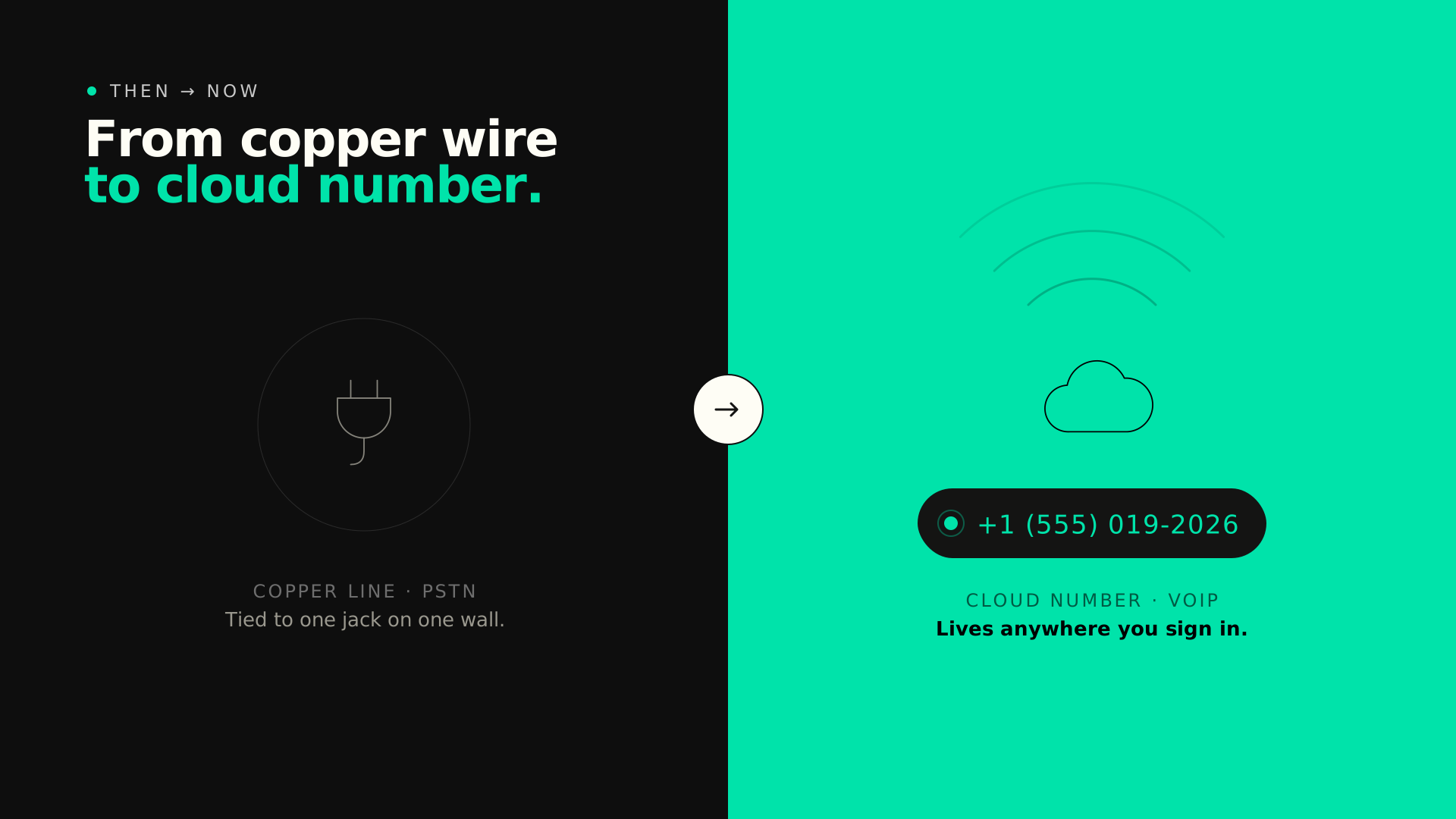
In February 2004, Pew Research surveyed 2,204 Americans about a technology that almost nobody used at home. Of every respondent in that sample, exactly one said Voice over Internet Protocol (VoIP) was the phone service in their household. Just 27% of internet users had even heard of the term, and 11% had ever placed a call over the internet. VoIP was a curiosity for early adopters with broadband connections and a tolerance for choppy audio.
Two decades later, the picture has inverted. According to the FCC's most recent Voice Telephone Services Report, released in May 2026 with data current as of June 30, 2025, VoIP is now the dominant form of wireline voice service in the United States. The novelty became the default.
If you are evaluating a VoIP phone number for a small business, a remote team, or an inbound voice application, this guide covers what a VoIP number actually is, how it works, the types available, how it compares to a landline, how to get one, and the fraud and trust questions that matter most in 2026.
What is a VoIP phone number?
A VoIP phone number is a real telephone number that places and receives calls over the internet instead of over traditional copper or analog circuits. To the people you call, it looks and behaves like any other phone number. Behind the scenes, your voice is converted into digital packets, routed over IP networks, and converted back into audio at the other end.
The technical foundation is the Session Initiation Protocol (SIP), defined by the IETF in RFC 3261. SIP is the signaling protocol that sets up, modifies, and ends a call. It locates the other party, negotiates how the media will be exchanged, and tears the session down when you hang up. Most modern voice services, including carrier-grade phone numbers and Voice API platforms, run on SIP.
The FCC draws an important distinction here. An "interconnected" VoIP service is one that lets you call and receive calls from the regular telephone network, also called the public switched telephone network (PSTN). That interconnection is what makes a VoIP number a full participant in the phone system rather than an app that only reaches other users of the same app.
How does a VoIP phone number work?
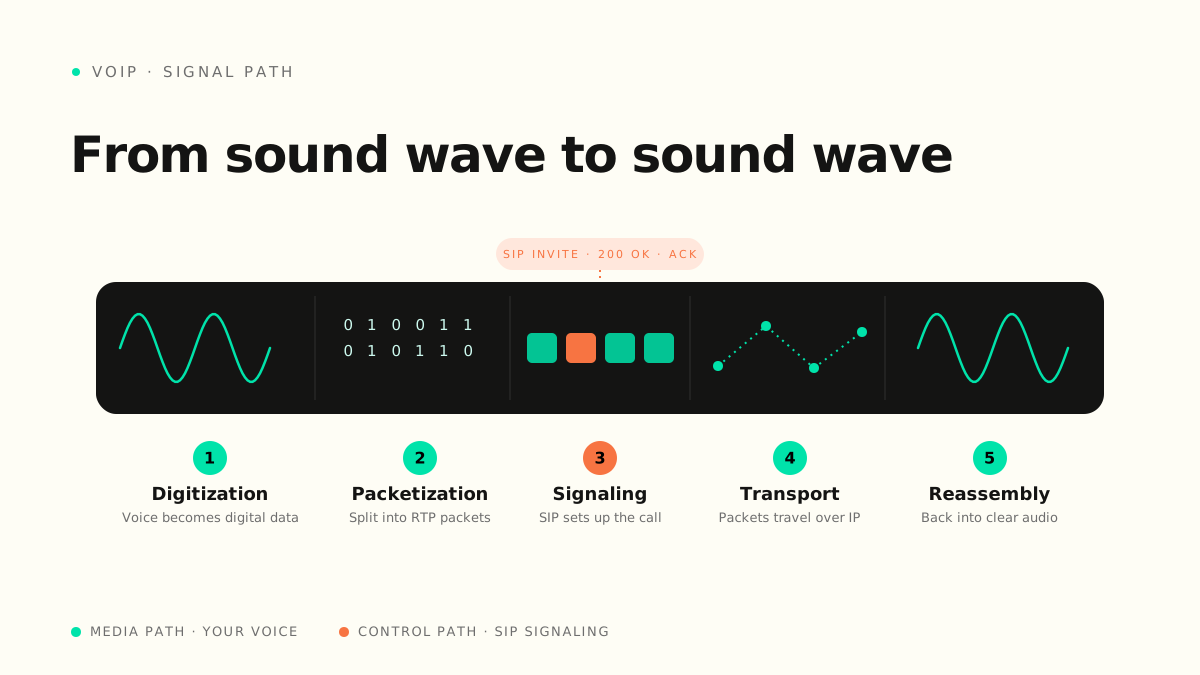
A VoIP call moves through a few clear stages:
- Digitization. Your device or adapter converts the analog voice signal into digital data.
- Packetization. That data is broken into small packets and labeled for delivery.
- Signaling. SIP establishes the session between the two endpoints, handling who is calling whom and on what terms.
- Transport. The packets travel across IP networks to their destination.
- Reassembly. At the receiving end, the packets are reassembled and converted back into audio.
When you call a number on the PSTN, the call hands off from the IP network to the traditional telephone network so it can reach a landline or mobile phone. The quality of that handoff, and the physical path the data takes to get there, has a direct effect on latency and call clarity. This is why network ownership matters, addressed below.
Types of VoIP phone numbers
Not all VoIP numbers behave the same way. The main categories you will encounter are:
| Type | What it is | Tied to a location? | Best for |
|---|---|---|---|
| Fixed VoIP | A number associated with a physical address, typically through a registered provider | Yes | Businesses needing reliable E911 and caller ID trust |
| Non-fixed VoIP | A number not bound to a physical address, often provisioned online | No | Flexible or distributed teams, virtual presence |
| Toll-free VoIP | An 800-style number reachable at no cost to the caller | No | Customer service and brand-facing lines |
| Local VoIP | A number in a specific area code, regardless of where the user sits | Loosely | Establishing local presence in target markets |
The fixed versus non-fixed split has real consequences for E911 requirements and for how downstream networks treat your caller ID. Fixed numbers from a registered carrier generally carry stronger trust signals, which matters more every year as fraud filtering tightens.
VoIP phone number vs. landline: what changed
A traditional landline relies on a dedicated switched circuit between you and the local telephone company's switch. That circuit is the basis of plain old telephone service, and for a century it was how most people made calls. A VoIP number replaces that dedicated circuit with shared IP infrastructure, which is why it can offer features and pricing that a fixed circuit cannot match.
The FCC's June 2025 data shows how decisively the market has moved. Of the 26 million wireline residential voice connections in the United States, 58.4% were non-incumbent (non-ILEC) interconnected VoIP subscriptions and another 16.8% were incumbent (ILEC) interconnected VoIP, meaning roughly three out of four residential wireline connections now run on VoIP rather than traditional switched access lines.
The business side has shifted even further. The same report shows that 81.5% of wireline business voice connections are non-ILEC interconnected VoIP, with another 2.2% delivered as ILEC interconnected VoIP. Combined, that is about 84% of wireline business voice connections running over VoIP. The technology that one household in approximately two thousand used in 2004 is now the standard way American businesses connect calls.
A few practical differences are worth keeping in mind:
- Portability. Under the FCC's local number portability rules, you can keep your number when you switch providers, including porting between wireline, wireless, and VoIP, as long as you stay in the same geographic area. Telnyx supports number porting so you can bring existing numbers with you.
- Power and connectivity. A VoIP number depends on internet access and power. Unlike a legacy landline, it will not work during an outage unless you have a backup.
- 911 handling1. Interconnected VoIP providers carry 911 obligations, but VoIP 911 works differently from traditional 911, especially for non-fixed numbers where location is harder to determine automatically.
1. Interconnected VoIP providers are required by FCC rule (47 CFR § 9.10) to provide E911 service and to ensure the registered location is current. Non-fixed VoIP numbers may not automatically transmit location information to 911 dispatchers. Users must register and keep updated their E911 address with their provider. Failure to maintain accurate E911 registration can result in emergency calls being routed to the wrong PSAP or without location data.
How to get a VoIP phone number
Getting a VoIP number is straightforward, but the provider you choose determines what that number is actually worth. The basic steps are:
- Choose a provider. Decide whether you need a single line, a team solution, or programmable numbers for an application.
- Select your number type. Local, toll-free, fixed, or non-fixed, based on the use case in the table above.
- Provision the number. With a developer-focused platform, you can search for and provision numbers through a portal or an API in minutes.
- Configure routing and features. Set up call forwarding, voicemail, SIP trunks, or AI-powered call handling.
- Verify compliance. Confirm E911 registration and caller ID authentication are in place before you go live.
The difference between providers shows up most clearly in that last step, and it is the difference between a number that connects and a number that gets trusted.
The trust problem: VoIP fraud and caller ID
Because VoIP runs on internet infrastructure, it inherits the internet's risks. The Cybersecurity and Infrastructure Security Agency (CISA) explains in its official VoIP guidance that an attacker can inject a false caller ID into a VoIP call so the recipient believes it comes from a trusted source, such as a bank. The recipient, fooled by the displayed identity, may then hand over account numbers or other sensitive information. This is the VoIP version of phishing, often called vishing.
The industry's answer is STIR/SHAKEN, a caller ID authentication framework that lets the originating provider cryptographically attest to its relationship with a number and lets the terminating provider verify that the caller ID was not altered in transit. The framework's technical standards and governance are maintained by the Alliance for Telecommunications Industry Solutions through its Secure Telephone Identity Governance Authority, building on the IETF's underlying STIR protocols.
STIR/SHAKEN assigns each call one of three attestation levels. A-level (full) attestation means the originating provider knows the customer and has confirmed the customer's right to use that number. B-level is partial, and C-level is gateway attestation where the originator cannot vouch for the number. Calls signed at A-level are far more likely to reach the recipient with a clean caller ID, while lower levels are more likely to be flagged or screened.
Here is the detail that separates real carriers from resellers. The FCC's rules, published in the Federal Register, require every provider with a STIR/SHAKEN obligation to make its own attestation-level decisions and to sign calls with its own certificate, not a third party's. A number resold from an upstream carrier cannot inherit that carrier's trust standing. The entity that owns the network and the certificate is the entity that can attest. The same emphasis on owned, controlled infrastructure runs through good security design more broadly, as captured in NIST's foundational Security Considerations for Voice Over IP Systems.
This is also why the regulatory ground is shifting. California now formally treats VoIP providers as telephone corporations. Under CPUC Decision 24-11-003, interconnected VoIP providers operating in the state must report gross intrastate revenue monthly and remit user fees, with those obligations effective July 1, 2025. VoIP is no longer treated as a regulatory afterthought. It is treated as telecom, because that is what it has become.
The regulatory direction matters because the wrong rules can do more harm than good. As Telnyx CEO David Casem has argued, "Unilateral, aggressive policy against VoIP doesn't stop fraud. It just dismantles the primary telecom AI onramp for the next generation of builders." The point is that trust should be built into the network, not bolted on after the fact or regulated away.
Why the underlying network matters
Two VoIP numbers can look identical and behave very differently. The reason usually comes down to who owns the infrastructure underneath them.
Most consumer-facing VoIP brands and free VoIP apps resell numbers provisioned on someone else's network. That arrangement adds hops between the caller and the destination, and every additional hop is more distance for data to travel and more latency to accumulate. It also means the brand you buy from is not the entity attesting to your caller ID, which weakens reputation and fraud-prevention outcomes.
A licensed carrier operates differently. A VoIP number provisioned on owned infrastructure is a real number with carrier-grade STIR/SHAKEN attestation, direct control over routing, and a shorter physical path between endpoints. For ordinary business calls, that translates into better caller ID reputation and fewer calls flagged as spam. For real-time voice AI, where every added millisecond of latency degrades how natural an agent sounds, owning the network is the difference between an experience that feels human and one that does not.
This is the foundation Telnyx is built on. By operating its own global network and colocating infrastructure close to its points of presence, Telnyx provisions numbers on a network that supports carrier-grade A-level attestation where the customer's right to use the number has been verified. The number is not resold from an upstream carrier. It is native to the network.
Choosing a VoIP phone number that connects and converts
A VoIP phone number in 2026 is not a discount alternative to a landline. It is the mainstream way American homes and businesses make calls, and it is the entry point for a new generation of AI-powered voice applications. The questions worth asking are not just about price and features. They are about whether the provider owns the network, whether your number carries genuine A-level attestation, and whether the infrastructure is close enough to deliver the low latency that real-time voice demands.
Telnyx is a licensed carrier in more than 30 markets with PSTN reach in over 100 countries, provisioning numbers on its own private global network with carrier-grade authentication built in. Whether you need a single business line or programmable numbers for an inbound voice AI application, you can search, provision, and configure numbers on the same platform you use to build everything else.
Ready to get started? Explore Telnyx phone numbers and provision a VoIP number on an owned, carrier-grade network in minutes.
* This article is for informational purposes only and does not constitute legal, regulatory, or compliance advice. Consult qualified counsel for guidance specific to your business and jurisdiction.
Share on Social