
Published 24 Nov 2026
Seven hacks, six companies, one pattern: attackers went after the services holding your prompts and API keys. Here's what happened and what to check.
 By Eli MogulContent Writer & Editor
Takeaways
- Attackers go after the middleman now, because a proxy that stores upstream keys hands over all of them at once.
- Removing a key from a vendor's dashboard doesn't kill it. Revoke it with whoever issued it.
- A Zero Data Retention label covers what a provider stores, not who else can see your request on the way through.
- A breach doesn't have to steal anything to hurt you. One attacker quietly changed which model answered requests.
If you call AI models through a router, a proxy, or a hosted inference provider, a third party sits in the middle of every request. It sees your prompts and often holds your upstream provider keys. In 2026, attackers noticed. Wiz counted at least nine AI developer platforms that disclosed incidents in October alone, though most weren't inference providers.
On November 22, OpenRouter removed three providers it hasn't named and pulled 125 endpoints from Zero Data Retention (ZDR) eligibility. It says its own systems weren't breached.
That move followed research from Dragos, which sent about 2 million canary prompts (prompts seeded with trackable fake secrets) from July through November. It found exposed data at three or more providers. None knew until Dragos told them, and the earliest, breached in mid-July, still hadn't disclosed it. One attacker hit two providers at once from a single rented server. The largest breach took a couple hundred planted AWS keys, some from requests the provider rejected before a model ran. Dragos names none of them, so we don't either.
Separately, MiniMax said on November 24 that its own security system had opened links in forwarded prompts, including ZDR requests, and has turned that off. That wasn't a hack.
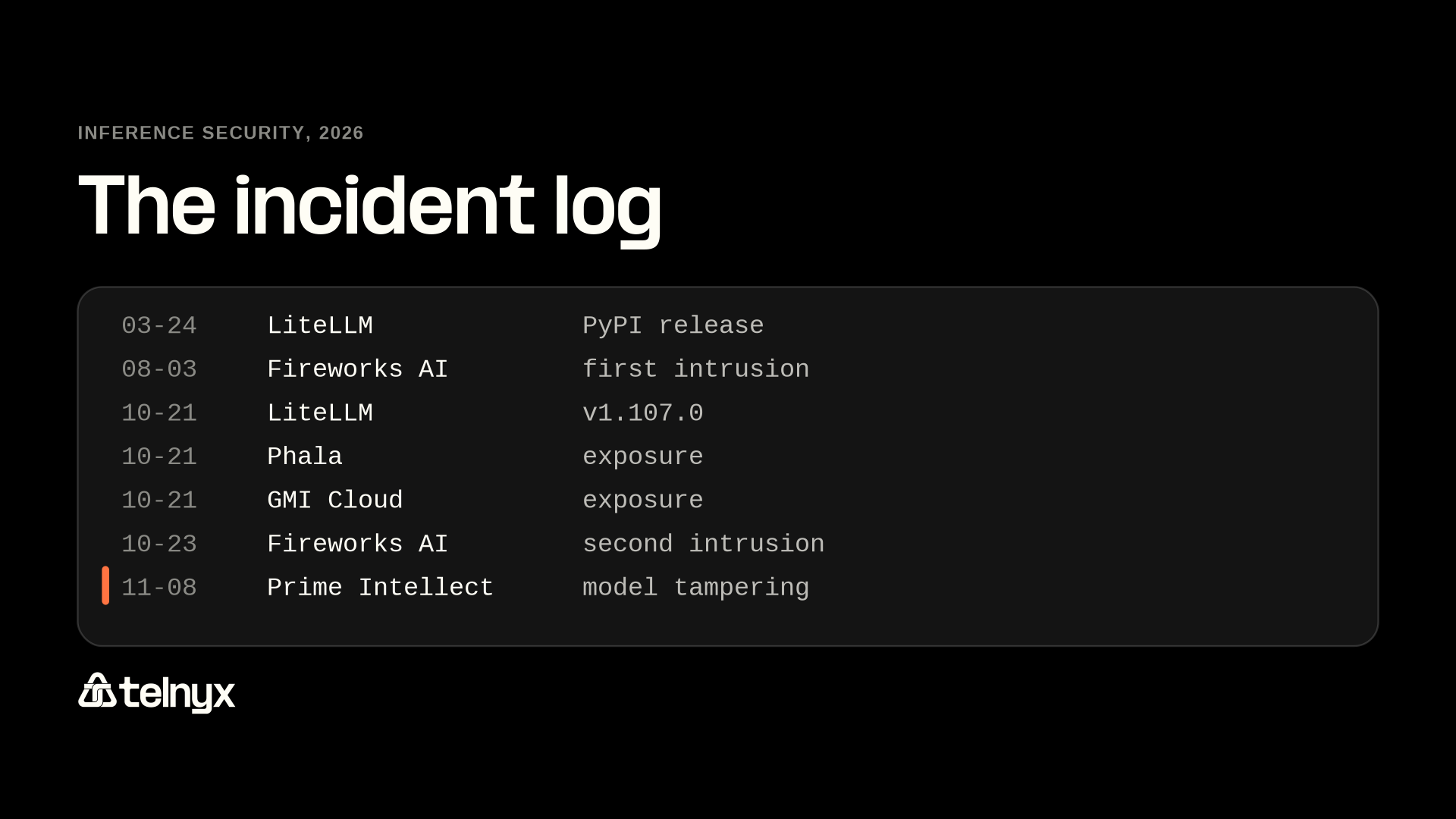
This page covers companies that handle your prompts or hold your provider keys, listed by date.
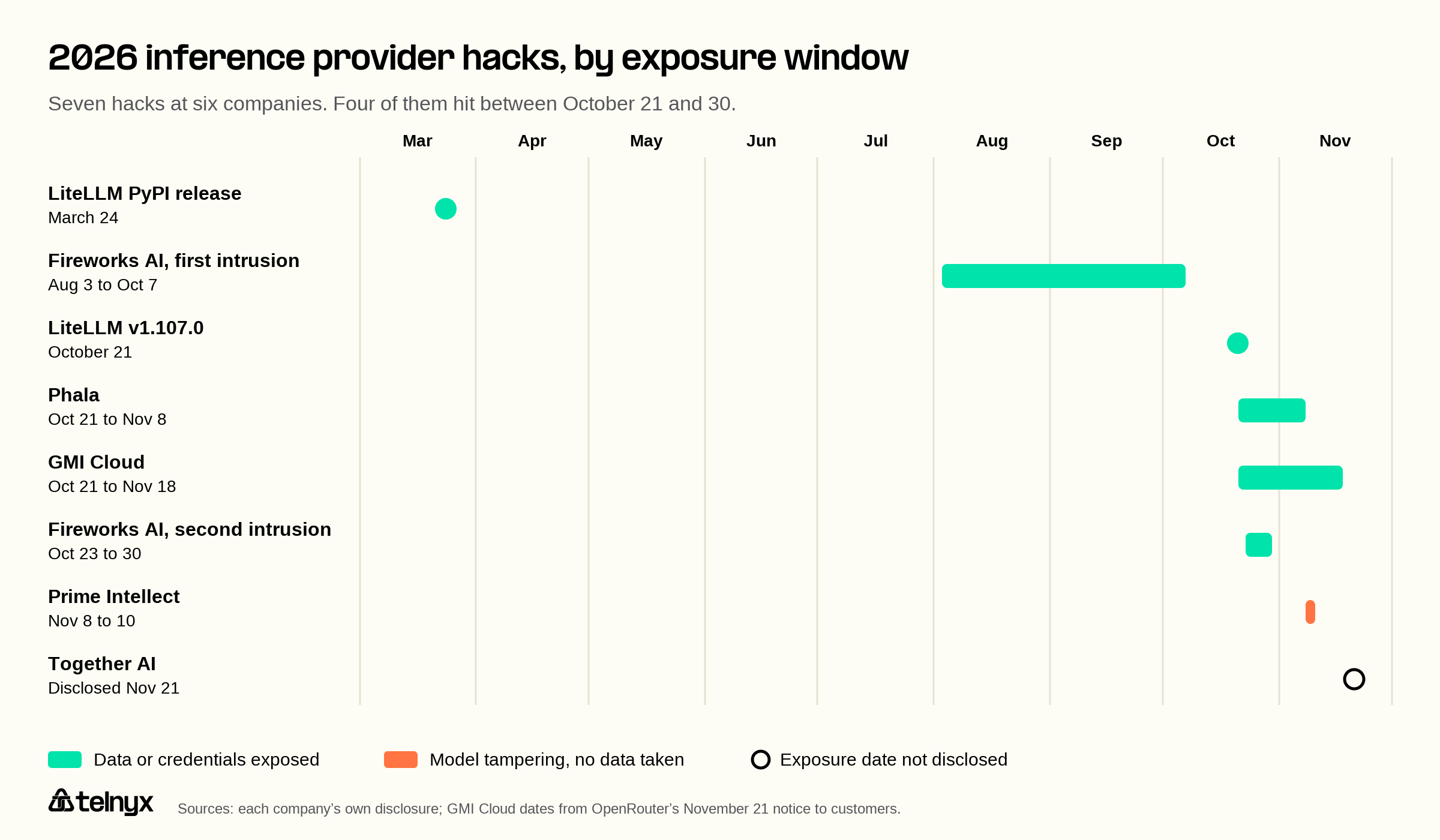
2026 inference provider hacks, by exposure window
| Incident | Exposure window | What was exposed |
|---|---|---|
| LiteLLM PyPI release | March 24 | SSH keys, cloud tokens, Kubernetes secrets, .env files |
| Fireworks AI, first intrusion | August 3 to October 7 | Secrets, model files, and datasets for a few customers |
| LiteLLM v1.107.0 | October 21 | Host credentials, including stored provider keys |
| Phala | October 21 to November 8 | Request content and application credentials |
| GMI Cloud | October 21 to November 18 | About three days of stored request content |
| Fireworks AI, second intrusion | October 23 to 30 | Billing info for accounts created before October 30, plus some customer data |
| Prime Intellect | November 8 to 10 | No data taken; a tampered model answered requests |
| Together AI | Not disclosed | Prompt samples from June and July requests |
LiteLLM hack March 2026
LiteLLM is an open-source proxy that gives you one API for dozens of model providers, so it tends to live on machines full of credentials. On March 24, malicious versions 1.82.7 and 1.82.8 went out on PyPI.
The attackers first compromised Trivy, a vulnerability scanner in LiteLLM's CI pipeline, and used it to get LiteLLM's PyPI publishing credentials. Researchers attribute the campaign to a group called TeamPCP.
The payload collected SSH keys, cloud tokens, Kubernetes secrets, and .env files. Version 1.82.8 added a .pth file, which Python runs at startup, so it fired even if your code never imported LiteLLM. PyPI quarantined the package the same day. LiteLLM says its Docker proxy image wasn't affected.
What affected users were told to do: Treat any machine that installed either version as compromised, and rotate every credential in its environment variables or config files.
Fireworks AI hack October 2026
Fireworks AI hosts open models for inference and fine-tuning, and customers can store secrets there, like the API keys their jobs need. Fireworks widened its disclosure across three updates. Its November 17 update, used here, confirms two separate incidents.
First intrusion: August to October
From August 3 to October 7, an unauthorized party used stolen Fireworks credentials and a vulnerability in one Fireworks service. For a small number of customers, the attacker accessed secrets, model files, and datasets. Fireworks identified the activity on October 6.
Second intrusion: October 23 to 30
This one came in sideways. A third-party cloud provider hosting Fireworks development machines had its own incident, and the attacker used that access to reach part of Fireworks' production systems. Billing information for every account created before October 30 was exposed, though Fireworks says it doesn't store card numbers. A few customers also lost datasets, model files, or secrets.
Notion's own notice says the breach exposed Notion AI chat transcripts for fewer than 1% of its workspaces. They had gone to Fireworks for Insights, Notion's admin analytics feature. Notion has turned off Insights and disconnected from Fireworks.
What Fireworks told customers: Deleting a secret from Fireworks doesn't invalidate it. Rotate or revoke it with the provider that issued it.
LiteLLM hack October 2026
Seven months later, LiteLLM was hit again, through the front door. On October 21, its own release pipeline built, signed, and published a malicious v1.107.0 to PyPI, Docker Hub, and GHCR.
It started on May 27, when an admin key for LiteLLM's internal Agent Platform was committed to a public GitHub repo. The file was deleted about three hours later, but the commit stayed in history and the key was never revoked. From there, per LiteLLM's attack-chain post:
- On October 10, the attacker used the key to get a GitHub organization owner's OAuth token.
- They ran throwaway CI workflows that sent repository secrets, including maintainers' tokens, to an outside endpoint.
- On October 21, they pointed the release workflow at a lookalike fork,
Berri-AI/litellm, and approved the release with a stolen maintainer token.
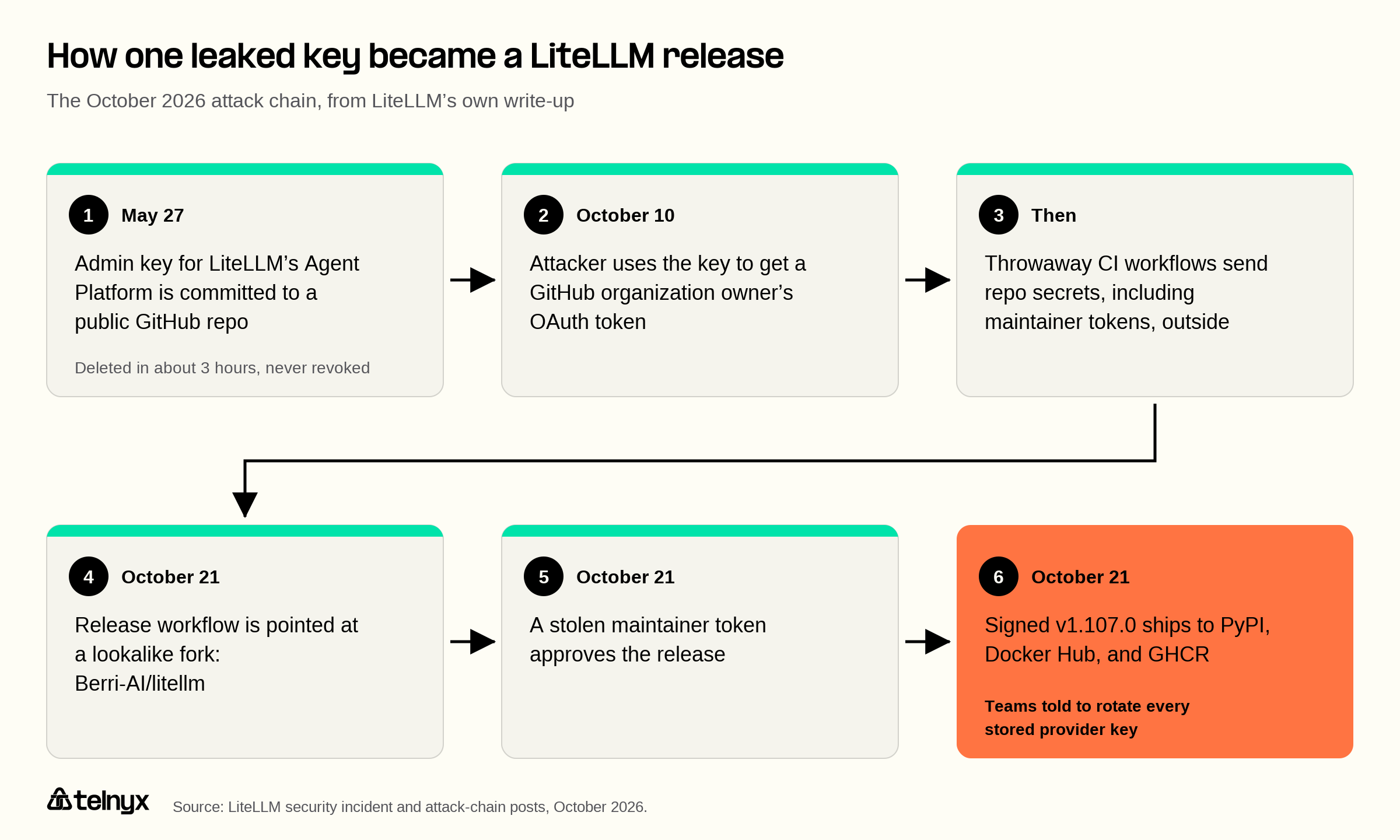
LiteLLM says the attacker mainly wanted upstream inference API tokens. That's this whole page in one incident: a proxy holds every provider key a team uses, so one compromise reaches all of them. LiteLLM's incident post says to rotate every provider key in the proxy database, plus master keys, virtual keys, the database password, and the host's IAM role.
Cleanup order matters. Don't start with pip install, because any Python process reruns the malicious files. Delete cook.pth, cook.py, sitecustomize.py, and their .pyc files first, stop the process holding /tmp/remote_code_loader.lock, then reinstall litellm==1.106.2.
Phala hack October 2026
From October 21 to November 8, an attacker controlled the Phala server that ran DeepSeek V4 Flash 0731 for requests routed from OpenRouter. Request content on that server was exposed, and application credentials were stolen.
Phala's preliminary report says the way in was a legacy internet-facing service chained to management interfaces. Phala detected it on November 5 and contained it on November 8.
GMI Cloud hack October 2026
GMI Cloud hasn't made a public statement, so every detail here comes from OpenRouter's November 21 notice to customers. According to the notice, an attacker got into a GMI internal system on October 21 and 22, then again from October 27, using two stolen credentials. GMI revoked them on November 18.
That system kept about three days of request content for troubleshooting, and the attacker searched it for credentials. Three days sounds short, but it was enough. OpenRouter turned off every GMI Cloud endpoint.
What OpenRouter told customers: If you sent requests to GMI Cloud between October 18 and November 18, rotate any secret you put in a prompt.
Prime Intellect hack November 2026
This one was tampering and not data theft. From November 8 at 01:24 UTC to November 10 at 06:35 UTC, an unauthorized party swapped the model behind Prime Intellect's deepseek/deepseek-v4.1-flash endpoint for an "abliterated" copy, one modified to remove most refusals.
Requests kept getting answers, so nothing looked broken. Prime Intellect's advisory says no keys or customer credentials were affected, and it found no evidence that prompts left the cluster. It hasn't said how the attacker got in.
What Prime Intellect told customers: If your app relied on the model's refusals, review its outputs from that window.
Together AI hack November 2026
Together AI hasn't said when this download happened, so this section is dated to its November 21 disclosure. An AI coding agent committed a credential to a public GitHub repo. That credential opened a private Hugging Face repository of stored prompt samples, and someone downloaded them.
The samples came from June and July requests to MiniMax M3, GLM-5.2, and Kimi K2.6. It's the same mistake as LiteLLM's May commit, except an agent made it.
How to check your exposure
Every step below comes from the disclosures above.
- Rotate at the source. Revoke keys with the provider that issued them, not just the platform that stored them.
- Read ZDR as a policy, not a guarantee. Dragos and MiniMax both found ZDR-marked requests handled in ways the label didn't cover.
- Find out where your traffic really goes. Dragos traced about 2,000 routes, and several hundred passed through a system it couldn't identify. Ask your router which providers served your requests.
- Keep secrets out of prompts. Every incident here exposed whatever was in the request. Gateway tools like AI Gateway guardrails can flag sensitive data before it reaches a model.
- Scope every key. Per-app keys, like the scoped token keys in Telnyx AI Gateway, can be revoked one at a time instead of all at once.
- Check outputs and packages. If your app depends on refusals, check responses yourself. Search lockfiles and images for litellm 1.82.7, 1.82.8, or 1.107.0.
AI inference provider breach FAQ
Does Zero Data Retention protect my prompts from a breach? Not by itself. ZDR limits what a provider keeps, but an attacker inside the request path can still read traffic live. Check each provider's data residency docs for what gets stored and where.
Which providers did OpenRouter remove? OpenRouter hasn't named them, and neither has Dragos. We'll add them if the companies confirm.
Can I control where my inference requests are processed? On some platforms, yes. Telnyx Inference lets you pin a request to one region (USA, EU, AUS, or UAE) using strict mode.
Fewer hops, fewer places for a prompt to leak. Telnyx Inference runs open-source models on Telnyx-owned GPUs through an OpenAI-compatible API. Get started or see pricing.
By Eli MogulContent Writer & Editor