
Conversational AI
What is an AI API? The unified surface for building with multiple models
This article explains what an AI API is, why the unified-gateway pattern won, what the economics look like...

By Eli Mogul
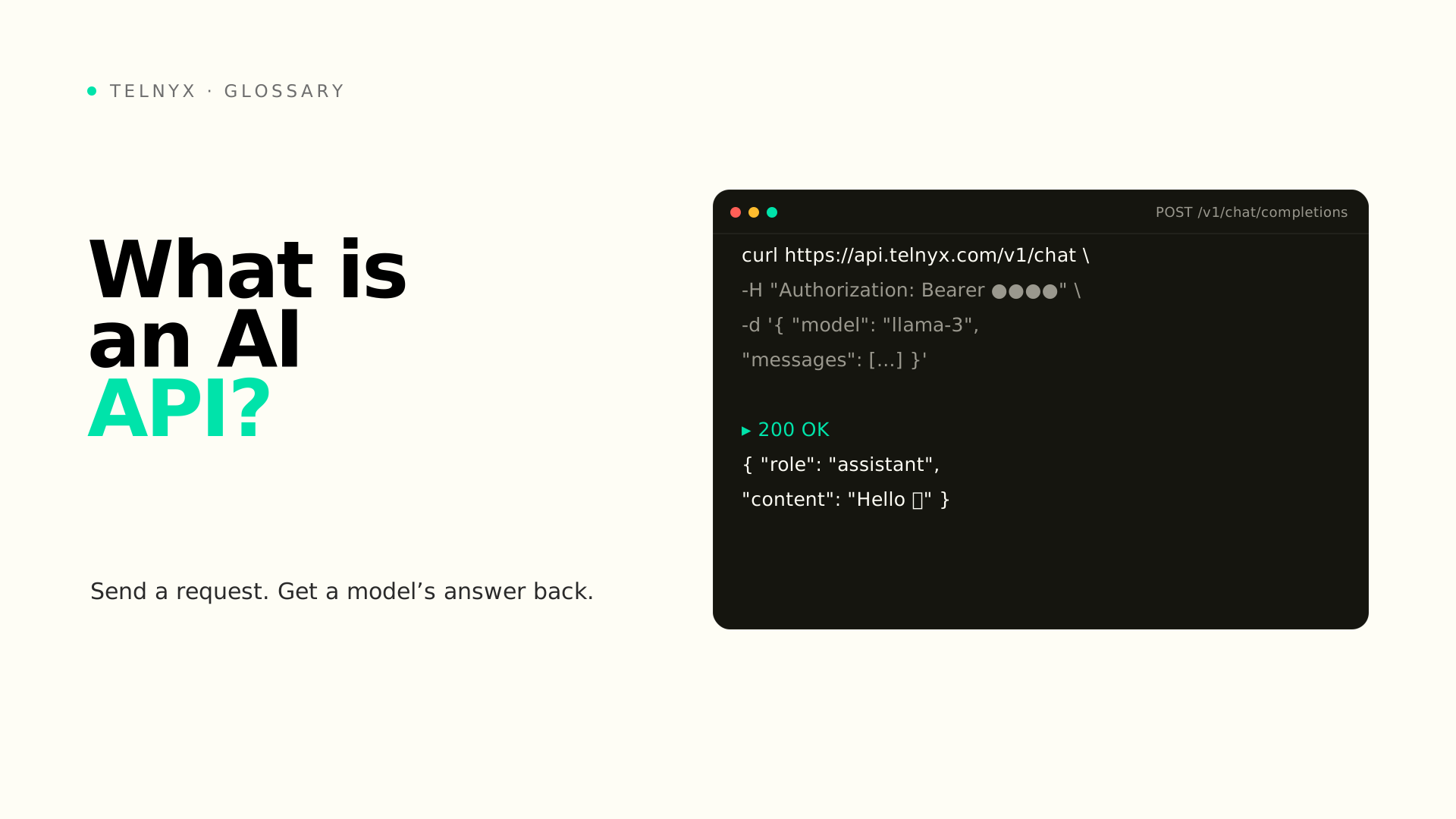
An AI API is the programmable interface a developer calls to send a request to an artificial intelligence model and receive a response. In practice, that response can be generated text, a transcription, a synthesized voice, a vector embedding, or the next turn in a live conversation. The model does the work; the API is how your software reaches it.
What changed recently is not the definition but the architecture. The category has shifted from "pick one model provider and integrate against its endpoint" to "front many models behind one consistent API surface." The most authoritative examples of this pattern are not vendor marketing. They are the AI gateways now run by major universities and the US federal government, which have settled on a single specification so that teams can swap models without rewriting their code.
This article explains what an AI API is, why the unified-gateway pattern won, what the economics look like as costs continue to collapse, and where a carrier-grade AI API like Telnyx Inference fits when latency and voice are part of the requirement.
Why AI APIs became the default integration layer
AI is no longer an experimental side project bolted onto a product. It is the integration layer that production software is built on. Stanford HAI's 2026 AI Index Report found that in 2025, 58% of employees globally reported using AI at work on a semiregular or regular basis, with the share exceeding 80% in India, China, Nigeria, the United Arab Emirates, Egypt, and Saudi Arabia. US data shows the same trajectory: Gallup's Q4 2025 workforce survey found daily AI use among US employees rising to 12% and frequent use to 26%, continuing a steady climb since 2023. When a technology reaches that level of daily use, the API becomes the surface where most of that interaction actually happens, because that is how AI gets embedded into the tools people already use.
The same report captured a tension that shapes how enterprises buy. Stanford HAI documented that the global share of respondents who say AI products offer more benefits than drawbacks rose from 55% in 2024 to 59% in 2025, even as the share saying these products make them nervous rose to 52%. That combination of rising optimism and rising anxiety pushes organizations toward gateway-style AI APIs, where access, auditing, and policy controls live in one place rather than scattered across a dozen direct vendor integrations.
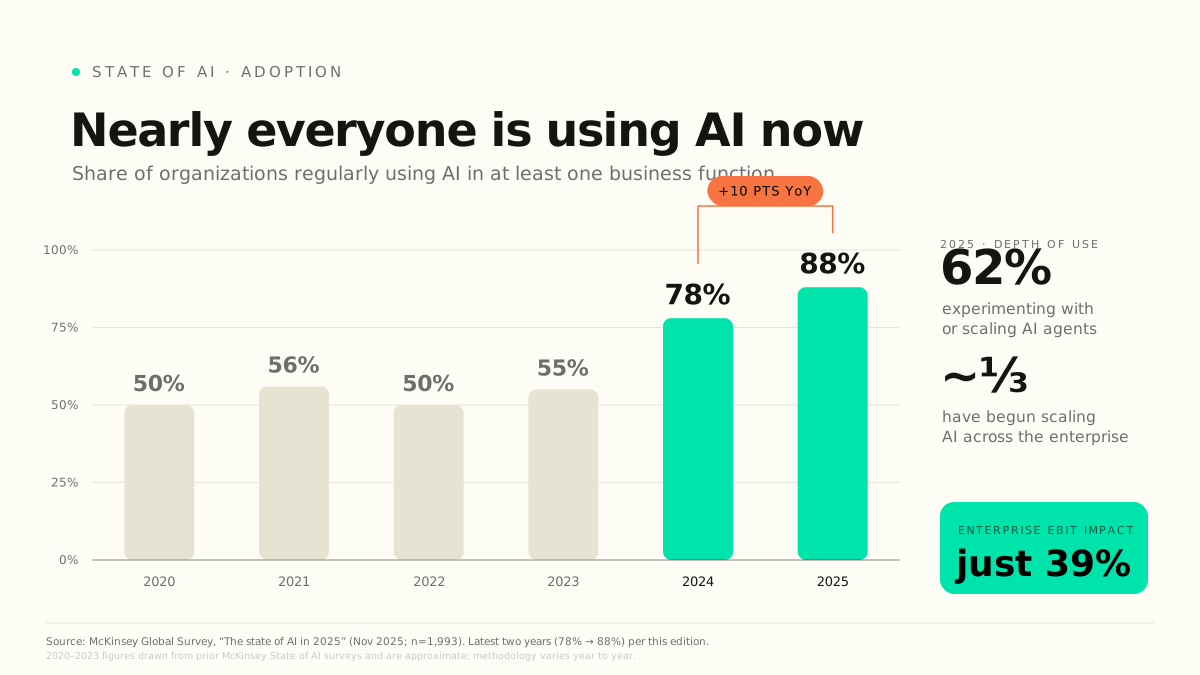
Enterprise behavior backs this up. In McKinsey's 2025 State of AI survey, 23% of respondents reported their organizations were scaling an agentic AI system somewhere in the enterprise, with an additional 39% experimenting with AI agents. Agents are multi-step systems that call models repeatedly, which means they live or die on the reliability and consistency of the API underneath them.
The "one API, many models" pattern
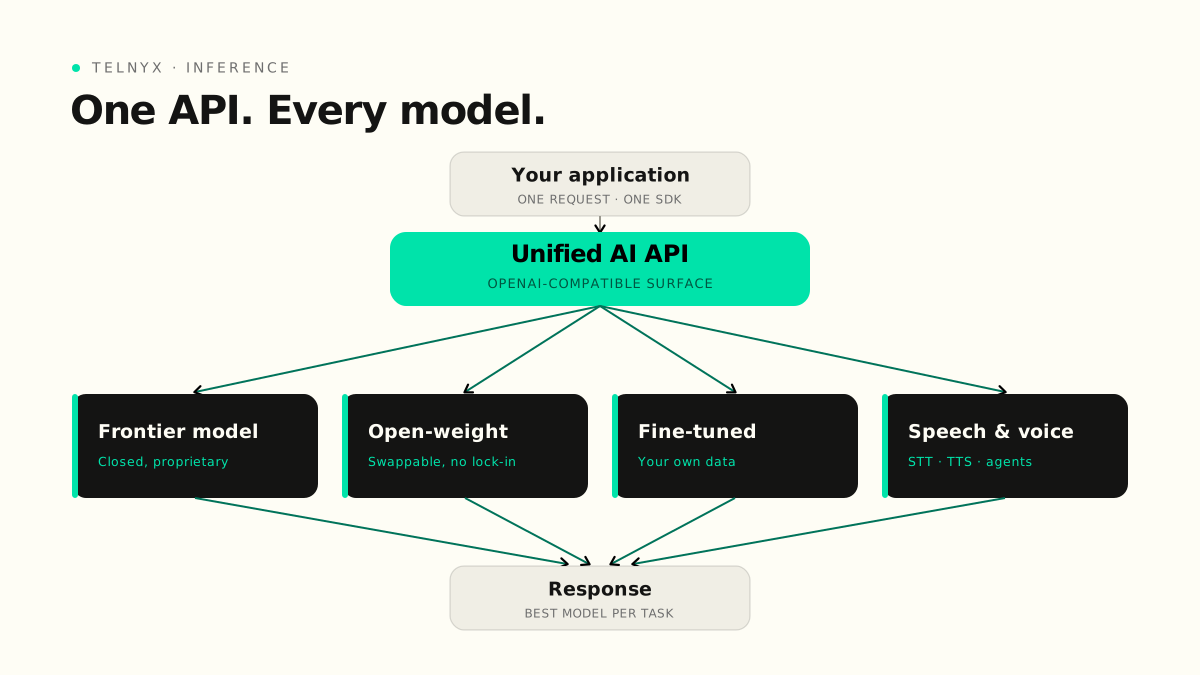
The clearest signal that the unified AI API has become standard architecture is who adopted it first: institutions with the strongest requirements for security, auditability, and procurement discipline.
Stanford University IT runs an official AI API Gateway service. Per its service page, the gateway connects to AI models hosted within Stanford cloud infrastructure, leverages the same large language models provided by commercial third parties, is built on an open-source platform, and is maintained by University IT. Harvard takes the same approach through its API Portal and Gateway, which gives Harvard constituents access to multiple generative AI API providers, including OpenAI, Bedrock for Claude, and Gemini, through a single portal.
The federal government codified the pattern explicitly. The US General Services Administration's USAi platform exposes Sonnet 4.5, GPT-5.4, and Gemini 2.5 to agencies through AI models hosted in FedRAMP authorized environments. The GSA's own description of why it built the API this way is worth quoting directly:
"Built on the industry-standard OpenAI specification, USAi API provides a stable, single point of access to a variety of AI models, empowering agencies to select the best model for any task based on capability, cost, and speed without being locked into a single provider's platform."
Source: USAi, US General Services Administration
Engineering teams at the national-lab level reached the same conclusion. Lawrence Berkeley National Laboratory's CBORG service documents that its API server is OpenAI-compatible, which means in most cases it can be used as a drop-in replacement for any program built to work with OpenAI's ChatGPT. When Stanford, Harvard, the GSA, and a Department of Energy lab independently converge on the same design, "one API, many models" is no longer a positioning claim. It is the reference architecture.
The economics that made it possible
Part of what made the unified AI API viable is that the marginal cost of a model call collapsed. Stanford HAI's 2025 AI Index, as summarized in this inference-cost analysis, found that the cost of querying a model scoring the equivalent of GPT-3.5 on the MMLU benchmark dropped over 280-fold between November 2022 and October 2024, with hardware costs declining roughly 30% per year and energy efficiency improving about 40% per year over the same period.
When intelligence gets that cheap to call, the bottleneck moves. It is no longer "can we afford to run the model." It is "can we route, govern, and integrate model calls fast enough to capture value." That is precisely the problem an AI API gateway is designed to solve.
AI API patterns compared
Different AI APIs solve for different things. The table below maps the major patterns to what they optimize for and where they fall short.
| API pattern | Models exposed | Optimized for | Primary tradeoff |
|---|---|---|---|
| Single-provider API | One vendor's models | Deepest access to that vendor's newest features | Vendor lock-in; rewrites to switch |
| Institutional gateway | Multiple commercial models | Governance, auditing, procurement control | Access only, not real-time media |
| Open-source self-host | Models you deploy | Full control, data residency, cost at scale | You own the infrastructure burden |
| Carrier-grade AI API | Inference plus voice and PSTN | Low-latency real-time voice, one stack | Newer category, fewer reference designs |
Where a carrier-grade AI API is different
Most AI APIs run on top of the network. A carrier-grade AI API runs inside it. That distinction is invisible for a text chatbot and decisive for live voice.
Real-time voice has a physics problem. Every turn in a spoken conversation has to travel from the caller, through the public switched telephone network, to speech-to-text, to a language model, to text-to-speech, and back, fast enough that the pause does not feel robotic. When the signaling lives on one provider's network and the model lives on another's, every turn pays a trans-network round trip. Owning the SIP signaling layer and the language model on the same physical infrastructure is what removes that penalty, which is not achievable when the signaling sits on someone else's box.
Telnyx is built around closing that gap. The same API surface that exposes Telnyx Inference and Fine-tuning also exposes Voice AI Agents that connect directly to the PSTN. Because the GPUs are co-located with the telephony points of presence, the round trip the rest of the voice AI stack pays is removed rather than optimized around. For teams building spoken experiences, that is the difference between an agent that sounds like it is thinking and one that sounds like it is buffering. The deeper architecture is covered in our guide to what it takes to build great AI voice agents.
The open-source dimension matters here too. Because Telnyx runs leading open-weight models directly alongside its communication infrastructure, you can experiment with and swap models the same way Stanford and the GSA do behind their gateways, without the lock-in of a single proprietary endpoint. That flexibility, combined with co-location, is what lets a carrier-grade AI API serve real-time voice at a price point that high-volume use cases can actually sustain.
The telecom industry reached the same conclusion
The "one standardized API, many networks" idea is not unique to AI. The mobile industry has spent three years building the same thing for network capabilities. GSMA reported that, three years after launching its Open Gateway initiative, 86 operator groups representing more than 300 networks and 80% of global mobile connections are now aligned behind a standardized set of APIs, turning network features into something developers can call with a consistent interface regardless of carrier. The underlying CAMARA project, an open-source effort housed at the Linux Foundation, defines those APIs so developers do not need to understand the nuances of every mobile network to build against them. Adoption is already broad: operator-side documentation notes the standardized APIs are in use across 50-plus operators worldwide, abstracting telecom features into interfaces developers can consume like cloud resources.
That convergence is the whole story in miniature. Whether the resource is a language model or a mobile network, the winning pattern is the same: abstract the underlying complexity behind one consistent, well-documented API so developers can build once and choose the best backend per task. Telnyx applies that principle to the layer where AI and telecom meet, which is exactly where real-time conversational AI gets built.
Build your AI API on infrastructure you control
The unified AI API won because it gives teams control: control over which model handles which task, control over cost, and control over how the whole system is governed. For anything involving real-time voice, the missing piece is control over the network the calls actually travel on.
That is what Telnyx provides. One API surface spans inference, fine-tuning, and voice agents, all co-located with a carrier-grade global network so latency-sensitive voice AI runs without a trans-network penalty. Explore Telnyx conversational AI to see how the full stack fits together, and start building on infrastructure you actually own.
Share on Social