
Conversational AI
Conversational AI vs Voice AI: What's the Difference?
Learn the difference between conversational AI and voice AI, how they overlap, and when speech is the right interface for customer interactions.

By Osman Husain
The difference between conversational AI vs voice AI is one of category and interface.
Conversational AI is the broader category: software that understands and responds to human input via channels including voice, chat, text, and more. Voice AI is a subset of conversational AI; tools that bundle together speech-to-text, text-to-speech, and real-time audio so that voice is the primary interface.
What is conversational AI?
Conversational AI is a software platform that can understand, process, and respond to human language in a multi-turn exchange. It powers chatbots, virtual assistants, AI support agents, natural-language IVRs, and voice assistants.
The core job is to remediate and resolve issues, triage problems, and remove humans from the first layer. Conversational AI systems should understand what the person is asking, keep track of context, decide what should happen next, and generate useful responses. If required, they should hand over the conversation to a human, preserving context of the initial interaction.
The top conversational AI platforms use large language models to analyze human queries, map questions to knowledge databases, provide context, and generate responses.
Conversational AI can include voice as one interface, but it does not depend on it. A support chatbot on a website, a WhatsApp agent, an AI email assistant, and a ticketing-system assistant are examples of conversational AI that don't include a speech layer.
What is voice AI?
Voice AI is a sub-category of conversational AI that uses spoken language as its exclusive interface. Voice AI agents are typically used in customer interaction systems, where an assistant listens to a human on the other end of the line, processes the query, and responds with a solution.
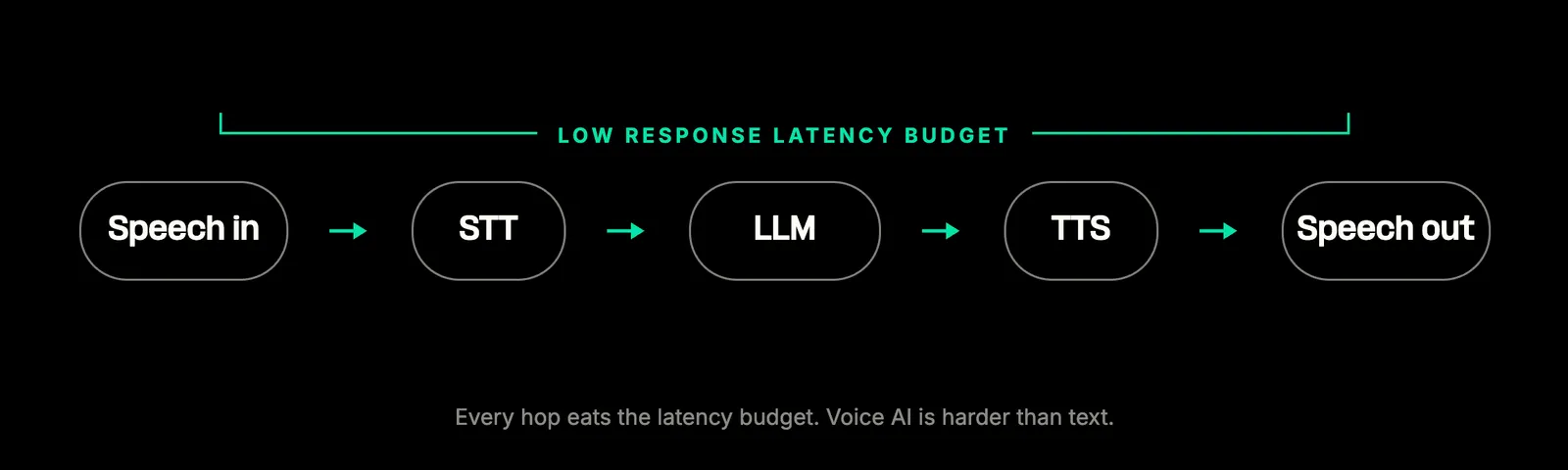
That adds more moving parts than a text chatbot. A typical voice AI pipeline starts with speech-to-text, turning raw audio into text. The conversational AI layer then interprets the request, manages the dialogue, and generates a response. Text-to-speech turns that response back into audio so the system can speak.
Voice AI can also include related tasks that are not conversational on their own, such as transcription, voice cloning, speaker identification, speech analytics, and audio enhancement. This is where the distinction matters; voice agents and voice assistants are voice-delivered conversational AI. Standalone speech tools are voice AI, but they are not necessarily conversational AI.
Voice also has a tighter timing problem than text. A chatbot can take a second or two and still feel usable.
Conversational AI vs voice AI: the key differences
The simplest distinction between the two is this: conversational AI refers to the dialogue layer, while voice AI refers to the speech interface and speech processing layer.
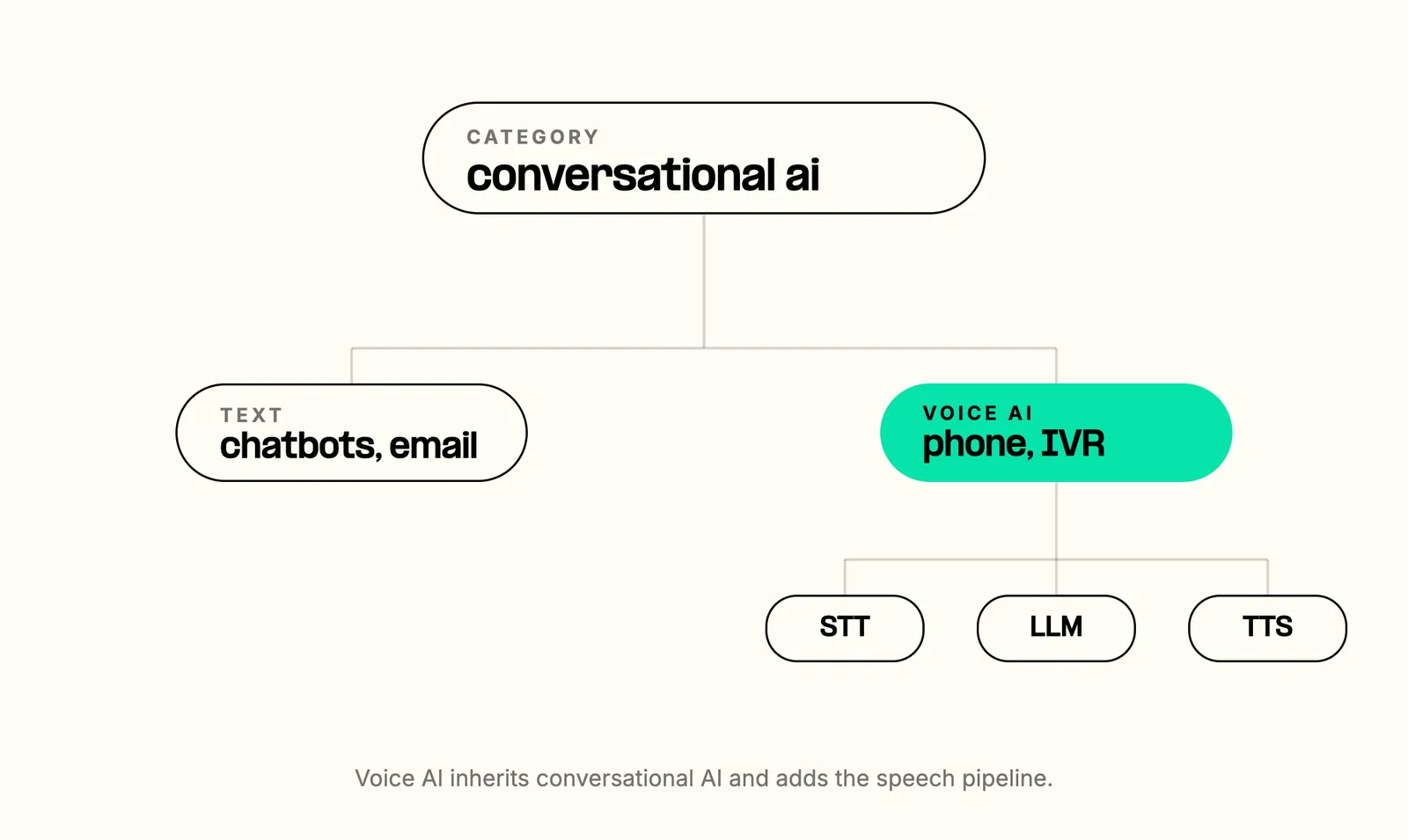
A chatbot and a voice agent can share the same LLM, intent model, memory, tool calls, and business logic. The difference is the channel. The chatbot accepts typed text and returns text. The voice agent accepts spoken audio, transcribes it, reasons over the request, and responds with synthesized speech.
That speech interface changes the engineering problem. Voice AI has to deal with audio quality, silence detection, interruptions, turn-taking, accents, phone networks, and latency. Text conversational AI can often be async. Voice AI usually cannot.
Conversational AI vs voice AI at a glance
| Dimension | Conversational AI | Voice AI |
|---|---|---|
| Scope | Broad category across modalities | Speech interface and speech-processing layer |
| Input | Text, voice, or both | Primarily speech |
| Output | Text, voice, or both | Speech, transcripts, summaries, and logs |
| Core components | NLU, dialogue management, NLG, LLMs, tools | STT, NLU, dialogue management, LLMs, TTS, audio handling, orchestration |
| Latency sensitivity | Moderate, especially for async text | High, because pauses affect the conversation |
| Channels | Chat, email, messaging, voice, multimodal | Phone, voice assistants, voice agents, IVR |
| Common use cases | Chatbots, AI email triage, support assistants | Inbound phone support, outbound reminders, voice agents |
| Relationship | Does not require voice | Voice agents use conversational AI underneath |
This is why the two terms often blur. A voice agent is both conversational AI and voice AI. A text chatbot is conversational AI, but not voice AI. A transcription API is voice AI, but not necessarily conversational AI.
How voice AI and conversational AI relate
Voice AI for customer conversations is conversational AI with a voice interface wrapped around it.
The reasoning, intent recognition, context handling, and dialogue management can be the same capabilities used in a text agent. What voice adds is the speech layer: speech-to-text for listening, text-to-speech for speaking, real-time media handling, interruption handling, and a much tighter latency budget.
Modern deployments often share the same agent logic across channels. The agent that handles support chat on a website can answer a phone call if the speech layers and telephony layer are added around it. It can use the same knowledge base, the same CRM lookup, and the same rules for when to escalate.
The interface still matters. Voice changes how people behave. People interrupt. They hesitate. They change their mind mid-sentence. They expect the system to understand tone, timing, and words. A voice agent also operates inside a live audio session, often over the public telephone network.
That makes voice the more demanding version of the same conversational problem. The language understanding might be shared. The production constraints are different.
When to use conversational AI without voice
Text-based conversational AI makes sense when the interaction happens in a digital channel and the user is not required to speak.
Examples include website support chat, WhatsApp automation, AI-assisted email triage, onboarding assistants, and ticketing-system copilots. These workflows are easier to test and update because they do not depend on audio quality, speech recognition, or phone routing.
Text also works well when the customer needs to read, compare, or copy information. Order numbers, troubleshooting steps, plan details, and legal documents are often easier to handle in writing. Async timing can be an advantage too. A customer can send a message, step away, and return later.
Start with text-based conversational AI when the primary channel is already digital, the task does not require urgency, and customers are comfortable typing. Adding voice too early can add cost and engineering work without improving the customer experience.
When you need voice AI specifically
Voice AI fits when the interaction is telephonic, urgent, hands-free, or sensitive to tone.
Inbound phone support is the obvious case. Customers call when the issue feels urgent, when chat did not work, or when phone is still the default support channel. A voice AI agent can answer, collect context, resolve common requests, or route the call to the right person.
Outbound calling is another strong fit. Appointment reminders, fraud alerts, collections, lead follow-up, customer surveys, and proactive service updates all depend on reaching someone in the moment. Voice can carry urgency in a way that a notification cannot.
Voice also fits hands-free contexts: driving, field work, healthcare settings, warehouse work, accessibility use cases, and any workflow where typing is inconvenient.
The harder part is production quality. Voice AI has to handle silence, interruptions, background noise, poor connections, and people who talk over the system. It also has to respond fast enough that the user does not lose confidence.
That is why voice AI needs more than chatbot logic with audio added. The dialogue layer may be shared, but the speech and telephony layers decide whether the interaction feels natural.
Where agentic AI fits
Agentic AI describes what a system can do, not how it communicates.
A conversational AI system holds a dialogue. A voice AI system uses speech as the interface. An agentic AI system can take actions, use tools, and complete multi-step tasks with some autonomy.
Those categories can overlap. A voice agent that books an appointment is conversational, voice-based, and agentic. It talks to the user, understands the request, checks calendar availability, books the slot, and confirms the appointment.
A chatbot that reschedules a delivery is conversational and agentic without being voice AI. It uses text as the interface, but it still takes action through tools.
This distinction helps keep product requirements clear. If you need a system to talk, you need conversational AI. If it needs to talk by phone or speech, you need voice AI. If it needs to complete tasks, you need agentic behavior.
Building voice AI in production
Running voice AI in production means speech-to-text, LLM inference, text-to-speech, orchestration, and telephony have to work together in real time.
Every provider boundary in that path can add latency, operational complexity, and another place to debug when something breaks. Orchestration platforms can reduce integration work, but they do not remove every boundary in the underlying voice AI path.
Those boundaries show up in ordinary moments. A transcription delay can make the agent answer the wrong part of a sentence. A slow model response can cause both sides to talk at once. A TTS or media-routing issue can make an otherwise accurate answer feel awkward. The user does not see the pipeline, but they hear the delay.
Telnyx approaches the problem as an infrastructural challenge. Its voice AI agents run on a carrier-owned network, with telephony, speech, inference, and orchestration designed to work as one. Telnyx also supports routing options for third-party models and voice providers, so teams can choose components without rebuilding the whole voice path.
For teams that want to build closer to the call layer, the Telnyx Voice API provides programmable call control and real-time media streaming. For teams building agents, Telnyx Voice AI connects the speech and AI layers into a production voice agent stack.
FAQs
Is voice AI a type of conversational AI?
For voice agents and voice assistants, yes. Voice AI is conversational AI delivered through spoken language. The reasoning, intent recognition, and dialogue management come from conversational AI. Voice adds speech-to-text, text-to-speech, real-time media handling, interruption handling, and a tighter latency budget.
What is the difference between conversational AI and voice AI?
Conversational AI is the broader category: any system that can hold a multi-turn dialogue in human language. Voice AI for conversations is the form where input is primarily speech and output is often speech. Voice agents use conversational AI underneath.
Can conversational AI work without voice?
Yes. Text-based chatbots, messaging bots, AI email assistants, and ticketing-system AI are all conversational AI with no voice component. They can use the same dialogue logic as a voice agent, but they do not need speech-to-text, text-to-speech, or telephony.
Is voice AI harder to build than text conversational AI?
Usually, yes. Voice AI has to process speech, generate a response, and speak back before the pause feels awkward. Text conversational AI can often be async. Voice also adds interruption handling, turn-taking, audio quality, phone routing, and live-call reliability.
Which is better for customer support, conversational AI or voice AI?
Neither is universally better. Text conversational AI suits chat, email, messaging, and async support. Voice AI suits phone support, urgent inbound requests, outbound calling, and hands-free use cases. Mature support teams often use both, with shared context across channels.
Where does agentic AI fit in?
Agentic AI adds tool use and autonomous multi-step actions. A voice agent that books an appointment is conversational, voice-based, and agentic at once. A chatbot that reschedules a delivery is conversational and agentic without voice. Agentic AI describes what the system does, not how it talks.
Build AI agents on infrastructure designed for live conversations
Voice AI is the harder interface because the user hears every delay. The system has to listen, reason, speak, and recover from interruptions live.
Turn conversational AI into voice AI
Build voice agents with telephony, speech, inference, and orchestration on carrier-owned infrastructure.
Start for freeShare on Social
Osman is the Global AEO/SEO Lead at Telnyx, helping make voice AI and communications products clearer for builders. With almost a decade of experience in SEO, he previously led growth at Windscribe and Enzuzo, shipping and scaling organic programs that reached millions.


