
Email API
Marketing vs transactional email explained for developers
Learn the difference between marketing vs transactional email, when to use each, and why separating streams protects deliverability of critical messages.

By Eli Mogul
Takeaways
- Transactional email is triggered by a user action and sent to one recipient. Marketing email is initiated by the sender and broadcast to a list.
- The marketing vs transactional email distinction is an infrastructure decision, not just a content one. The two message types carry different delivery guarantees, consent rules, and reputation profiles.
- CAN-SPAM exempts transactional messages from most of its requirements, but only when the primary purpose of the message is transactional. Strip out the promotional content and ask whether what remains is a message the user still needs. If it is, the message is transactional.
- Mixing both streams on the same IPs and domains lets marketing complaints degrade the delivery of password resets and one-time passcodes.
- Separate at the subdomain, IP pool, and authentication level. Separating streams does not require separating vendors.
What is the difference between marketing and transactional email?
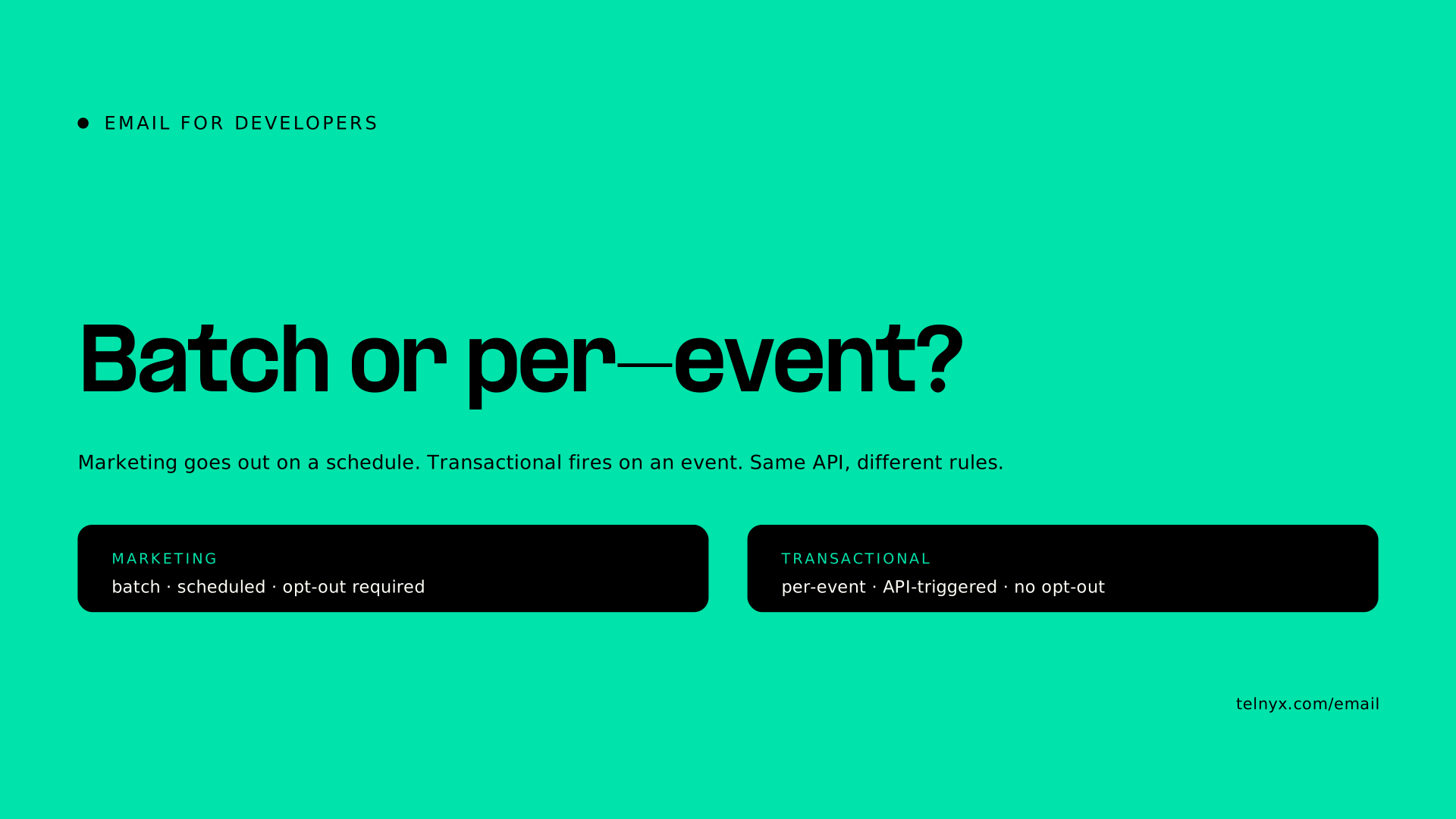
Transactional email is triggered by a user action and sent to a single recipient, such as a password reset, receipt, shipping update, or one-time passcode. Marketing email is initiated by the sender and broadcast to a list of recipients to promote something. Transactional email rests on an existing relationship. Marketing email requires opt-in consent.
That definition covers the content difference. The operational difference matters more. Transactional messages are latency-sensitive and expected to arrive within seconds, because a user is sitting on a login screen waiting for a code. Marketing messages are scheduled, batched, and tolerant of a delay measured in minutes. One is a synchronous part of your product. The other is a campaign.
Those different delivery requirements produce different engineering requirements. Transactional sending needs an API that your application calls at the moment of the event, plus webhooks that tell you what happened to each message. Marketing sending needs list management, segmentation, scheduling, and suppression handling. Building one system that does both well is possible. Running both through the same sending reputation is where teams get into trouble.
Transactional email examples
Password resets, email address verification, one-time passcodes for multi-factor authentication, order confirmations, shipping notifications, invoices and receipts, account balance statements, security alerts, and terms-of-service change notices. Each one is generated programmatically in response to a specific event, which is why teams send transactional email through an API rather than a campaign tool.
Marketing email examples
Newsletters, product announcements, promotional offers, abandoned cart reminders, win-back campaigns, seasonal sales, and event invitations. Most fall under a broader ecommerce email strategy built around segments and campaign calendars rather than individual triggers.
Marketing vs transactional email compared
| Attribute | Transactional | Marketing |
|---|---|---|
| Trigger | User action or system event | Sender initiates on a schedule |
| Recipients | One | Many, from a list |
| Consent | Implied by the relationship | Opt-in required |
| Unsubscribe link | Not generally required | Required |
| Delivery expectation | Seconds | Minutes to hours |
| Sending method | API or SMTP, per event | Campaign platform, batched |
| Typical engagement | High opens, high intent | Lower opens, variable intent |
| Reputation risk | Low complaint rate | Higher complaint and bounce rate |
The categories break down in the middle. A shipping confirmation with a "customers also bought" block is doing two jobs. A welcome email confirming an account and pitching a paid tier is doing two jobs. Most comparisons acknowledge this gray area and then move on without resolving it.
Here is a decision rule that resolves it. Strip out the promotional content and ask whether what remains is a message the user still needs. If yes, the message is transactional and the promotion is a passenger. If the message collapses without the promotion, it was marketing wearing a receipt as a costume, and it needs consent and an unsubscribe link.
You can apply that rule at the architecture level too. If a message is genuinely transactional, route it through your transactional stream even when it carries a small promotional footer. If it fails the test, route it through marketing, where the consent and suppression machinery already lives.
Mailbox providers reach the same conclusion from the delivery side. Gmail's sender guidance tells senders not to mix content types within a single message, and gives promotions inside sales receipts as the specific practice to avoid. The legal test and the deliverability test point the same direction here, which is unusual and worth taking as a signal.
Compliance rules differ for each email type
Note: This section is general information about how these regimes work, not legal advice. Have counsel review your specific sending program.
In the United States, CAN-SPAM applies to commercial email based on the primary purpose of the message. The FTC's compliance guide defines five narrow categories of transactional or relationship content. Those categories cover messages that complete a transaction the recipient already agreed to, provide warranty or safety information, notify recipients of a change to an ongoing relationship or their standing in it, give employment and benefits information, or deliver goods and services. A message made up only of that content is exempt from most CAN-SPAM requirements, though it still cannot carry false routing information.
Mixed-content messages are decided on placement and framing. If the subject line reads as promotional, or if the transactional content does not appear mainly at the beginning of the message, the FTC treats the message as commercial. Each violating email carries a civil penalty of up to $53,088. The FTC set that amount in its January 2025 inflation adjustment and it remains current, because no federal inflation adjustment was issued for 2026. The agency revisits the figure each January, so confirm it before citing it.
Enforcement is not theoretical. In August 2023 the Department of Justice, acting for the FTC, obtained a permanent injunction and a $650,000 civil penalty against Experian Consumer Services. The complaint alleged that Experian sent account holders millions of emails implying they contained important account information when the messages actually promoted additional services, and that the emails gave recipients no way to opt out. Labeling a marketing email as transactional does not make it one.
Outside the US the rules are tighter. In the UK and EU, marketing emails to individuals generally require consent or a narrow soft opt-in. The ICO treats customer service messages as falling outside direct marketing, but only where they are purely service-related. Add promotional content to a service email and the marketing rules attach to the message, which mirrors the CAN-SPAM primary-purpose test closely enough to use one mental model for both. Breaches of the GDPR's consent and lawful basis conditions fall under Article 83(5), the higher of the regulation's two administrative fine tiers, capped at EUR 20 million or 4% of total worldwide annual turnover, whichever is higher. Canada's regime is stricter still. The CRTC can impose administrative monetary penalties of up to CAD 10 million per violation for a business and CAD 1 million for an individual.
Transactional messages also carry content your marketing stream never touches, including account details, reset tokens, and partial financial data. That raises the email security tradeoffs worth reviewing before you decide what belongs in a message body versus behind an authenticated link.
Why separating email streams protects deliverability
Mailbox providers score reputation at the IP address and domain level, not the message level. They do not know that one of your emails is a password reset and another is a Black Friday blast. They see traffic from an IP and a domain, and they assign that traffic a trust score based on how recipients react to it.
That scoring is why mixing streams is a delivery risk. Marketing email naturally produces lower open rates, higher complaint rates, and more bounces from stale addresses. Transactional email produces the opposite. Merge them and the marketing behavior sets the reputation for both. Google's sender guidelines require domains sending more than 5,000 messages a day to Gmail accounts to publish SPF, DKIM, and DMARC records, keep spam complaint rates below 0.3%, and offer one-click unsubscribe. Microsoft began enforcing comparable requirements for high-volume senders to Outlook.com in May 2025, routing non-compliant mail to junk. Yahoo's sender best practices are blunter still, advising senders not to send bulk mail from the same IPs used for transactional traffic. A marketing list that drifts over the complaint threshold takes your one-time passcodes down with it.
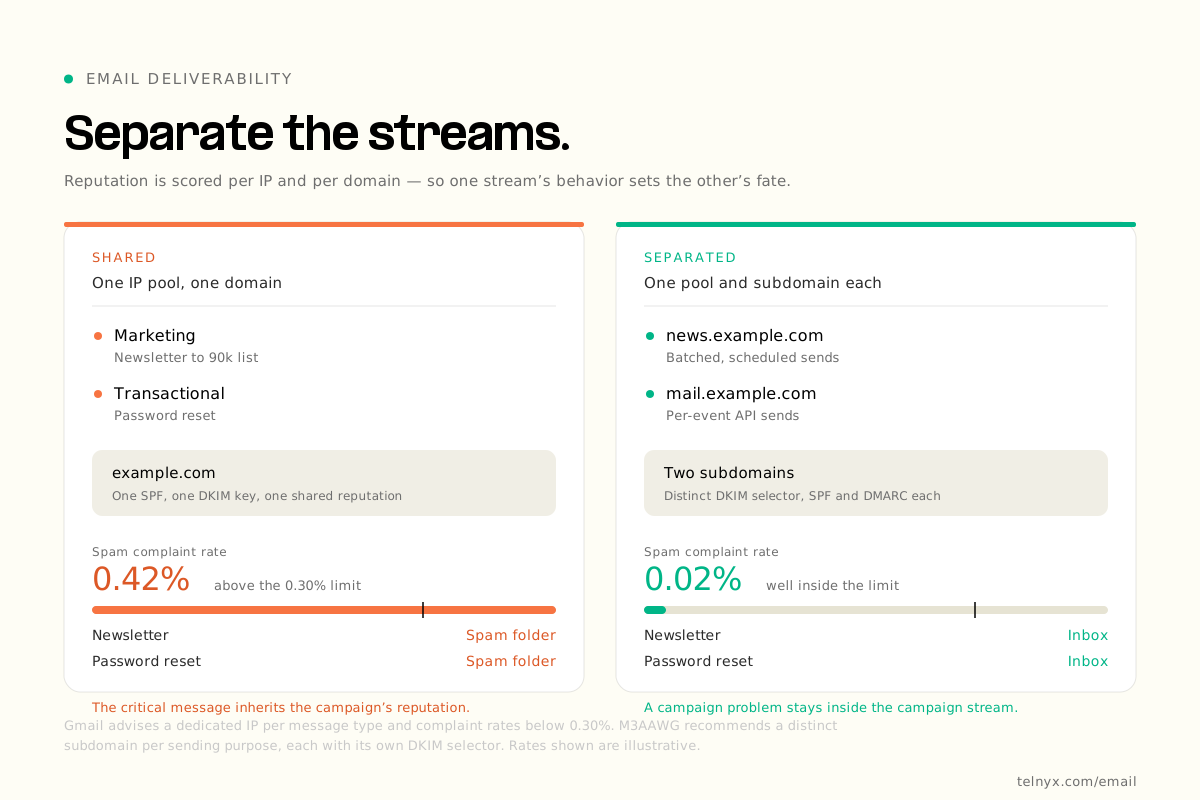
Separation is a concrete architecture, not a philosophy. Implement it at four layers:
- Subdomains: Send transactional mail from something like mail.example.com and marketing from news.example.com. M3AAWG's sending domains best common practices note that receiving operators want traffic types separated, and that separation requires distinct subdomains and in some cases distinct IP addresses.
- IP pools: Give each stream its own dedicated IP or pool once volume justifies it. Below roughly 100,000 messages a month, a well-managed shared pool often outperforms a dedicated IP you cannot keep warm.
- Authentication per subdomain: Publish an SPF record on each sending subdomain's Return-Path, and give each subdomain its own DKIM selector, which M3AAWG recommends so a weak or rotated key on one stream cannot affect the other. Publish DMARC on the organizational domain where you can, and on the subdomain as an interim step where you cannot.
- Sending path: Call an API for transactional messages so your application can react to per-message webhook events in real time. Reserve SMTP for legacy integrations, and handle campaign sends through tooling built for lists. Getting the retry, suppression, and bounce logic right on both paths is where email automation best practices earn their keep.
Google states the principle directly rather than leaving it to inference. Its sender guidance advises that senders using more than one IP address dedicate a different IP to each message type, and gives account notifications versus promotional messages as the example. Postmark's message streams show the pattern implemented commercially, running parallel transactional and broadcast infrastructure so the two never share IP ranges. The mailbox providers set the requirement. Vendors are catching up to it.
That distinction settles a question teams often get backward. Separating streams is about isolating reputation, not about counting vendors. One provider that isolates reputation properly gives you separation. Two providers that both drop you into the same shared pool do not.
Redundancy is the other half of the argument. For time-critical notifications, email alone is a single point of failure. Pairing an emailed one-time passcode with SMS messaging as a fallback gives the user a second path when the first one stalls, which matters most for exactly the messages you least want delayed.
Choose infrastructure built for both streams
The decision framework is short. Classify every message by trigger and by what survives when you remove the promotional content. Route the two classes through separate subdomains, separate IP pools, and separate authentication records. Match the sending method to the requirement, with an API for event-driven messages and campaign tooling for lists. Then pick a provider based on whether it isolates reputation between streams, not on how many logos are on your vendor list.
Telnyx builds communications products the same way at every layer. We own and operate our network rather than reselling someone else's capacity, we run messaging and voice on one platform so teams can consolidate providers without collapsing everything into one shared reputation, and we staff in-house engineering support around the clock for the teams whose traffic cannot wait for a ticket queue.
Talk to a Telnyx expert about architecting communications infrastructure that treats your time-critical messages like the infrastructure they are.
FAQ
Share on Social