
Insights and Resources
Top 3 Voice AI Providers in Colombia
For Colombian enterprises evaluating voice AI providers, the shortlist comes down to three things: Spanish-language quality, regional infrastructure, and transparent pricing. Here are the top three providers worth evaluating.

By Eli Mogul

Colombia is quickly becoming one of Latin America's most active markets for AI adoption. The country approved its National Artificial Intelligence Policy (CONPES 4144) in February 2025, backed by USD 115.9 million in funding through 2030. According to Statista, Colombia's broader AI market is projected to grow at a 28.37% CAGR through 2030, reaching nearly USD 3 billion. And according to SAP research cited by BBVA Spark, Colombia ranks among the top three Latin American countries investing in AI, with 69% of companies expecting the technology to significantly affect their industry.
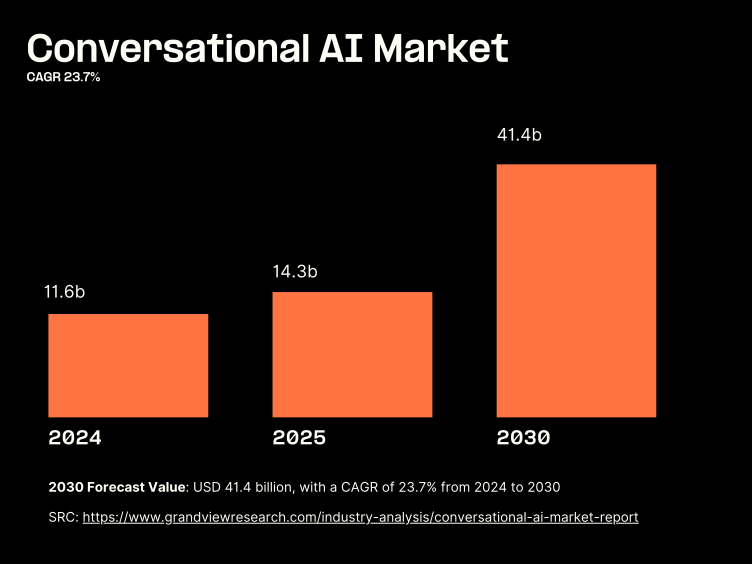
Voice AI is where this investment hits hardest for businesses operating contact centers, logistics operations, or customer-facing services. The global conversational AI market is expected to reach USD 41.39 billion by 2030, growing at a 23.7% CAGR according to Grand View Research.
The Latin America AI market alone is projected to grow from USD 40.50 billion in 2026 to USD 504.71 billion by 2034, at a CAGR of 37.07%. For Colombian enterprises evaluating voice AI providers, the shortlist comes down to three things: Spanish-language quality, regional infrastructure, and transparent pricing. Here are the top three providers worth evaluating.
1. Telnyx
Telnyx is a full-stack conversational AI platform that owns and operates every layer of the voice pipeline, from the PSTN to GPU inference. That distinction matters in a market like Colombia, where latency, call quality, and local number availability directly affect whether a voice AI deployment succeeds or fails.
What sets Telnyx apart is its colocated infrastructure. Telnyx places dedicated GPUs directly adjacent to its global Points of Presence (PoPs), minimizing the physical distance data travels and delivering sub-500ms end-to-end latency. For context, competing platforms typically show 800ms to 1,200ms latency once you factor in the full round trip from PSTN to AI processing and back. Telnyx consistently operates within the sub-200ms round-trip window that matches natural human conversational pacing.
For Colombia specifically, Telnyx offers PSTN replacement, including voice, fax, number portability, and emergency services on local and national numbers. Colombian phone numbers start at just $1/month and can be provisioned via API in minutes. There's no need to stitch together a third-party carrier, a separate AI provider, and yet another vendor for phone numbers. It all runs on one platform.
On the AI side, Telnyx supports 40+ languages with real-time multilingual transcription, making it a strong fit for Colombia's Spanish-speaking market while also supporting businesses with English-language or bilingual requirements. Telnyx also maintains an open-source LLM library that allows developers to run leading models directly alongside the voice infrastructure, avoiding vendor lock-in and giving teams the flexibility to experiment with different models for their specific use case.
From a compliance standpoint, Telnyx holds SOC2 Type II, HIPAA, PCI, and GDPR certifications. The company is a licensed telecom provider in 30+ markets, with local calling available in 80+ countries and PSTN replacement in 45+ markets.
Pricing is transparent and pay-as-you-go. Voice AI orchestration starts at $0.05/min (USD), with STT and Telnyx-native TTS included, which is significantly less than what most cloud AI providers charge for comparable functionality.
Best for: Enterprises and developers who need full-stack control over voice AI, low-latency performance, local Colombian phone numbers, and scalable pricing without multi-vendor complexity.
2. Twilio
Twilio is one of the most recognized names in cloud communications and offers a mature set of voice APIs with global reach. Its Programmable Voice product supports SIP trunking, call control, and basic speech recognition, and the company has built a significant ecosystem of integrations and developer tools over the past decade.
For Colombia, Twilio offers voice pricing and phone number availability, and its platform supports calling in 180+ countries. Twilio's newer Conversational AI products, including ConversationRelay and Conversational Intelligence, add virtual agent capabilities with support for Spanish, Portuguese, and several other languages. According to a Twilio press release from January 2026, 31% of Latin American companies have already fully deployed conversational AI for customer service, exceeding the global average of 28%.
However, Twilio's voice AI capabilities require more assembly. Most voice AI projects on Twilio involve stitching together multiple services, including third-party LLMs, external TTS providers, and additional logic layers. This adds complexity and can introduce latency. Twilio's voice channel shows average latency of around 950ms, which reflects the overhead of routing through extensive carrier integrations rather than owning the underlying infrastructure.
Pricing follows a pay-as-you-go model, but costs can climb once you layer in AI services, phone numbers, and third-party tools. Twilio also offers volume discounts for committed usage.
Best for: Teams already embedded in the Twilio ecosystem or those who need broad CPaaS functionality beyond voice AI, such as SMS, email, and video, within a single vendor relationship.
3. Vonage
Vonage, now a subsidiary of Ericsson, offers a suite of communication APIs that includes voice, messaging, and video, along with AI-powered features through its AI Studio platform. AI Studio provides a low-code/no-code flow builder that lets non-technical teams create and deploy virtual agents across voice and messaging channels.
For Spanish-language support, Vonage's Voice API offers automatic speech recognition in 120 languages, and the company recently partnered with AWS to integrate Amazon Nova Sonic for real-time, natural-sounding voice agent interactions. This integration supports English and Spanish, with the ability to switch between languages depending on the caller.
Vonage also offers a fully managed deployment option. For businesses that lack in-house AI or developer resources, Vonage's AI experts can design, deploy, and maintain the voice AI solution, which can be appealing for mid-market companies entering the space for the first time.
That said, Vonage faces the same limitations as Twilio when it comes to voice AI infrastructure. The platform relies on third-party AI models and does not own the underlying telecom network at the same level as a carrier-grade provider. Latency benchmarks for Vonage have been reported in the 800 to 1,200ms range, which can affect conversational flow during real-time interactions. Pricing is less transparent than some competitors and typically requires a conversation with a sales team for custom quotes.
Best for: Non-technical teams or mid-market businesses that want a managed AI voice solution with low-code tools and are comfortable trading some performance and control for ease of deployment.
How the top 3 compare
| Criteria | Telnyx | Twilio | Vonage |
|---|---|---|---|
| Colombia phone numbers | Yes, local numbers from $1/mo via API | Yes, available with pay-as-you-go pricing | Yes, available via Voice API |
| Voice AI latency | Sub-500ms end-to-end; sub-200ms RTT | ~950ms average | 800–1,200ms range |
| Infrastructure ownership | Owns full stack: PSTN, IP backbone, GPUs | Cloud-based, relies on carrier integrations | Cloud-based, relies on AWS and third parties |
| Spanish-language support | 40+ languages with real-time multilingual AI | Spanish supported via Conversational AI | 120 languages via ASR; Spanish via Nova Sonic |
| Pricing transparency | Pay-as-you-go, from $0.05/min for orchestration (STT and Telnyx-native TTS included) | Pay-as-you-go, costs vary with add-ons | Custom quotes, managed service options |
What to look for when choosing a provider in Colombia
Selecting a voice AI provider for Colombia requires more than comparing feature lists. Here are the factors that matter most in this market.
Spanish-language quality, not just support. Many platforms list Spanish as a supported language, but the actual quality of speech recognition and synthesis varies significantly across regional dialects. Colombian Spanish is distinct from Castilian or Mexican Spanish, and the difference matters in customer-facing interactions. Test with real callers in your target market before committing.
Local number availability and PSTN connectivity. If your voice AI agent cannot connect to the public telephone network with a local Colombian caller ID, you lose trust immediately. Customers are far more likely to answer and engage with a call from a recognizable local number. Verify that your provider offers local number provisioning, number portability, and reliable inbound and outbound PSTN calling in Colombia.
Latency under production conditions. Demo latency and production latency differ significantly. Ask for real-world benchmarks under concurrent call load, not synthetic test results. Research from Glean indicates that delays exceeding 800ms cause 40% higher call abandonment rates in contact centers. For voice AI to work in practice, sub-500ms end-to-end response time should be the baseline target.
Compliance and data residency. Colombian businesses operating in financial services, healthcare, or insurance face regulatory requirements around data handling. Confirm that your provider holds relevant certifications (SOC2, HIPAA, PCI, GDPR) and can address data residency concerns for your specific use case.
Total cost of ownership. Advertised per-minute rates often exclude STT, TTS, LLM inference, and telephony costs. According to a comparison by Fonema AI, real all-in costs for stitched multi-vendor stacks can reach $0.13 to $0.33/min once every component is added. Full-stack providers with itemized per-component pricing tend to offer more predictable costs at scale.
The bottom line
Colombia's AI market is accelerating, and voice AI is at the center of how businesses in the region plan to scale customer interactions. Of the three providers reviewed here, Telnyx offers the strongest combination of infrastructure ownership, low-latency performance, local Colombian presence, and transparent pricing. For teams that want a full-stack conversational AI platform without the complexity of multi-vendor integration, it's the clear starting point.
Twilio and Vonage remain viable options depending on your existing tech stack and internal capabilities. But for businesses where call quality, response speed, and cost efficiency are the deciding factors, Telnyx's owned infrastructure gives it a structural advantage that cloud-only platforms cannot replicate.
Evaluating voice AI for your business in Colombia? Explore Telnyx Voice AI Agents or browse Colombian phone numbers to get started.
Share on Social


