
Messaging
Twilio vs Telnyx SMS Pricing
Compare Twilio vs Telnyx SMS pricing for 2026. See per-message US rates, carrier fees, and hidden costs to find out which SMS API is cheaper at scale.
Takeaways
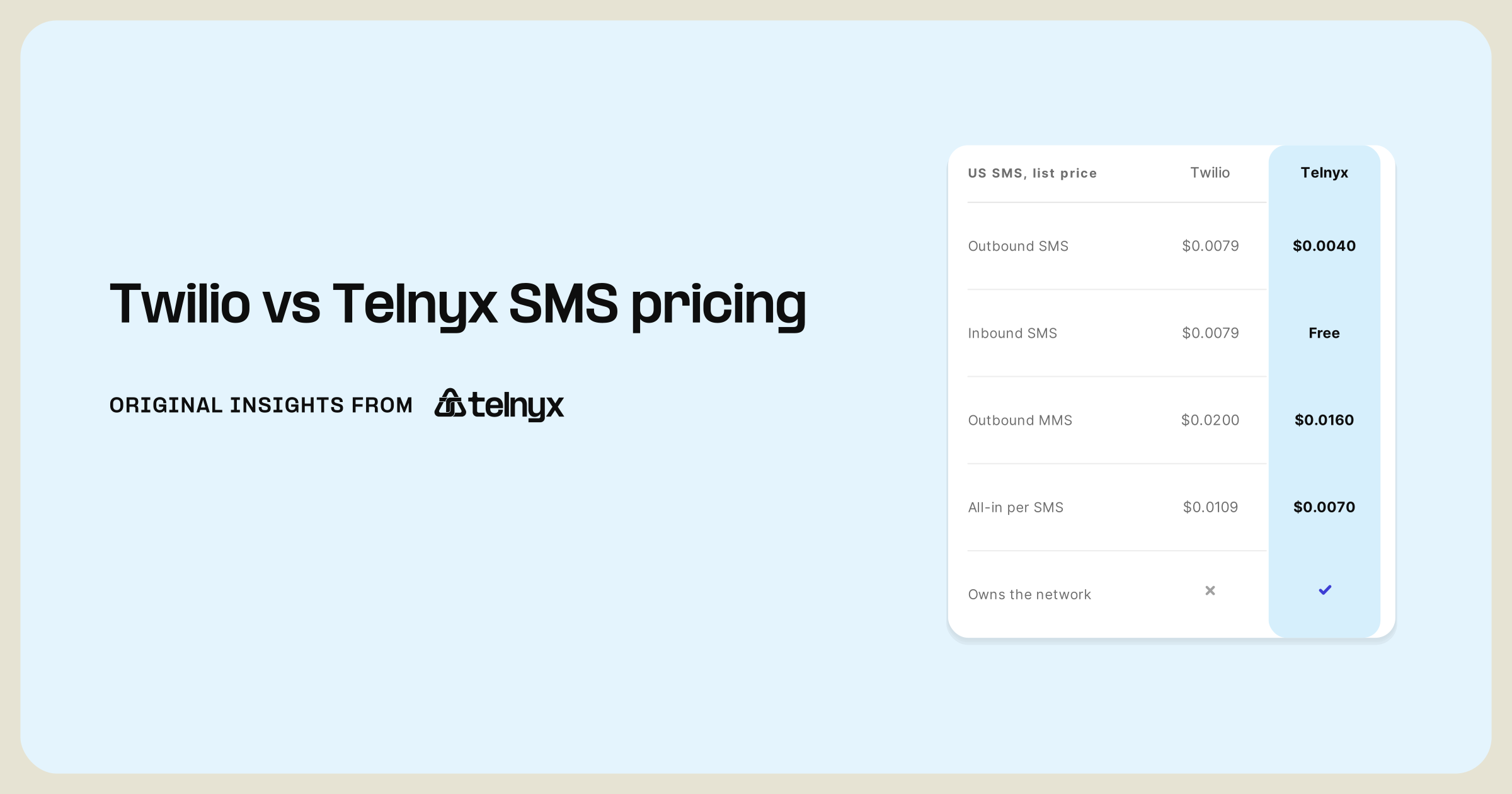
- In any Twilio vs Telnyx SMS pricing comparison, Telnyx US outbound SMS starts at $0.0040 per message versus $0.0079 on Twilio, inbound SMS is free on Telnyx, and there is no platform markup on top.
- Total cost on both platforms includes carrier pass-through fees, around $0.003 per SMS on AT&T, T-Mobile, and Verizon, so the base rate and markup decide who is cheaper.
- Telnyx owns its network and carrier connections, so rates stay transparent and stable instead of absorbing third-party price increases.
- Automatic volume discounts and committed-use agreements push Telnyx per-message rates below list price at high volume.
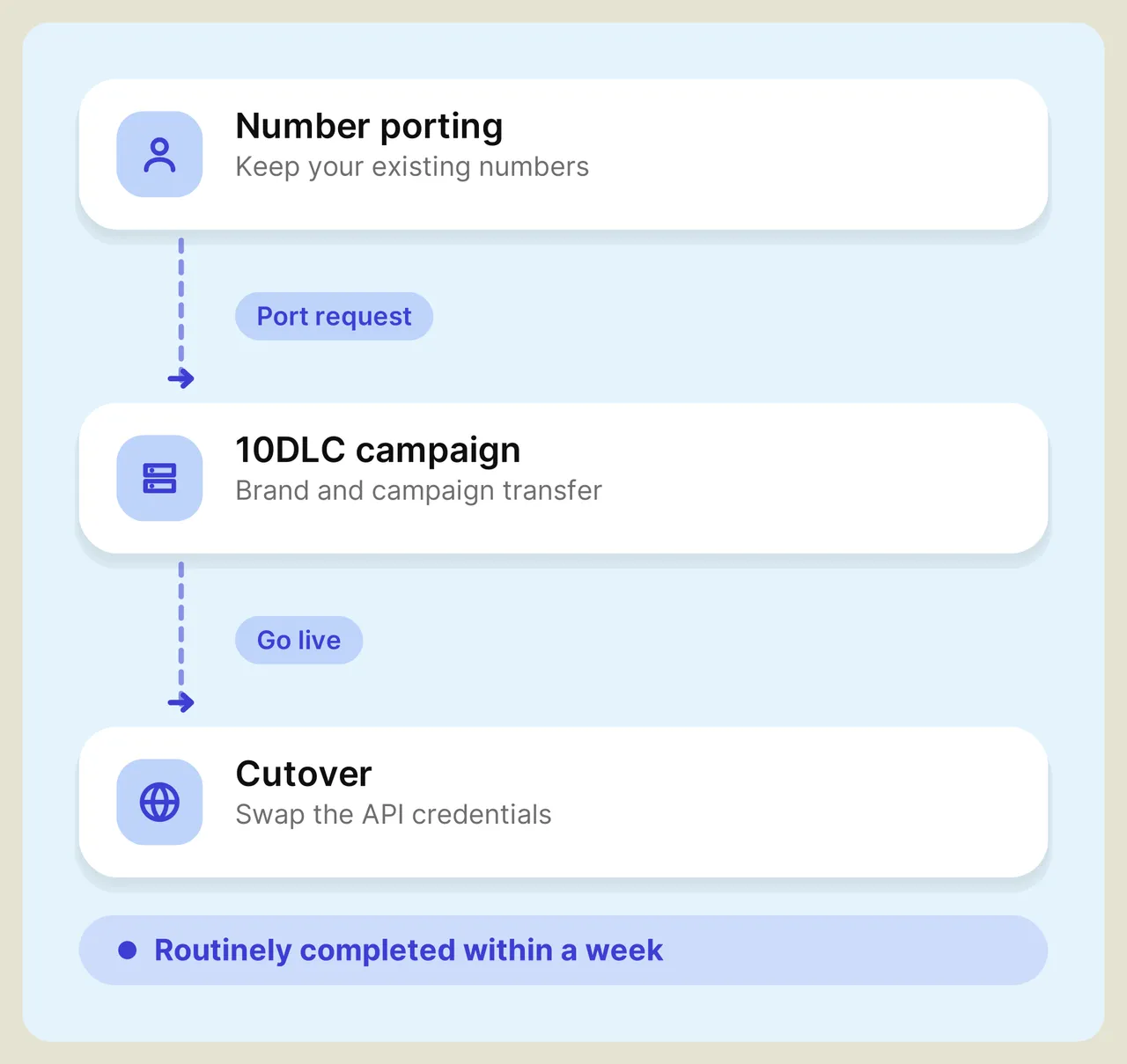
- Migrating SMS from Twilio, including number porting and 10DLC campaign transfer, is routinely completed within a week.
Twilio vs Telnyx: SMS pricing compared
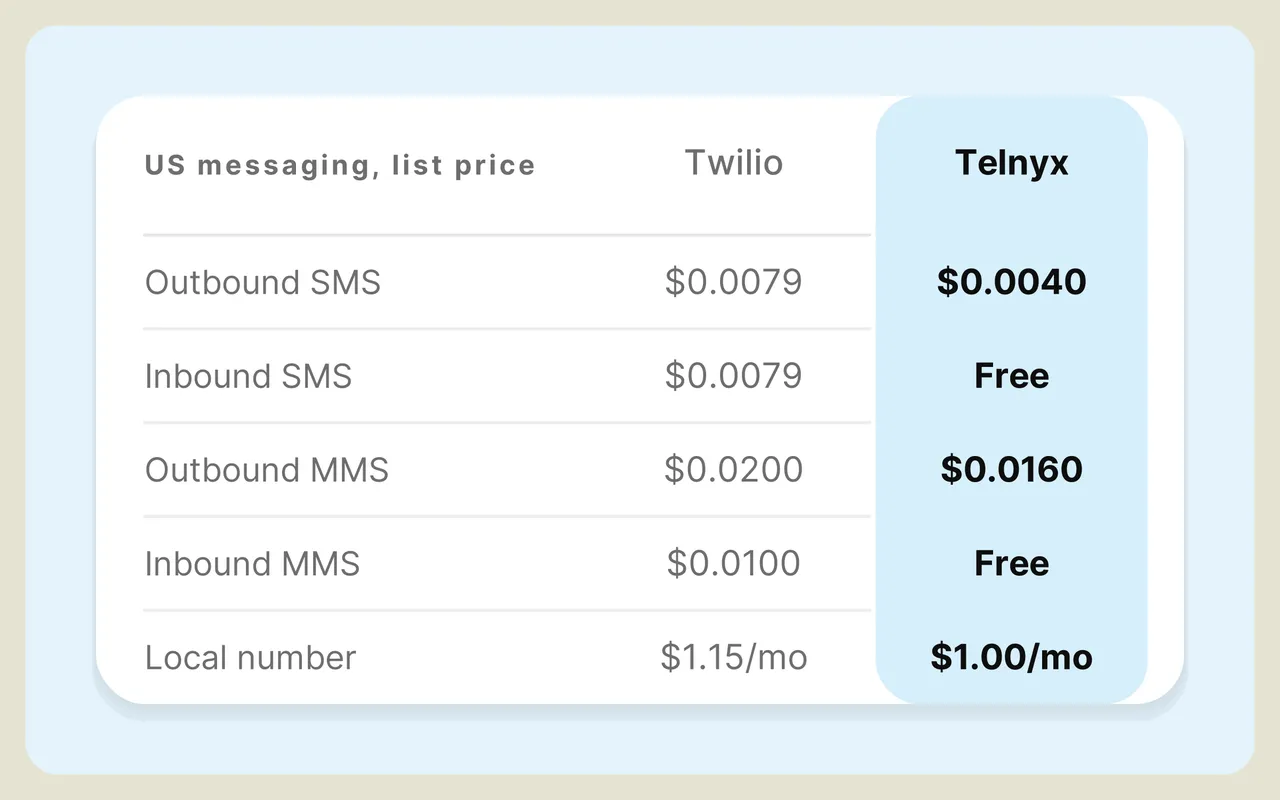
The short version of the Twilio vs Telnyx SMS pricing question: Telnyx charges $0.0040 per outbound US SMS and nothing for inbound. Twilio charges $0.0079 per message in both directions at list price. Before carrier fees, Twilio costs roughly twice as much per message. After carrier fees, the gap narrows in percentage terms but grows in absolute dollars as volume climbs.
That gap is why the comparison matters. Once a sender's all-in Twilio cost crosses one cent per message, the math at scale stops being a rounding error and starts being a line item a finance team asks about, often right as a contract renewal deadline arrives.
Side-by-side SMS rate comparison for 2026
Rates below reflect published list pricing as of January 2026. Check the live Twilio SMS pricing page and the Telnyx pricing page before modeling your own volume, since list rates change.
| Message type | Twilio | Telnyx |
|---|---|---|
| Outbound SMS (long code) | $0.0079 | $0.0040 |
| Inbound SMS | $0.0079 | Free |
| Outbound MMS | $0.0200 | $0.0160 |
| Inbound MMS | $0.0100 | Free |
| Local number rental | $1.15/month | $1.00/month |
Carrier fees and hidden surcharges
Both providers pass through the fees that US mobile carriers charge on application-to-person traffic. AT&T, T-Mobile, and Verizon each add roughly $0.003 per outbound 10DLC SMS, and neither Twilio nor Telnyx controls those fees. What each provider does control is everything stacked on top of the pass-through: the base message rate, number rental, and any platform charges.
Note: Your true per-message cost on either platform is base rate + carrier pass-through fee. Both platforms also pass through 10DLC registration costs (a $4 one-time brand fee and roughly $10 per month for a standard campaign) and charge monthly number rental. When you compare quotes, compare the all-in figure, never the base rate alone.
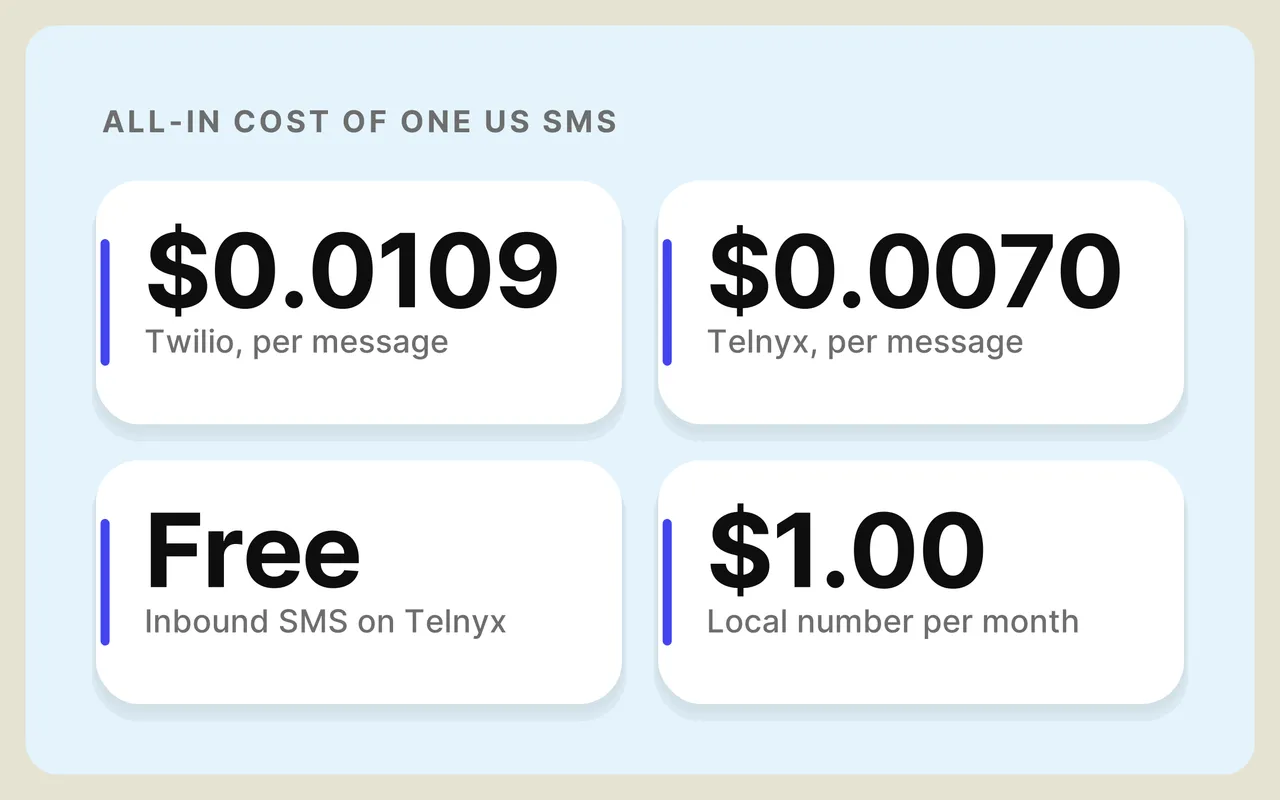
On Twilio, that stack works out to about $0.0109 per SMS at list price ($0.0079 base plus $0.003 carrier fee). On Telnyx, the same message costs about $0.0070 all-in ($0.0040 base plus the same $0.003 pass-through). Same carriers, same fees, different markup.
What the difference means at volume
Run the numbers at realistic volumes. At 500,000 messages per month, Twilio's all-in list cost is about $5,450 per month, or $65,400 per year. Telnyx comes to about $3,500 per month, or $42,000 per year. That is $23,400 in annual savings at identical traffic. At 5 million messages per month, the same math produces roughly $654,000 per year on Twilio against $420,000 on Telnyx, a difference of $234,000 annually before any volume discount is applied.
[BRANDED ASSET: bar_chart - estimated annual all-in SMS spend, Twilio vs Telnyx, at 100K, 500K, and 5M messages per month, including carrier fees]
The reason for the gap is structural rather than promotional. Telnyx operates its own network with direct connections to US carriers, so there is no reseller layer taking a margin on every message. Providers that ride on resold infrastructure have to price above their own wholesale costs, which is how all-in rates end up north of one cent. A discount can shrink a markup for a contract term. Owning the network removes it.
Cut your per-message costSend US SMS from $0.0040 per message with free inbound on the Telnyx Messaging API, running on a network Telnyx owns end to end.
Explore the Messaging APITelnyx SMS pricing breakdown
Telnyx US SMS rates for 2026
Telnyx pricing is flat and public. Outbound US SMS is $0.0040 per message across long code, toll-free, and short code routes. Inbound SMS is free. Outbound MMS is $0.0160 and inbound MMS is free. Carrier pass-through fees apply on outbound traffic exactly as they do everywhere else, with no markup added.
The figures below are current as of January 2026 and verifiable against the live Telnyx pricing page. Carrier pass-through fees apply on every provider in the market, so the numbers that actually separate providers are the base rate and the markup, never the pass-through itself.
| Channel | Outbound SMS | Outbound MMS |
|---|---|---|
| Long code (10DLC) | $0.0040 | $0.0160 |
| Toll-free | $0.0040 | $0.0160 |
| Short code | $0.0040 | $0.0160 |
Inbound messages are free on all three channels. Toll-free senders complete a free verification step required across the industry.
Campaign registration is passed through at cost:
| Pass-through item | Telnyx price |
|---|---|
| 10DLC brand registration | $4 one-time (pass-through) |
| 10DLC standard campaign | ~$10/month (pass-through) |
Number costs are equally direct. Telnyx phone numbers are available in 140+ countries, with US local numbers at $1.00 per month and instant activation. Short codes carry a registry lease of $500 per month for a random code or $1,000 per month for a vanity code, and those lease costs are the same regardless of provider.
US carrier fees by network in 2026
US carriers set their own per-message surcharges on A2P traffic, following the interoperability framework described in the CTIA messaging guidelines. Every provider passes these through.
| Carrier | SMS fee | MMS fee |
|---|---|---|
| AT&T | $0.0030 | $0.0050 |
| T-Mobile | $0.0030 | $0.0100 |
| Verizon | $0.0030 | $0.0050 |
To compute your true all-in cost per message, add the carrier fee for the destination network to the base rate. A 10DLC SMS to an AT&T subscriber costs $0.0070 all-in on Telnyx and $0.0109 on Twilio at list price. The pass-through is identical in both cases. The markup is the entire difference.
Telnyx SMS API pricing and what's included
There is no platform fee on top of the per-message rate. The full Messaging API, webhooks, delivery reports, number pooling, and the Mission Control portal are all included. The distance from pricing page to production is short. This Flask example runs a rate-limited bulk campaign against the Telnyx API:
The full example on GitHub adds campaign creation, batch sending, and delivery tracking via webhooks. Every feature in it is covered by the per-message price.
Volume discounts and committed-use pricing
List rates are the ceiling, never the floor. Telnyx applies automatic volume discounts as monthly traffic grows, and high-volume senders can negotiate committed-use agreements that lock in lower per-message rates for the contract term. For teams sending millions of messages per month, committed pricing turns an already lower base rate into a materially smaller annual bill.
Having a whole stack ownership lets us also control the pricing of it, so that we can charge a fair amount and not increase the charges overnight just because one of our vendors has decided to increase the price.
That stability matters most after you switch. A provider that resells someone else's network inherits that network's price changes. A provider that owns its network sets its own rates and can hold them. Moving traffic over is fast as well. Migrations from other providers typically take days, not months, so a lower committed rate starts paying off within the same billing cycle.
Why teams switch from Twilio to Telnyx
Beyond price: control, deliverability, and support
Price opens the conversation, but the value that keeps teams on the platform is control. Because Telnyx owns the full telephony stack, senders get granular delivery receipts per carrier, real-time webhooks, and number lookup data that returns carrier and line type before a message is sent, which cuts spend on unreachable numbers. Support comes from engineers who operate the network the traffic runs on, so deliverability questions get answered with routing data instead of ticket numbers.
Moving from either Twilio or VAPI to Telnyx is the level of control we have on the telephony side. Like, even compared to Twilio, I feel like people are surprised by what we're able to control.
For a broader look at features, deliverability tooling, and API differences beyond cost, see the full Telnyx vs Twilio comparison.
How to migrate SMS from Twilio to Telnyx
A Twilio-to-Telnyx SMS migration is a bounded project, and it is routinely completed within a week. The sequence looks like this:
- Port your numbers. Long codes, toll-free numbers, and short codes all port to Telnyx, and existing traffic keeps flowing during the port.
- Transfer your 10DLC campaigns. Brands and campaigns registered with The Campaign Registry move to Telnyx without re-vetting your use case from scratch.
- Swap the API endpoint. The Telnyx Messaging API follows familiar REST patterns, so most integrations change a base URL, credentials, and webhook handlers.
- Test and cut over. Send test traffic per carrier, confirm delivery receipts, then shift production volume.
Teams under a contract-notice deadline can run the port and the integration work in parallel, which is how one-week cutovers happen in practice. The migration tool on GitHub audits an existing Twilio account and maps numbers, messaging profiles, and webhook configs to their Telnyx equivalents automatically.
FAQ
Run the numbers on your own trafficModel your all-in cost at your real volume, or talk to our team about committed-use pricing and a migration plan measured in days. Create a free account and start sending at $0.0040 per message.
Sign up freeShare on Social

Serhii Omelchenko
Global AEO/SEO Manager
Serhii is Global AEO/SEO Manager at Telnyx, based in Amsterdam, he is focused on making communications infrastructure findable and credible across both traditional search and AI-driven discovery. He previously led SEO and GEO strategy for some of the world’s most recognized consu


