
Conversational AI
Voice AI in Healthcare: A Guide for Australian Healthcare Providers
A practical guide for Australian healthcare organisations evaluating Voice AI. Covers patient journey workflows, infrastructure considerations, data sovereignty, and what to ask vendors before deploying.
%20(1).png?width=400&format=webp)
Healthcare organisations across Australia are continually looking for ways to improve patient access while managing growing demand and increasing operational pressure. Much of that demand still comes through one channel: the phone.
Patients call to book appointments, follow up on referrals, request prescription refills, reschedule visits, confirm instructions, and ask routine questions. These conversations are often the first step in accessing care and play a significant role in the overall patient experience.
Many of these interactions are administrative rather than clinical. They consume staff time, create queues, and reduce the time available for conversations that require clinical expertise or human judgment.
Voice AI gives healthcare organisations a way to automate routine patient communication while keeping clear escalation paths for more complex or sensitive conversations. But moving from a proof of concept to production requires more than choosing the right AI model. It requires communications infrastructure built for reliable, real-time conversations.
This guide explores where Voice AI fits across the patient journey, what Australian healthcare organisations should look for when evaluating a platform, and why communications infrastructure is just as important as the AI itself.
Why Voice AI in Healthcare Makes Sense Now
Healthcare communication is particularly well suited to Voice AI because many patient interactions follow predictable workflows.
Patients call to book appointments, reschedule visits, request prescription refills, check referral status, or ask questions about their upcoming care. These interactions are important, but they do not always require a member of staff to complete them.
Voice AI can automate routine administrative conversations while escalating more complex requests to the right person. That helps improve patient access, reduce administrative workload, and free healthcare teams to focus on delivering care.
Healthcare workflows that are well suited to Voice AI include:
High-volume, repeatable calls: Appointment booking, reminders, patient intake, prescription refills, FAQs, and follow-ups follow structured workflows that Voice AI can manage consistently.
Phone-first patient behaviour: Unlike many industries, healthcare remains voice-first. Patients often prefer to call when they need timely answers or personal guidance.
After-hours demand: Patients remember health admin tasks outside business hours. Voice AI provides support for bookings, reminders, and common questions 24/7.
Administrative pressure: Healthcare teams continue to face growing administrative workloads. Voice AI helps reduce repetitive tasks so staff can spend more time supporting patients.
Faster patient access: Routine requests can be handled immediately, reducing wait times and helping care teams focus on conversations that require human expertise.
Where Voice AI Fits Across the Patient Journey
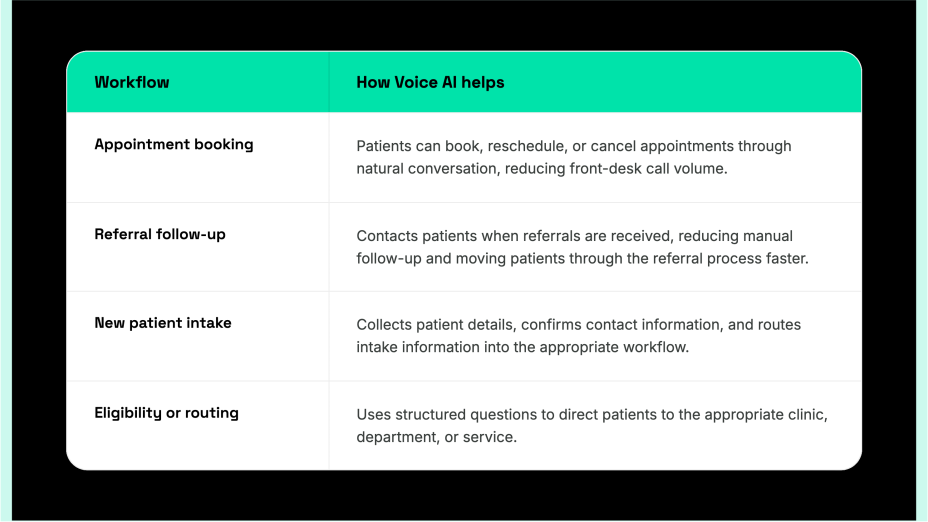
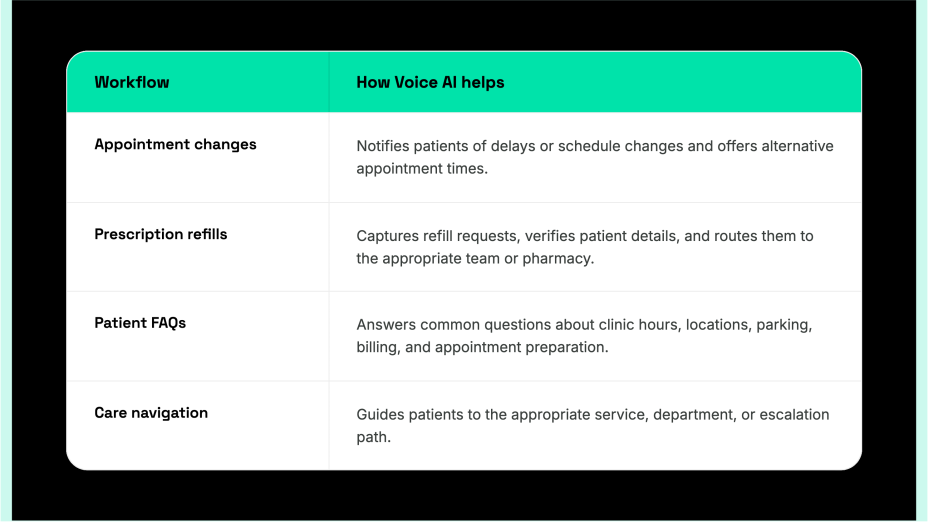
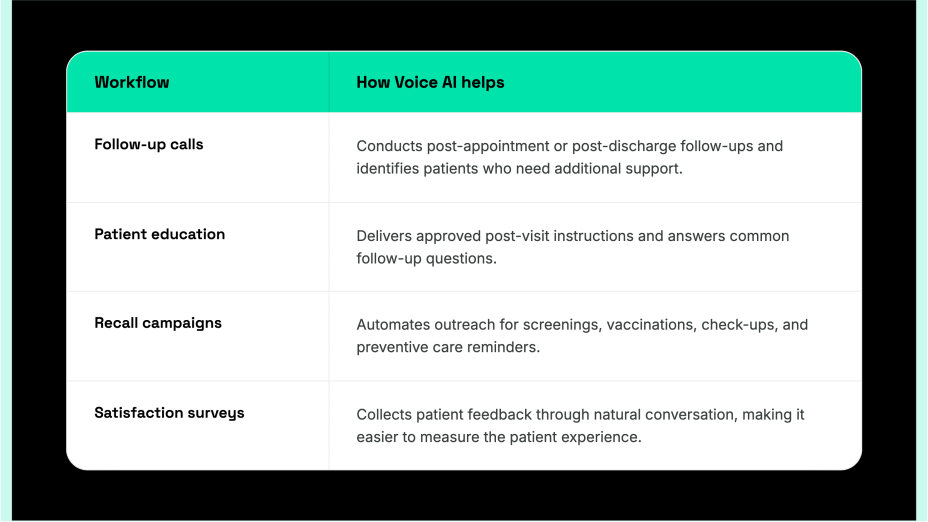
Voice AI in healthcare is not limited to a single workflow. It can support patient communication across the entire care journey, from the first appointment through to post-care follow-up.
Before the Patient Visit
During Patient Care
After Patient Care
Benefits of Voice AI in Healthcare
Voice AI is not about replacing healthcare teams. It is about making patient communication faster, more consistent, and easier to scale.
For healthcare providers, that can mean:
Improved patient access: Patients can book appointments, request information, or complete routine tasks without waiting on hold.
Lower administrative workload: Staff spend less time on repetitive requests and more time supporting patients who need human assistance.
More consistent communication: Approved workflows and responses are delivered consistently across every interaction.
Support beyond business hours: Patients can access routine services 24/7 without increasing staffing levels.
Scalable operations: Voice AI helps manage seasonal demand, service changes, and call spikes without compromising the patient experience.
The next step is choosing a platform that can deliver those outcomes reliably in production.
What to Look for in a Voice AI Platform
Choosing a Voice AI platform is about more than evaluating the AI model. In healthcare, every patient conversation involves operational workflows, sensitive information, and real-time communications. The infrastructure behind the platform is just as important as the AI itself.
When evaluating vendors, consider the following.
Data residency and governance
Patient conversations generate audio, transcripts, call recordings, and AI outputs. Healthcare organisations should understand where each stage of the conversation is processed, transmitted, and stored.
Ask questions such as:
- Where is voice data processed?
- Where are transcripts and recordings stored?
- Does patient data leave Australia during processing?
- What controls exist over data routing, retention, and deletion?
For Australian healthcare organisations, these are governance questions as much as technical ones.
Australian voices
Patients expect conversations to sound natural and familiar. Look for Australian English voices, accurate pronunciation of local names and places, and multilingual support where required.
Voice quality is more than a user experience feature. In healthcare, it helps build trust and confidence in automated interactions.
Infrastructure location
Latency is one of the biggest differences between a successful production deployment and a compelling demo.
If calls move between multiple vendors and cloud regions for speech-to-text, AI inference, and text-to-speech, delays quickly become noticeable. Patients talk over the agent, conversations feel less natural, and confidence in the experience drops.
Ask where telephony, speech-to-text, text-to-speech, and AI inference are physically hosted, and whether they are located close to your patients.
Healthcare integrations
Voice AI creates the most value when it can complete work, not just answer questions. Look for platforms that integrate with scheduling systems, practice management software, EHRs, CRMs, and internal workflows through APIs and automation tools.
Human escalation
Healthcare conversations do not always belong with AI. The platform should recognise when a patient needs human assistance and transfer the conversation, with context, to the appropriate team.
One communications platform
Healthcare communication rarely happens through a single channel. Patients may receive an SMS reminder, call to reschedule, receive a follow-up call, and later receive another message with instructions.
Managing voice, messaging, telephony, and AI across multiple vendors increases operational complexity. A unified communications platform makes those workflows easier to build, manage, and scale.
Why Telnyx for Australian Healthcare
Voice AI is only one part of the equation. The infrastructure behind it determines how quickly conversations respond, how patient data is handled, and how easily healthcare organisations can move from pilot projects to production deployments.
Many Voice AI deployments rely on separate providers for telephony, speech recognition, AI models, messaging, and orchestration. Every additional vendor introduces more latency, operational complexity, and potential points of failure.
Telnyx brings those layers together on one platform.
Our Sydney Point of Presence combines Australian telephony with co-located GPU infrastructure for speech-to-text, text-to-speech, and LLM inference. Calls, media, and AI processing stay on the same network, closer to Australian patients, helping deliver faster, more natural conversations.
Rather than routing calls between multiple providers and cloud regions, audio enters the Telnyx network and stays on the same local stack for telephony, speech processing, and AI inference.
Built for Australian healthcare
Healthcare organisations need visibility and control over how patient data is stored, transmitted, and processed throughout every interaction.
With Telnyx:
Data at rest: Call recordings, transcripts, and logs can remain stored in Australian data centres with configurable retention policies to support local governance requirements.
Data in motion: Voice traffic stays on the Telnyx private network, reducing unnecessary cross-border routing during live conversations.
Data processing: Speech-to-text, text-to-speech, and LLM inference can all run on Sydney-based GPU infrastructure, giving organisations greater control over where patient conversations are processed.
A full-stack platform for Voice AI
Rather than stitching together multiple vendors, healthcare teams can build on a single communications platform.
That includes:
Australian phone numbers and carrier-grade telephony
Sydney-hosted speech-to-text, text-to-speech, and LLM inference
Australian English voices for natural patient conversations
Voice AI, Voice API, SMS, and SIP Trunking on one platform
One API. One platform. One support team.
Whether you're deploying your first Voice AI workflow or scaling patient communication across multiple sites, Telnyx provides the communications infrastructure to build, deploy, and scale Voice AI in Australia.
Deploy Voice AI with Australian telephony, Sydney-hosted AI infrastructure, and one communications platform - Schedule a demo.
Share on Social
Megha is a Dubai-based product marketing manager from India. She has a master's degree in Innovation Management and Entrepreneurship from the University of Manchester, with 8 years of experience in tech marketing, having previously worked as head of marketing at Vantheon Technolo


