

- The WhatsApp Business API cost is Meta's fee per delivered message plus your provider's fee, and on Telnyx that is Meta's rates at $0 markup plus just $0.004 per message, so you can work out your whole bill line by line.
- A 50,000-message month to North America comes to $583 on a single invoice, of which $382.60 is Meta and $200.00 is Telnyx, or $0.0117 per message all in, with no platform fee, minimum or contract.
- Meta's North America rates are $0.0250 for marketing and $0.0034 for utility, authentication and service, with the first 1,000 service replies per number free each month.
- Category moves the bill most, since 10,000 messages cost $34.00 in Meta fees as utility and $250.00 as marketing.
How much does the WhatsApp Business API cost in 2026?
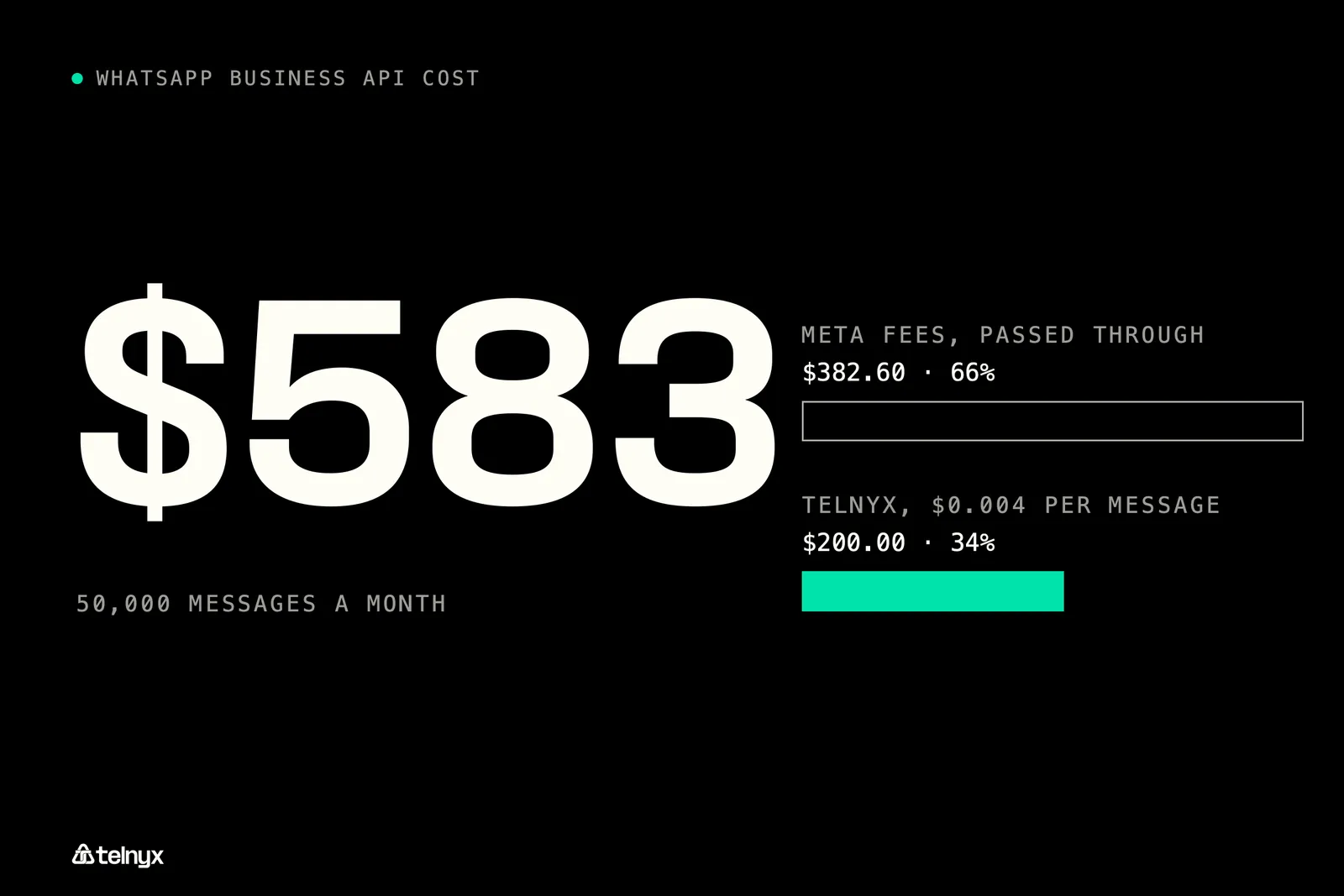
Your WhatsApp Business API cost is Meta's fee for each delivered message, set by the message's category (marketing, utility, authentication or service) and the recipient's country, plus whatever your provider adds. On the Telnyx WhatsApp Business API, Meta's rates pass through at $0 markup and Telnyx adds just $0.004 per message.
Meta bills only the delivered messages you send, never the ones customers send you. Since October 1, 2026, the free-form replies your team writes (Meta calls them service messages) bill after the first 1,000 per number each month.
What a 50,000-message month costs, line by line
Take a month of 50,000 messages to North America: 10,000 promotions, 20,000 order and delivery updates, 15,000 one-time passcodes and 5,000 replies from your team. On the Telnyx pricing estimator that month totals $583. Three inputs produce every line of it: your message count in each category, the recipient's country and how many numbers you send from.
| Line on the invoice | Volume and rate | Monthly cost |
|---|---|---|
| Meta marketing | 10,000 x $0.0250 | $250.00 |
| Meta utility | 20,000 x $0.0034 | $68.00 |
| Meta authentication | 15,000 x $0.0034 | $51.00 |
| Meta service | 5,000, first 1,000 free, 4,000 x $0.0034 | $13.60 |
| Telnyx platform usage | 50,000 x $0.004 | $200.00 |
| Platform fee, minimum, contract | none | $0 |
| Total | 50,000 messages | $583 |
The Meta lines on your bill use Meta's North America rates as of November 5, 2026, read from the Telnyx WhatsApp pricing estimator, and they exclude taxes. You pay Meta $382.60 across its four lines, or 66% of your bill, and Telnyx's line is the other 34%. Your lines sum to $582.60, which the estimator shows as $583, and you pay $0.0117 per message all in.
WhatsApp calls are a separate line: $0.0025 per minute to Telnyx, plus Meta's calling fee of $0.0121 per minute in North America on calls you place, while calls customers place to you carry no Meta fee.
If a Telnyx AI Assistant answers on the number, its model and speech usage is billed on top, at the rates on Voice AI Agents pricing.
WhatsApp Business API cost per message, by category and market
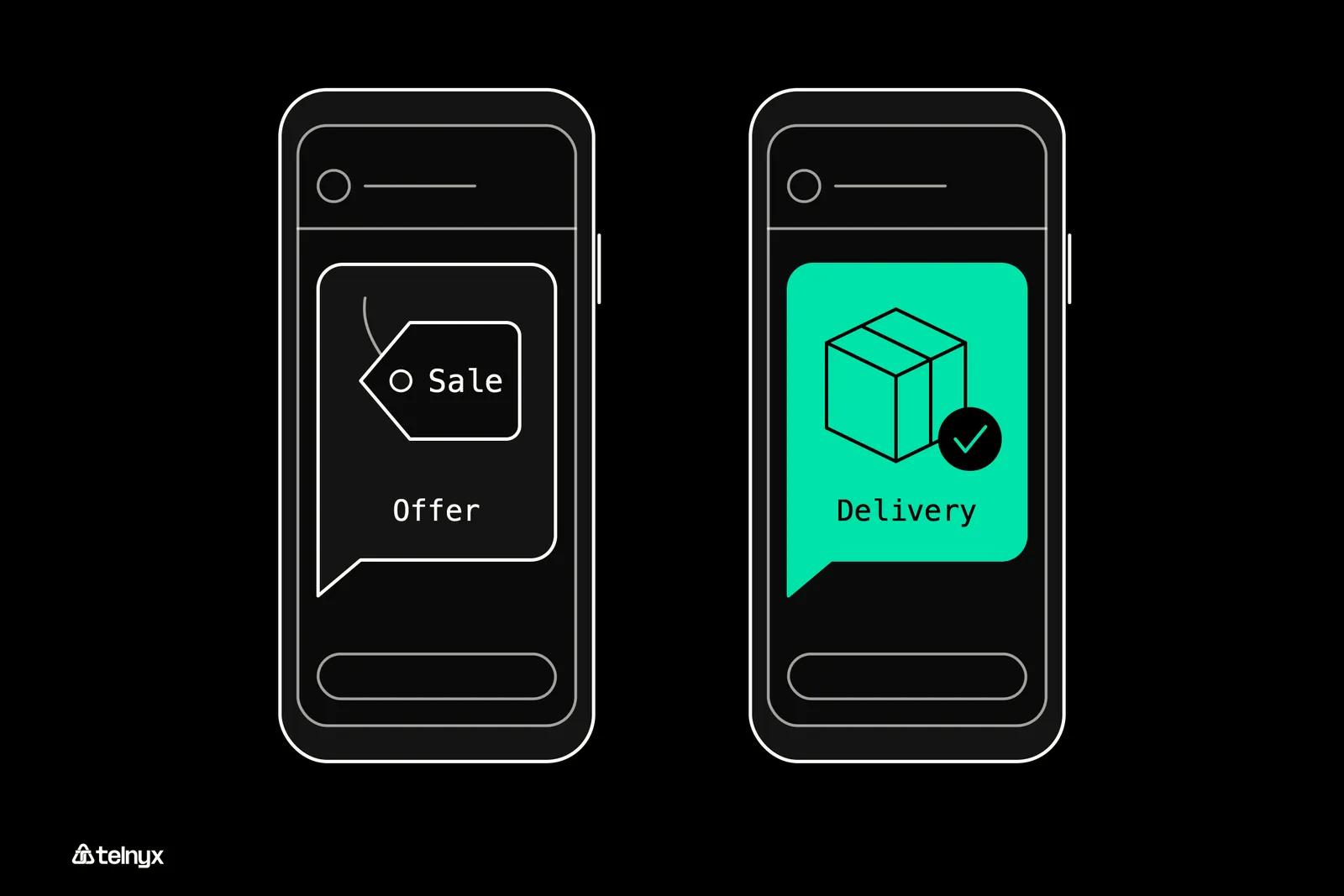
Every time you send a WhatsApp message through Telnyx, Telnyx's flat fee is added to Meta's rate for that message's category. One message costs the sum of the two.
Meta files each message under one of four categories.
- Marketing is a promotion you send first.
- Utility covers ecommerce order updates, delivery notices and appointment reminders.
- Authentication is a one-time passcode.
- Service is a free-form reply your team writes inside the 24-hour window.
Cost of one message to North America, Meta's rates as of November 5, 2026
| Message category | Meta's rate, North America | All in on Telnyx |
|---|---|---|
| Marketing | $0.0250 | $0.0290 |
| Utility | $0.0034 | $0.0074 |
| Authentication | $0.0034 | $0.0074 |
| Service, after the first 1,000 per number | $0.0034 | $0.0074 |
| Service, first 1,000 per number | free | $0.004 |
A flat fee weighs differently on each row. On a marketing message, the Telnyx fee adds 16% to Meta's $0.0250. On a utility message it is larger than Meta's own rate. Your category mix therefore decides your bill more than any headline rate does.
Meta's part also moves with the recipient's market.
- The rate follows the country of the phone you message, whichever country you send from.
- Meta's pricing rules set out the rate card and its volume tiers.
Meta's rates by recipient market, as of November 5, 2026
| Recipient market | Marketing | Utility and authentication |
|---|---|---|
| North America | $0.0250 | $0.0034 |
| United Kingdom | $0.0635 | $0.0220 |
| Brazil | $0.0625 | $0.0068 |
| Germany | $0.1365 | $0.0550 |
| India | $0.0118 | $0.0014 |
Sending to another market changes only these Meta rates. Pick the destination in the estimator, or read the two rates from Meta's rate card, and run the same sum.
How to compare WhatsApp API pricing across providers
Meta's fee is the same with every provider, so the only line you can compare is the provider's own. Telnyx publishes its line in full: Meta's rates at $0 markup, a per-message fee, no fixed charges around it and both parts on a single invoice. The same rates are published in machine-readable form at GET /v2/public/pricing?primitive=whatsapp.
Direct to Meta, or through a provider?
- Voice or SMS already on Telnyx numbers: add Telnyx WhatsApp Business API to the same number. One invoice covers voice, SMS and WhatsApp, with Meta's rates at $0 markup.
- AI answering both chats and calls: use a Telnyx AI Assistant on your WhatsApp number. Chats and calls share one number, and WhatsApp messages still cost Meta's rate plus $0.004.
- Platform onboarding your own customers: use a Telnyx hosted signup link. Each customer connects their own WhatsApp Business Account, with no platform fee, minimum or contract on Telnyx.
- WhatsApp only, engineers to maintain Meta: going direct to Meta avoids the provider fee, and you maintain the integration yourself.
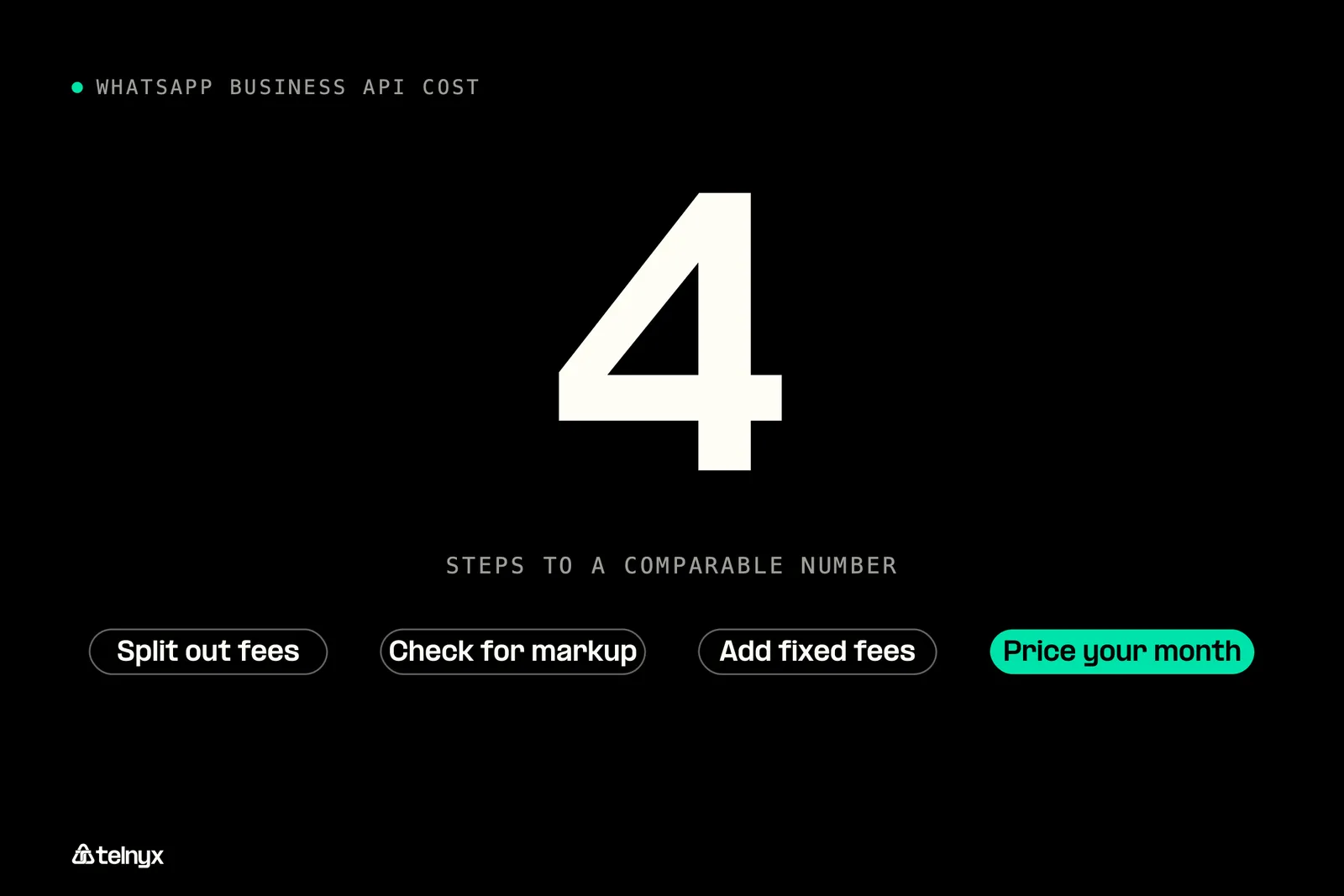
Any quote becomes comparable in four checks. First, split Meta's fees from the provider's fee. Second, check whether Meta's rates are marked up. Third, add any fixed fees, such as a platform or seat subscription, a monthly minimum or a contract term. Fourth, price your own month with your own volumes. You can put them to a provider as four questions, and Telnyx's published answer follows each one here.
- Are Meta's fees passed through unchanged? Yes.
- What is your own fee per message? One flat fee, the same in every category.
- Is there a platform fee, minimum or contract? None.
- Are both parts on one invoice? Yes, a single invoice.
Telnyx vs Twilio WhatsApp pricing in a worked example
Run the same 50,000-message month through both providers and the Meta lines are identical, because Meta bills its own rate card whichever provider carries the message. Only the provider line differs.
Twilio's per-message fee, the message types it applies to and any fixed charges are on Twilio's WhatsApp pricing page. Read them on the day you compare. Check whether the fee applies to messages your customers send you as well as the ones you send, because that decides how many messages the Twilio line is multiplied by.
| Line | Telnyx | Twilio |
|---|---|---|
| Meta fees | $382.60 | $382.60 |
| Provider fee per message | $0.004 | see Twilio's pricing page |
| Provider line for the month | $200.00 | that fee x the messages it applies to |
| Platform fee, minimum, contract | none | see Twilio's pricing page |
| Total | $583 | $382.60 plus Twilio's line |
Should you go direct to Meta or use a provider?
You pay Meta's WhatsApp Cloud API pricing from the same rate card on both paths. What changes for you is who does the work and what else runs on your number.
- Through Telnyx: WhatsApp runs on the same number and the same invoice as your phone calls, SIP (Session Initiation Protocol) and SMS, and a Telnyx AI Assistant can answer chats and calls on that number.
- Direct to Meta: there is no provider fee, but you build and maintain the Meta integration yourself, and you pay Meta separately through its Billing Hub.
Since Meta's fee does not change with the path, weigh the provider line against the engineering time the integration takes and the channels you want on one number.
How to reduce WhatsApp Business API cost when Meta sets the rate
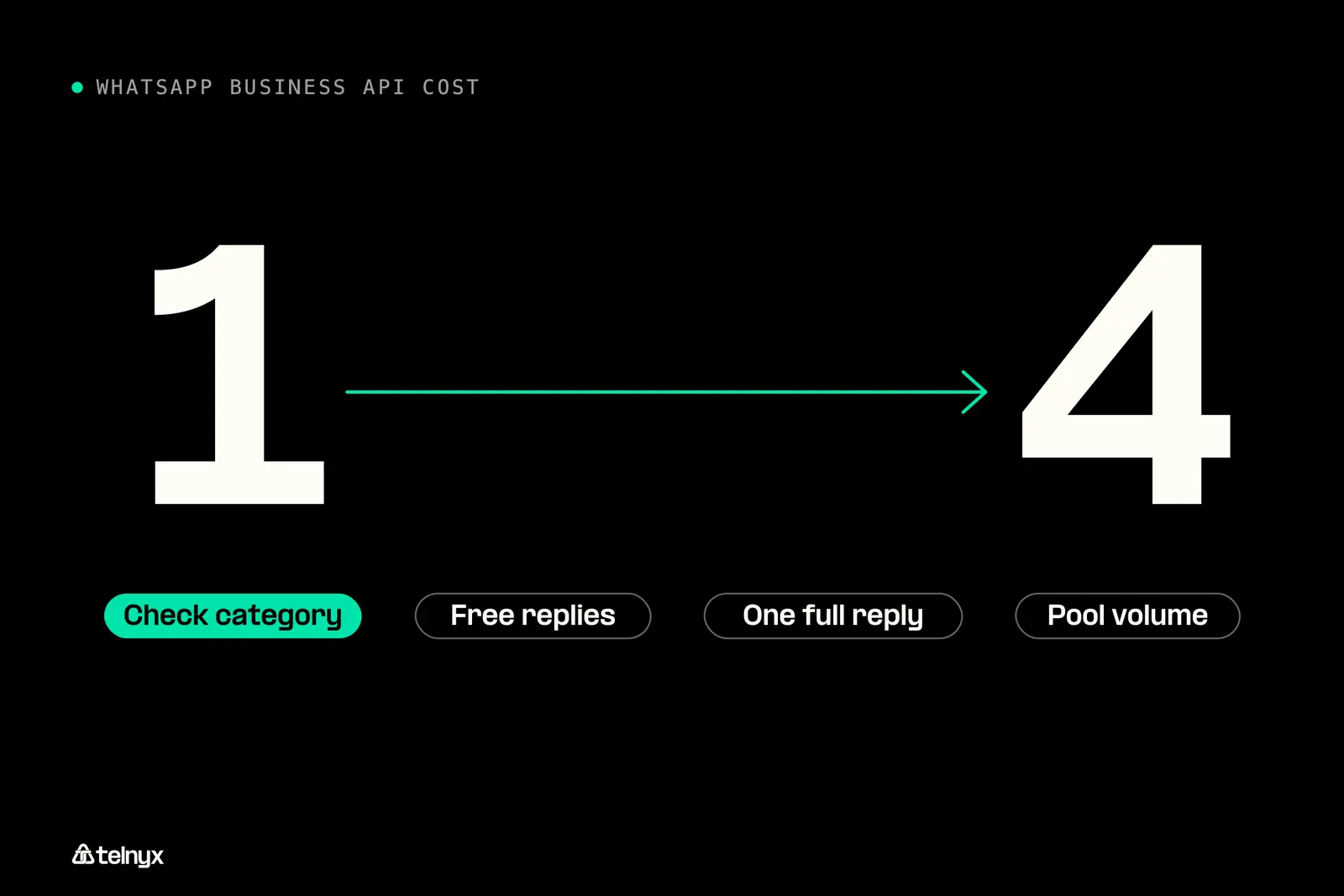
The largest saving is the category each template is approved in. Meta assigns the category at approval, and on the worked month moving 10,000 messages from marketing to utility saves $216.00. Check the approved category of every template you send at volume. When you create a message template on Telnyx and submit it for Meta approval from the portal, the category is shown there.
| What you change | On the worked month | What it is worth |
|---|---|---|
| Template category | 10,000 messages at the utility rate in place of marketing | $34.00 against $250.00, saves $216.00 |
| Free service replies | first 1,000 per number each month | $3.40 per number |
| Fewer, fuller replies | one reply in place of three, past the free tier | $0.0074 against $0.0222 |
| Meta volume tiers | 20,000 utility and 15,000 authentication | $0.00 at this volume |
The free service allowance helps, but it is too small to justify adding numbers. You can list your WhatsApp numbers to count how many already carry it.
Reply count is the third lever, and it matters most if your contact center agents answer in short bursts. Past the free tier you pay Meta's service rate plus the Telnyx fee for each service reply, $0.0074 in all. Three short fragments cost you $0.0222 where one full reply costs you $0.0074.
Meta's volume tiers come last. They apply to the utility, authentication and calling you send, and leave your marketing and service replies at the list rate. At 20,000 utility and 15,000 authentication messages the Telnyx estimator shows $0.00 saved by tiers, so they only matter to you at much higher volume.
WhatsApp Business API cost FAQ