
Insights and Resources
AI Compute: what it is, how it works, and why it matters
When people talk about the cost of AI, the scarcity of chips, or the latency of a voice assistant, they are talking about AI compute.

By Eli Mogul

AI compute is the computational infrastructure, primarily GPUs, TPUs, and specialized accelerators, used to train and run AI models. It powers every stage of the AI lifecycle, from processing raw data to training a model to serving real-time predictions. When people talk about the cost of AI, the scarcity of chips, or the latency of a voice assistant, they are talking about AI compute. Understanding it is the first step toward making infrastructure decisions that hold up under real workloads.
Most explanations stop at the hardware. That misses the part that matters most for anyone building production AI: where your compute lives is as consequential as how much you have. A GPU sitting three network hops away from your data behaves very differently from one sitting next to it. This guide covers what AI compute is, how it works, and the infrastructure choices that shape latency, cost, and data sovereignty.
What is AI compute
AI compute refers to the processing power required to run the math behind machine learning. Neural networks are, at their core, enormous chains of matrix multiplications. Training and running them demands hardware that can perform billions of these operations in parallel, which is why graphics processors, originally built to render video game frames, became the default engine of modern AI.
NVIDIA frames AI computing as a three-step process: extract, transform, and load data (ETL), train the model, and then run inference to generate insights from new inputs. That structure is useful, but the interesting decisions happen underneath it, in the infrastructure that carries data between each step.
The three inputs: data, algorithms, compute
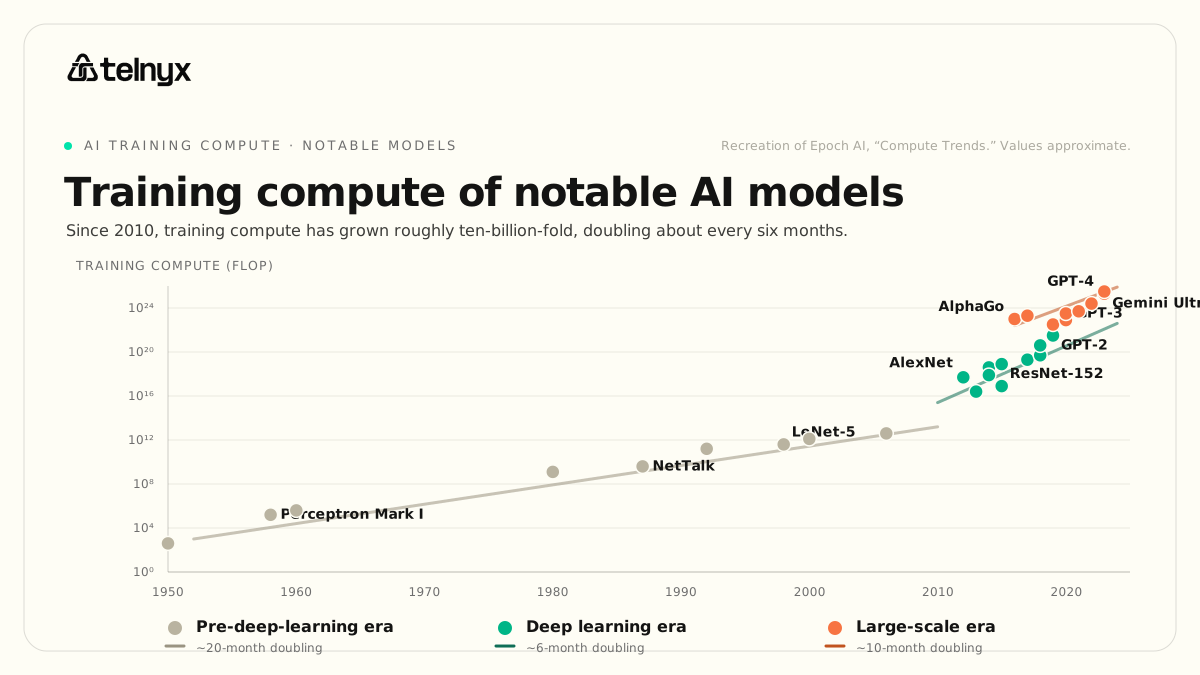
Every AI system rests on three inputs. Data is the raw material. Algorithms are the model architecture and training methods. Compute is the horsepower that turns the first two into a working model. You can have excellent data and a strong algorithm, but without sufficient compute, training stalls and inference crawls. Compute is the input that scales most directly with cost, which is why it dominates infrastructure budgets. Its trajectory is steep: training compute for the largest models has grown by a factor of 10 billion since 2010, far outpacing Moore's Law.
Training compute vs inference compute
The single most important distinction in AI compute is the split between training and inference.
Training is the one-time, capital-intensive process of teaching a model. It runs across large GPU clusters for hours or days, processing massive datasets to set the model's parameters. It is expensive, batched, and not latency-sensitive. Nobody cares if a training run finishes at 2:00 or 2:05.
Inference is the recurring, operational process of running a trained model on new inputs. It powers every user-facing interaction: a chatbot response, a transcription, a voice agent reply. Inference is smaller per request but latency-sensitive, and it scales with usage. Every query costs compute.
This split matters because enterprise spend is shifting decisively toward inference. Inference now accounts for an estimated 60 to 70 percent of total AI compute demand across major hyperscalers, up from roughly 40 percent in 2024. For a deeper look at the two workloads, see our breakdown of ML inference and how it differs from training.
Why AI compute infrastructure matters
Once a model is trained, the questions that determine whether it works in production are all infrastructure questions. Three stand out: latency, cost, and sovereignty.
Latency: where your GPUs live determines your response time
For real-time AI, physical distance is the enemy. Every network hop between vendor boundaries adds delay. A voice AI pipeline stitched together from separate providers routes audio from a telephony vendor to a speech-to-text vendor to an LLM vendor to a text-to-speech vendor, and each handoff crosses the public internet and adds latency.
A typical voice AI agent latency budget breaks down across network ingress and SIP signaling (50 to 200ms), speech-to-text (80 to 300ms), LLM inference (150 to 1,000ms), and text-to-speech (60 to 250ms). The inter-vendor hops on a stitched architecture dominate that budget. Co-located infrastructure collapses those hops by running every layer on one network. This is the core of how AI voice works at conversational speed.
Cost: the compute squeeze and what drives it
AI compute has become one of the largest line items in technology budgets. The four largest hyperscalers alone are on track to spend roughly $725 billion on AI infrastructure in 2026, up about 77 percent from the prior year, with the vast majority directed at compute, data centers, and networking. BloombergNEF's analysis finds these operators report being supply-constrained rather than demand-constrained, a sign that appetite for compute still outruns the ability to build it.
For most teams, the real cost driver is not raw compute but architectural inefficiency. Every third-party vendor in a pipeline adds a markup, and every hop adds latency that has to be engineered around. Owning fewer layers, or working with a provider that owns more of them, changes the unit economics. Our analysis of scaling voice AI costs walks through where the money actually goes.
Data sovereignty: regional compute requirements
Where AI runs is increasingly a legal question, not just a performance one. The EU AI Act for high-risk system obligations take effect on August 2, 2026, with penalties up to 7 percent of global annual turnover. A subtle trap: choosing an EU region from a US-headquartered provider does not guarantee sovereignty, because the US CLOUD Act can still compel access to that data regardless of where the servers sit. Meeting these requirements means running compute, not just storing data, inside the relevant jurisdiction.
How AI compute works
Underneath the abstractions, AI compute is three layers working together: hardware, software, and network.
The hardware: GPUs, TPUs, and accelerators
GPUs handle the parallel matrix math that neural networks require, which is why they dominate both training and inference. TPUs are Google's application-specific chips, tuned for tensor operations and tightly coupled to TensorFlow and JAX. Specialized inference accelerators are a growing third category. The right choice depends on your framework, your workload, and your ecosystem. Our TPU vs GPU comparison covers the tradeoffs in detail.
The software: inference engines and model serving
Hardware alone does nothing. An inference engine is the software layer that loads a trained model into memory and executes it efficiently against incoming requests, handling batching, memory management, and throughput optimization. This layer determines how much useful work you extract from each GPU. It is where a well-tuned stack pulls ahead of a naive one.
The network: why proximity is performance
The network connecting compute to data and users is the overlooked layer, and it is where real-time AI is won or lost. Most edge compute providers place GPUs in cloud-adjacent regions and call it edge, which shortens the distance but keeps inference on a separate network hop from the application. Running the model on the same network where the data originates removes that hop entirely. For workloads that span multiple nodes, distributed inference spreads the load while keeping proximity intact.
Choosing an AI compute provider
The decision comes down to how much of the stack a provider owns and how far your data has to travel. The table below frames the two dominant models.
| Factor | Multi-vendor stack | Co-located compute |
|---|---|---|
| Latency | 4+ network hops, delay compounds at each vendor boundary | Single network, hops removed, designed for sub-200ms RTT |
| Data sovereignty | Depends on each vendor's footprint and headquarters | Compute runs in-region, one jurisdiction to verify |
| Support and billing | Separate contract, invoice, and support desk per vendor | One platform, one bill, one point of contact |
| Model access | Locked to each vendor's supported models | OpenAI-compatible endpoint, multiple models via one API |
Co-located vs stitched-together infrastructure
A stitched-together pipeline assembles four to six vendors for a single voice AI workload. Each seam is a place where latency accrues, a markup compounds, and support fragments. This assembled stack has a name in the industry: the Frankenstack. Co-located infrastructure puts telephony and GPU compute in the same facilities, on the same private network, which removes the seams rather than papering over them.
Multi-model access and vendor lock-in
Committing your infrastructure to a single model provider is a risk. A provider offering OpenAI-compatible endpoints lets you route to different models, including open-source LLMs, through one interface. You can swap models as the field moves without rebuilding your stack.
Regional infrastructure and data sovereignty
Sovereignty is becoming a default requirement rather than an edge case. A provider with in-region compute across the Americas, Europe, and APAC lets you keep data and inference inside the borders your regulators care about, with the flexibility to expand as localization laws multiply.
AI compute use cases
Real-time voice AI
Voice AI is the workload that makes the latency argument concrete. A natural conversation leaves almost no room for delay, so every millisecond of network overhead is audible as an awkward pause. Co-locating speech-to-text, LLM inference, and text-to-speech in the same facility where the call lands is what keeps a voice agent feeling human rather than robotic.
Inference at scale
High-volume workloads such as batch transcription, retrieval-augmented generation, and document processing depend on inference throughput and predictable per-request cost. Here the win is economic: owning the compute removes the per-token markup that resellers add, and a well-tuned inference engine maximizes work per GPU.
Edge AI compute
Edge AI pushes inference closer to where data is created, cutting both latency and bandwidth cost. For voice, IoT, and other latency-sensitive workloads, running the model at the network edge rather than a distant cloud region is the difference between a responsive system and a laggy one.
The future of AI compute
Three trend lines are converging, and they all point the same direction.
First, the GPU crunch has moved rather than disappeared. The computing power needed to train AI has grown seven times faster than hardware efficiency gains. While chip scarcity has eased, the constraint is now whether you can serve inference fast enough and cheaply enough to run real-time workloads at scale. Efficiency matters as much as raw capacity.
Second, regional sovereignty is shifting from a nice-to-have to a baseline requirement. With the EU AI Act, expanding localization laws across Asia and Latin America, and the sovereignty gap in US-headquartered cloud regions, in-region compute is becoming the price of doing business in regulated markets. Analysts now frame data sovereignty as an AI strategy risk rather than a compliance footnote.
Third, spend is moving from training to inference. Training is a one-time capital event; inference is a recurring cost that scales with every user interaction. McKinsey projects that inference will become the dominant workload by 2030, reshaping how infrastructure gets built. The infrastructure decisions that once optimized for training throughput are being replaced by decisions that optimize for inference latency and cost. Providers built around co-located, regional inference are aligned with where the market is heading, not where it has been.
Frequently asked questions
What is AI compute? AI compute is the computational infrastructure, primarily GPUs, TPUs, and specialized accelerators, used to train and run AI models. It powers every stage of the AI lifecycle, from data processing through model training to real-time inference.
How much does AI compute cost? Costs vary widely by workload. Training large models can run into millions in GPU hours. Inference is cheaper per request but scales with usage. The biggest hidden cost is often architectural: multi-vendor pipelines add latency, markups, and complexity that raw compute pricing does not reveal.
What is the difference between AI training and AI inference compute? Training compute processes massive datasets to build a model and requires large GPU clusters running for hours or days. Inference compute runs the trained model on new inputs to generate predictions, and it is latency-sensitive for real-time applications like voice AI.
Why does GPU location matter for AI compute? GPU location determines network latency. For real-time applications, every hop between vendor boundaries adds delay. Co-locating compute with telephony infrastructure removes those hops and keeps round-trip time low enough for natural conversation.
What is AI compute sovereignty? Compute sovereignty means running AI workloads within a specific jurisdiction's borders to comply with local law. It is stricter than data residency, because choosing a regional endpoint from a provider headquartered elsewhere can still expose data to that provider's home jurisdiction.
Build on compute that lives where it matters
Telnyx co-locates GPU compute directly alongside its global telephony points of presence, connected by a private backbone. That means your voice AI, speech models, and LLM inference run on one network, removing the vendor hops that slow a stitched-together stack and pushing round-trip time under 200ms. One platform, one API, and OpenAI-compatible endpoints let you run the models you want without rebuilding your infrastructure.
Explore Voice AI built on co-located compute, or talk to our team about deploying low-latency, in-region AI for your workloads.
Share on Social