
Insights and Resources
The best transactional email API providers for developers in 2026
A missed password reset costs you a user. Compare the best transactional email API providers in 2026 on free tiers, webhooks and IP control, then send one in Python.

Takeaways
A transactional email API is a programmatic interface an application calls to send one-off emails triggered by a user action, such as a password reset or an order receipt.
- 1. Telnyx: Best for teams adding email alongside SMS and voice
- 2. Amazon SES: Best for high-volume senders managing their own IPs
- 3. Twilio SendGrid: Best for large senders needing dedicated IPs and dynamic templates
- 4. Postmark: Best for password resets and receipts on separate message streams
- 5. Mailgun: Best for senders needing EU hosting and inbound routing
- 6. Resend: Best for developers building templates in React Email
- 7. Mailchimp Transactional: Best for Mailchimp customers adding receipts to a marketing plan
The best transactional email API providers compared
We ranked seven transactional email API services on delivery events, logs, IP and region control, and free-tier caps. We left prices out, because published rates never cover the same components (attachments, IPs, retention), so each rate sits in its vendor's pricing line and the free-tier section.
Seven email API providers compared
Amazon SES
Best for
High-volume senders managing their own IPs
Key trade-off
Bare API: templates, logs and bounce handling need extra AWS services
Twilio SendGrid
Best for
Large senders needing dedicated IPs and dynamic templates
Key trade-off
Permanent free plan replaced by a 60-day trial, and a dedicated IP needs Pro
Postmark
Best for
Password resets and receipts on separate message streams
Key trade-off
No marketing features, and a dedicated IP needs 300,000 emails a month
Telnyx
Best for
Teams adding email alongside SMS and voice
Key trade-off
An Email API newer than its voice and messaging APIs, so fewer third-party integrations
Mailgun
Best for
Senders needing EU hosting and inbound routing
Key trade-off
Free plan caps at 100 emails a day, and log retention depends on plan
Resend
Best for
Developers building templates in React Email
Key trade-off
Free tier caps at 100 emails a day, and fewer regions than the incumbents
Mailchimp Transactional
Best for
Mailchimp customers adding receipts to a marketing plan
Key trade-off
No sending without a paid Mailchimp Standard plan
A dedicated IP is an address allocated to one account, so its sending reputation is that sender's alone.
Run email, SMS and voice on one account
The Telnyx Email API shares one set of credentials with SMS and voice, so a delayed login code can fall back to a text.
1. Telnyx: Best for teams adding email alongside SMS and voice
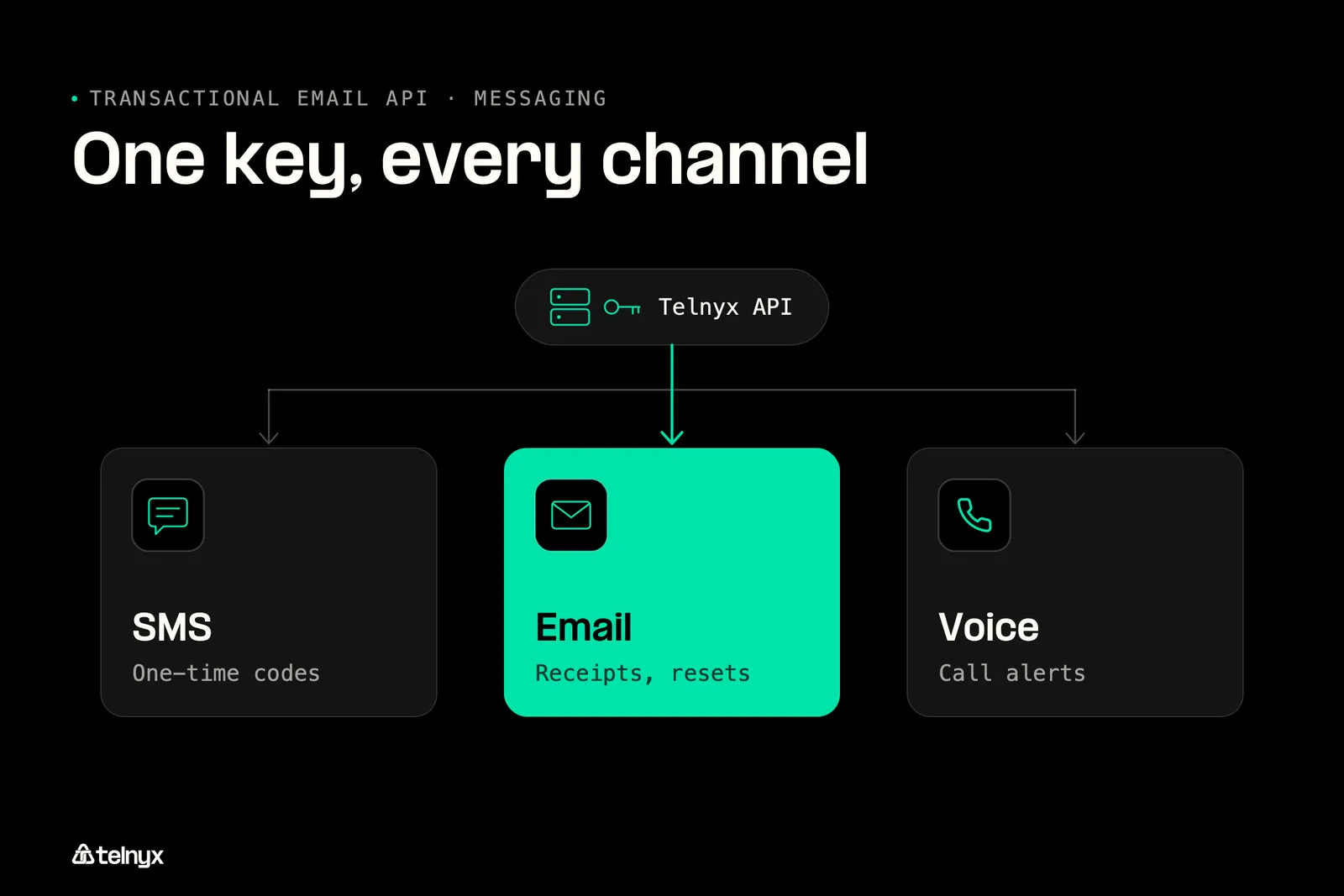
Telnyx's Email API sends and receives transactional email on the same API key as its SMS and voice APIs. A login code that fails as an email can fall back to an SMS without a second vendor.
Best for: Teams that already run messaging or voice on an API and want receipts, resets and inbound replies on one bill, provided they do not need a dedicated IP.
One Telnyx account covers each email an app sends and the replies it gets back:
| What happens on Telnyx | |
|---|---|
| Password resets and receipts | Sent from the app's verified domain through the Email API |
| Customer replies to those emails | Arrive in an inbox on the same domain and trigger an email.received webhook |
| A login code that never reaches the inbox | Resent by the app as an SMS from the same Telnyx account |
Key features
- Verified sending domains managed through the email domains endpoint, with per-send open and click tracking, and delivery and engagement events available by webhook or by polling each message's event history.
- Inbound email through inboxes on verified domains, where an arriving message fires an email.received webhook, so replies land on the same API as sends.
- Drafts endpoints to create, update and send a draft, or create a reply draft, plus an official Python SDK that verifies Ed25519 webhook signatures.
Limits
- Dedicated IPs cost $14 per IP a month on top of sending, and suit high-volume senders that can keep one warm.
- The Email API is in beta and newer than Telnyx's voice and messaging APIs, so third-party integrations are fewer.
Pricing
Telnyx from $0.30 per 1,000 emails. SMS and voice usage is billed under its own rates.
Choose Telnyx if
the organization wants one vendor and one account for email, SMS and voice, and sends on the shared pool or a dedicated IP of its own.
2. Amazon SES: Best for high-volume senders managing their own IPs
Amazon SES carries the lowest published per-email rate on this list and is most often chosen by teams that already run on AWS and want to own IP reputation themselves. It is a sending engine rather than a finished product: the API accepts the message, a configuration set routes the events, and the dashboard is assembled from other AWS services.
Best for: High-volume senders with the operations capacity to:
- Warm and manage dedicated IPs, one per recipient domain if they choose.
- Build logs and templates from CloudWatch, SNS and Kinesis.
Key features
- An SMTP interface and the SES v2 API, with configuration sets that route send, delivery, bounce and complaint events to event destinations such as SNS, Kinesis Data Firehose and CloudWatch.
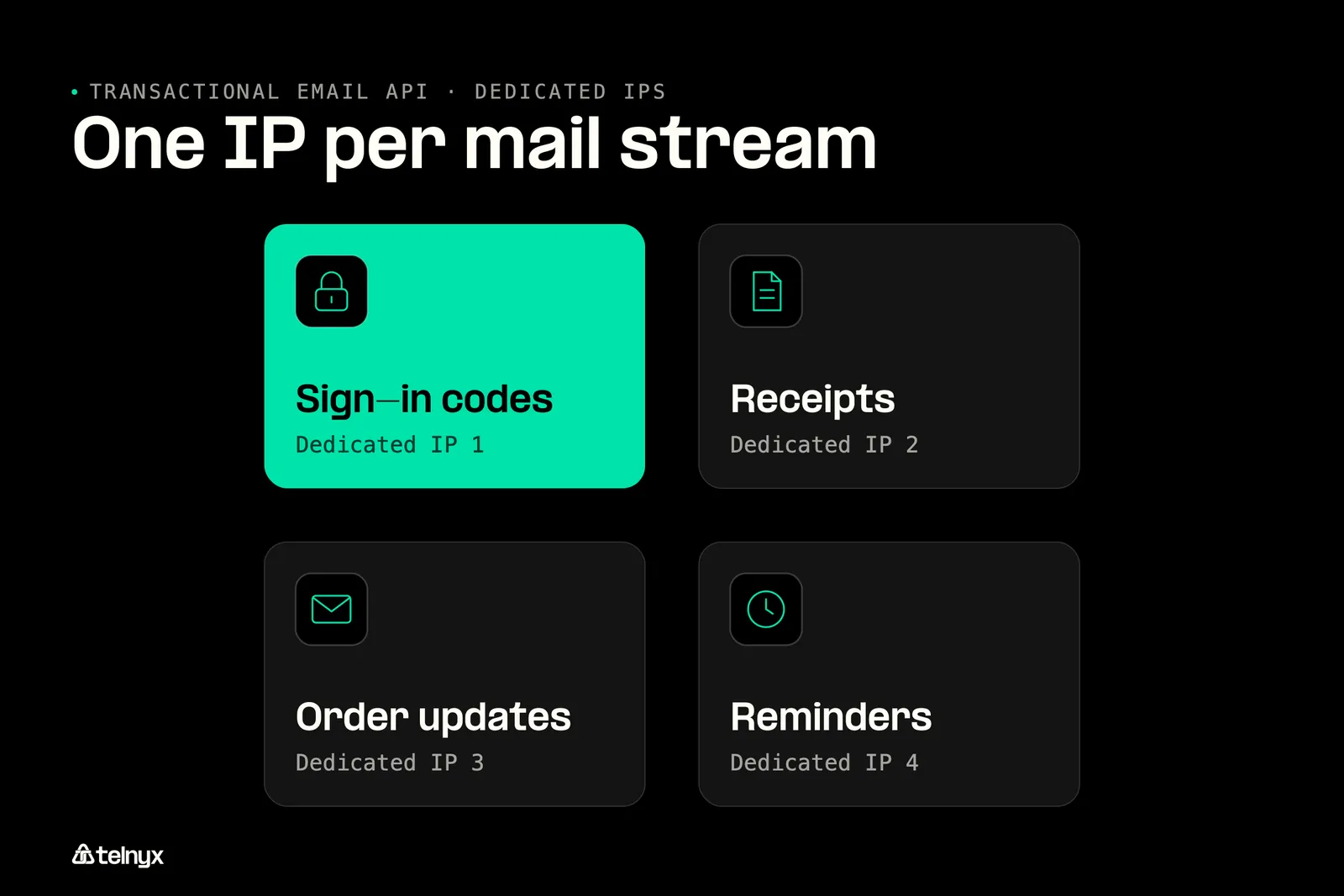
- Dedicated IPs in standard and managed forms, allocated to the account rather than drawn from a shared pool, so a sender can place Gmail traffic on one address and Outlook traffic on another.
- Virtual Deliverability Manager dashboards per mailbox provider, and a free tier of 3,000 messages a month for the first 12 months.
Limits
- New accounts start in a sandbox that allows sends only to verified recipients and only 200 messages a day until AWS grants production access, which takes a support request.
- There is no template editor, log UI or suppression console comparable to the dedicated vendors, so the team builds those or buys them.
Pricing
AWS lists $0.10 per 1,000 outbound emails and $24.95 per month per dedicated IP on its SES pricing page, with attachment data, Virtual Deliverability Manager and the managed dedicated IP tier billed separately.
Choose Amazon SES if
the organization already pays an AWS bill and has an engineer willing to own warm-up, bounce processing and log storage.
3. Twilio SendGrid: Best for large senders needing dedicated IPs and dynamic templates
Teams that send hundreds of thousands of receipts a month and want templates, IPs and SMS under one vendor contract land on SendGrid, the email arm of Twilio.
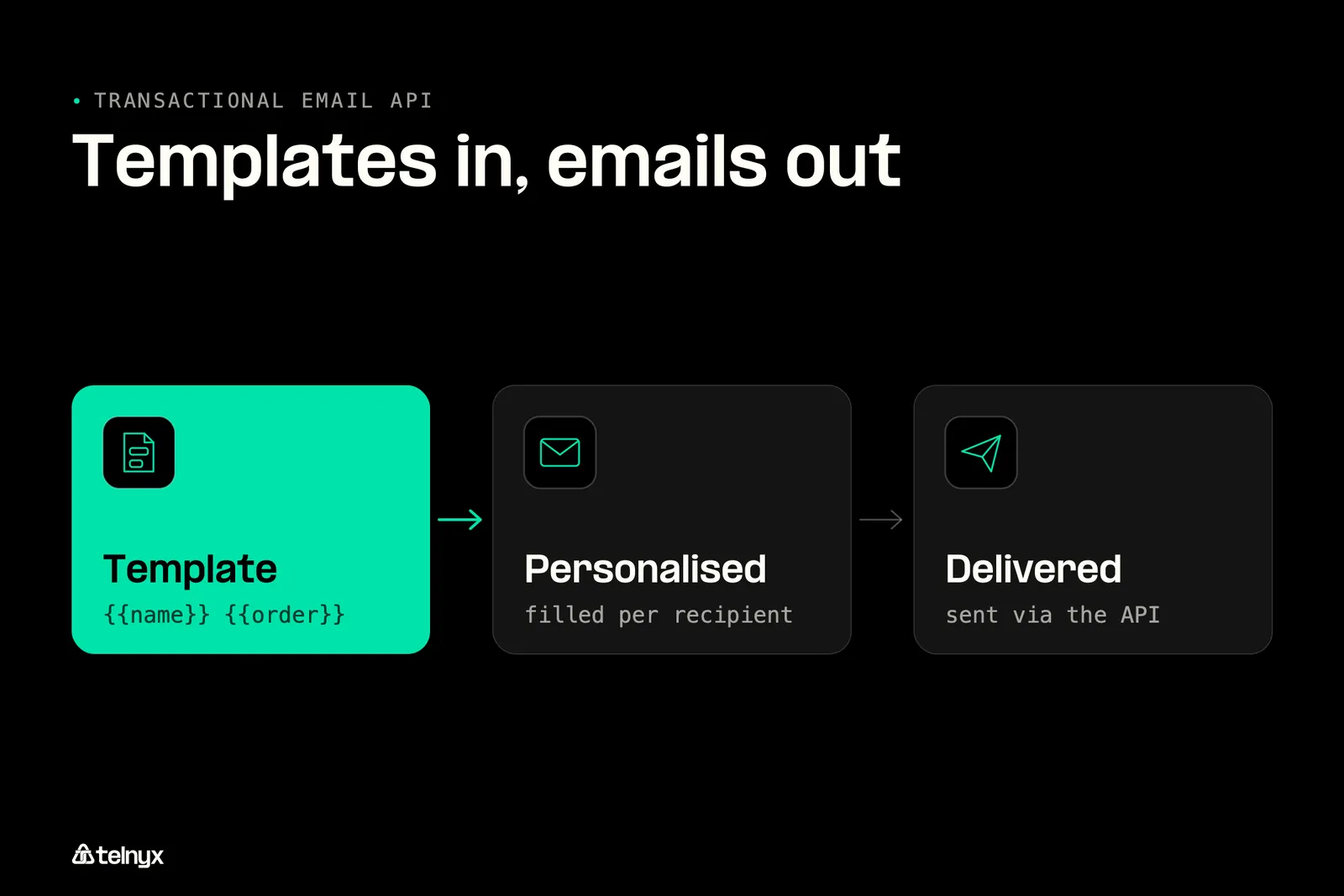
A send request carries a template ID and template data, and the same account runs marketing campaigns, so product and marketing teams share one sender reputation and one invoice.
| Plan | Price | Sending IP |
|---|---|---|
| Free trial | No charge for 60 days, capped at 100 emails a day | Shared pool |
| Essentials | $19.95 per month for 50,000 emails | Shared pool |
| Pro | $89.95 per month for 100,000 emails | Dedicated IP |
Best for: Large senders that need a dedicated IP, Handlebars dynamic templates and official SDKs in seven languages, and will pay the Pro tier for the IP.
Key features
- The v3 Mail Send API plus an SMTP relay, with dynamic templates rendered from Handlebars and the template data passed in the request body.
- The Event Webhook, which delivers processed, delivered, bounce, dropped, spam report and open events to one endpoint the sender registers.
- Official SDKs for Python, Node.js, Ruby, PHP, C#, Java and Go, with marketing campaigns on the same account.
Limits
- The permanent free plan was retired in favour of a 60-day free trial capped at 100 emails a day, a change still in force on 27 October 2026, so a side project has no long-term free lane.
- A dedicated IP is included only from the Pro plan.
Pricing
Twilio lists Essentials from $19.95 per month for 50,000 emails and Pro from $89.95 per month for 100,000 emails with a dedicated IP. Email validation and additional IPs are billed separately.
Choose Twilio SendGrid if
the team is already contracted with Twilio for messaging and wants email on the same invoice and support path.
4. Postmark: Best for password resets and receipts on separate message streams
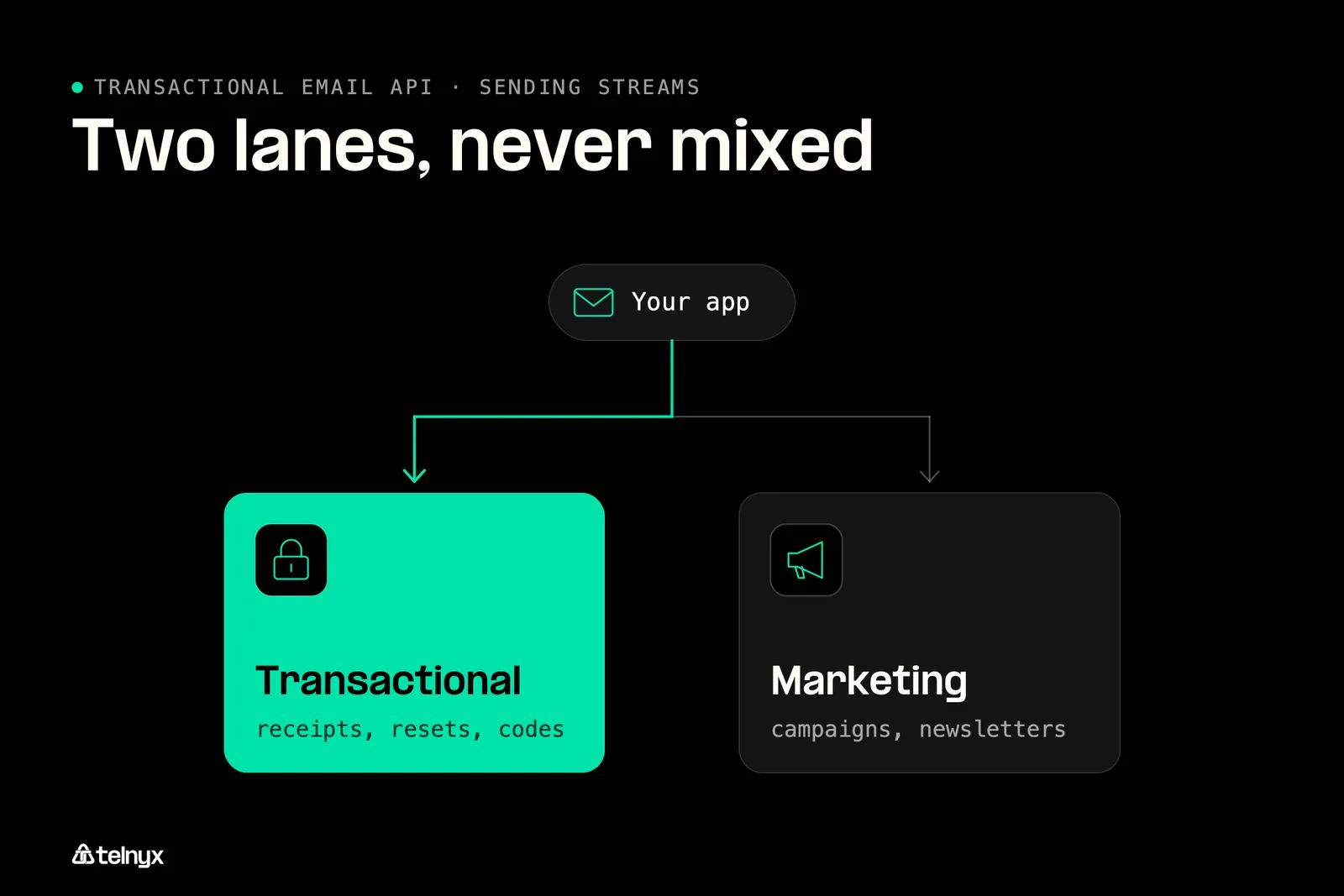
Postmark splits every server into message streams, so transactional mail never shares an IP pool or a reputation with broadcast mail, and the transactional stream rejects bulk content outright. It also publishes time-to-inbox figures for the major mailbox providers on its status page, which a buyer can read before signing up rather than measure after.
The result is a product built around one job, the message a single user is waiting for, and nothing on the account competes with that message for reputation.
| Stream | Mail it carries | Reputation |
|---|---|---|
| Transactional | Resets, verification codes and receipts, bulk content rejected | Its own IP pool and reputation |
| Broadcast | Newsletters and bulk mail | Separate from transactional mail |
Best for: Product teams whose only critical mail is resets, verification codes and receipts, and who want that traffic isolated by design rather than by paying for a dedicated IP.
Key features
- Separate transactional and broadcast message streams per server, with the transactional stream refusing bulk content so a newsletter cannot be routed through it by mistake.
- Full message events (delivery, bounce, spam complaint, open, click) by webhook and searchable in the activity log, with retention configurable up to 365 days on paid plans.
- An email API and SMTP, templates with Mustachio syntax, inbound processing and official libraries.
Limits
- The developer free allowance is 100 test emails a month, enough to wire up an integration and nothing more.
- A dedicated IP is offered only to accounts sending at least 300,000 emails a month.
Pricing
Postmark lists $15 per month for 10,000 emails, with retention beyond 45 days and the dedicated IP tier priced separately.
Choose Postmark if
the organization sends no marketing email through this account and values a published time-to-inbox page over the lowest rate.
5. Mailgun: Best for senders needing EU hosting and inbound routing
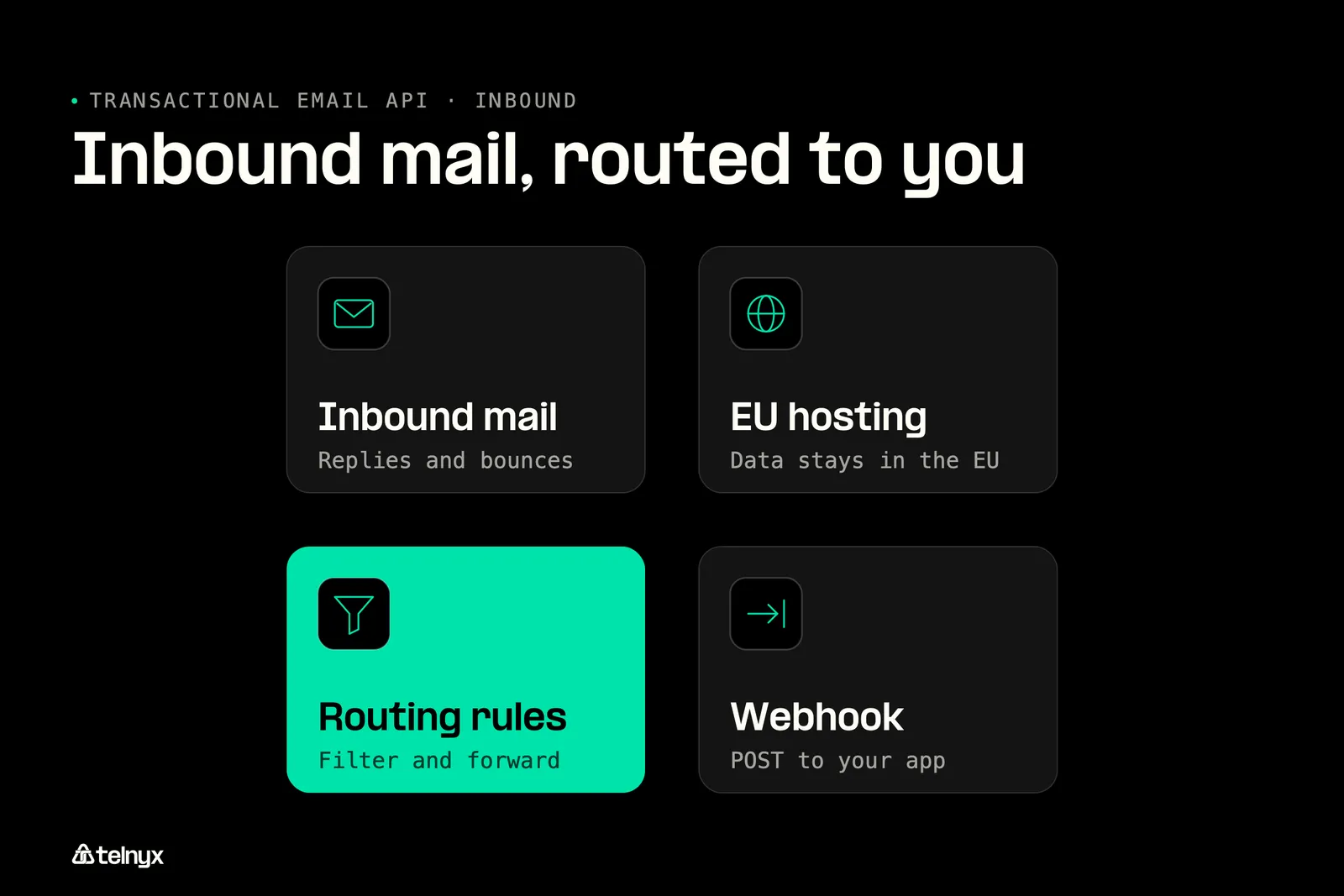
Mailgun is the long-running developer email API that offers a choice of US or EU data region, picked per domain with its own API base URL, and inbound routes that parse incoming mail into webhook posts.
Sending, inbound routing and the add-ons share one account, so a team sets up a domain once and turns on what it needs:
- Inbound routes, for replies and support mail
- Email validations, checked before a send
- Send-time optimization, for scheduled campaigns
Best for: Senders with EU customers who need message content and logs stored in-region, and apps that process inbound replies or support mail programmatically.
Key features
- US and EU regions with separate API base URLs, chosen per domain, so an EU domain's mail and logs stay in the EU region.
- Inbound routes with match rules that forward, store or post parsed messages to a webhook, which turns a reply into a ticket without a mailbox poller.
- An email validation API, send-time optimization and logs with per-event webhooks for delivered, failed, opened, clicked and complained.
Limits
- The free plan caps at 100 emails a day.
- Log retention is one day on the free plan and rises by tier, so a support team on a low plan loses the trail quickly.
Pricing
Mailgun lists Basic at $15 per month for 10,000 emails and Foundation at $35 per month for 50,000, a dedicated IP is included only from the Scale plan at $90 per month, and email validations are billed separately.
Choose Mailgun if
the organization's data-residency policy requires EU storage of message content and logs, or the app turns inbound email into tickets or records.
6. Resend: Best for developers building templates in React Email
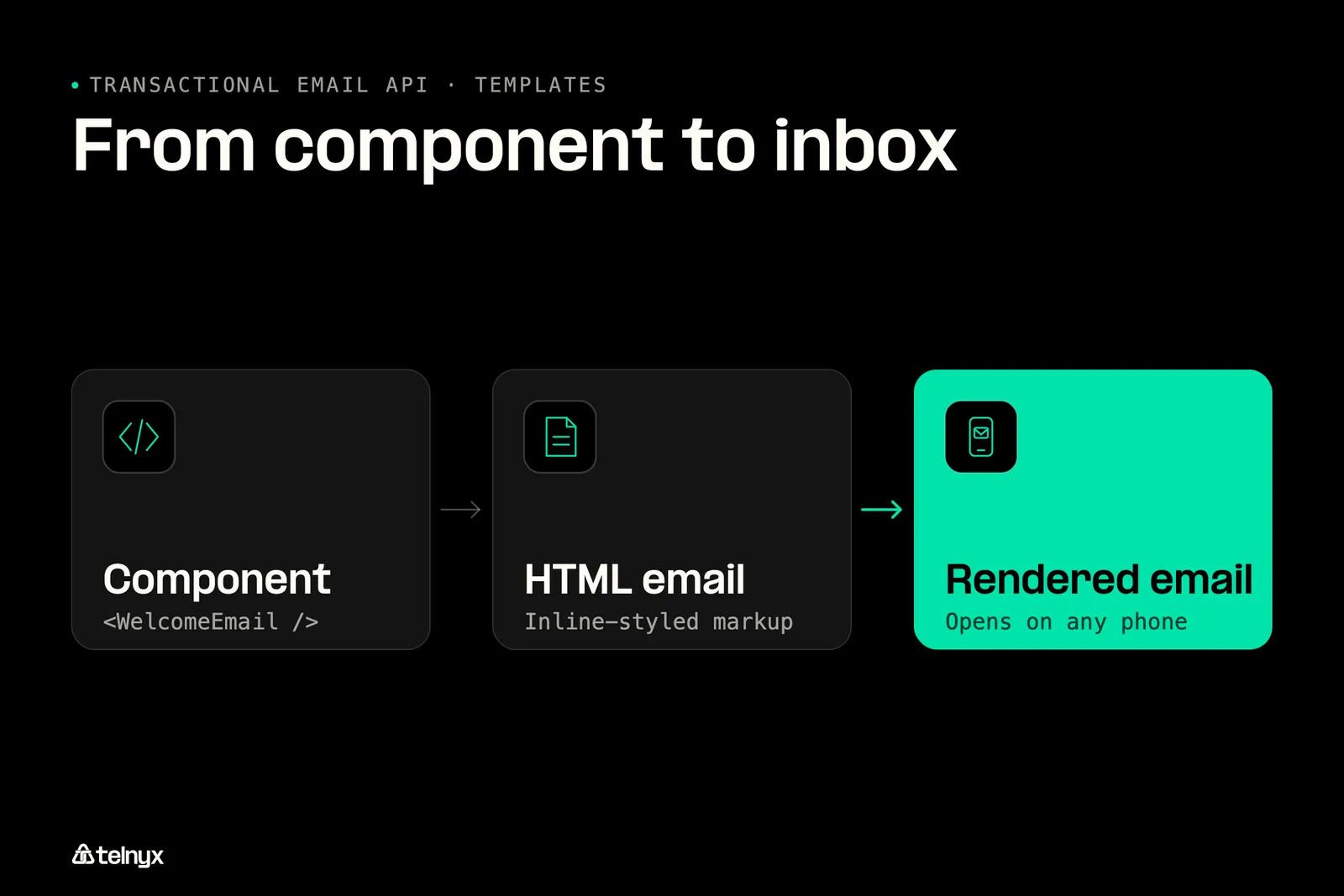
Developers who already write their product UI in React and want their emails in the same components reach for Resend, which maintains the React Email library and renders those components server-side into the send call.
- The API is one POST per email.
- The SDKs are thin.
- The free plan is permanent, which is why it has become a default for side projects and early-stage startups.
Best for: Small teams and startups on a JavaScript or TypeScript stack who want a permanent free tier and a single-request send, and who do not yet need multiple regions.
Key features
- React Email templates rendered into the send request, alongside plain HTML and text bodies.
- An idempotency header carrying one identifier per logical email, so a request retried after a timeout cannot send the same password reset twice, plus a batch endpoint for up to 100 emails per call.
- Domain verification, webhooks for sent, delivered, bounced, complained and opened events, and official SDKs for Node.js, Python, Go, Ruby, PHP, Java, Rust and .NET.
Limits
- The free plan allows 3,000 emails a month but caps sends at 100 a day, so a launch-day spike exhausts it before noon.
- Dedicated IPs and extended data retention are paid add-ons, and the platform has fewer regions than the incumbents.
Pricing
Resend lists Pro at $20 per month for 50,000 emails, a dedicated IP is a separate monthly add-on, and the free plan holds 3,000 emails a month at 100 a day.
Choose Resend if
the engineering team owns the templates as code and ships from a Node.js backend.
7. Mailchimp Transactional: Best for Mailchimp customers adding receipts to a marketing plan
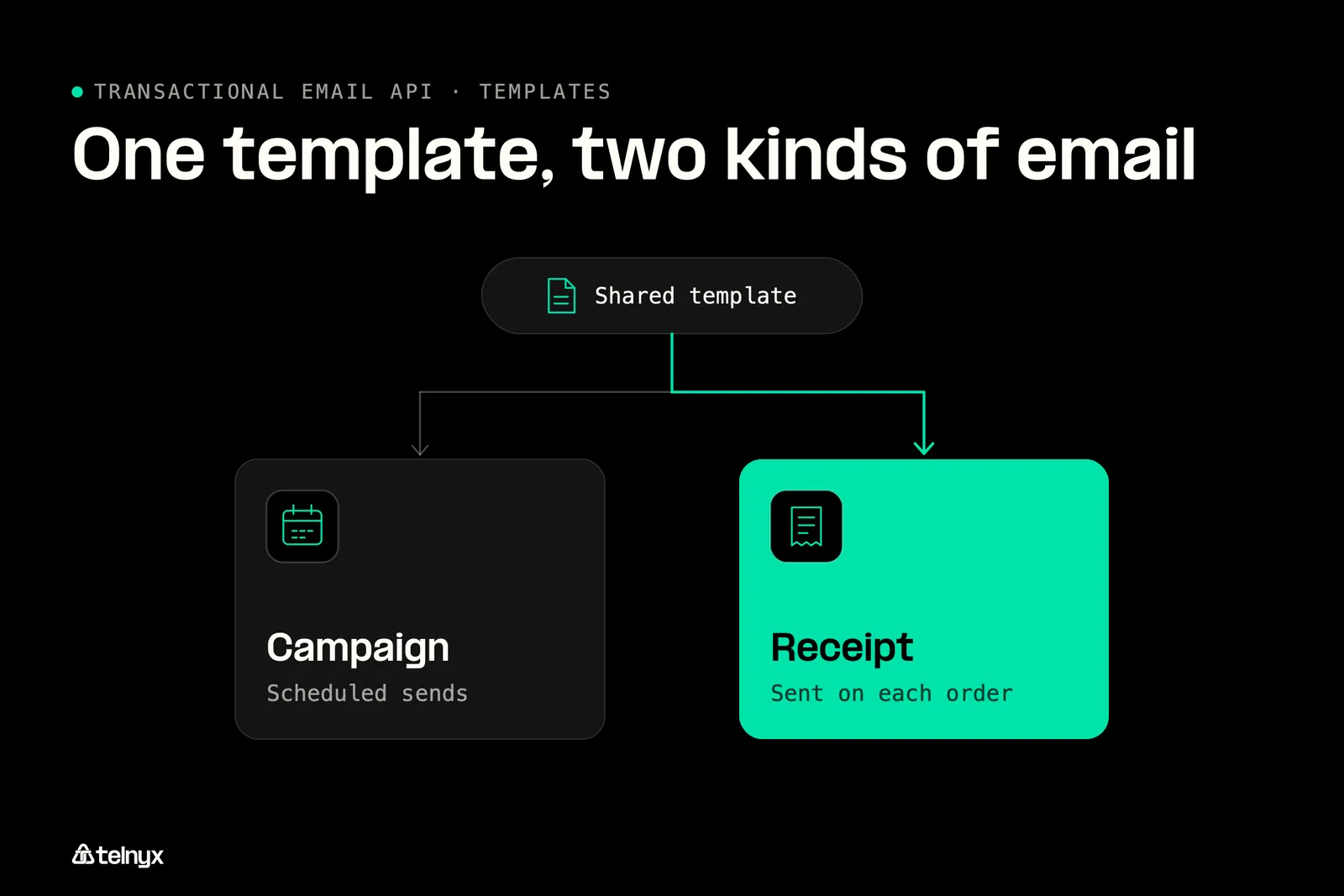
Mailchimp Transactional, formerly Mandrill, is the transactional add-on to the Mailchimp marketing platform and shares templates, audience data and the account itself with it.
A receipt and a campaign can be built from the same template and reported in the same place, which is the case for it, and the dependency on the marketing plan is the case against it. A developer who only wants an API cannot buy one here.
| Case for | Case against |
|---|---|
| Receipts and campaigns built from the same template | Dependency on the Mailchimp marketing plan |
| Receipts and campaigns reported in the same place | No API-only purchase |
Best for: Companies already paying for Mailchimp Standard who want receipts and account notices to use the same templates and reporting as their campaigns, and who send in blocks rather than at steady high volume.
Key features
- API and SMTP sending with templates editable in Mailchimp, and merge tags shared across campaigns and transactional mail.
- Webhooks for send, deferral, hard and soft bounce, open, click, spam complaint and unsubscribe, plus a searchable activity view.
- Dedicated IPs available as an add-on, governed by the marketing account's reputation controls.
Limits
- No transactional sending is possible without a paid Mailchimp Standard plan, so the API alone is not for sale.
- Email blocks are bought in advance and unused credits expire, so a quiet quarter wastes paid volume.
Pricing
Mailchimp lists transactional email in blocks of 25,000 emails from $20 per block, on top of a Standard plan that starts at $20 per month, with dedicated IPs and additional blocks billed separately.
Choose Mailchimp Transactional if
the marketing team already lives in Mailchimp and the product team wants one template system rather than a second vendor.
What to look for in a transactional email API service for developers
Four things decide whether a transactional email arrives: the authentication records on the sending domain, the event feedback the provider returns, whether a retry can send a duplicate, and whose reputation the mail rides on.
Campaigns, segmentation and subject-line tests are a different category, covered in the email marketing providers comparison.
Email authentication: SPF, DKIM and DMARC
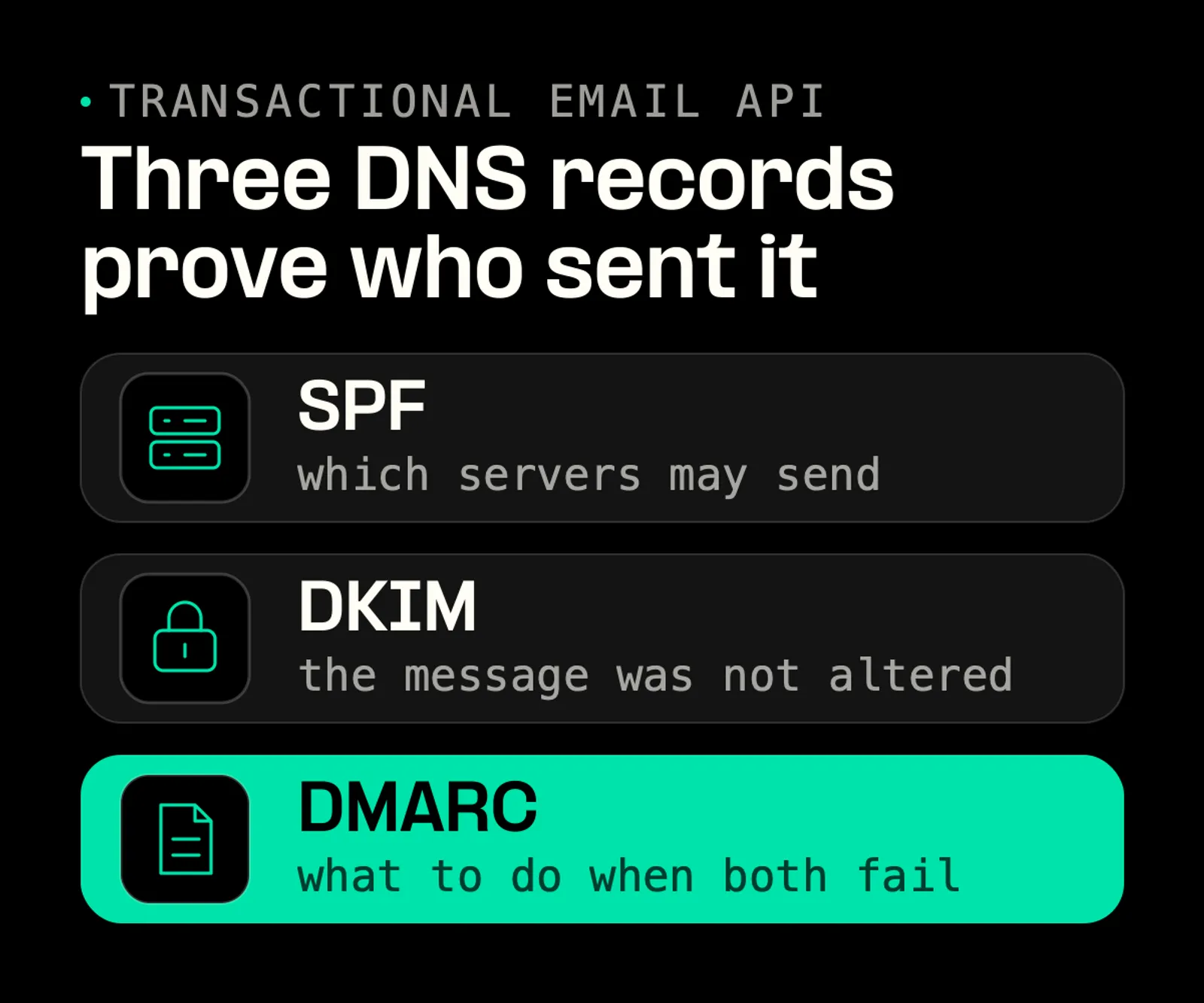
SPF is a DNS record that lists which servers may send mail for the domain, so a receiving server can check that the message came from an address the domain owner approved. DKIM adds a signature to each message, which the mailbox provider checks against a public DNS record to confirm the message was not altered in transit.
DMARC is the policy record on top: it tells the receiver what to do when SPF and DKIM both fail, from monitoring to outright rejection, and where to send the reports that show who is sending as the domain.
- Since February 2024 the Google sender guidelines have required anyone sending 5,000 or more messages a day to Gmail to authenticate with SPF, DKIM and DMARC.
- The same senders must keep the reported spam rate below 0.3%.
- Yahoo applies matching rules.
Every provider on this list asks for these records at domain verification, and transactional senders are not exempt. The email authentication guide covers each record and the values a provider returns.
Delivery events, webhooks and logs
Every support team gets the same ticket: the user never received the verification email. A log answers it with four facts.
- Accepted: the API took the message and returned an ID.
- Delivered: the recipient's mail server accepted it.
- Bounced: the recipient's server rejected it, hard or soft.
- When: the timestamp on each of the above.
A retail and ecommerce receipt that was accepted and delivered at 14:02 moves the conversation to the customer's spam folder. A message accepted and nothing else is still queued, the one case the provider owns.
A webhook is the provider POSTing each of those events to an endpoint the app registers.
- Every event carries the message ID the API returned at send time.
- The app must persist that ID with the user record the moment the send call returns.
- Without it, the delivered event for one of 10,000 receipts has nothing to match against.
Two ways to consume delivery events
| Route | How events arrive |
|---|---|
| Webhook | The provider POSTs each event to the URL set at the Telnyx email webhook endpoint |
| Polling | The app enables tracking per send and polls each message's event history on a timer, the pattern in the Telnyx Node.js email setup example |
Idempotency, suppression and dedicated IPs
Safe retries come from idempotency.
- The app sends one identifier per logical email, this password reset for this user.
- The provider returns the original result when the same identifier arrives twice.
- Without it, a request that timed out after the provider had accepted the message produces two reset links, and the user clicks the invalidated one.
Suppression is what the provider does with addresses that should not receive mail again.
How providers classify a failed transactional email
| Event | What it means | What the provider does |
|---|---|---|
| Hard bounce | The address does not exist | Suppresses it, no further sends |
| Soft bounce | Mailbox full or server busy | Retries for a period, then drops it |
| Spam complaint | The recipient marked it as spam | Suppresses the address |
| Unsubscribe | The recipient opted out | Suppresses the address for that stream |
| Invalid or role address | Malformed, or a role address such as postmaster@ | Rejected before send on some providers |
A shared pool inherits the provider's reputation and needs no warm-up. A dedicated IP is worth paying for when volume is steady enough to build a reputation of its own, and some senders run one IP per recipient domain so that a Gmail problem never touches Outlook delivery.
On this list Amazon SES, Twilio SendGrid and Telnyx sell that setup, and Postmark offers it only at high volume. Telnyx charges $14 per dedicated IP a month, with built-in warm-up controls, IP pools and routing between them.
Note: Below a steady daily volume a dedicated IP has no reputation, and mailbox providers treat its mail with more suspicion than a well-run shared pool. It needs weeks of warm-up, so buying one the week before go-live makes delivery worse.
Which transactional email API has a free tier, and how to send one in Python
Three of the seven providers keep a permanent free tier, every one of them caps it per day, and a first send in Python takes an API token, a verified domain and one request. The figures below are each vendor's published numbers, checked on 27 October 2026, and they are comparison points rather than quotes.
How the seven transactional email API free tiers compare
A free tier is for integration and staging, and the daily cap matters more than the monthly one, because transactional mail arrives in bursts: a product launch, a newsletter mention, a wave of password resets after a breach notice.
Free tiers across seven transactional email APIs
| Vendor | Free allowance and daily cap |
|---|---|
| Telnyx | No monthly free allowance. A new trial account gets $5 in testing credit and sends only to the account owner's address |
| Amazon SES | 3,000 messages a month for the first 12 months, 200 a day while in the sandbox |
| Twilio SendGrid | 60-day trial at 100 emails a day, no permanent free plan |
| Postmark | 100 test emails a month |
| Mailgun | 100 emails per day |
| Resend | 3,000 a month, capped at 100 a day |
| Mailchimp Transactional | None without a paid Standard plan |
Note: A daily cap of 100 emails covers a staging environment and a beta, and it does not cover a launch, so the buyer sizes the first paid tier (Postmark $15, Mailgun Basic $15, Resend Pro $20, SendGrid Essentials $19.95 per month) before go-live.
Sending a first email in Python on the Telnyx Email API
Three steps precede the first send:
- Create an API token in the Mission Control portal and keep it in an environment variable, never in the repository, because public code hosts are scanned for leaked credentials within minutes of a push and a leaked token sends on the account's reputation.
- Verify the sending domain by adding the SPF and DKIM records the email domains endpoint returns for it, and wait for the domain status to show verified.
- Send the request from an address on the verified domain, and store the message ID the response returns.
The code below is a working AI reply agent in Python from the Telnyx code examples on GitHub: a customer emails the inbox, an inbound webhook fires, the agent asks the Telnyx LLM API to draft a reply, and the Email API sends it back in the same thread.
The AI email agent example holds the webhook verification and the Flask app, and it reads the API token from the TELNYX_API_KEY environment variable and the verified from-address from INBOX_ADDRESS. These lines draft the reply and hand it to the send helper:
The send returns a message ID, and the agent keeps it so the delivered event that arrives on the webhook from the previous section has something to match.
The same request with a from address, a to address, a subject and a body is the whole of a password reset or a receipt, and the send emails via API walkthrough shows that bare request without the agent around it.
Transactional email API FAQ
Send receipts, resets and the SMS fallback on one account
Telnyx's Email API runs on the same account credential as its SMS and voice APIs, so a login code that fails as an email can go out as a text with no second vendor. Start with a verified domain and the Python send above.
Start sending with TelnyxShare on Social
Deniz is a Senior Product Marketing Manager at Telnyx with 10 years of experience in technology and healthtech marketing. She previously led go-to-market initiatives at Philips Healthcare, Vodafone, and The Coca-Cola Company. Originally from Türkiye and based in Amsterdam, she ho


