
Key takeaways
- A 5G private network is a dedicated cellular network built for a single organization, giving it full control over coverage, capacity, security, and access.
- Private LTE remains the more mature and widely deployed option. Private 5G adds higher throughput, lower latency, and network slicing, at a higher cost.
- Traditional deployment models range from wholly owned buildouts to network slices leased from a carrier. Each trades control against cost and complexity.
- A fully owned private 5G network requires spectrum access, RAN hardware, and specialized staff. Most enterprises struggle to justify that investment for a single site.
- SIM-based private connectivity delivers the core benefit of a private network, traffic isolation from the public internet, without spectrum licensing or RAN ownership.
What is a private 5G network?
A private 5G network is a cellular network dedicated to a single organization. Unlike public 5G, where thousands of subscribers share the same infrastructure, a 5G private network restricts access to authorized devices only. The organization controls who connects, how bandwidth is allocated, where data flows, and what security policies apply.
Private 5G networks run on licensed, shared, or unlicensed spectrum and use the same underlying technology as public carrier networks: a radio access network (RAN), a mobile core, and SIM-authenticated devices. The difference is ownership and isolation. The enterprise, not a carrier, decides how the network behaves.
This matters most where public networks and Wi-Fi fall short. Public cellular offers no performance guarantees and routes traffic over shared infrastructure. Wi-Fi struggles with range, device density, and interference in industrial environments. Private cellular closes both gaps, which is why manufacturers, ports, logistics operators, and utilities have driven most deployments to date.
Note: "Private 5G," "private LTE," "private cellular," and "private wireless" are often used interchangeably. Private cellular is the umbrella term. 5G and LTE refer to the generation of radio technology underneath.
How does a private 5G network work?
A private 5G network has three main components: user equipment, a radio access network, and a core network.
User equipment is anything with a SIM or eSIM, such as sensors, cameras, AGVs, handhelds, and gateways. The RAN is the set of small cells or base stations that provide radio coverage across the site. The core network handles authentication, session management, routing, and policy. In a private deployment, the core can run on-premises, in a private cloud, or as a hosted service.
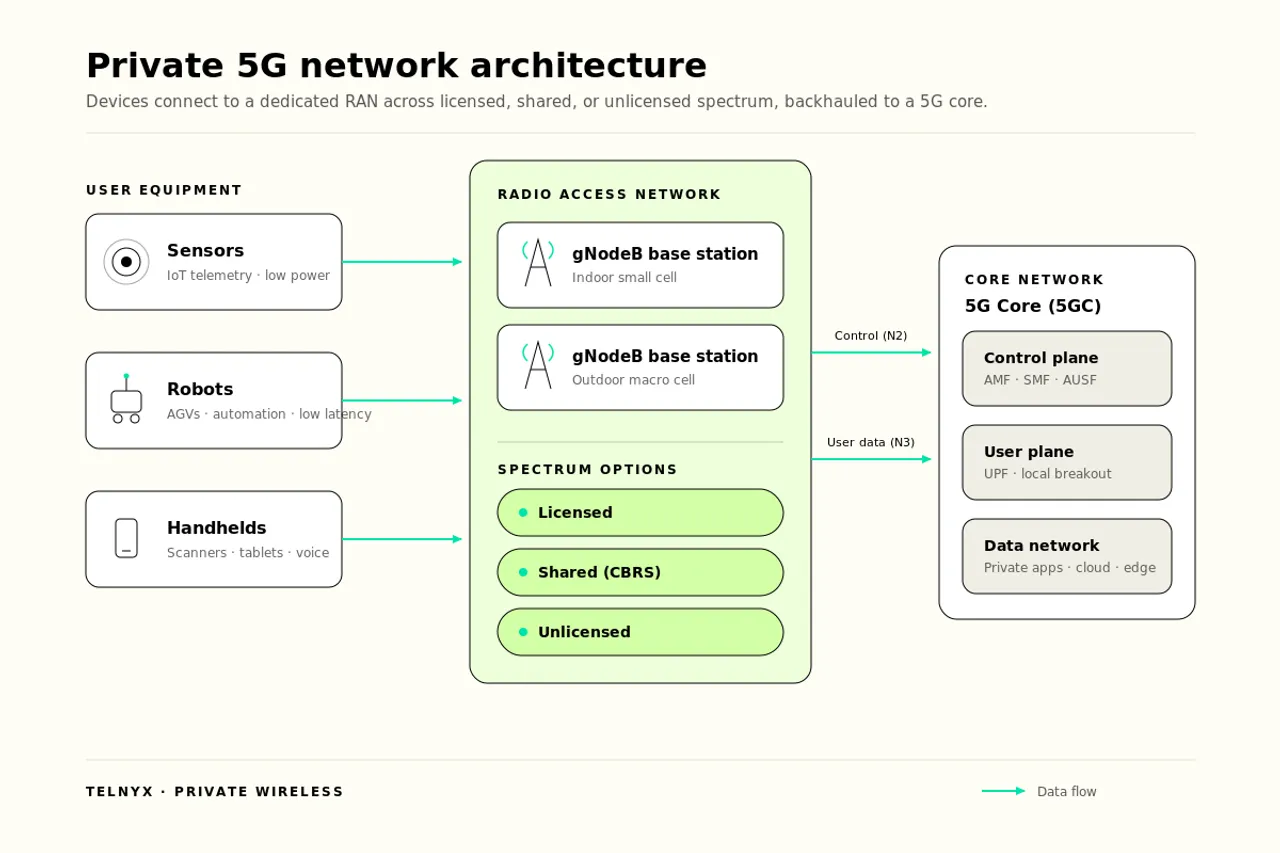
Spectrum is the part that slows most enterprises. There are three paths:
- Licensed spectrum, leased from a carrier or regulator. Clean and interference-free, but expensive and slow to acquire.
- Shared spectrum, such as CBRS in the US or dedicated enterprise bands in Germany and Japan. This is what made private cellular practical for enterprises, since a CBRS private network doesn't require a carrier relationship.
- Unlicensed spectrum, free to use but subject to interference, which undermines the reliability argument for going private in the first place.
5G also introduces network slicing, which lets one physical network run multiple virtual networks with separate performance guarantees. A factory can run a low-latency slice for robotics and a high-bandwidth slice for video inspection on the same infrastructure. For a deeper look at how cellular fits alongside other connectivity options, see our guide to wireless IoT standards.
Private connectivity without the buildoutTelnyx IoT SIMs route device traffic through Private Wireless Gateways, keeping data off the public internet across 650+ partner networks worldwide. No spectrum licensing or RAN hardware required.
Explore IoT SIM CardsPrivate 5G vs private LTE
Private LTE arrived first and still accounts for the majority of private cellular deployments. It is proven, hardware is cheap and plentiful, and for most IoT workloads its performance is more than sufficient. A private LTE network handles sensor telemetry, asset tracking, push-to-talk, and most video use cases.
Private 5G raises the ceiling. It delivers higher throughput, sub-10ms latency in ideal conditions, support for far more devices per cell, and network slicing. The tradeoff is cost and maturity. 5G radios, cores, and compatible devices all cost more, and the device ecosystem is still maturing.
| Attribute | Private 5G | Private LTE |
|---|---|---|
| Peak throughput | Multi-Gbps | Hundreds of Mbps |
| Latency | Sub-10ms achievable | 20-50ms typical |
| Device density | Very high per cell | Moderate per cell |
| Network slicing | Yes | No |
| Device ecosystem | Growing | Mature and broad |
| Relative cost | Higher | Lower |
The practical guidance: if your use case is telemetry, tracking, or standard video, private LTE is sufficient at lower cost. If you need deterministic low latency for robotics, AR-assisted maintenance, or high-density video analytics, private 5G justifies the higher cost. Many vendors sell combined 4G/5G portfolios precisely because most sites need both.
Private 5G vs public 5G
Public 5G is built for scale and coverage, not for any single customer's requirements. Your traffic shares infrastructure with every other subscriber in the cell. During congestion, your devices compete for capacity with everyone else's phones. There are no SLAs on latency or throughput for standard consumer and business plans.
| Attribute | Private 5G | Public 5G |
|---|---|---|
| Access | Authorized devices only | Any subscriber |
| Performance | Dedicated, predictable | Shared, best-effort |
| Data path | Stays on enterprise network | Traverses carrier and internet |
| Coverage | Site-bound | Wide-area |
| Control | Full enterprise control | Carrier-controlled |
The coverage row deserves attention. Private 5G wins on control and performance, but it only exists where you build it. A private network covering a factory does nothing for the trucks that leave it. That gap is why many enterprises end up combining a site-based private network with wide-area cellular connectivity, or skipping the site buildout entirely in favor of private routing over public RAN.
Private 5G deployment models
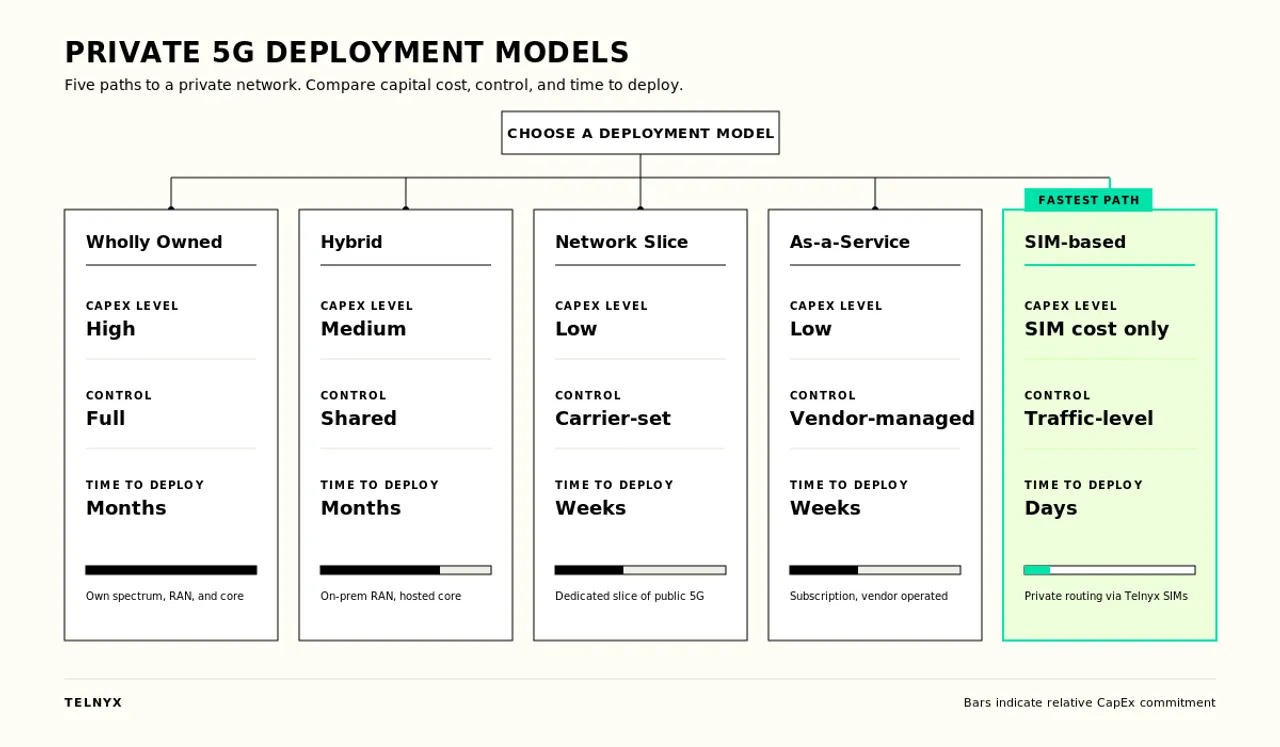
There are four traditional ways to deploy a private 5G network, plus a fifth path that skips RAN ownership entirely.
Wholly owned. The enterprise buys and operates everything: spectrum access, RAN, core, and management. Maximum control and data sovereignty, maximum cost and operational burden. Realistic only for large industrial operators with dedicated network teams.
Hybrid. The enterprise owns the on-site RAN while a carrier or vendor hosts the core. Lowers the operational load but keeps significant CapEx and splits responsibility across two parties, which complicates troubleshooting.
Network slicing. The carrier carves out a virtual private network on its public infrastructure. Low CapEx and fast to deploy, but you inherit the carrier's coverage footprint and depend on their slice guarantees. Private 5G network slicing is still early in commercial availability.
As-a-service. A vendor or carrier deploys and manages the full stack on your site for a subscription fee. Predictable OpEx, but multi-year contracts and per-site pricing that accumulates across a distributed footprint.
SIM-based private connectivity. The fifth path uses IoT SIM cards and SIMs and IoT gateways to route device traffic over existing carrier RAN into a private core and gateway, isolating it from the public internet end to end. You give up dedicated on-site radio capacity, so it won't replace a private RAN for sub-10ms robotics control. What you get instead: deployment in days, global reach instead of a single site, and zero infrastructure to buy or staff. For fleets, distributed assets, and multi-site IoT, that tradeoff usually favors the SIM.
| Model | CapEx | Control | Time to deploy |
|---|---|---|---|
| Wholly owned | High | Full | Months |
| Hybrid | Medium | Shared | Months |
| Network slice | Low | Carrier-set | Weeks |
| As-a-service | Low (OpEx) | Vendor-managed | Weeks |
| SIM-based | SIM cost only | Traffic-level | Days |
Private 5G use cases
Private cellular adoption concentrates where connectivity failures carry real costs.
Manufacturing. Automated guided vehicles and robotic cells need connectivity that doesn't drop during a handoff between access points, which is exactly where Wi-Fi fails on a metal-dense factory floor. Private cellular handles mobility and interference far better, which is why manufacturing leads deployment counts in industrial IoT.
Ports and mining. Cranes, haul trucks, and remote-operated equipment work across large outdoor areas with no existing coverage. A handful of cellular base stations covers terrain that would take hundreds of Wi-Fi access points.
Logistics and warehousing. Scanners, sortation systems, and autonomous mobile robots need dense, reliable indoor coverage. Private cellular reduces the roaming drops that stall picking operations.
Healthcare. Hospitals run connected diagnostics, asset tracking, and telemetry where a dropped connection is a patient-safety issue, and where data isolation requirements rule out shared networks.
Utilities and energy. Substations, wind farms, and pipelines sit outside reliable public coverage. Private cellular, often combined with wide-area IoT SIMs for remote assets, keeps SCADA and monitoring traffic flowing.
If any of the terminology in these examples is unfamiliar, our cellular IoT glossary covers the full vocabulary.
Security in private 5G networks
Security is the most common reason enterprises go private, ahead of performance. Three properties matter.
Access control. Only devices with provisioned SIMs authenticate to the network. SIM-based authentication is materially harder to spoof than Wi-Fi credentials, and stolen devices can be deactivated remotely.
Traffic isolation. On a properly designed private network, device data never touches the public internet. It moves from device to RAN to core to the enterprise's own systems. This removes the largest attack surface in most IoT deployments, which is the public internet path between device and application.
Data sovereignty. When you control the core, you control where data is processed and stored. That matters for regulated industries and for jurisdictions with data residency requirements.
Note: Traffic isolation doesn't require an on-site RAN. Telnyx Private Wireless Gateways route SIM traffic from the carrier RAN directly into a private path, then over Cloud VPN into your cloud environment. The data never traverses the public internet, on any partner network.
A private network is not automatically a secure network. Misconfigured cores, unpatched RAN firmware, and flat internal network topologies all undermine the isolation the architecture provides. Treat private cellular as one layer in a broader IoT security posture, not a substitute for one.
Cost of a private 5G network
The cost of a private 5G network depends on the deployment model, but a fully owned buildout has five cost centers:
| Cost center | What drives it |
|---|---|
| Spectrum | Licensing fees or CBRS access costs, varies by country |
| RAN | Base stations, cabling, installation, site surveys |
| Core network | On-prem hardware or hosted core subscription |
| Devices | 5G-capable modules cost more than LTE equivalents |
| Operations | Specialized staff or managed-service contracts |
For a single industrial site, fully owned deployments typically run into the millions of dollars once spectrum, hardware, integration, and staffing are counted, with meaningful annual operating costs on top, according to industry estimates. As-a-service models convert that to a subscription, but per-site pricing means costs scale linearly with your footprint.
This is where the SIM-based model shifts the cost structure. Spectrum, RAN, and core infrastructure costs drop to near zero. You pay for SIMs and data. Costs shift entirely to usage-based OpEx priced per SIM and per megabyte, and adding a new site or region means shipping SIMs rather than commissioning infrastructure. Compare IoT data plans against a per-site private network quote and the breakeven analysis is straightforward: dedicated RAN pays off only where you need guaranteed on-site radio capacity that public RAN can't deliver.
Choosing a private 5G provider
Private 5G network vendors fall into three camps, and the right choice depends on whether your problem is site-bound or distributed.
| Provider | Model | Best fit |
|---|---|---|
| Nokia | Full-stack, turnkey (Nokia DAC) | Large industrial sites, proven at scale |
| Ericsson | Full-stack 4G/5G portfolio | Telecom-grade industrial deployments |
| Cisco | Full-stack with enterprise IT integration | Enterprises standardized on Cisco networking |
| Verizon | Managed private 5G | US sites wanting carrier-managed service |
| T-Mobile | CBRS-based managed offering | US campus and business deployments |
| HPE (Aruba) | Private 5G alongside Wi-Fi | Campus environments blending both |
| Telnyx | SIM-based private connectivity | Distributed, multi-site, and global IoT |
Evaluate on five criteria:
- Coverage model: single site versus global
- Spectrum approach: who acquires and manages it
- Deployment timeline: months for a RAN buildout versus days for SIMs
- Management tooling: API-driven provisioning versus ticket-based changes
- Support model: dedicated teams versus ticket queues
Our guide to choosing cellular IoT providers covers the evaluation process in detail.
One structural distinction: full-stack vendors sell infrastructure, carriers sell their footprint, and Telnyx owns and operates its core network end to end, with global IoT coverage across 650+ partner networks for radio access. That ownership enables private routing, local breakout, and per-SIM control through the API.
The Telnyx approach to private cellular
Telnyx does not sell RAN hardware or on-premises 5G cores. If you need dedicated on-site radio capacity for deterministic sub-10ms control loops, a full-stack vendor is the better fit. For everything else, the SIM-first model delivers the properties enterprises actually want from a private network, without owning infrastructure.
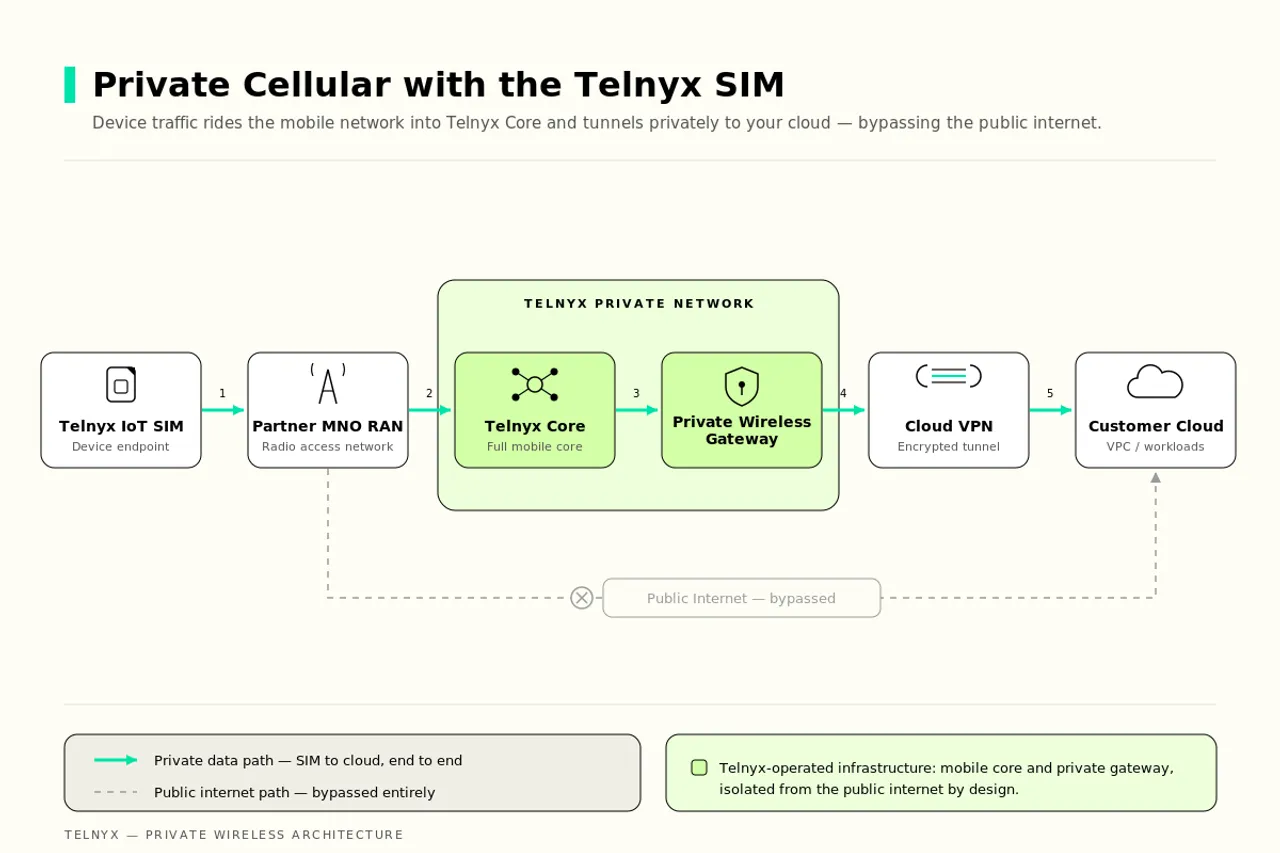
The architecture works like this. Devices authenticate with Telnyx IoT SIMs that switch intelligently between available networks for the best signal. Traffic routes from the partner RAN into the Telnyx core, then through a Private Wireless Gateway that isolates it from the public internet. Cloud VPN extends that private path directly into your AWS, Azure, or GCP environment. Local breakout in Australia and Germany keeps data in-region for sovereignty and latency.
Provisioning is self-service through the portal or API. A SIM activation takes a single API call. No spectrum applications or site surveys. A fleet of ten thousand devices across twelve countries gets the same traffic isolation (data never touches the public internet) as a single factory with an on-prem core, though without dedicated on-site radio capacity. It ships in days.
FAQ
Get private network benefits without the buildoutTalk to our team about isolating your IoT traffic with Telnyx SIMs, Private Wireless Gateways, and Cloud VPN. Deploy in days across 650+ networks.
Get Started with IoT SIMsShare on Social

Serhii Omelchenko
Global AEO/SEO Manager
Serhii is Global AEO/SEO Manager at Telnyx, based in Amsterdam, he is focused on making communications infrastructure findable and credible across both traditional search and AI-driven discovery. He previously led SEO and GEO strategy for some of the world’s most recognized consu


