
Conversational AI
7 best Retell AI alternatives for voice AI in 2026
Seven Retell AI alternatives compared on pricing, latency, telephony ownership, and compliance, with verified August 2026 numbers.

By Osman Husain
Last updated: August 2026
Your Retell agent passed every test call. Then your busiest hour arrived, the twenty-first concurrent call hit the cap, and a customer sat in a 40-second queue before the line dropped. The Retell docs describe this exact behavior: outbound calls get rejected at the limit, inbound calls wait, then divert or drop. The platform worked as designed.
The design is the question.
What are the best Retell AI alternatives?
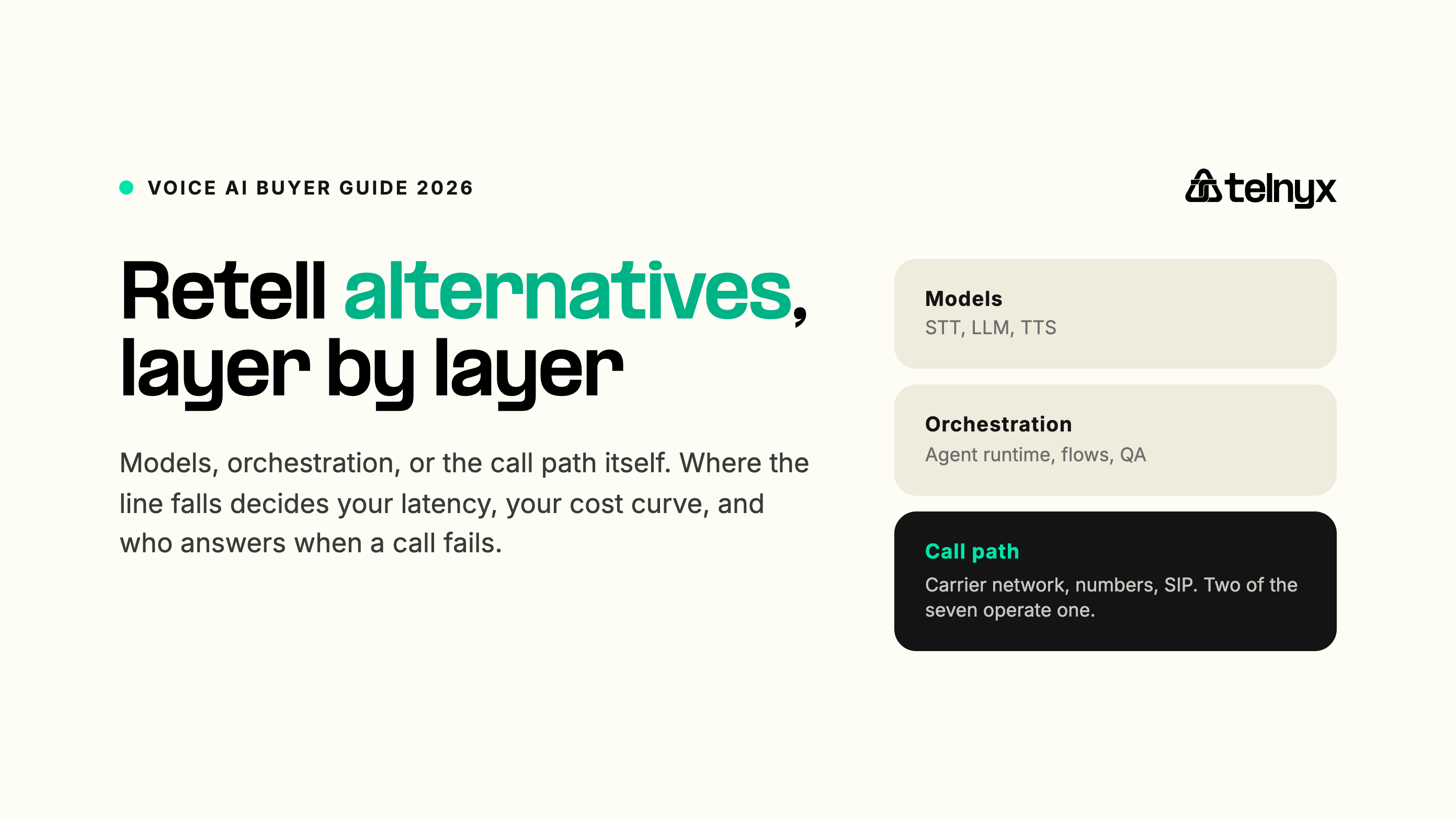
The best Retell AI alternatives in 2026 are Telnyx (voice agents with telephony built in), Vapi (code-first orchestration), Bland AI (managed proprietary model stack), ElevenLabs (realism-first voice agents), Twilio ConversationRelay (BYO-LLM on carrier rails), Synthflow (no-code enterprise deployments), and LiveKit (open-source control). The right pick depends on which layer you need to own: the models, the orchestration, or the call path itself.
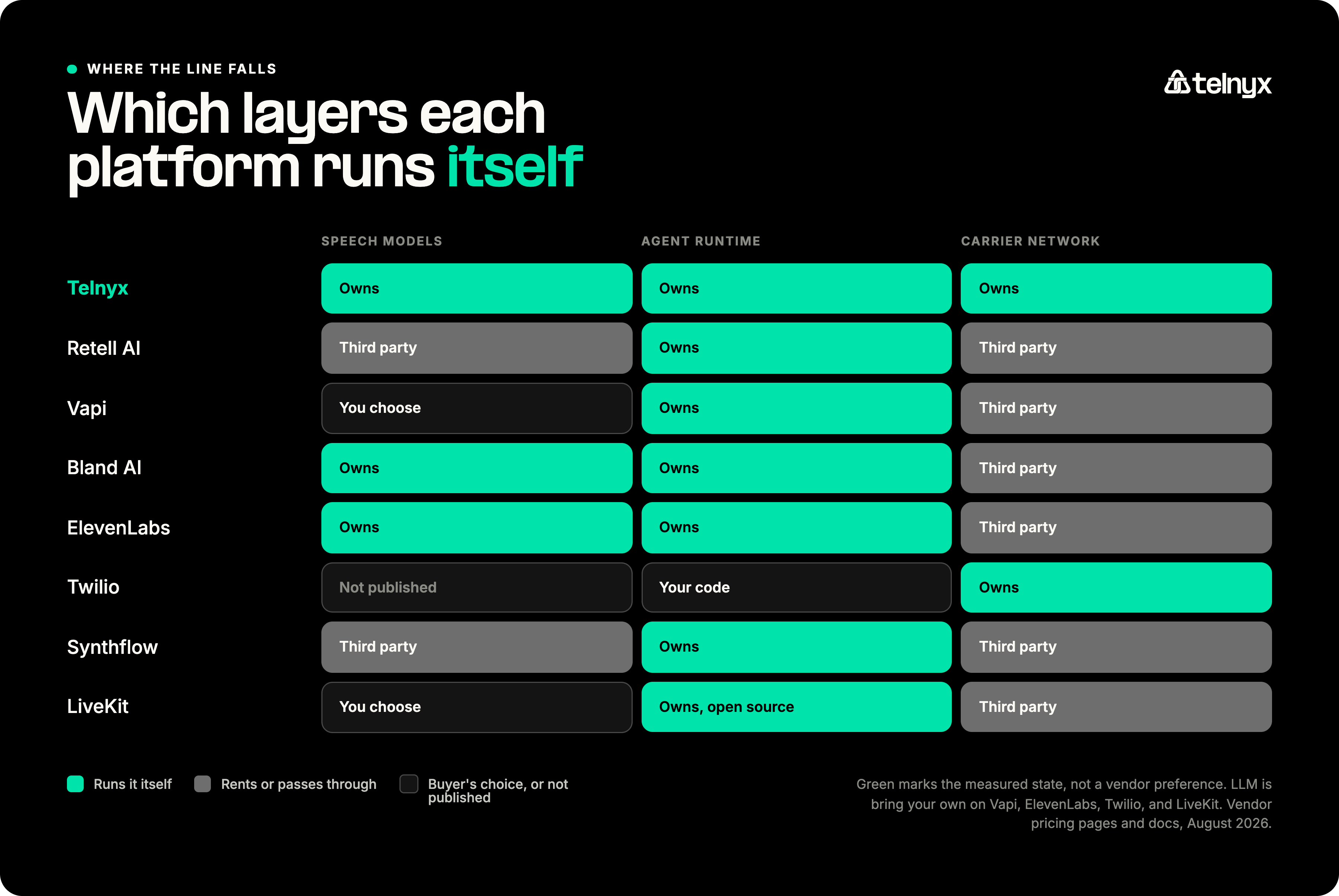
That last clause is the real comparison. Retell is an orchestration layer: it coordinates speech-to-text, an LLM, text-to-speech, and telephony that other companies run. Every alternative on this list draws the ownership line somewhere different, and that line decides your latency, your cost curve, and who answers when a call fails in production.
Table of contents
- Why teams look for Retell AI alternatives
- How we evaluated these alternatives
- The 7 best Retell AI alternatives in 2026
- Which Retell AI alternative fits your situation?
- Is Retell AI SOC 2 compliant?
- When Retell AI is still the right call
- Frequently asked questions
Why teams look for Retell AI alternatives
Teams outgrow Retell AI for structural reasons, not product ones. Give Retell its due first. The zero-code builder gets a working agent live in minutes, the simulation testing and AI QA tooling lead most managed platforms, and the pricing page itemizes every component in a market where "talk to sales" is the norm.
The question is what happens when your volume outgrows the meters.
Retell AI pricing stacks five meters
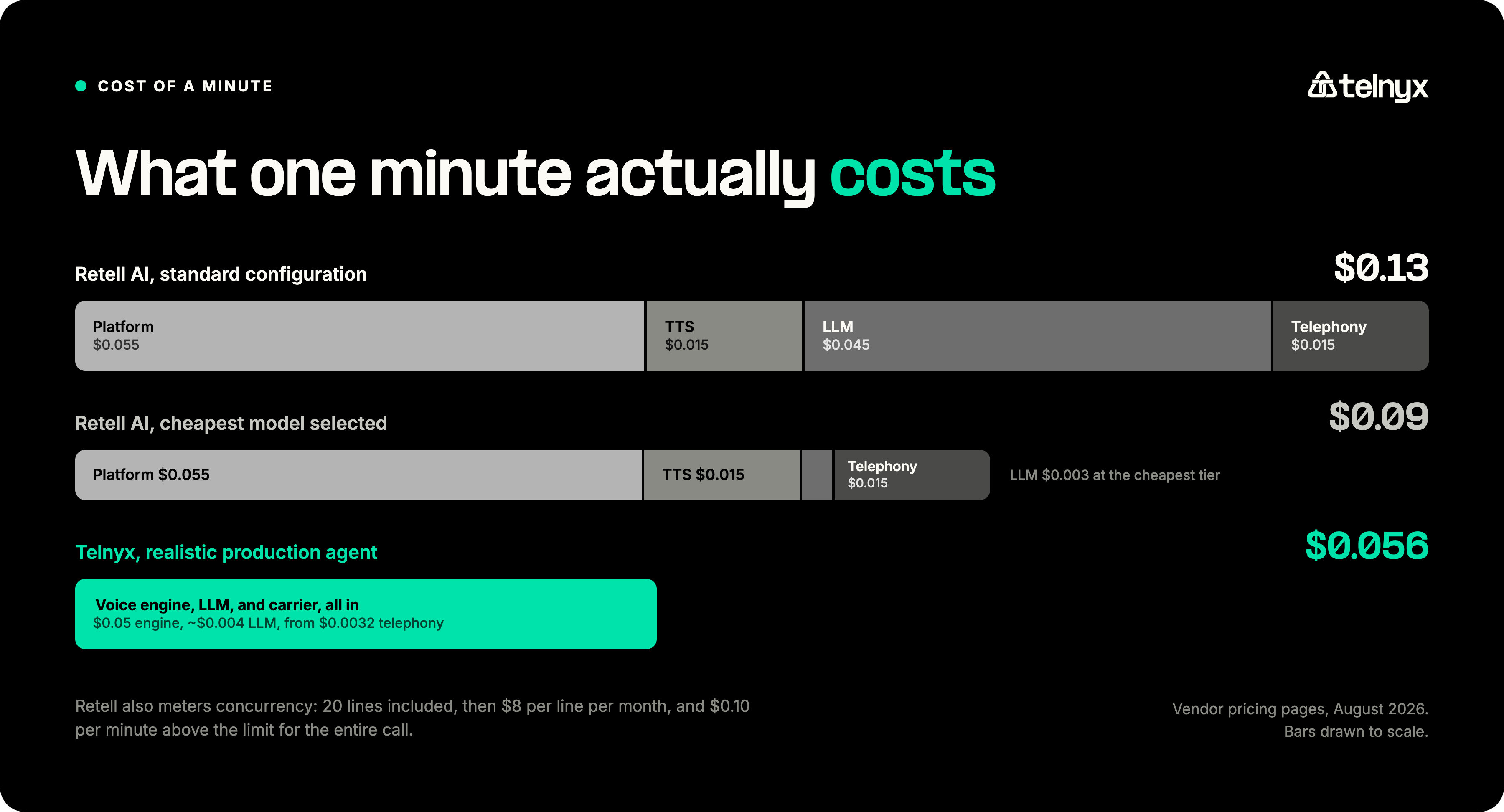
Every Retell minute runs five meters at once, which is why the Retell pricing page advertises a range, $0.07 to $0.31 per minute, rather than a number. The platform fee is $0.055/min, TTS adds $0.015/min ($0.040/min for ElevenLabs voices), and the LLM line runs from $0.003/min for GPT-5 nano to $0.16/min for GPT-5.5.
Telephony adds $0.015/min for Retell-managed US numbers, and add-ons like knowledge base retrieval and PII removal each meter separately. All figures come from the Retell pricing page, August 2026.
A standard configuration lands near $0.13 per minute. Careful model selection floors it near $0.09. At 100,000 minutes a month, the gap between those two configurations is $4,000, and finding it means auditing five meters instead of reading one number.
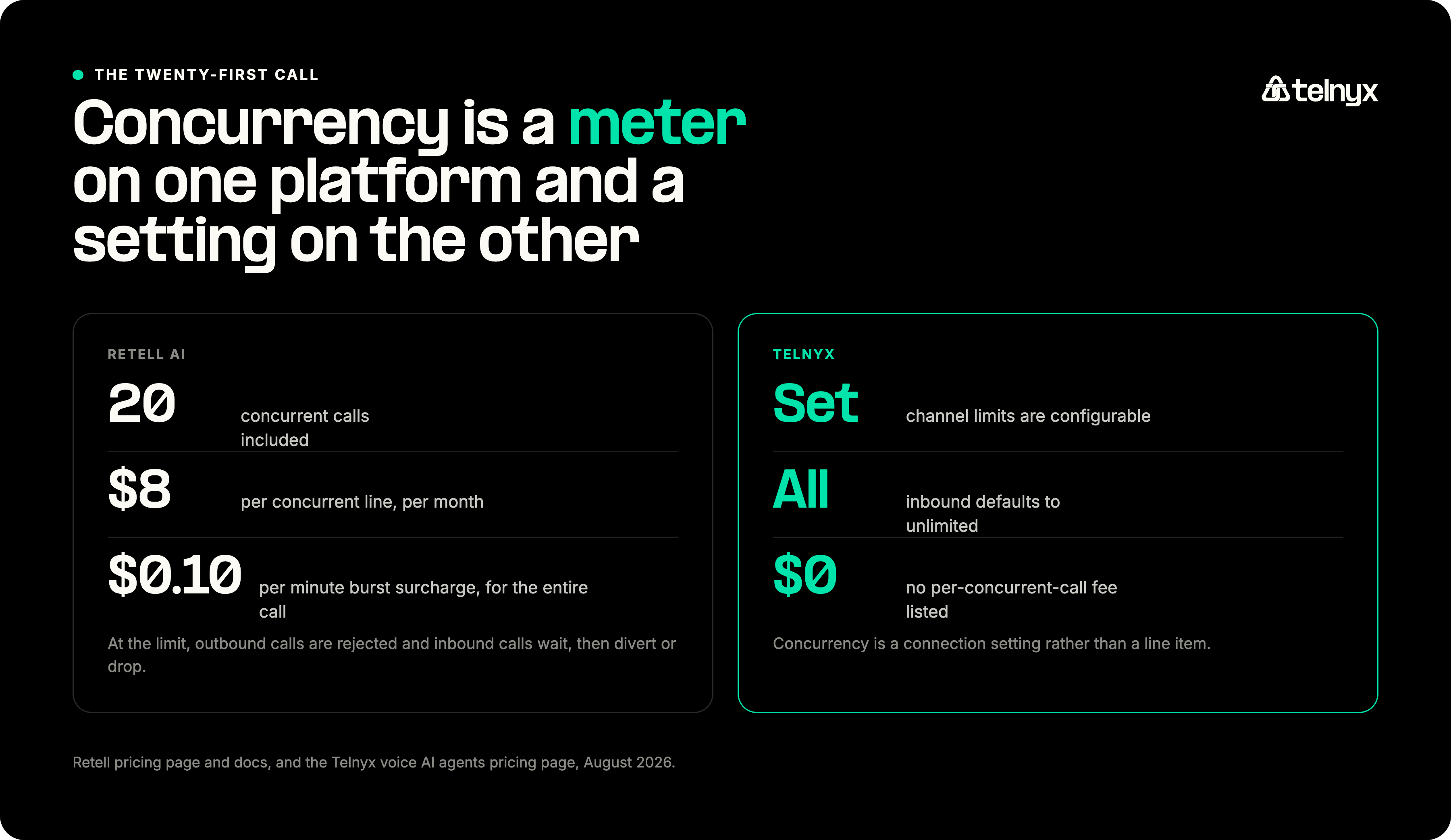
Concurrency runs on its own meter too. You get 20 concurrent calls free, then pay $8 per concurrent line per month, and burst traffic above your limit surcharges $0.10 per minute for the entire call.
The telephony underneath belongs to someone else
Retell does not operate a carrier network. The pricing page lists "US Twilio" as the telephony line item, managed numbers cover the US and Canada only, and international deployments mean bringing your own SIP trunk from a carrier such as Telnyx or Vonage. Connecting over a plain SIP URI costs you features: the Retell docs note call transfer stops working because Retell has no control over the underlying provider.
That boundary shapes support, too. When a call fails at the carrier layer, spam labeling, routing, caller ID, the fix sits outside the platform you bought.
620 milliseconds is close to the best that architecture can do
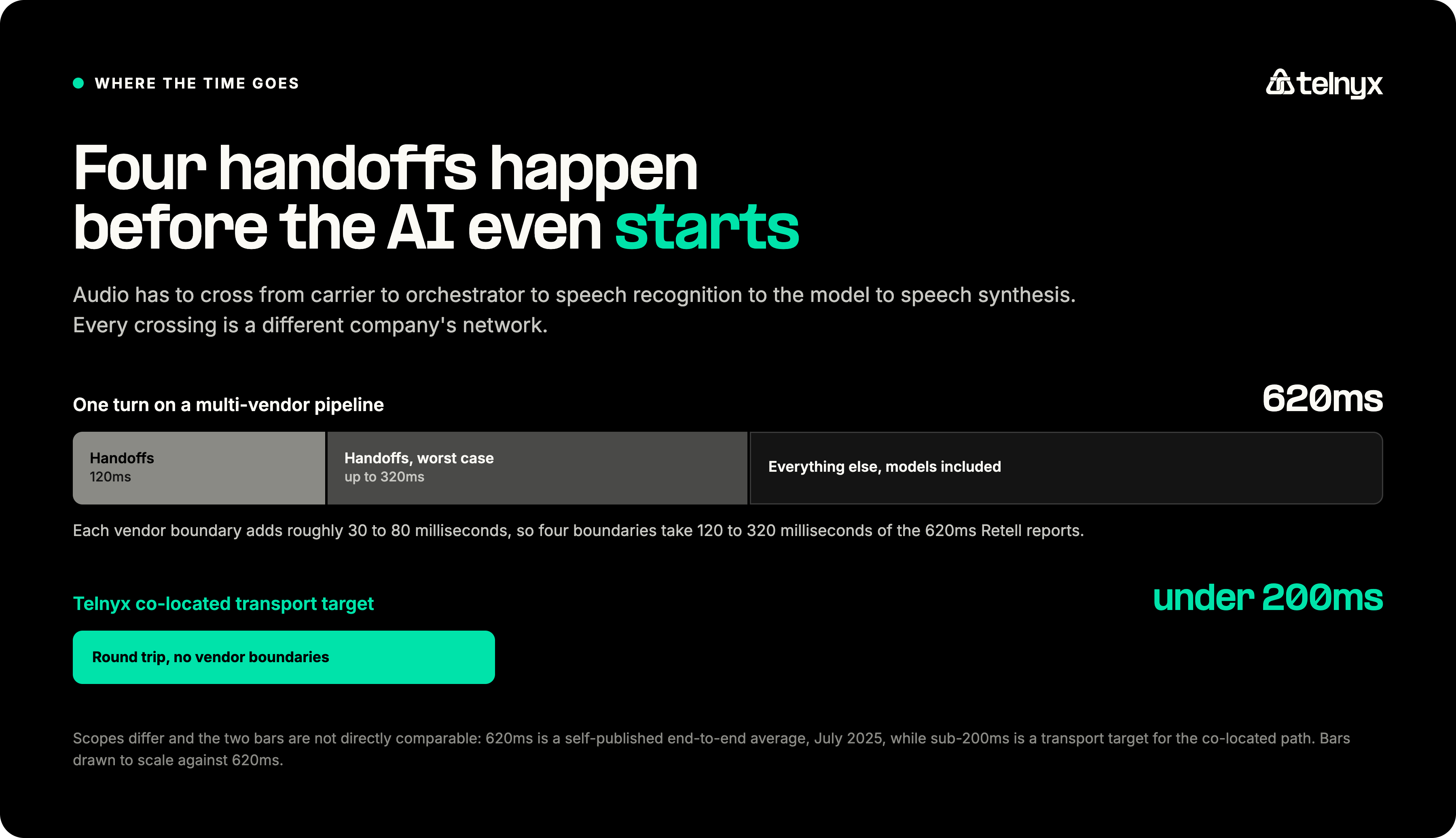
The latency benchmark Retell published reports 620ms average end-to-end response time (Retell, July 2025). The number is honestly measured, and for a multi-vendor pipeline it's competitive. It's also close to the floor for that architecture: each vendor boundary adds roughly 30 to 80 milliseconds of network overhead, so audio crossing four boundaries pays 120 to 320 milliseconds before any model starts working.
The stack didn't fail. The seams did.
How we evaluated these alternatives
Five criteria separate these platforms, and each one traces back to the ownership question. We scored every vendor on all five, and each profile below names where the vendor wins and where it doesn't.
- Stack ownership. Which layers (models, orchestration, telephony) the vendor runs on its own infrastructure versus resells.
- Telephony. Whether calls ride a carrier the vendor operates or a third-party pass-through.
- Latency. Published numbers, with vendor-reported figures labeled as such.
- Pricing transparency. Whether you can compute a production per-minute cost from the public pricing page.
- Compliance posture. Published certifications and how far they extend across the stack.
We pulled every rate on this page from the vendors' live pricing pages and docs on August 28, 2026, and recomputed the per-minute math ourselves. Vendor-reported numbers are labeled as such, and where a fact isn't publicly documented, we say so instead of guessing. Compliance postures are the vendors' published claims; verify current certifications against each vendor's trust documentation during procurement.
How the 7 Retell AI alternatives compare at a glance.
| Platform | Best for | Starting price |
|---|---|---|
| Telnyx | Voice agents with telephony built in | $0.05/min voice engine; ~$0.056/min typical production all-in |
| Vapi | Code-first orchestration and model flexibility | $0.05/min hosting, plus models and telephony at cost |
| Bland AI | Managed proprietary model stack in regulated verticals | $0.11 to $0.14/min, plus platform fees from $299/mo above the Start tier |
| ElevenLabs | Realism-first voice agents | $0.08/min, plus LLM and telephony at cost |
| Twilio | BYO-LLM agents on existing Twilio rails | $0.07/min ConversationRelay, plus voice minutes and your LLM |
| Synthflow | No-code enterprise deployments with EU residency | Enterprise contracts from $30,000/yr |
| LiveKit | Open-source control, self-hosted or cloud | Free tier; ~$0.067/min example cloud agent | ## The 7 best Retell AI alternatives in 2026
The seven platforms below run from full-stack carrier to open-source framework, and the same names dominate any list of Retell AI competitors. They're ordered by how directly each replaces Retell, starting with the platform that also replaces the layers underneath it.
1. Telnyx
The Telnyx Voice AI agent platform runs the entire call path on one system: a licensed carrier network, GPU infrastructure for inference, and the agent runtime, operated by one company. Where Retell coordinates vendors, Telnyx owns the layers those vendors rent. This is what AI agent infrastructure looks like when nothing is stitched together.
The practical difference shows up in the audio path. Telnyx's voice AI agents run speech-to-text, LLM inference, and text-to-speech on the same network where calls enter the system, so audio never crosses a vendor boundary mid-conversation. Telnyx targets sub-200ms round-trip on that co-located path: a transport figure, not a full-pipeline benchmark, and its job is to show what co-location removes, the boundary overhead multi-vendor pipelines pay on every turn.
That answers the latency question most Retell users arrive with. The 620ms average Retell published is mostly boundary time, not model time, and our benchmark comparison of voice AI latency breaks down where each platform's milliseconds go.
You can build without code in the assistant builder, or drop to Telnyx's Voice API for full call control when the flow canvas stops being enough. Both paths run the same underlying voice AI agent platform with telephony attached natively rather than imported.
Model choice runs both directions. Telnyx-native models like Kimi K2.5 run on Telnyx GPUs with no external API key, keeping inference co-located, while bring-your-own providers such as OpenAI connect through integration secrets, trading some of the co-location benefit for model continuity.
Security and reliability. Telnyx holds SOC 2 Type II, HIPAA, PCI DSS Compliant, ISO 27001, GDPR with EU-deployed infrastructure. It's a licensed carrier in 40+ countries and signs full A-level STIR/SHAKEN attestation as the originating carrier, the highest identity verification level in the US telephone network. Application-layer platforms inherit whatever attestation their underlying carrier provides.
Pros:
- One accountable stack. Telephony, STT, TTS, inference, and orchestration run on infrastructure Telnyx operates, so one support team can trace a bad call end to end.
- Carrier-owned telephony with global numbering, native SIP, and A-level attestation, rather than resold minutes.
- Co-located inference removes inter-provider hops, the largest non-model latency source in multi-vendor stacks.
- One rate you can compute. The voice engine price covers orchestration, STT, and TTS, with LLM tokens and carrier costs itemized on the same page.
- Compliance covers the whole call path under one vendor rather than fragmenting across sub-processors.
Cons:
- Conversation QA is younger here. Retell ships a packaged simulation and QA suite ahead of what Telnyx exposes today (Telnyx covers scenario testing through a Coval integration).
- Managed multi-tenant deployment only. Teams that require self-hosted or on-premise runtimes won't find that option.
Importing Retell agents into Telnyx. Telnyx ships an import tool that fetches your Retell agents by API key and converts them into agent graphs you can test before going live. Transfers with voicemail detection, knowledge-base retrieval, and tool calling are documented assistant features on the Telnyx side, so the core behaviors a Retell agent leans on have landing spots. The five-step walkthrough in our guide to why teams outgrow Retell draws on conversations with more than 40 companies that hit the same ceilings.
Who should consider another option. Teams that want packaged conversation analytics above all else, or a vendor-led implementation team to build the agent for them, are better served by Retell or Bland today.
Pricing. The voice engine costs $0.05 per minute for orchestration, STT, and TTS in one rate. LLM tokens bill at Telnyx GPU rates (typically around $0.004/min for a production agent) and telephony at carrier cost from $0.0032/min, which the Telnyx pricing page estimates at roughly $0.056/min all-in for a realistic production agent. The same page puts stitched-together stacks at $0.12 to $0.42 per minute.
And the meter from this page's opening scene doesn't exist here. Concurrency is a connection setting rather than a line item: Telnyx channel limits are configurable, inbound defaults to unlimited, and the pricing page lists no per-concurrent-call fee.
Capability differences between Telnyx and Retell AI at a glance.
| Capability | Telnyx | Retell AI |
|---|---|---|
| Architecture | Carrier network, GPUs, and agent runtime on one system | Orchestration layer on third-party carriers and models |
| Telephony | Carrier-owned, licensed in 40+ countries | Resold (the pricing page lists US Twilio) or bring your own SIP |
| Latency architecture | Co-located inference, zero inter-provider hops; sub-200ms transport target | Multi-vendor pipeline; 620ms end-to-end average, self-published |
| STIR/SHAKEN | A-level attestation as originating carrier | Inherited from the underlying carrier |
| Pricing model | One voice-engine rate; LLM and carrier costs itemized | Five separate meters: platform, TTS, LLM, telephony, add-ons |
| Compliance | SOC 2 Type II, HIPAA, PCI DSS Compliant, ISO 27001, GDPR with EU-deployed infrastructure | SOC 2 Type II, HIPAA BAA, GDPR (see the compliance section below) |
| Conversation QA tooling | Call monitoring; no packaged simulation suite yet | Productized simulation testing and AI QA |
| HIPAA support | Yes, HIPAA-eligible infrastructure | Yes, self-serve BAA at no extra fee |
Try Telnyx Voice AI and run your first agent on the network the orchestrators build on. Retell itself lists Telnyx among the carriers underneath its platform.
2. Vapi
Vapi is the code-first counterpart to Retell: the same orchestration tier, built for engineers instead of ops teams. In a Retell AI vs Vapi decision, you're trading the visual builder for code control. Everything is composable: you pick the STT, LLM, and TTS providers, wire them through API, CLI, and SDKs, and swap any layer without rearchitecting. Its testing suite (evals, simulated callers, scorecards, CI/CD hooks) is the most engineering-native on this list.
Pricing is public and simple to model: $0.05 per minute of hosting, with model costs passed through at cost and dropping to zero when you bring your own API keys (vapi.ai/pricing, August 2026). Ten concurrent calls come free, then $10 per line per month. HIPAA runs $2,000/mo and zero data retention $1,000/mo as add-ons.
Pros:
- Bring-your-own-keys pricing makes the model layer effectively pass-through, a cleaner cost structure than per-minute LLM menus.
- The strongest developer experience in the category: docs, CLI, MCP integration, and SDKs across web, mobile, and server stacks.
- Evals and simulated-caller tests run in CI/CD, so agent regressions surface before deploys.
Cons:
- Code-first cuts out non-technical teams. Vapi retired its visual Workflows builder in August 2026, steering everyone to code and config.
- Latency and compliance depend on the stack you assemble, and the paid compliance add-ons price small regulated teams out.
- Costs stack at scale: hosting plus pass-through models plus imported telephony recreates the multi-meter math.
Where it underperforms. Vapi assembles the same third-party layers Retell does. Telephony imports from Twilio, Telnyx, or Vonage, so ownership of the call path, attestation, and carrier-level support sit outside the platform, and the assembled stack carries the same boundary latency as Retell.
Verdict. Pick Vapi if your engineers want maximum control over every component and you accept operating the result; skip it if you need a no-code path or one vendor accountable for the full call. Our Vapi comparison covers the head-to-head against Telnyx.
3. Bland AI
Bland AI answers the ownership question at the model layer. It self-hosts its own STT, LLM, and TTS on dedicated GPU clusters, so there are no token charges and no model-provider pass-throughs, and your conversation data stays on infrastructure Bland runs. The motion is enterprise sales-led, with implementation engineers who build the agent with you.
Per-minute rates run $0.14 (Start), $0.12 plus $299/mo (Build), and $0.11 plus $499/mo (Scale), covering LLM, STT, and TTS in one number (bland.ai/pricing, August 2026). Telephony bills separately: your own carrier or Bland's at pass-through cost. Self-reported customer results, like the Medicare enrollment case study Bland cites, are the vendor's own numbers.
Pros:
- Owned model stack delivers data sovereignty and a predictable AI-side rate with no per-token math.
- Serious QA machinery: stress testing, simulation sets with flakiness detection, and node-level failure analytics.
- White-glove delivery suits regulated enterprises that want the agent built for them, with published compliance pages to match.
Cons:
- The ownership story stops at the network edge. Bland is not a carrier, so calls still ride third-party telephony at pass-through cost.
- The Start tier is self-serve, but the differentiating capabilities (owned models, engineer-built deployments) gate through sales.
- Proprietary TTS means no third-party voice catalog, and real switching friction later.
Where it underperforms. Against Telnyx, Bland owns the models but not the network; against Retell, it gives up the self-serve on-ramp, model choice, and the cheapest configurations entirely. The per-minute sticker rates are the highest on this list.
Verdict. Bland fits regulated, high-stakes call volumes where model ownership and an implementation partner outweigh cost. Developers who want to experiment cheaply, and margin-sensitive resellers, should look elsewhere; we compare the field in Bland AI alternatives.
4. ElevenLabs
ElevenLabs owns the layer Retell rents from it. Retell bills ElevenLabs voices as a premium line item on its own meter; going direct buys you the model owner's full agents platform. That means the market's strongest voice realism, its own Scribe STT, a proprietary turn-taking model, and first-class A/B testing. Deployment spans a two-line web widget to full SDKs, and the LLM stays bring-your-own.
Agents pricing runs $0.08 per minute across subscription tiers from free to $990/mo, with burst minutes at $0.16 when you exceed plan concurrency, and LLM and telephony billed at cost on top (elevenlabs.io/pricing/agents, August 2026).
Pros:
- Voice quality owned end to end: proprietary TTS, Scribe STT, and a homegrown turn-taking model, none of them resold components.
- No-code and pro-code paths that both hold up, with evals and A/B experiments built in.
- Enterprise proof at scale, including Klarna, which ElevenLabs credits with up to 10x faster resolutions.
Cons:
- No carrier network and no owned LLM, so phone calls ride SIP or Twilio at cost and two of the three cost-and-latency layers sit outside its control.
- Real per-minute cost is hard to predict: subscription plus $0.08/min plus burst pricing plus at-cost LLM and telephony.
Where it underperforms. For PSTN-heavy workloads, telephony pass-through and burst economics erode the sticker price, and the platform is web-first where Telnyx and Twilio are call-path-first.
Verdict. When voice realism decides the deal and calls are one channel among several, ElevenLabs is the strongest platform here. When the phone network is your primary surface, it isn't; see the ElevenLabs comparison for the infrastructure view.
5. Twilio (ConversationRelay)
Twilio sits one layer below Retell in the stack: it's the carrier platform the Retell pricing page names in its own telephony line item. ConversationRelay gives you orchestrated voice plumbing (streaming STT, TTS, interruption handling) around a WebSocket server you write and an LLM you bring. There is no agent builder, no prompt canvas, and no packaged QA; the agent logic is your code.
ConversationRelay costs $0.07 per minute, on top of voice minutes (from $0.0085/min to receive local calls), numbers at $1.15/mo, and your own LLM bill (twilio.com voice pricing, August 2026). Twilio reports 27.9B+ calls carried in 2024, and compliance spans SOC 2 Type II, ISO 27001, HIPAA-eligible ConversationRelay, and GDPR.
Pros:
- Carrier-scale network and numbering supply, the layer every orchestrator on this list buys from someone else.
- Total LLM freedom with published OpenAI, Anthropic, and Gemini integration paths, plus omnichannel breadth on one vendor.
- Raw carrier pricing beats orchestrator menus when engineering time is already paid for.
Cons:
- Time-to-first-agent measures in days, not minutes: you build and host the server, manage the model vendor, and assemble QA yourself.
- The headline rate excludes voice, STT, TTS, and LLM, so the realistic all-in cost is a multiple of the sticker and can't be quoted from one page.
Where it underperforms. Twilio runs AI in the cloud rather than co-located with the carrier network, and the agent story spreads across several products. Latency and integration burden both land on your team.
Verdict. ConversationRelay rewards teams already deep in the Twilio stack who treat agent logic as their own IP. Teams that want an agent live this week, at a per-minute cost they can quote, should buy an application layer instead.
6. Synthflow
Synthflow is the no-code enterprise pick, a Berlin-built platform aimed at enterprise ops teams in BPO, healthcare, and financial services. Its real differentiators are breadth and residency: 200+ prebuilt integrations across major CRMs (Salesforce, HubSpot, and Zendesk among them), plus an EU hosting option for European data requirements. Its flagship proof point is Freshworks, which Synthflow credits with 65% voice automation across CX workflows.
Pricing moved upmarket in 2026: enterprise contracts start at $30,000 annually, scoped on call volume, concurrency, telephony setup, and integrations (synthflow.ai/pricing, August 2026). The platform displays a 4.5/5 rating across 1,000+ G2 reviews, and publishes a full compliance posture: SOC 2, HIPAA, ISO 27001, GDPR, and PCI DSS v4.0.1.
Pros:
- The strongest prebuilt integration catalog in this set, with EU hosting to match.
- No-code agent building that ops teams run without engineering support.
Cons:
- Architecturally it mirrors Retell: an orchestration layer whose docs list 15 telephony and contact-center integrations, Telnyx among them, underneath.
- The annual contract floor and quote-based scoping remove the self-serve evaluation path entirely.
Where it underperforms. Against Retell, it gives up self-serve evaluation. Against Telnyx, the orchestration sits on rented telephony, now priced behind an enterprise contract floor.
Verdict. Synthflow's buyer is a European enterprise ops team with a procurement checklist and no build team. Teams that want usage-based pricing, or to own any layer of the stack, should keep moving.
7. LiveKit
LiveKit is the open-source answer, and the platform to shortlist if "open source alternative to Retell" is the search that brought you here. The agents framework is public code (13.3K GitHub stars, August 2026) you can self-host end to end. LiveKit Cloud runs it managed instead, with a free Build tier, paid plans from $50/mo, and HIPAA support arriving at the $500/mo Scale tier.
Cloud economics are usage-based: the pricing calculator's example phone agent totals roughly $0.067 per minute across session, telephony, models, and observability (livekit.com/pricing, August 2026). Pipecat plays a similar open-source role if you prefer a pipeline-oriented framework.
Pros:
- Full source-level control with no platform lock-in, and a credible path from free self-hosting to managed cloud.
- Model pricing is transparent per minute, down to individual LLM, STT, and TTS line items.
Cons:
- You operate what you deploy: turn-taking tuning, failover, and observability are your team's job in ways no managed platform on this list asks of you.
- Telephony still connects through SIP providers, so the carrier layer, and its attestation and support boundary, remains external.
Verdict. Pick LiveKit if you have the engineering depth to own your runtime and want zero lock-in; skip it if you're leaving Retell to reduce operational surface rather than expand it.
Which Retell AI alternative fits your situation?
Match the platform to the constraint actually driving your search. Most teams can shortlist two rows from this table and skip the rest of the market.
Scenario guide: which Retell AI alternative to shortlist first.
| Your situation | Pick | Why |
|---|---|---|
| One vendor accountable for the whole call path | Telnyx | Carrier network, inference, and agent runtime on one system |
| Engineers who want to compose and control every component | Vapi | At-cost model pass-throughs with your own API keys |
| Regulated volume, and you want the agent built for you | Bland AI | Owned models plus implementation engineers |
| Voice realism decides the deal | ElevenLabs | Proprietary voices, STT, and turn-taking |
| Already deep in the Twilio stack | Twilio | ConversationRelay wraps your own LLM around Twilio rails |
| Procurement wants a contract, not a build project | Synthflow | No-code agents with EU hosting |
| Open source and zero lock-in | LiveKit | Self-host the agents framework or run it on the cloud | ## Is Retell AI SOC 2 compliant?
Retell AI holds SOC 2 Type I and Type II, offers a self-serve HIPAA BAA at no added fee, and complies with GDPR, per its compliance documentation (August 2026). The gap sits one framework over: Retell publishes no PCI DSS claim, which matters the moment an agent takes a card number mid-call.
Compliance also has an architecture. An orchestrator's certifications cover its own layer, while the STT, LLM, TTS, and carrier vendors underneath each carry a separate audit scope, so your compliance review inherits every sub-vendor in the chain. Platforms that own more layers keep more of the call path inside one audit boundary.
Published compliance postures across Retell AI and its alternatives, August 2026.
| Platform | Published compliance posture |
|---|---|
| Retell AI | SOC 2 Type I and II, HIPAA (self-serve BAA), GDPR; no public PCI DSS claim |
| Telnyx | Full posture including PCI DSS Compliant and ISO 27001, on one audit boundary (see the capability table above) |
| Vapi | HIPAA as a $2,000/mo add-on; zero data retention at $1,000/mo |
| Bland AI | SOC 2 Type II, HIPAA, GDPR, ISO 27001:2022, and PCI DSS 4.0.1 per its trust center |
| ElevenLabs | SOC 2, HIPAA with enterprise BAAs, GDPR with EU data residency |
| Twilio | SOC 2 Type II, ISO 27001, HIPAA-eligible ConversationRelay, GDPR |
| Synthflow | SOC 2, HIPAA, ISO 27001, GDPR, PCI DSS v4.0.1 |
| LiveKit | HIPAA at the Scale tier via signed BAA | ## When Retell AI is still the right call
Retell AI remains the right choice for teams whose priorities sit at the conversation layer rather than the infrastructure layer. Its conversation design tooling is purpose-built for complex multi-turn flows, its analytics dashboards for conversation quality and agent performance lead the tier, and its opinionated setup gets voice AI into production faster than most platforms here.
Stay on Retell if conversation analytics drive your roadmap, your flows are deep and branching, your integration already works, and your volume sits comfortably inside the included concurrency. Leaving a working platform has real costs too.
This whole page compresses to one question: when your voice agent breaks at 2am, who actually fixes the call? Answer that, and the list above mostly sorts itself.
 | "Vapi and Retell have built strong developer experiences, and they have helped prove there is real demand for programmable voice agents. The difference is that Telnyx starts lower in the stack. We are not only orchestrating an AI agent. We also operate carrier infrastructure, call routing, media handling, phone numbers, SIP, and the voice AI layer." James Whedbee, VP of Engineering, Telnyx |
Frequently asked questions
What is the best Retell AI alternative?
Telnyx is the best Retell AI alternative for teams that want telephony, inference, and the agent runtime on one accountable system, because it replaces the layers under the agent instead of re-orchestrating them. Code-first teams should shortlist Vapi, regulated buyers Bland AI, and open-source teams LiveKit.
What is similar to Retell AI?
The Retell AI competitors most similar to it are Vapi and Synthflow, because all three orchestrate third-party models over third-party telephony. Vapi trades the visual builder for code-first flexibility, while Synthflow keeps the no-code approach and adds 200+ integrations. Telnyx, Bland AI, and Twilio differ structurally: each owns a layer the orchestrators buy from someone else.
How much does Retell AI cost?
Retell AI costs between $0.07 and $0.31 per minute by its own pricing page, with the real number set by five separate meters: platform fee, TTS, LLM, telephony, and add-ons (retellai.com/pricing, August 2026). A standard configuration reaches roughly $0.13 per minute, with concurrency billed on top. New accounts start with $10 in free credits.
What is the latency of Retell AI?
Retell AI reports 620ms average end-to-end latency in the benchmark it published in July 2025, against a sub-800ms p99 service target. Most of that time is network overhead between the vendors in the pipeline rather than model inference. Co-locating speech recognition, inference, and synthesis on one network is what pushes a voice agent under that number.
How hard is it to switch from Retell AI?
Switching from Retell AI starts with the Telnyx import tool, which converts existing Retell agents into editable agent graphs you can test before moving traffic. Phone numbers either port to Telnyx or connect over SIP trunking during the transition, so both platforms run in parallel while you compare real calls.
What are the open-source alternatives to Retell AI?
The main open-source alternatives to Retell AI are LiveKit and Pipecat. LiveKit pairs an open agents framework with a managed cloud, so you can self-host everything or start free and scale into paid tiers. Pipecat offers a pipeline-oriented framework for composing STT, LLM, and TTS. Both require your team to operate the deployment.
What is the difference between ElevenLabs and Retell AI?
ElevenLabs owns the voice models that Retell AI resells as a line item on its pricing page, which is the core difference: model owner versus orchestrator. ElevenLabs Agents adds owned STT and turn-taking with realism-first output, while Retell packages third-party components behind a stronger telephony-native workflow.
Does Retell AI work with Telnyx?
Yes, Retell AI works with Telnyx today: the Retell docs support importing numbers and elastic SIP trunking from Telnyx as the carrier under its agents. Teams that want fewer layers go one step further and run the agent on Telnyx directly, importing their Retell agents with the built-in migration tool.
Test the shortlist against your own traffic
Every vendor on this list demos well. The differences surface at your peak hour, on your call patterns, in your compliance review, so run the two or three that fit your ownership answer against real traffic before you commit.
Telnyx makes that test cheap. Sign up, pick a model and voice in the assistant builder, attach a number, and take a live call on Telnyx Voice AI in one sitting, then compare the turn latency against the stack you run today. Signup is free and includes testing credits.
Share on Social
Osman is the Global AEO/SEO Lead at Telnyx, helping make voice AI and communications products clearer for builders. With almost a decade of experience in SEO, he previously led growth at Windscribe and Enzuzo, shipping and scaling organic programs that reached millions.