
General
Why Email Marketing Is Important
Learn why email marketing is important, from unmatched ROI and direct reach to customer retention. Explore key benefits, statistics, and honest limitations.

By Eli Mogul
Takeaways
- Why email marketing is important comes down to ownership. Your email list is a direct, permission-based line to customers that no algorithm can take away, and it delivers the highest ROI of any digital channel.
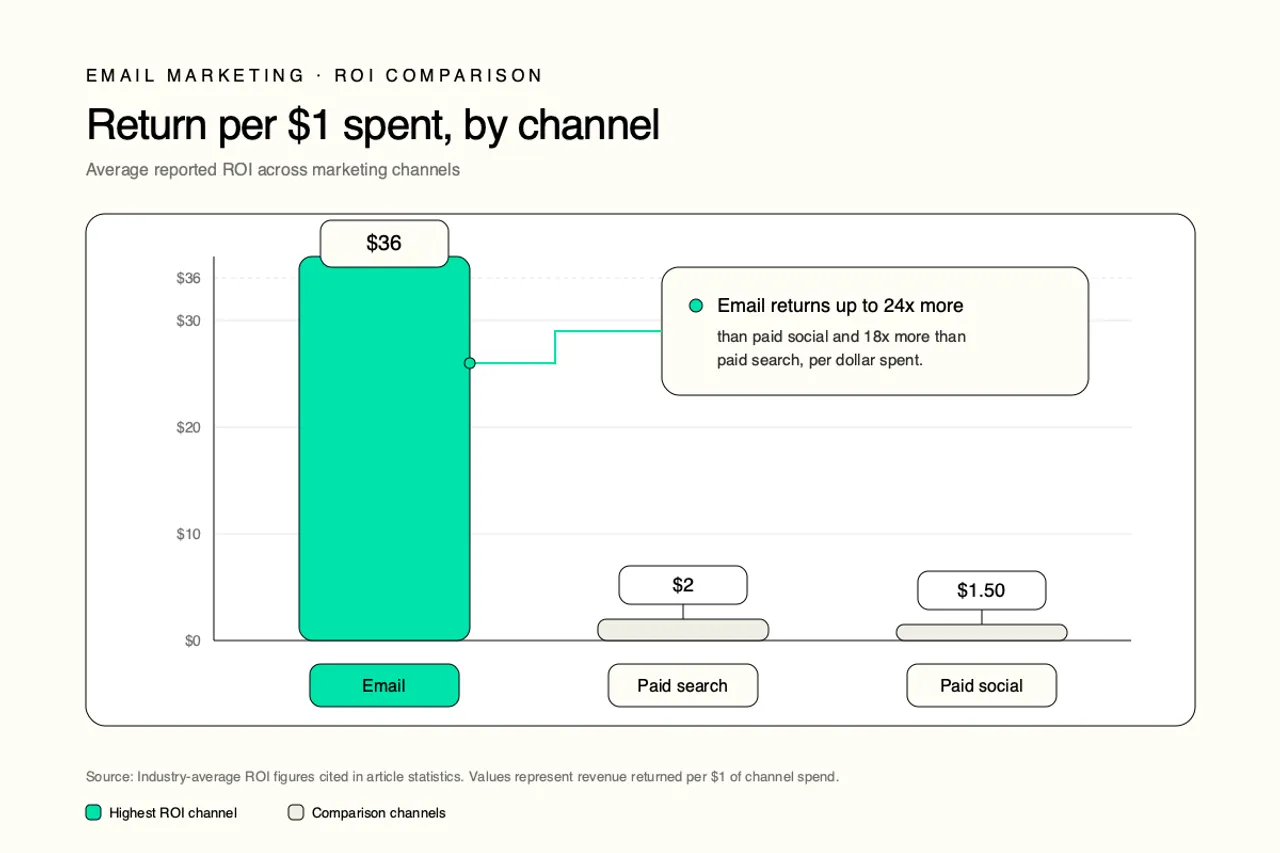
- Email returns roughly $36 for every $1 spent, according to Litmus research, outperforming paid social and paid search on return.
- More than 4 billion people use email worldwide, which means your customers already check the channel every day.
- For small businesses, email removes the ad auction. Cost per send is a fraction of a cent, and a well-built list competes with brands ten times your size.
- Email has real limitations, including deliverability hurdles, crowded inboxes, and compliance obligations. Each one has a known, practical fix.
Why email marketing matters
Understanding why email marketing is important starts with a simple distinction. Email is the only major digital channel your business owns outright. When someone joins your list, they give you permission to reach them directly, and no third party sits between your message and their inbox deciding whether it gets seen.
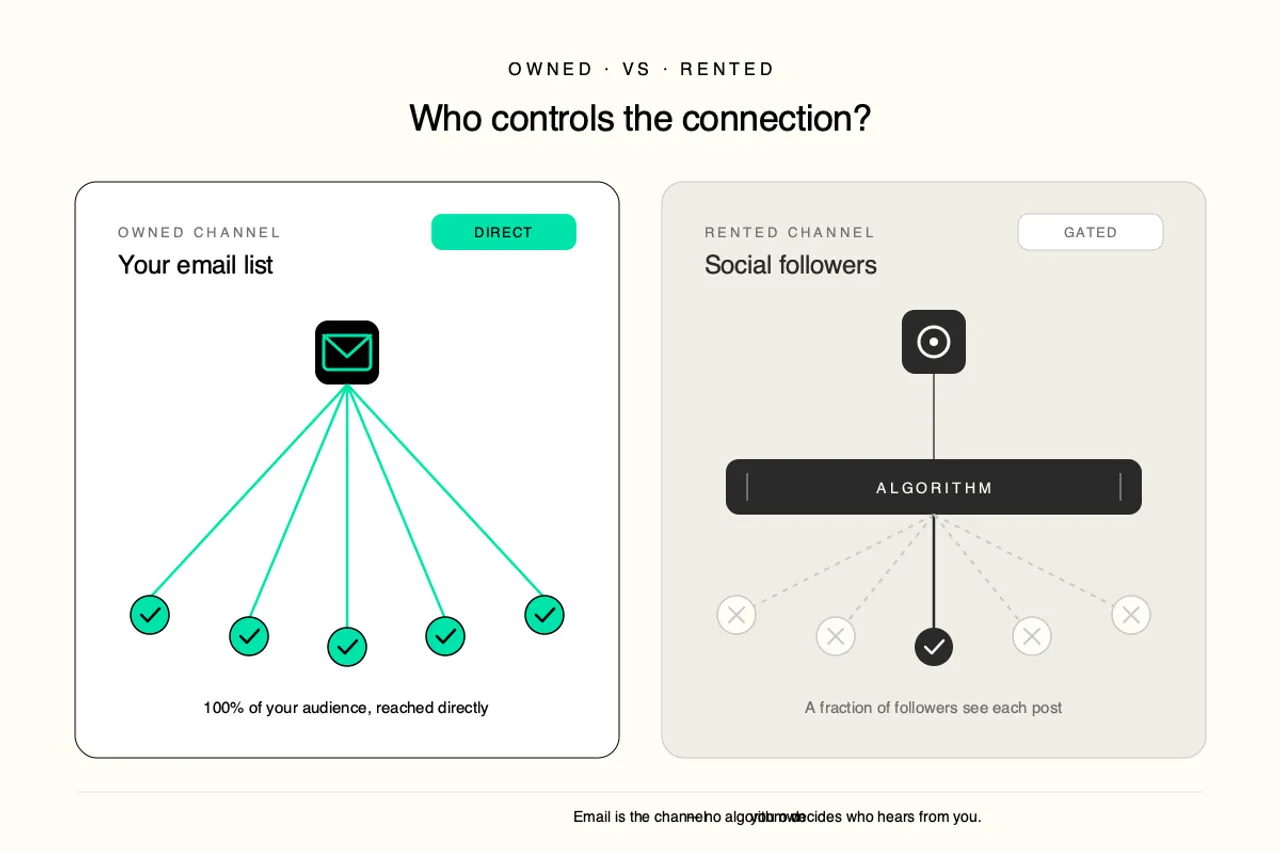
Compare that with social media. Your followers live on someone else's platform, subject to someone else's algorithm and someone else's business model. If the platform changes its ranking rules, your organic reach drops overnight and you did nothing wrong. If the platform disappeared tomorrow, your audience would disappear with it. Your email list would still be sitting in your database, ready to send.
| Attribute | Email list | Social following |
|---|---|---|
| Who controls reach | You | The platform's algorithm |
| Access to audience data | Full | Limited |
| Cost to reach 100% of audience | Near zero | Paid promotion |
You own your audience, not an algorithm
An email address is a durable asset. It moves with you if you switch sending platforms, and it keeps working whether or not you buy ads that month. That permanence changes how you plan. You can invest in list growth this quarter knowing the asset compounds for years, instead of renting attention one campaign at a time.
Email reaches customers where they already are
This is also why email marketing matters at the behavioral level. People check email as part of a daily routine, often multiple times per day, for work and for personal life. You are not asking customers to adopt a new habit. You are joining one they already have, with a message they agreed to receive, in a channel where every open, click, and conversion is measurable.
Build communications you ownTelnyx puts email, SMS, and voice on one platform with one API credential. Explore the Telnyx platform and turn owned channels into a revenue system.
Explore the platformMain advantages of email marketing
The advantages of email marketing show up in mechanics, not slogans. Each one below pairs a specific capability with the business outcome it produces.
Personalized content at scale
Segmentation lets you split one list into many audiences based on purchase history, browsing behavior, location, or lifecycle stage. A returning customer sees a loyalty offer. A cart abandoner sees the exact product they left behind. The mechanism is simple database logic, and the outcome is measurable: relevant messages earn more opens, more clicks, and higher average order value than one-size-fits-all blasts.
Hi Maria, the boots you looked at on Tuesday are back in your size. Checkout takes one tap.
That message took a segment rule and a template to send. No copywriter wrote it by hand, and it converts because it arrives with context.
Improved sales and conversions
Triggered flows do the selling while your team sleeps. Abandoned cart sequences recover revenue that would otherwise vanish. Post-purchase emails cross-sell related products. Win-back campaigns reactivate lapsed buyers. Because every email carries tracking, you can attribute revenue to a specific message and cut what does not perform. Few channels give you that tight a loop between spend and sale.
Stronger customer relationships and retention
Acquiring a new customer costs far more than keeping an existing one, and email is the retention channel. Drip sequences onboard new customers so they reach value faster. Regular newsletters keep your brand present between purchases. Renewal and replenishment reminders arrive exactly when the customer needs them. The outcome is lower churn and higher lifetime value, both of which compound quietly in the background of your revenue numbers.
Note: Retention emails often outperform acquisition campaigns on revenue per send because the audience already trusts you. Check your own data before shifting budget toward acquisition by default.
Increased website traffic
Every email is a controlled traffic source. A product launch, a new blog post, or a limited offer can put thousands of qualified visitors on a specific page within hours of sending, without bidding in an ad auction. Because subscribers opted in, that traffic converts better than cold clicks. Marketers who publish content rely on email to give each new piece an immediate audience instead of waiting on search rankings.
Automation that saves time and budget
Modern teams increasingly run email programmatically. Instead of a marketer clicking through a campaign tool, an API sends transactional messages, triggered flows, and even AI-drafted replies. The example below is an AI Email Agent built on the Telnyx Email API. A customer emails in, the AI drafts a reply, and the Email API sends it back with proper threading. One platform, one API credential, one agent.
The full working example is on GitHub. The budget outcome is direct. Automated flows send themselves, which means headcount scales with strategy rather than with send volume.
The numbers that prove it
Email marketing statistics make the investment case without much argument. The figures below come from high-authority sources you can cite in your own budget discussions.
$36
average return for every $1 spent on email marketing, per Litmus
ROI and revenue statistics
Litmus research on email marketing ROI puts the average return at roughly $36 for every $1 spent, with retail and ecommerce brands seeing returns as high as $45 per dollar. That figure beats what most teams see from paid search or paid social, where the ad auction absorbs a growing share of every budget. Email's cost structure explains the gap. Once the list exists, the marginal cost of each send is close to zero, so revenue from a strong campaign flows almost entirely to margin.
Consumer preference data points the same direction. Surveys consistently find that customers prefer email over other channels for hearing from brands about offers and updates 69% of consumers prefer email from brands.
Reach and engagement statistics
Statista counts more than 4 billion global email users worldwide, a number projected to keep climbing toward 5 billion. That is more than half the planet, and it dwarfs the active user base of any single social platform. Engagement follows the same pattern. An email lands in front of every subscriber who opens their inbox, while organic reach on major social platforms has declined for years as ranking algorithms favor paid promotion. When you need a message seen by your whole audience, email is the channel that can actually deliver it.
Why email marketing is important for small businesses
Small teams feel every dollar of channel spend, which is exactly why email marketing is important for small business budgets. There is no ad auction to lose, no algorithm to appease, and no minimum spend. A list of 2,000 engaged subscribers costs almost nothing to email and can outperform a paid campaign many times its cost.
Low cost, high return
List building does not require a big budget either. A lead magnet like a discount code or a useful guide, a signup form on your site, and a checkbox at checkout will grow a list steadily from traffic you already have. Transactional touchpoints, such as order confirmations and shipping updates, keep your sender reputation warm between promotional sends. Small businesses can also pair email with SMS for time-sensitive offers. The Telnyx SMS API handles high-throughput sending with 10DLC and toll-free compliance built in, so a flash sale hits the inbox and the phone at the same moment.
Note: Start with three flows before you send a single newsletter: a welcome sequence, an abandoned cart recovery, and a post-purchase follow-up. These three cover the highest-intent moments in the customer journey.
Competing with bigger brands on relationships
A national brand can outspend you on ads every day of the week. It cannot out-relate you. Email rewards specificity and voice, and a small business that knows its customers by name can write messages a corporate template never will. Reply-to addresses that reach a real person, recommendations based on actual purchase history, and a founder's note in the monthly newsletter build the kind of loyalty that ad budgets cannot buy. In the inbox, the playing field is level.
Honest limitations to weigh
Most articles on this topic skip the disadvantages of email marketing entirely. That is a mistake, because every limitation below is manageable once you name it and plan for it.
Deliverability and spam filters
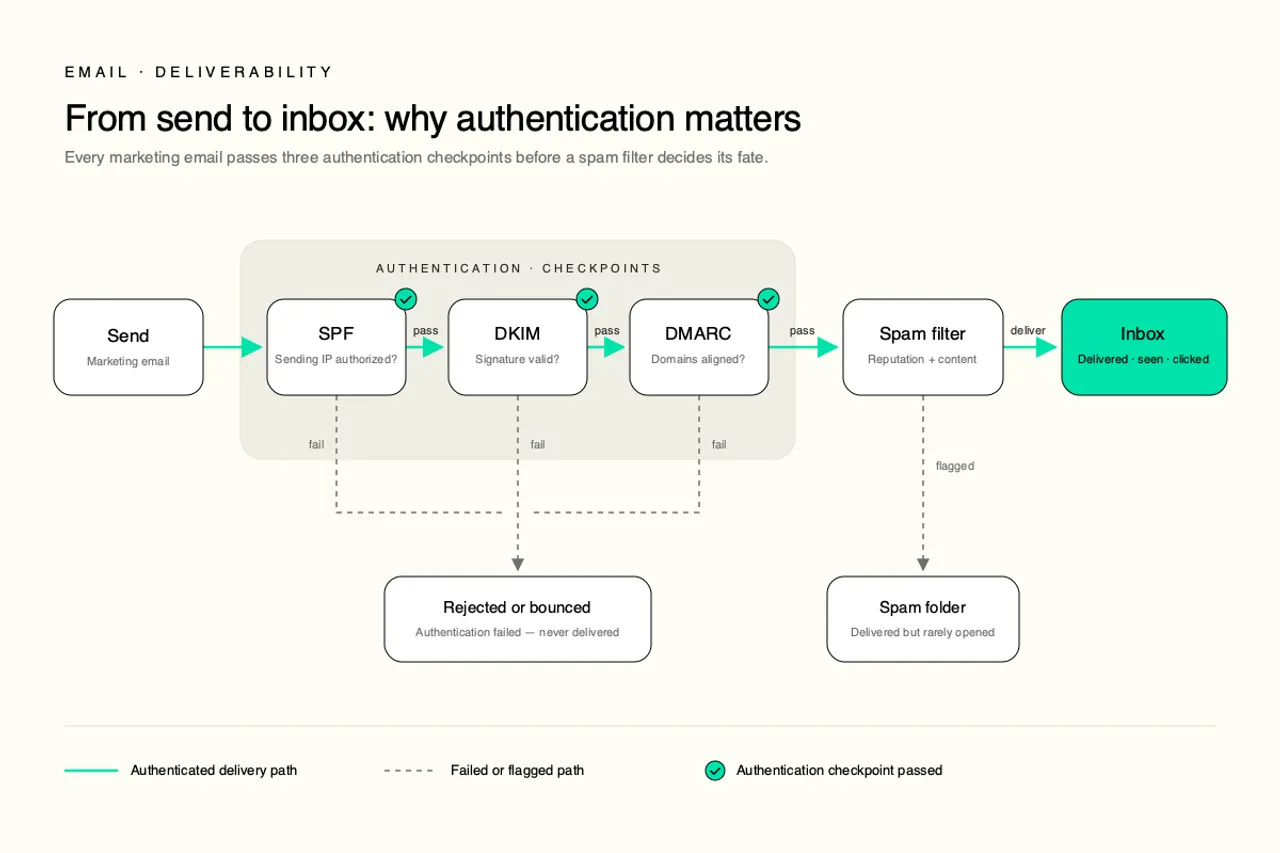
Getting an email delivered is not guaranteed. Mailbox providers check sender reputation, authentication records, and engagement signals before deciding whether your message lands in the inbox, the promotions tab, or the spam folder. The mitigation is technical and well documented. Publish SPF, DKIM, and DMARC records so receiving servers can verify you are who you claim to be, warm up new sending domains gradually, and prune addresses that never engage. Teams that treat deliverability as an engineering discipline rather than an afterthought see inbox placement improve within weeks.
Inbox competition and list fatigue
Your subscribers receive dozens of marketing emails a day, and every irrelevant send trains them to ignore you. Over-mailing is the fastest way to burn a list. Engagement drops, unsubscribes climb, and spam complaints damage the deliverability you worked to build. The fix is restraint backed by data. Segment so each message reaches only the people it applies to, set frequency caps, and suppress subscribers who have gone cold instead of mailing them harder.
| Limitation | Practical mitigation |
|---|---|
| Spam filters and deliverability | SPF, DKIM, DMARC, and list hygiene |
| Inbox competition and fatigue | Segmentation and frequency caps |
| Legal compliance | Double opt-in and clear unsubscribe |
Compliance requirements (CAN-SPAM, GDPR)
Email is regulated. In the US, the FTC's CAN-SPAM compliance guide requires accurate sender information, a physical address, and a working unsubscribe mechanism, with penalties that can reach tens of thousands of dollars per violating email. In the EU, GDPR requires demonstrable consent and gives regulators the power to fine up to 4% of global revenue. Other jurisdictions, such as Canada's CASL and Brazil's LGPD, impose similar or stricter consent requirements. Double opt-in, a visible one-click unsubscribe, and clean consent records satisfy both regimes and improve list quality at the same time.
The mature answer to these limitations is multichannel, with email as the anchor rather than the whole strategy. When a message is urgent, SMS reaches the phone in seconds. When a conversation needs a human, voice picks up where text stops. Telnyx phone numbers activate instantly in 140+ countries, so the same platform that sends your email can also carry your texts and calls. One vendor, one API, one bill.
FAQ
Turn email into a revenue systemOwn your audience across email, SMS, and voice on one platform. Talk to a Telnyx expert and start building today.
Get started with TelnyxShare on Social

%20(1).png?prefix=cms-media)