
Voice
The best AI receptionists for small businesses
Seven AI receptionists compared on phone numbers, booking, human backup, compliance and the monthly cost of 300 three-minute calls.

By Osman Husain
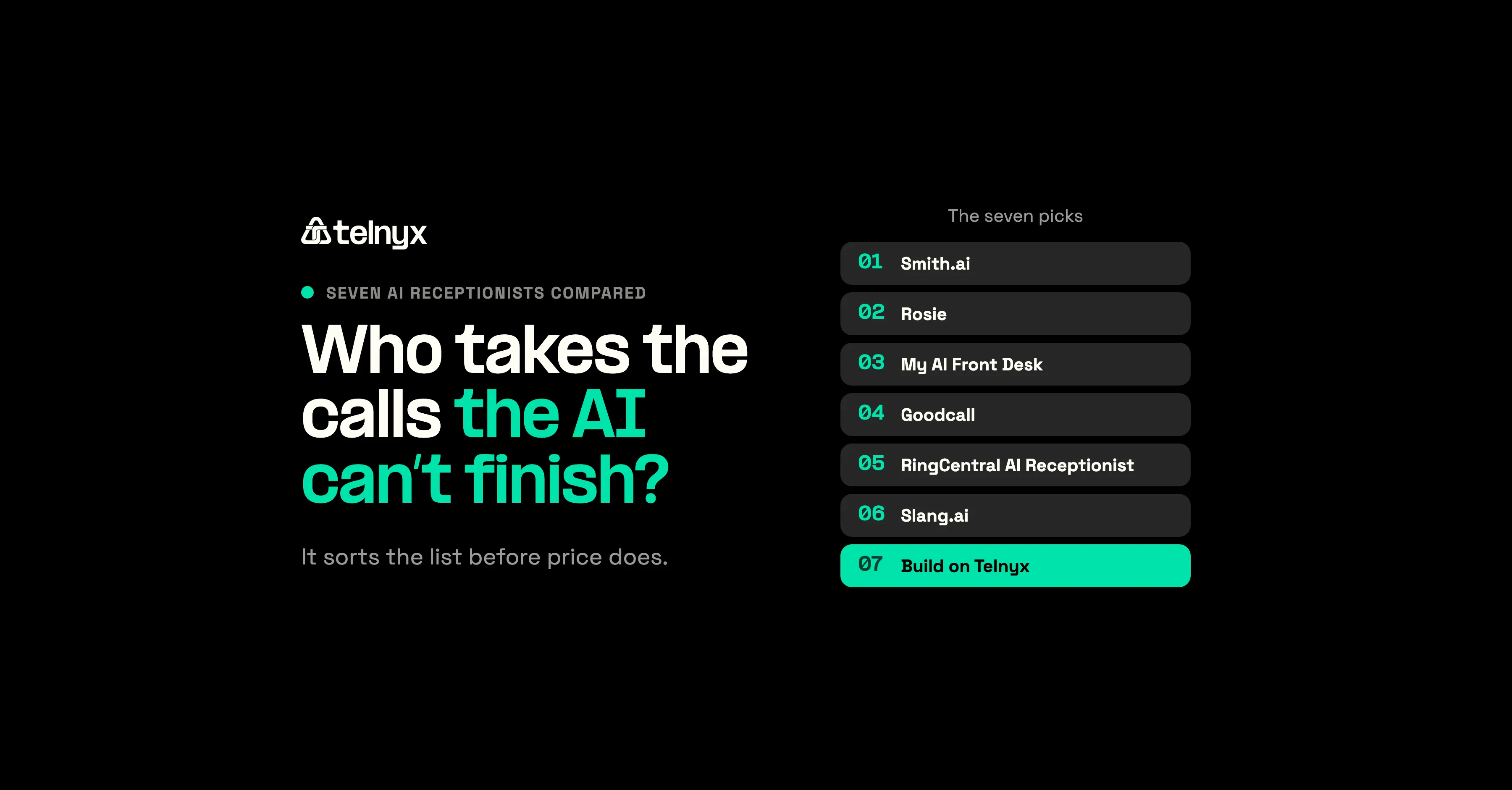
An AI receptionist is a voice agent that answers business calls, books appointments, and transfers callers to staff. Here's Telnyx's list of the best AI receptionists for small businesses, ranked in no specific order:
- Smith.ai: Best for AI answering with human backup
- Rosie: Best for service businesses that run on a CRM
- My AI Front Desk: Best for phone, chat and text in one plan
- Goodcall: Best for businesses with long calls
- RingCentral AI Receptionist: Best for RingCentral phone customers
- Slang.ai: Best for restaurant reservations by phone
- Telnyx: Best for teams building a custom receptionist
Evaluating AI receptionists
I compared seven AI receptionists on the criteria most relevant for small businesses:
- Can the receptionist answer on the number the business already has?
- Can it book, transfer and take messages without staff stepping in?
- Does it connect to the calendar and CRM the business already uses?
- What happens when a caller needs a person?
- What does a month of calls cost, overage included?
- Does it meet the business's compliance needs, such as HIPAA or card payments?
Research findings
The seven vendors bill in different ways: per call, minutes by plan, minutes plus credits, unique customers, a license plus minutes, per-minute usage and custom quotes.
Of the seven, only Smith.ai keeps paid live agents behind its AI. Every other receptionist on the list hands a caller who needs a person to the business's own staff.
Compliance varies among the seven, too. Smith.ai states that it is not HIPAA-compliant. The RingCentral terms bar its receptionist from card payments.
Goodcall signs a BAA, the business associate agreement HIPAA requires for patient data, only on its Scale ($299) or Enterprise plan.
The AI receptionists compared
Seven AI receptionists compared by best fit and key trade-off.
| Vendor | Best for | Key trade-off |
|---|---|---|
| Smith.ai | AI answering with human backup | Not HIPAA-compliant, so it can't take calls involving patient health information |
| Rosie | Service businesses that run on a CRM | US businesses only; booking and transfers start on the second plan |
| My AI Front Desk | Phone, chat and text in one plan | 200 voice minutes included, so a busy line runs into overage |
| Goodcall | Businesses with long calls | English only, and it can't port a number yet |
| RingCentral AI Receptionist | RingCentral phone customers | 100 minutes included, and its terms bar card payments |
| Slang.ai | Restaurant reservations by phone | Restaurants only, on quote-based contracts that auto-renew |
| Telnyx | Teams building a custom receptionist | The business builds and maintains the receptionist itself |
1. Smith.ai: Best for AI answering with human backup
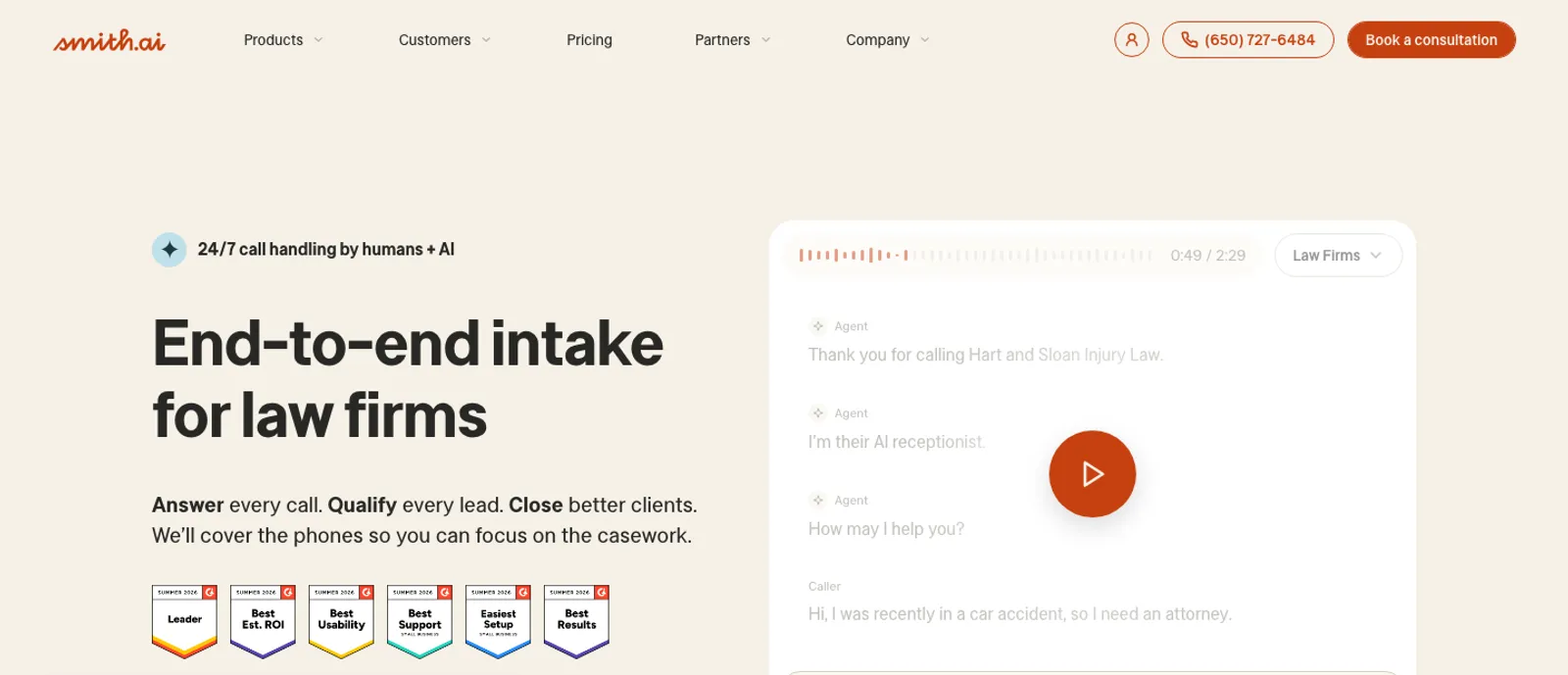
Best for: Businesses that want AI on routine calls and a trained person on the calls the AI can't finish.
Smith.ai sells three kinds of answering: an AI receptionist, a hybrid of AI and live agents, and human-only virtual receptionists.
Behind the AI sits a network of more than 500 North America-based live agents. When the AI decides a caller needs a person, escalation is free.
Its AI plans include:
- Booking through Calendly and other scheduling tools, plus warm transfers that pass the caller's context to the staff member who answers.
- Lead qualification and intake questions, with a summary, recording and transcript after every call. Native connections cover Salesforce, HubSpot and Clio.
- Quality Studio, a test environment that runs simulated calls before the receptionist goes live. Smith.ai puts setup at about 15 minutes.
Its limits:
- The service is not HIPAA-compliant, so a medical or dental practice can't route calls with patient health information to it.
- When the business assigns live agents to certain call types, such as scheduling, each of those calls carries an add-on fee with no published price.
Calls reach Smith.ai through forwarding or a port of the existing number.
Billing is per call, not per minute. The Free plan covers 25 calls a month at $0, then charges $3.00 a call. Pro starts at $150 a month for 75 calls. Enterprise lists $500 a month for 300 calls, then $2.17 a call.
Every plan runs month to month, with 30 days' notice to cancel.
Smith.ai is the pick for a law firm or agency that wants routine calls on AI and a human safety net when intake goes off script.
2. Rosie: Best for service businesses that run on a CRM
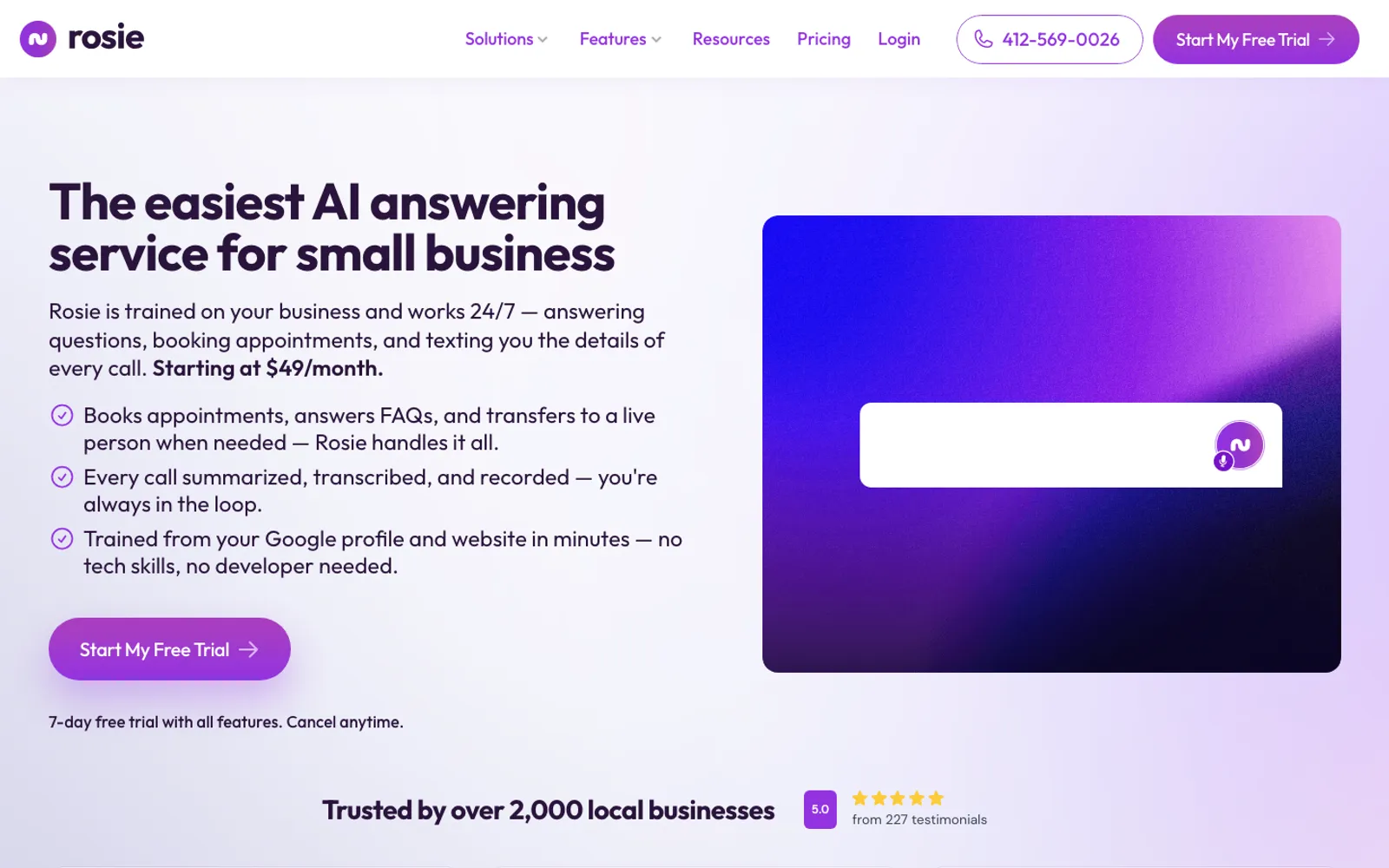
Best for: Home-service and sales businesses whose day runs on a CRM, since every call, text and chat lands in the customer record without a separate automation tool.
Rosie is an AI receptionist for small businesses, with no live agents of its own. It drafts its answers from the business's website and Google Business Profile for the owner to confirm.
The existing number stays with its carrier. Rosie answers either every forwarded call or only the ones staff miss.
Rosie includes:
- Native logging into 18 named CRMs on every plan, from field-service tools such as Jobber and Housecall Pro to sales tools such as HubSpot and Pipedrive.
- Booking into Google Calendar, Calendly or Acuity Scheduling, with English and Spanish answering on every call.
- Cold and warm transfers to the business's own staff on Scale, with a briefing before a warm transfer connects. Waterfall transfers, which ring several numbers in turn, need Growth.
Its limits:
- Rosie supports US businesses only and issues only US numbers.
- Calendar booking and transfers start on the second plan, Scale. The entry plan texts callers a booking link instead.
Rosie lists Professional at $49 a month for 250 minutes, Scale at $149 for 1,000 minutes and Growth at $299 for 2,000 minutes. Each plan starts with a seven-day free trial.
There is no published per-minute overage rate. The Rosie terms say an account that runs over its minutes moves up to the next plan and stays there until the owner downgrades.
A covered healthcare business must sign a BAA with Rosie under those terms, which don't say which plans include one.
Rosie suits a plumbing, HVAC or cleaning company whose calls already end as a job in Jobber or Housecall Pro.
3. My AI Front Desk: Best for phone, chat and text in one plan
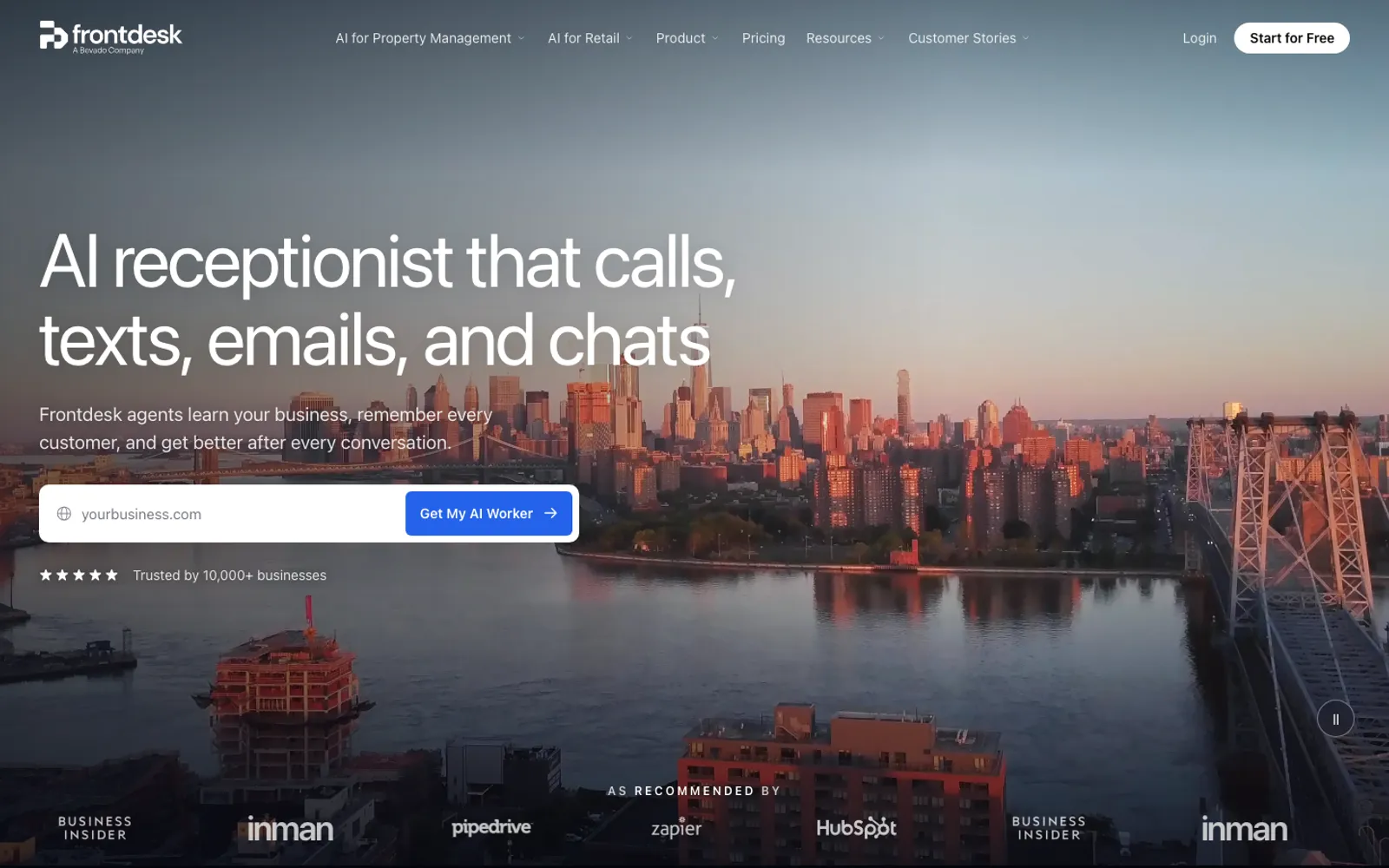
Best for: Small businesses that want calls, chats and texts in one inbox instead of three tools.
My AI Front Desk, which now also brands itself Frontdesk, packages phone answering with web chat, two-way texting, a built-in CRM and automations in one self-serve plan.
The vendor's FAQ puts setup at under five minutes.
My AI Front Desk includes:
- Three ways onto the line: forward the existing number, port it in, or take a new local or toll-free number in the US, Canada, the UK or Australia.
- Booking against live calendar availability during the call, confirmed by text, with Google Calendar, Outlook and Cal.com connections.
- Scenario-based transfer rules, a whispered summary to whoever picks up, and the AI taking the call back if a transfer fails.
Its limits:
- The plan includes 200 voice minutes a month, so a busy line pays overage on most of its calls.
- Direct API access and custom integrations need the custom-priced Partner and Enterprise tier.
My AI Front Desk lists Business-in-a-Box at $99 a month, or $79 billed annually. The plan includes 200 voice minutes, plus 1,000 overage credits, worth $10, that cover about 40 more. Each minute after that costs $0.25.
The plan has no contract. Its seven-day free trial still carries usage fees under the vendor's terms.
The homepage states HIPAA compliance with signed BAAs, without naming the plan that includes one.
My AI Front Desk makes sense when leads arrive by web form and text as often as by phone, and call volume stays near 200 minutes a month.
4. Goodcall: Best for businesses with long calls
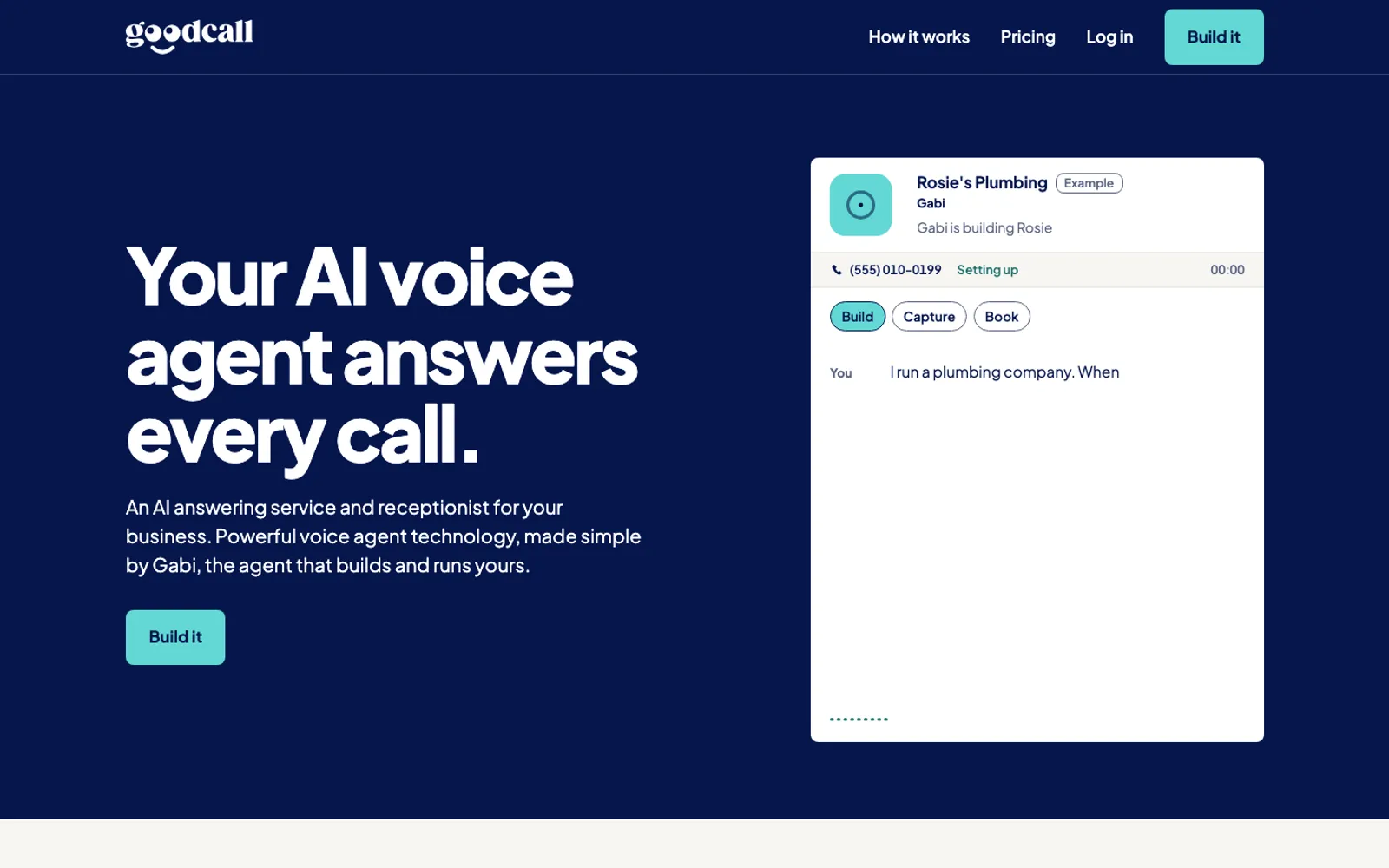
Best for: Businesses whose consultations, quotes or detailed bookings run long, since a nine-minute call costs the same as a thirty-second one.
Goodcall bills per unique customer each month, so it doesn't meter minutes, calls or tokens.
An AI assistant named Gabi builds the receptionist from the owner's description of the business, then runs practice calls before anything goes live.
Goodcall includes:
- A local US number on every plan, with the existing number kept by forwarding all calls or only busy and unanswered ones.
- Booking into Google Calendar, plus transfers that retry busy lines and move through up to three contacts.
- Native connections to Google Calendar, Google Sheets and HighLevel, with other systems connected through an API tool.
Its limits:
- Goodcall answers in English only, offers local US numbers only and can't port a number yet.
- Its texts are send-only: the number can send a confirmation but can't receive the reply.
Goodcall lists Starter at $79 a month for 100 unique customers, Growth at $129 for 500 and Scale at $299 for 2,000. Each extra customer costs 79¢, 26¢ or 15¢ by plan.
A caller counts once a month however often they call. Spam doesn't count. Plans run month to month. A free demo agent can be built and tested before any charge.
The Goodcall homepage states HIPAA and SOC 2 compliance. A signed BAA requires Scale or Enterprise.
Goodcall works best for a consultancy or trades business whose calls run several minutes and whose customers call back within the month.
5. RingCentral AI Receptionist: Best for RingCentral phone customers
Best for: Businesses already on RingEX that want a call queue's overflow answered without a second vendor.
RingCentral AI Receptionist comes from the company behind the RingEX cloud phone system. On RingEX it syncs the account's existing numbers, contacts, directory and settings automatically.
US and Canadian businesses can also buy it on its own and forward calls to it from any phone system.
RingCentral AI Receptionist includes:
- Setup from the business's website or Google Business Profile, which pre-fills the description, hours and FAQs. Testing before launch runs in a chat window or by dialing in.
- Booking, rescheduling and confirming appointments through Google and Outlook calendars, plus routing to users, extensions, queues or outside numbers. A person who takes the call gets a summary of it.
- Salesforce, HubSpot and Zoho CRM connections, and answering in six languages, including English, Spanish and French, with mid-call switching.
Its limits:
- The RingCentral terms bar using the receptionist to process payment card data.
- Outside the US and Canada it is sold only as an add-on to RingEX.
RingCentral lists the standalone plan at $49 a month with 100 minutes. The RingEX add-on costs $39 a month, also with 100 minutes, on top of a RingEX plan from $30 per user.
Minutes pool across the account with no rollover. Each minute over costs $0.50, billed in 30-second increments. Both plans include a 14-day free trial.
RingCentral names the receptionist among the services its BAA covers.
A RingEX customer that wants after-hours and overflow calls answered inside its current phone system should look at RingCentral AI Receptionist first.
6. Slang.ai: Best for restaurant reservations by phone
Best for: Restaurants whose phone line is mostly reservations and hours questions during service.
Slang.ai is an AI phone concierge built only for restaurants. It books reservations by phone directly in OpenTable, SevenRooms, Yelp and Resy, so the booking lands where the host stand already looks.
On OpenTable it also changes and cancels reservations and adds notes.
Slang.ai includes:
- Reservation booking through the restaurant's own platform, with the Slang.ai onboarding team handling setup. The pricing FAQ says a restaurant can go live the same day.
- Private-event leads sent to Tripleseat or Perfect Venue, and VIP callers routed straight to staff.
- Call recordings and summaries, and English and Spanish answering on Core. Premium adds Superhost, which answers in 97 languages for restaurants on OpenTable or Resy.
Its limits:
- Slang.ai publishes no integrations for general calendars or CRMs and covers nothing outside hospitality.
- Pricing is quote-based. The terms bind the restaurant to an auto-renewing contract with 30 days' written notice to cancel.
Slang.ai lists Core as starting at $399 per location and Premium at $599 per location. The page doesn't state the billing period, the included calls or an overage rate.
Keeping the existing number means forwarding it through the carrier to a new Slang number. Transfers ring a separate line at the host stand, staffed by the restaurant's own team.
The pricing page lists SOC II compliance and shows a SOC 2 Type 2 badge. OpenTable, not Slang.ai, captures card details when a booking needs one.
For a restaurant that takes most reservations by phone, Slang.ai books straight into the OpenTable or Resy account the host stand already uses.
7. Telnyx: Best for teams building a custom receptionist
Best for: Teams that want control of the prompt, tools and number, with someone to own the build.
Telnyx's voice AI agent platform is the build option on this list. A business or its developer builds the receptionist in the no-code Telnyx portal or through the API.
Telnyx's voice AI agent platform runs the agent on the same carrier network that provides Telnyx phone numbers, call transfer and SIP connections.
Telnyx includes:
- Four ways onto the line: a new Telnyx number, a port of the existing one, forwarding from the current carrier, or a SIP trunk from an existing phone system.
- Native booking with Calendly and Outlook, CRM connections to Salesforce and HubSpot, and webhook tools for anything else.
- Warm transfers over Telnyx's Voice API that brief the staff member first, plus scripted test calls before launch.
Its limits:
- The business writes and maintains the prompt, tools and tests itself, with no live agents from Telnyx.
- Until an account passes the identity checks of the Verified level, every call opens with a spoken notice that the call is automated.
Telnyx bills per minute with no plan tiers: $0.05 for the voice engine, which covers speech-to-text, text-to-speech and orchestration.
With the language model and inbound calling, Telnyx's pricing page puts a production agent at about $0.06 a minute. The platform fee and call recording add $0.002 a minute each, for about $0.063 in all. A US number costs $1 a month.
Telnyx holds SOC 2 Type II and offers a HIPAA BAA to customers who meet commercial thresholds.
Telnyx is best suited for agencies or developers building receptionists for several locations or clients.
AI receptionist vs answering service
The main difference between an AI receptionist and an answering service is that the receptionist answers with a voice agent, while a human answering service routes calls to receptionists on the service's payroll.
AnswerConnect is an example of the second kind: it clearly says it doesn't use AI agents. The cheapest plan covers 900 minutes a month for $1,325, plus a $49.99 setup fee.
A human service costs more per minute because a person handles every call. It earns that cost on calls that need judgment, such as an upset customer or a complex request.
The Smith.ai hybrid plans sit between the two, with AI on routine calls and live agents on the rest.
An in-house receptionist at the median wage of $18.27 an hour in May 2025, per the Bureau of Labor Statistics, costs about $3,170 a month full time before payroll taxes.
How much does an AI receptionist cost?
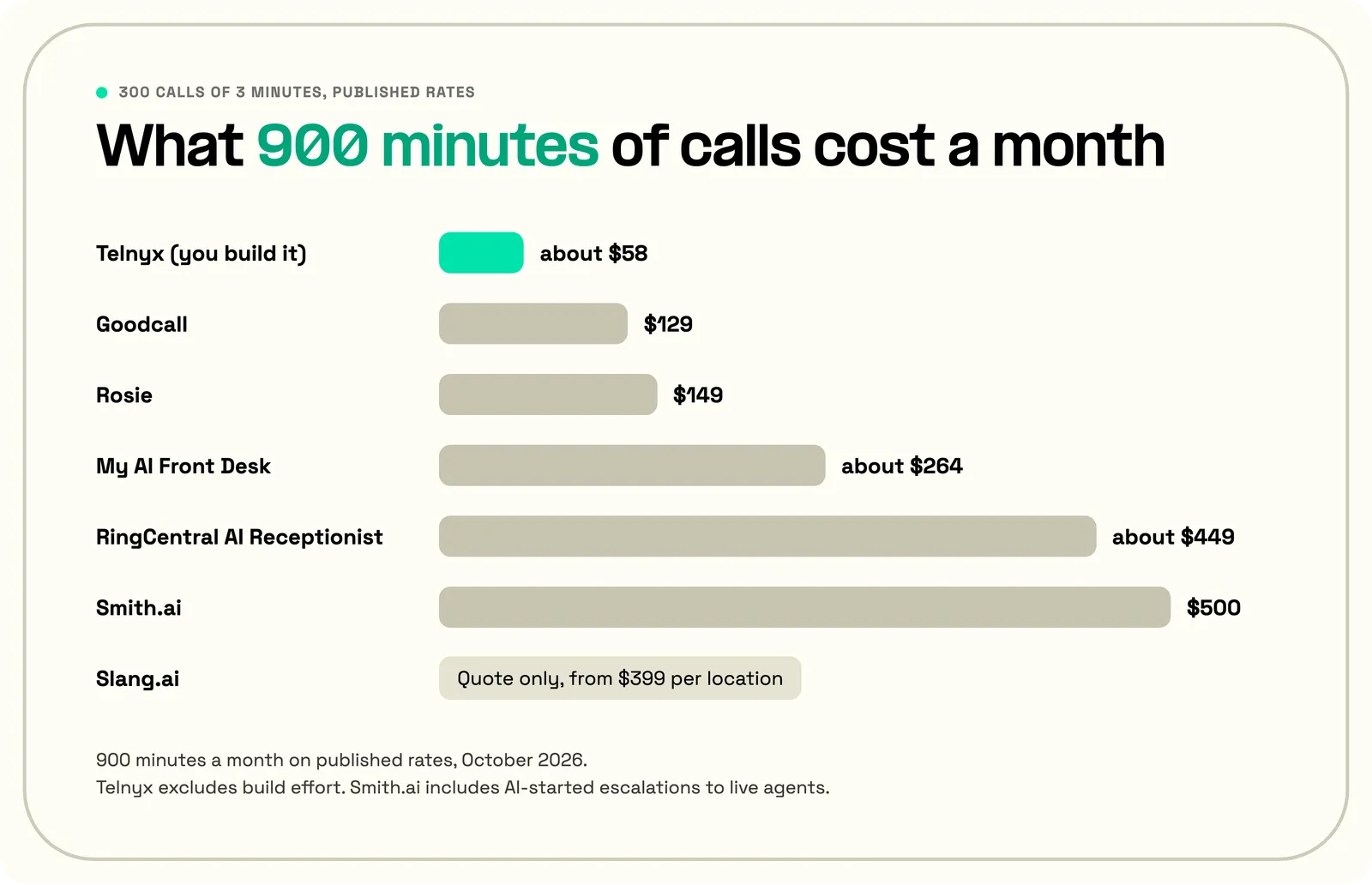
An AI receptionist costs about $58 to $500 a month for 300 three-minute calls, across the six vendors here that publish their rates.
Monthly cost of 300 three-minute calls on each vendor's published rates.
| Vendor | How it bills | 300 calls of 3 minutes a month |
|---|---|---|
| Smith.ai | Per call | $500 (Enterprise, 300 calls) |
| Rosie | Minutes, by plan | $149 (Scale, 1,000 minutes) |
| My AI Front Desk | Minutes plus credits | About $264 ($99 plan plus 660 minutes at $0.25) |
| Goodcall | Unique customers | $129 (Growth, up to 500 customers) |
| RingCentral AI Receptionist | License plus minutes | About $449 ($49 plan plus 800 minutes at $0.50) |
| Slang.ai | Quote | Not published (from $399 per location) |
| Telnyx | Per minute | About $58 (900 minutes at about $0.063, plus a $1 number) |
The Rosie figure leaves 100 minutes of headroom. A month over 1,000 minutes moves the account up to Rosie Growth at $299 until the owner downgrades.
The Telnyx figure buys the line and the agent, not a finished receptionist: someone still has to write the prompt and test the calls.
The Smith.ai figure includes AI-started escalations to live agents at no extra fee, which none of the other six offer.
Rosie, My AI Front Desk, RingCentral and Smith.ai don't publish whether a transferred call keeps using plan minutes or calls.
The best AI receptionist by industry
Rosie fits home services, Slang.ai fits restaurants, and Smith.ai fits law firms, while medical and dental offices require vendors that offer a BAA.
- Home services such as HVAC and plumbing fit Rosie, which logs calls into Jobber, Housecall Pro, ServiceM8 and other field-service tools.
- Restaurants fit Slang.ai, which books straight into OpenTable, SevenRooms, Yelp and Resy.
- Law firms fit Smith.ai, which connects to Clio and backs AI intake with live agents.
- Medical and dental offices need a signed BAA before patient calls reach the receptionist. RingCentral, Goodcall (Scale or Enterprise), My AI Front Desk and Telnyx (above its commercial thresholds) offer signed BAAs.
What to test before choosing an AI receptionist
An AI receptionist trial should run the calls most likely to break it, with pass or fail metrics decided before the first test call.
Human callers are part of the test. In a Gartner survey of 5,728 customers in December 2023, 64% said they would prefer companies didn't use AI for customer service.
Difficulty reaching a person topped those concerns, which puts the handoff test as a priority:
- The handoff test asks for a person mid-call. It passes when the caller hears that a transfer is coming and the staff member gets the context before picking up.
- The email test has a caller spell out an email address. It passes when the receptionist waits for the whole address and reads it back correctly.
- The goodbye test has a caller say "goodbye" before the booking is done. It passes when the call stays open until the task is finished, a failure users report in a 3CX community thread.
- The booking test books an appointment end to end. It passes when the slot appears in the calendar and the call ends cleanly after the confirmation.
- The after-hours test calls outside business hours. It passes when the receptionist answers and an urgent request reaches the on-call person.
Disclosure deserves its own test. In a 90-day test at a four-engineer heating repair firm, Lilach Bullock reported that 6 of 61 answered calls ended when the caller realized the receptionist was AI.
Choosing the right AI receptionist
The right AI receptionist depends on who should handle calls the AI can't finish and which system the call has to land in.
- A business that wants a person on the hard calls without hiring one should start with Smith.ai.
- A home-service company running on Jobber or Housecall Pro should start with Rosie.
- A business whose leads arrive by chat and text as often as by phone should start with My AI Front Desk.
- A business with long calls, or customers who call back often, should start with Goodcall.
- A team already on RingEX phones should start with RingCentral AI Receptionist.
- A restaurant that takes bookings by phone should start with Slang.ai.
- A developer or agency building receptionists for clients should start with Telnyx.
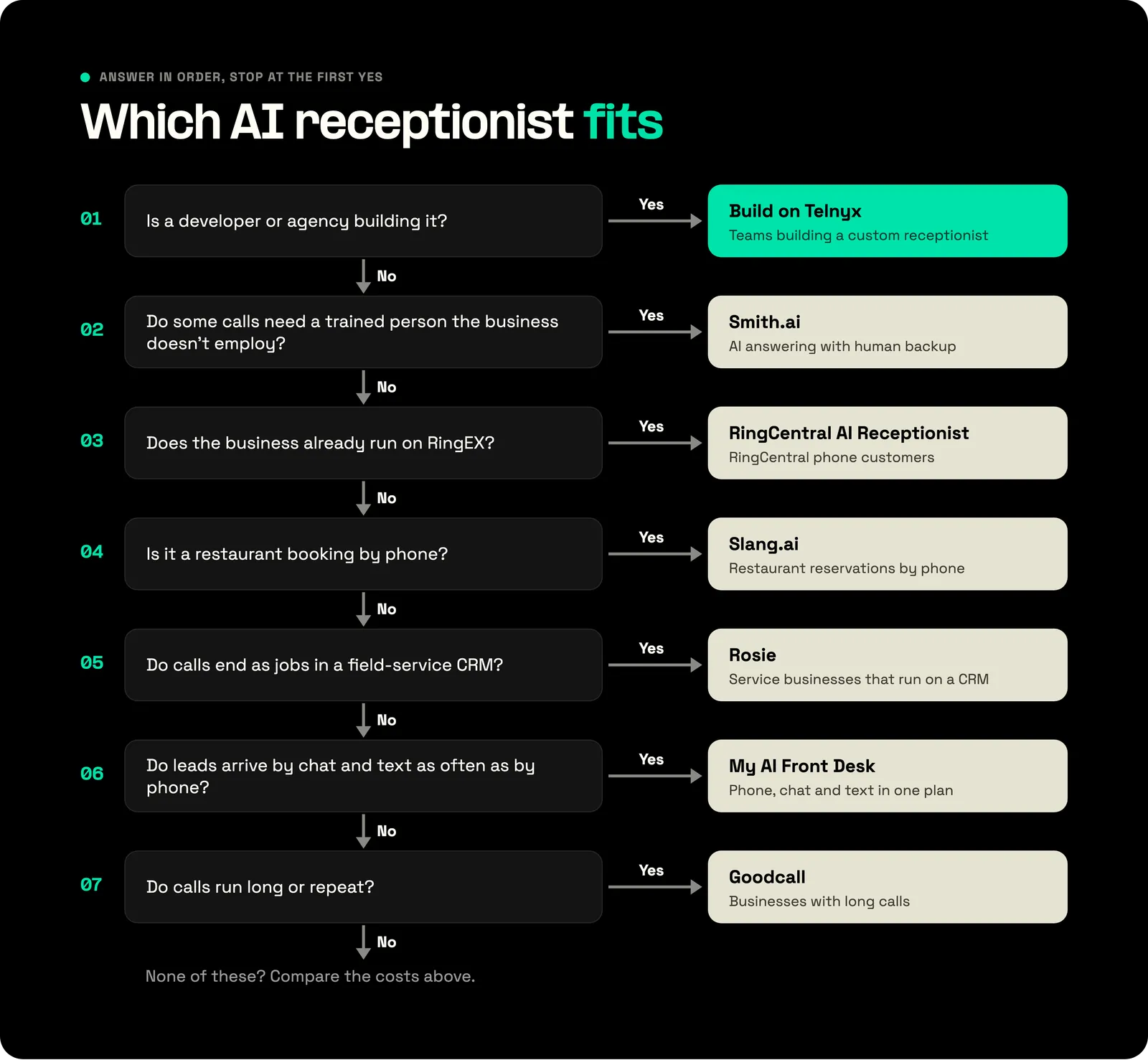
A build option is the wrong pick for a business with nobody to own the prompt and the testing. A practice that handles patient health information should have a signed BAA in place before it forwards a single call.
Building an AI receptionist on Telnyx instead of subscribing
Building a receptionist beats subscribing to one when it has to fit a business's own systems, numbers or volume, and someone can own the build.
Telnyx's voice AI agent platform runs the agent on the same carrier network that provides Telnyx phone numbers, call transfer and SIP connections.
The step-by-step build covers the prompt, the booking and transfer tools, the four ways onto a phone line and the first week of testing. The AI receptionist overview explains what a receptionist handles before any build starts.
Frequently asked questions
How much do AI receptionists cost?
For 300 three-minute calls a month, an AI receptionist costs about $58 to $500 across the six vendors here that reveal pricing publicly.
Is there a free AI phone receptionist?
The Smith.ai Free plan answers 25 calls a month at no charge, then bills $3.00 a call.
Goodcall lets a business build and test a demo agent free until it adds a number. Telnyx gives new accounts $5 of test credit. Rosie, My AI Front Desk and RingCentral offer free trials of seven to 14 days.
Is an AI receptionist a good idea?
An AI receptionist is a good idea for a business that misses calls, because a missed call is a customer who may not call back.
According to CallRail data, 28% of inbound calls go unanswered on average. Businesses whose calls require judgment may do better with a human or hybrid service.
What is the best AI answering service?
The best AI answering service depends on what happens after the AI answers: Smith.ai for live-agent backup, Rosie for CRM logging, Goodcall for long calls and Slang.ai for restaurants.
How do you build an AI receptionist?
The Telnyx step-by-step guide shows how to build an AI receptionist without writing any code. All it requires is a Telnyx API key, prompts, adding booking and transfer tools, and connecting to a phone line.
Build your AI receptionist on Telnyx
Put a receptionist on a phone number, call it the way a customer would, and judge it on real calls.
Start buildingShare on Social
Osman is the Global AEO/SEO Lead at Telnyx, helping make voice AI and communications products clearer for builders. With almost a decade of experience in SEO, he previously led growth at Windscribe and Enzuzo, shipping and scaling organic programs that reached millions.


