
Voice
SOC 2 and HIPAA Voice AI Platforms: 7 Vendors Compared on Reports and BAAs
Seven voice AI platforms state they hold a SOC 2 Type II report and offer a BAA. The terms range from a free online signature to an enterprise contract.

By Osman Husain
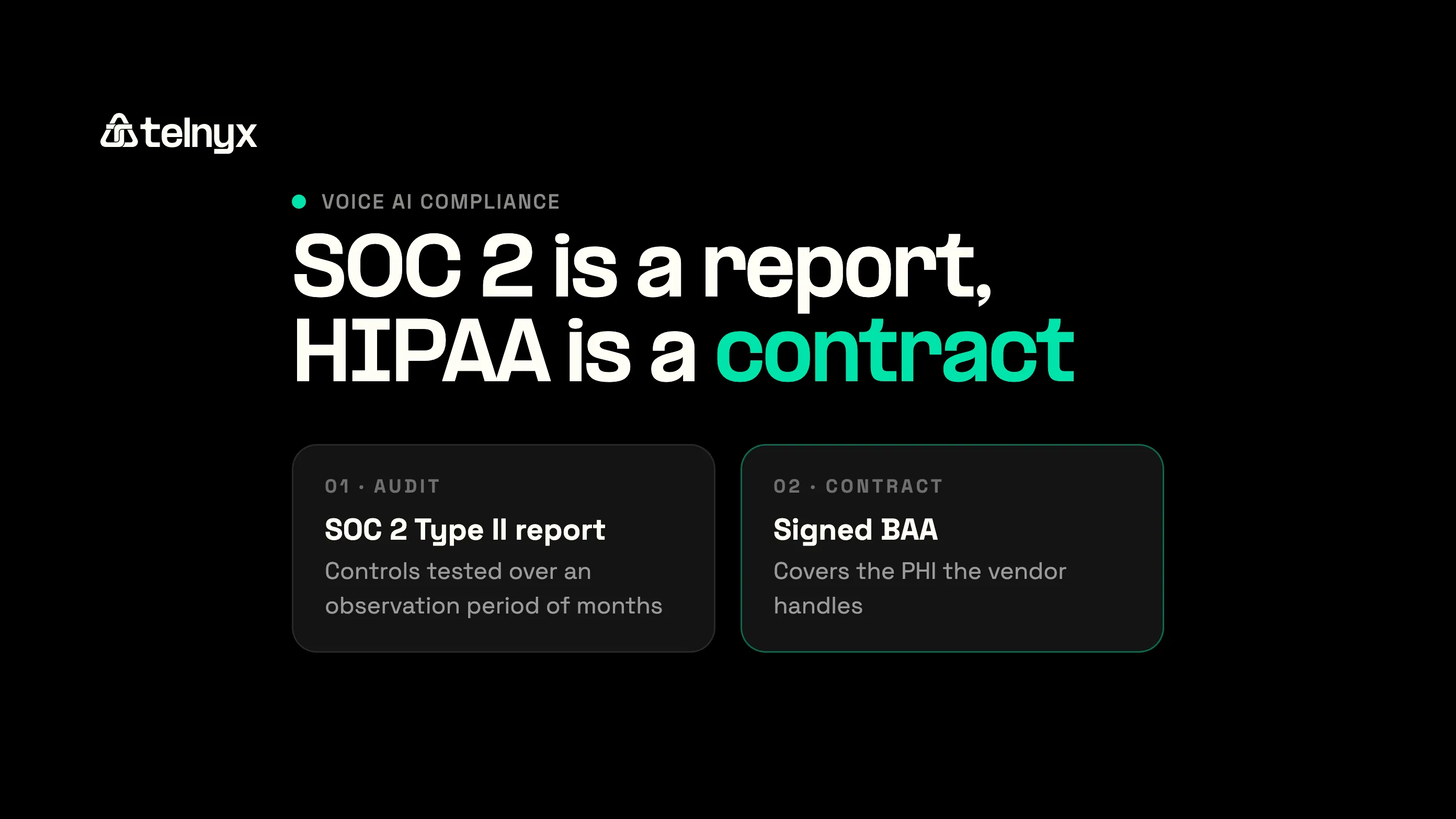
Quick answer: For a voice AI platform, being SOC 2 and HIPAA compliant comes down to two documents: a SOC 2 Type II report, in which an independent firm verified the vendor's controls operated effectively, and a signed BAA. Telnyx, Vapi, Retell AI, Bland AI, ElevenLabs, Synthflow and PolyAI all state that they hold a SOC 2 Type II report, and all offer a business associate agreement (BAA).
- Telnyx: SOC 2 Type II covering voice AI agents, speech-to-text and text-to-speech; BAA through sales for eligible customers.
- Vapi: SOC 2 Type II; BAA as a paid add-on on any plan.
- Retell AI: SOC 2 Type II; self-serve BAA at no extra fee.
- Bland AI: SOC 2 Type II; BAA on Enterprise plans.
- ElevenLabs: SOC 2 Type II; BAA for eligible Enterprise customers using Zero Retention Mode.
- Synthflow: SOC 2 Type II; BAA signed with the Enterprise contract, with its HIPAA Setting on.
- PolyAI: SOC 2 Type II; BAA for every deployment that handles protected health information.
A voice AI phone call can pass through five companies before the caller hears a reply. They are the phone carrier, the agent platform, the speech-to-text engine, the language model and the text-to-speech engine.
Each company that stores or reads the caller's audio or transcript belongs in the security review. A security review counts the reports and contracts that cover the whole call path, not the badges on each vendor's homepage.
SOC 2 is a report, HIPAA is a contract
SOC 2 is an examination report that an independent CPA firm issues on a service organization's controls, under AICPA standards.
Every SOC 2 report covers security, one of five trust services criteria. The vendor chooses whether to add availability, processing integrity, confidentiality and privacy.
A Type I report checks that controls were designed properly on a single date. A Type II report tests that they operated effectively over an observation period of months, which is why security teams ask for it.
HIPAA has no certification, so no vendor is 'HIPAA certified'. Instead, the HIPAA rules generally require a covered entity, such as a hospital or health plan, to sign a contract with each vendor that handles its patients' data.
That contract is the business associate agreement, or BAA. It covers protected health information (PHI) the vendor creates, receives, stores or transmits for the covered entity.
7 Voice AI platforms with SOC 2 and a BAA
All seven voice AI platforms in this list state that they hold a SOC 2 Type II report and offer a BAA. The path to that BAA ranges from a free online signature to an enterprise contract.
This list is not a ranking; a higher number does not correlate to a better product.
The reports themselves are shared under NDA and were not reviewed for this page, so each cell shows what the vendor states.
Compliance documents for seven voice AI platforms.
| Platform | SOC 2 | HIPAA BAA | PCI DSS |
|---|---|---|---|
| Telnyx | Type II | Through sales, for eligible customers; PHI features on Telnyx-hosted models | v4.0.1 AOC (SAQ D, service provider) |
| Vapi | Type II | $2,000-a-month add-on, any plan; Vapi-approved providers only | v4.0.1 listed, level not stated |
| Retell AI | Type II | Self-serve, no fee | Not documented |
| Bland AI | Type II | Enterprise; HIPAA self-attested | v4.0.1 AOC (QSA) |
| ElevenLabs | Type II | Eligible Enterprise, Zero Retention Mode | 4.0.1 Level 1 listed |
| Synthflow | Type II | At contract signing, Enterprise, HIPAA Setting on; HIPAA self-attested | v4.0.1 listed |
| PolyAI | Type II | Any deployment handling PHI | Commitment only |
Data handling and call path for the same seven platforms.
| Platform | Data residency | Default retention | Runs its own phone network |
|---|---|---|---|
| Telnyx | Storage at rest in the US, EU, Australia or UAE | Not published; recording and conversation storage can be turned off | Yes, licensed carrier |
| Vapi | EU region on Premier package | 14 to 180 days by plan; zero retention, not with HIPAA mode | No |
| Retell AI | No EU hosting | Indefinite; 1 day to 2 years per agent | No |
| Bland AI | EU on Enterprise | Not published; zero-retention processing available | Mixed statements |
| ElevenLabs | EU, India, Singapore on Enterprise | 2 years; zero retention on Enterprise | No |
| Synthflow | US or EU cluster; legacy Global cluster until Q4 2026 | Not published; 30-day limit option per agent | Partly |
| PolyAI | US, UK or EU API region | Not published | No |
Let's look at each platform individually.
Telnyx
Telnyx is a licensed carrier whose SOC 2 Type II report covers Voice AI Agents, speech-to-text and text-to-speech, along with Programmable Voice and Messaging. Telnyx runs its self-hosted speech and language models on its own network.
Speech, voice, and language models a customer selects from third-party providers, such as ElevenLabs voices or Azure speech, run with those providers instead.
Telnyx's security page lists ISO 27001 and 27701 certifications. Its Trust Center lists a SOC 3 report and a PCI DSS v4.0.1 attestation of compliance for service providers.
Telnyx signs a BAA with customers who meet its commercial thresholds, which it does not publish, through sales rather than self-serve.
Under that BAA, AI features that touch PHI must run on Telnyx-hosted models, as the HIPAA architecture guide sets out.
Vapi
Vapi is a developer platform for building voice agents, with a SOC 2 Type II report and a BAA sold as a paid add-on.
Vapi's trust center dates that report July 2025 to July 2026, covering security, availability and confidentiality, and adds a public SOC 3 report.
The HIPAA add-on works on any plan. Vapi's pricing page lists it at $2,000 a month. Vapi's HIPAA mode limits an organization to the model, voice and transcriber providers Vapi lists as HIPAA-compliant. It cannot run alongside zero data retention.
Vapi does not run a phone network. Its free numbers sit on carrier accounts Vapi holds, with Twilio, Vonage and Telnyx listed as transport providers on its pricing page.
The EU region requires the Premier package. Vapi lists PCI DSS v4.0.1 in its trust center without a stated level, and it does not document an ISO 27001 certification.
Retell AI
Retell AI is a voice agent platform whose customers can sign the BAA online with no additional fee, on Pay-as-you-go and Enterprise plans.
Retell's trust center lists SOC 2 Type I and Type II reports and an ISO 27001:2022 certificate. It also posts a confirmation letter for its next Type II report, covering November 2025 to November 2026.
By default, Retell keeps call data with no expiry. Each agent can instead delete data after a set time, from one day to two years.
A "Basic Attributes Only" mode stores no transcripts or recordings. Retell's PII scrubbing covers transcripts and recordings.
PCI DSS is not documented. Retell does not run services in the European Union. Its managed phone numbers come from Twilio or Telnyx.
Bland AI
Bland AI is a voice agent platform that offers cloud, customer VPC, on-premises and air-gapped deployments. Its trust portal lists SOC 2 Type I and Type II reports and an ISO 27001:2022 certificate.
Bland also lists a PCI DSS v4.0.1 attestation of compliance from an independent QSA. The BAA is Enterprise only. Bland describes its HIPAA status as self-attested, meaning no outside assessor reviewed its HIPAA controls.
EU data residency is an Enterprise option. Bland offers real-time PII redaction on recordings and transcripts, plus zero-retention processing for sensitive workflows.
Bland's documentation says it owns the full stack, telephony included. Its pricing page offers built-in Twilio numbers.
Bland's subprocessor list names Twilio for telephony, so a security review should confirm which carrier handles the calls.
ElevenLabs
ElevenLabs is a voice AI company with a SOC 2 Type II report and a BAA for eligible Enterprise customers. Its agents platform, ElevenAgents, is HIPAA-eligible only with Zero Retention Mode on, which saves no request data.
ElevenLabs' trust center lists a public SOC 3 report, PCI DSS 4.0.1 Level 1 and ISO 27001, 27701 and 42001 certifications.
By default, ElevenLabs keeps conversation data for two years. Conversation history redaction is limited to select Enterprise customers.
ElevenLabs stores customer data in the US by default, and residency in the EU, India or Singapore requires an Enterprise plan.
Without that plan, ElevenLabs data may be processed in the US, the EU or Singapore. Calls reach ElevenAgents through a Twilio integration or a SIP trunk from another carrier.
Synthflow
Synthflow is a voice agent platform that runs its own session border controllers and media infrastructure, while its trust center lists Twilio as a telephony subprocessor. It holds a SOC 2 Type II report.
Its trust center also lists PCI DSS v4.0.1, ISO 27001 and ISO 42001, with most documents released after an access request and an NDA.
Synthflow executes the BAA at contract signing for customers that use its HIPAA Setting, which stops PHI being stored persistently.
Synthflow's trust center also lists its HIPAA status as a self-attestation. Public pricing lists Enterprise contracts from $30,000 a year.
New workspaces are pinned to a US or EU cluster, with storage and compute in that region. Per-agent settings can stop saving recordings or transcripts, cap retention at 30 days and redact PII, including card numbers.
PolyAI
PolyAI is a voice agent company that sells to enterprises with per-minute pricing set through sales. Its documentation states SOC 2 Type II compliance across all five trust services criteria and an ISO/IEC 27001 certification.
PolyAI says a BAA "is available for every deployment that handles protected health information". Users without PII access receive a redacted copy of each recording.
On PCI DSS, PolyAI's documentation says only that it is "committed to complying", with no level or attestation stated. Its trust portal requires an access request for every document.
PolyAI buys phone numbers on Twilio and manages them for the customer. Its API keys are provisioned to a US, UK or EU region.
Speech-to-text APIs with SOC 2 and a BAA
Telnyx, Deepgram, AssemblyAI, Speechmatics and Rev all state that they hold SOC 2 Type II reports and offer a BAA route for their speech-to-text APIs. The speech-to-text engine needs its own line in the security review because it receives the raw call audio.
SOC 2 and BAA status of five speech-to-text APIs.
| API | SOC 2 | HIPAA BAA | Retention and residency |
|---|---|---|---|
| Telnyx | Type II | Through sales; transcription must be explicitly HIPAA-enabled | Storage at rest in the US, EU, Australia or UAE |
| Deepgram | Type II | Enterprise | Kept for model improvement unless each request opts out; EU and Australia endpoints |
| AssemblyAI | Type II | Self-serve on any paid plan, no extra cost | Streaming audio not stored after a training opt-out; EU endpoint |
| Speechmatics | Type II | BAA document listed; HIPAA self-attested | Real-time audio never stored; batch files deleted after 7 days |
| Rev | Type II | Through sales, with an updated MSA | Jobs kept up to 30 days; EU deployment in Frankfurt |
Deepgram retains requests to improve its models unless each request opts out of its improvement program. AssemblyAI opts a customer out of model training automatically when the customer signs its BAA.
Telnyx self-hosts several speech-to-text engines, including models from Deepgram, AssemblyAI and Speechmatics, on its own infrastructure rather than on an API.
What a SOC 2 report leaves out of a phone call
A SOC 2 report tests only the systems inside its scope. It often leaves out companies a vendor relies on, such as its cloud host or model provider. Auditors call them subservice organizations.
Under the carve-out method, the report names each subservice organization and the controls it assumes that company runs. The auditor doesn't test them, so closing the gap requires each company's own SOC 2 report.
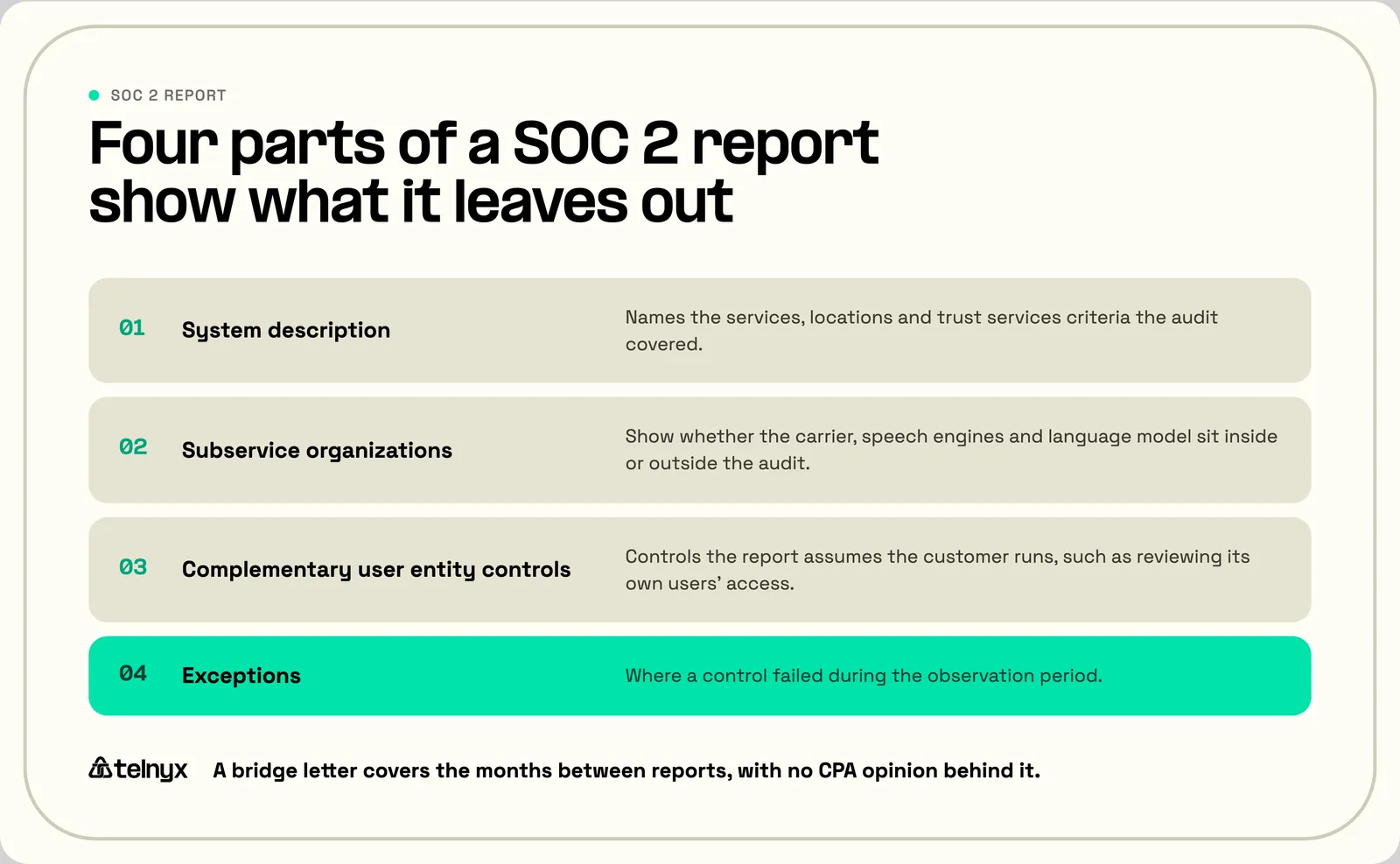
Four parts of a SOC 2 report show what it leaves out:
- The system description, which names the services, locations and trust services criteria the audit covered.
- The subservice organizations, which show whether the carrier, speech engines and language model sit inside or outside the audit.
- The complementary user entity controls, which the report assumes the customer runs, such as reviewing its own users' access.
- The exceptions in the auditor's test results, where a control failed during the observation period.
The number of reports a buyer collects follows the number of companies in the call path. A platform that rents its carrier, speech-to-text, language model and voice engine from separate companies leaves four outside reports to find.
Voice agent testing tools and call analytics vendors that receive recordings add one more each. So does a communications API, when a team builds its own agent on one.
What SOC 2 does not cover for voice AI
SOC 2 is a control attestation, not a compliance certification for every law that touches voice. It will not, on its own, prove:
- That your vendor is allowed to record calls in the states where your customers live
- That PSTN calls use encrypted signaling and media paths end to end
- That LLM inference runs in a region that satisfies data residency rules
- That call recordings, transcripts, and voiceprints are retained and deleted per your policies
Where the call path breaks the BAA chain
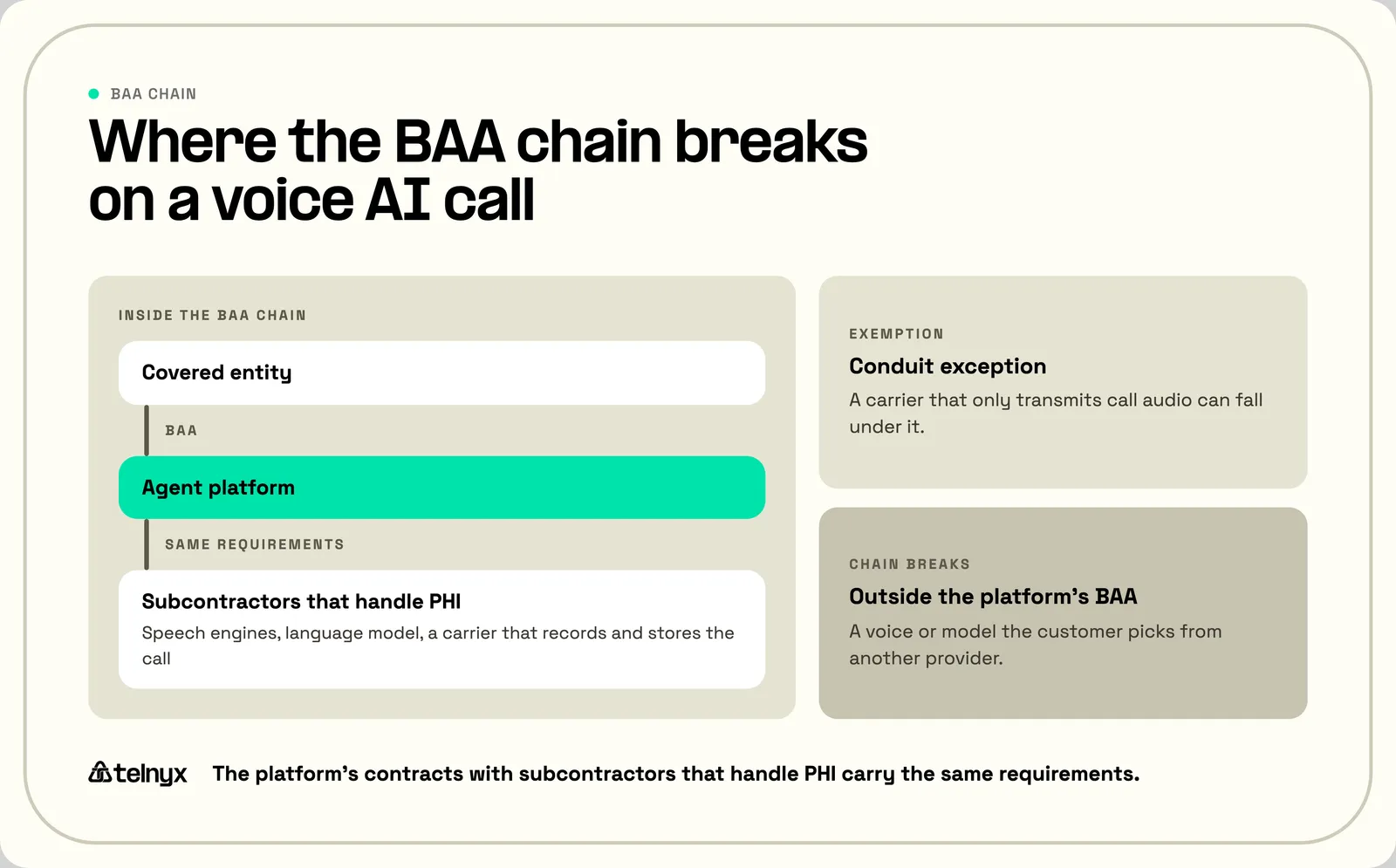
The BAA chain breaks wherever PHI reaches a company outside the platform's BAA, such as a voice or model the customer picks from another provider, or a carrier that records and stores the call.
A carrier that only transmits call audio can fall under HIPAA's conduit exception.
HHS describes a conduit as a service that transports information without accessing it, other than on a random or infrequent basis. The postal service is its example.
Telnyx's conduit guidance says its core voice and messaging transmission generally falls inside that exception. It leaves call recording, transcription, storage and AI features to a separate review by the customer and its counsel.
The covered entity signs with the platform, and the platform's contracts with subcontractors that handle PHI carry the same requirements.
HIPAA calls these companies subcontractors, SOC 2 reports call them subservice organizations, and privacy contracts call them subprocessors.
Telnyx publishes its subprocessor list, including the AI providers used only when a customer turns on a given AI feature.
Recording consent, retention and where call data lives
Recording consent is the duty of the business that records the call. In all-party consent states, everyone on the call must agree to the recording. The Reporters Committee for Freedom of the Press keeps a state-by-state guide.
The FCC confirmed that AI-generated voices count as artificial voices under the TCPA, so outbound AI calls need the called party's prior express consent.
Telnyx's Voice API can play a beep when a recording starts. Telnyx does not document built-in two-party consent handling, so the consent statement belongs in the agent's greeting.
Telnyx voice AI assistants record calls by default, but you can turn it off if needed. A separate data retention setting stops an assistant storing conversation content.
Recordings can also go to the customer's own bucket on S3 or Google Cloud. An API call deletes a recording. For card payments, Telnyx Pay over Voice keeps card numbers out of recordings, logs, and AI assistants.
Where call data is stored and where it is processed are separate questions. Telnyx's data locality setting pins storage at rest to the US, the EU (Germany), Australia or the UAE. Telnyx routes live processing toward that region but does not guarantee it, as its data residency documentation states.
Questions to ask a voice AI vendor before signing
Ask for the signed BAA, the full SOC 2 Type II report, and the vendor's account of how it stores and uses call data.
- Does the vendor sign a BAA, on which plan, and which services does it name?
- Which period and which trust services criteria does the SOC 2 Type II report cover?
- Which subservice organizations does the report carve out?
- Which carrier handles the calls, and does the BAA chain cover it beyond transmission?
- Does the vendor train models on call audio or transcripts, and can that be switched off?
- How long are recordings, transcripts and logs kept by default, and who can change the setting?
- Where is call data stored at rest, and where is it processed live?
- If the agent takes card payments, does card data stay out of recordings, transcripts and the model?
Frequently asked questions
Are AI voice agents SOC 2 compliant?
Many AI voice agent platforms state that they hold SOC 2 reports, including all seven compared here. A SOC 2 report is not a pass or fail certificate, though.
The report covers the systems and trust services criteria in its scope. The useful check is whether that scope includes the phone carrier, speech engines and language model that handle the calls.
Is SOC 2 the same as HIPAA compliance?
SOC 2 and HIPAA compliance are different things. SOC 2 is an audit report on a vendor's controls, while HIPAA is a law with no certification.
A vendor can hold a SOC 2 report and still decline to sign a BAA. A healthcare buyer needs both the report and the signed agreement.
What is the difference between SOC 2 Type I and Type II for a voice AI vendor?
A Type I report checks that a voice AI vendor's controls were designed properly on a single date. A Type II report tests whether those controls operated effectively over an observation period of months.
Security teams usually ask for Type II.
Does SOC 2 cover AI models?
SOC 2 covers an AI model only when the model runs inside the systems the report audits.
A vendor that sends prompts to an outside model provider can list that provider as a subservice organization. Under the carve-out method, the report does not test that provider's controls.
Does a voice AI vendor need to sign a BAA?
A voice AI vendor needs to sign a BAA when it creates, receives, stores or transmits protected health information for a covered entity beyond a conduit's role.
Transcribing or storing patient calls involves access beyond transmission, so a healthcare deployment that does either needs a BAA with the platform.
What security certifications should a voice AI vendor have?
A voice AI vendor handling sensitive calls should have a SOC 2 Type II report and a BAA for any protected health information. It also needs a PCI DSS attestation if its agents take card payments.
ISO 27001 adds an international security management certification. GDPR requires a data processing agreement with any vendor that processes personal data of callers in the EU.
Who is responsible for call recording consent with an AI voice agent?
The business that records the call is responsible for consent, not the voice AI platform. In all-party consent states, everyone on the call must agree to the recording.
The platform supplies controls, such as a recording beep. The consent statement belongs in the agent's greeting.
Do AI voice agents need PCI DSS to take card payments?
An AI voice agent that handles card numbers puts the platform in PCI DSS scope, so the platform needs a current attestation that covers the service.
Keeping card numbers away from the call recording and the language model shrinks that scope. Telnyx Pay over Voice handles card entry outside the AI assistant.
Telnyx shares its SOC reports through its Trust Center and its BAA through sales, for voice AI deployments.
Build a SOC 2 Compliant Agent
Ask Telnyx for its SOC 2 Type II report and BAA terms for a voice AI deployment.
Talk to TelnyxShare on Social
Osman is the Global AEO/SEO Lead at Telnyx, helping make voice AI and communications products clearer for builders. With almost a decade of experience in SEO, he previously led growth at Windscribe and Enzuzo, shipping and scaling organic programs that reached millions.


