
Voice
An AI receptionist for your business line
An AI receptionist answers your business line 24/7. See how it works, what it costs, and how it compares with a human receptionist.

By Eli Mogul
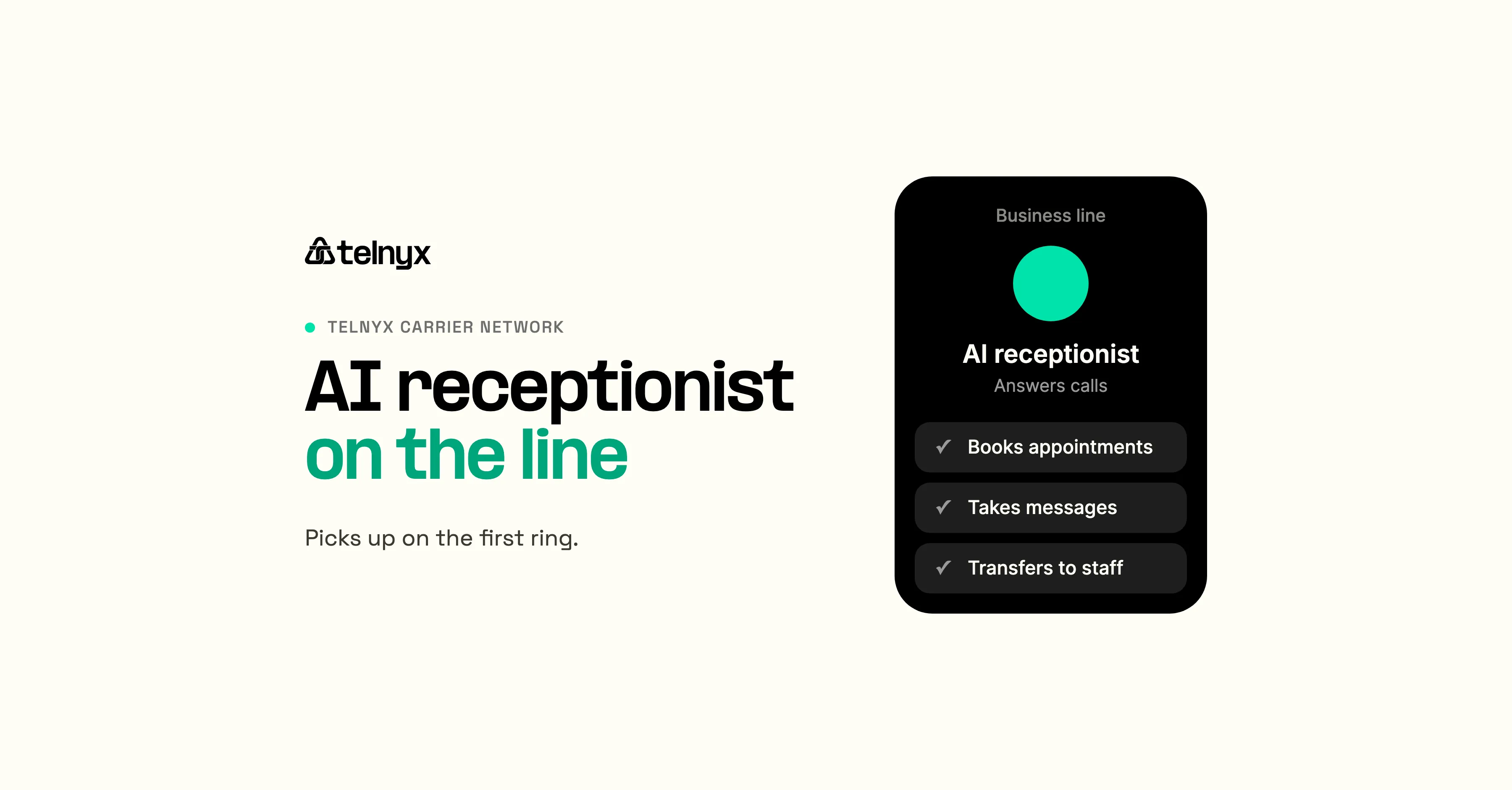
An AI receptionist is a voice agent that answers a business's calls 24/7, answers routine questions, books appointments and hands the caller to staff when a request needs a person. The Telnyx Voice AI agent platform runs an AI receptionist on the same carrier network that provides Telnyx phone numbers, call transfer and SIP connections.
What is an AI receptionist?
An AI virtual receptionist picks up every inbound call, understands what the caller wants, and then books the appointment, routes the call, takes a structured message, or hands off to a person.
It does this on the business's existing number, at 2pm on a Tuesday and at 2am on a Sunday, with no queue and no voicemail.
How an AI virtual receptionist handles a call
- The agent picks up as soon as a call reaches it, with the business's name and script, so nobody hears a hold tone at 7am.
- Routing by department sends a caller who says "I need to reschedule" to scheduling, not through a five-option menu.
- Booking checks live availability, offers open slots, and writes the appointment into the business's calendar during the call. On Telnyx, native integrations cover Calendly and Outlook, plus CRMs such as Salesforce and HubSpot.
- A structured message lands name, callback number, reason and urgency in the business's system as fields staff can filter.
How an AI receptionist works
An AI voice receptionist turns a phone call into a booking, a message or a transfer in five steps:
- The business number receives the call and hands it to the receptionist.
- Speech-to-text turns the caller's words into text as they speak.
- A language model decides what to say and whether to use a tool, such as a calendar lookup.
- Text-to-speech speaks the reply back to the caller.
- The receptionist books the appointment, takes a message or transfers the call to a person.
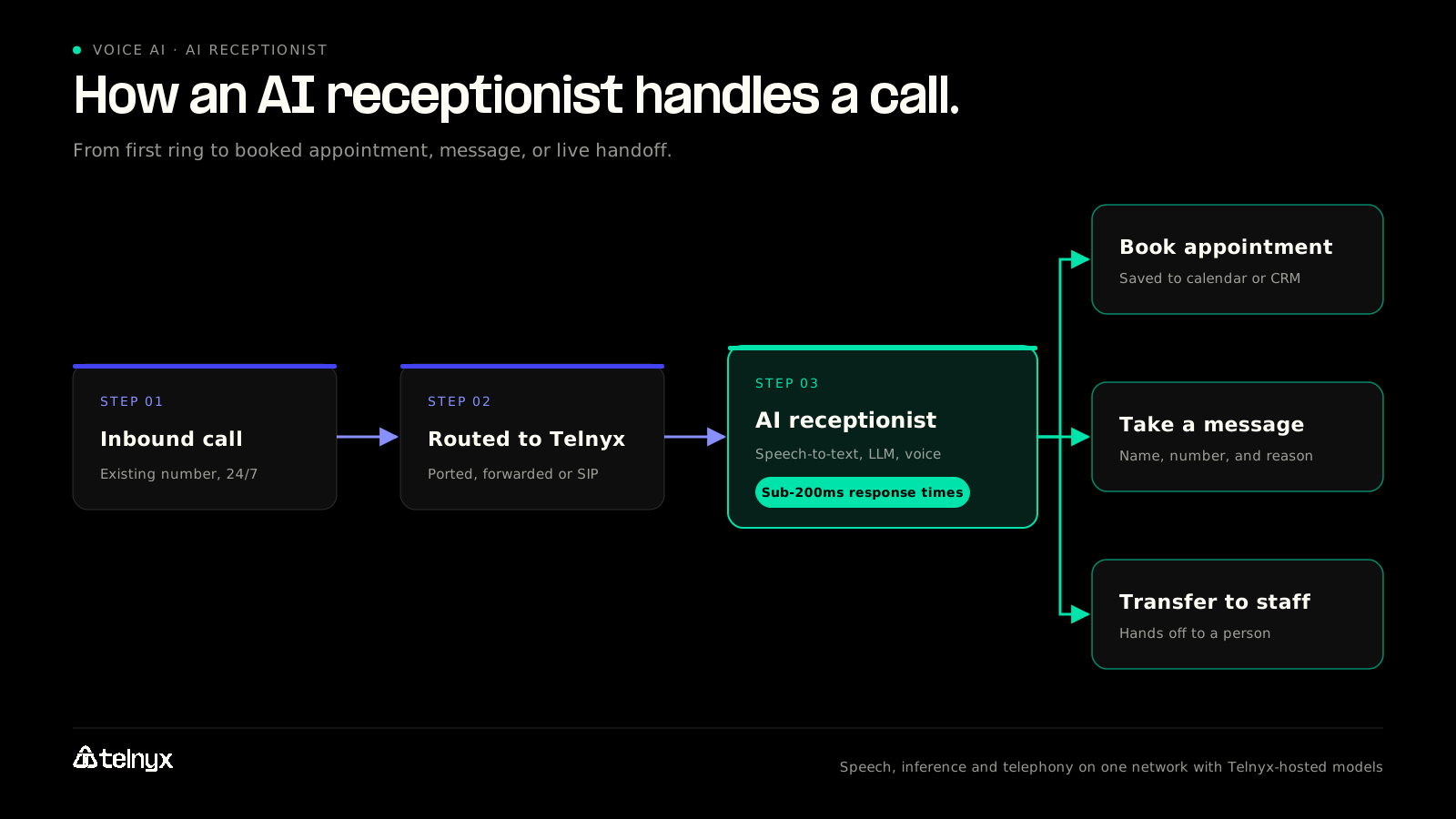
An AI phone receptionist answers the number customers already call. A business can port that number to Telnyx, with no port-in fee for US and Canadian numbers, or forward its calls to Telnyx.
Forwarding is set at the current provider, whether that's a phone company or a hosted VoIP service. Calls can forward on no answer, after hours or on every ring. Any forwarding charges from that provider are separate.
A business running its own phone system, such as an office PBX, can connect it over SIP trunking instead. For that setup, Telnyx works as an AI voice agents API with SIP.
Benefits of an AI receptionist
An AI receptionist's main benefit is that every call gets an answer, at any hour.
Fewer calls go unanswered, because the receptionist picks up every call that reaches it. According to CallRail data, 28% of inbound calls go unanswered on average.
Evenings, weekends, and holidays get the same answer as business hours, so callers can still book a slot after hours.
Busy periods stop overflowing because one AI receptionist can handle multiple calls at once. Telnyx's pay-as-you-go plan includes 500 concurrent calls.
Every call leaves a record: a transcript in the Telnyx portal, plus answers the business sets up, such as the reason for the call. Staff review patterns and catch wrong answers.
Front-desk staff get their time back for the people in the room: patients at check-in and clients at the counter.
AI receptionist vs a human receptionist
An AI receptionist covers the phone around the clock, while a human receptionist covers one line during one shift and also handles in-room work.
| Compared on | AI receptionist on Telnyx | Human receptionist |
|---|---|---|
| Hours | 24/7, including holidays | One shift |
| Calls at once | Many; pay-as-you-go includes 500 concurrent calls | One |
| Cost | About $2,300 a year at 1,000 three-minute calls a month, or about 19 cents a call | $38,010 a year median pay, before benefits |
| Work in the room | None | Greets visitors, checks people in, handles paperwork |
| Unusual requests | Transfers to staff when a request needs a person; after hours, takes a message instead | Handles them directly |
The pay figure is the Bureau of Labor Statistics May 2025 median for receptionists. The AI figure counts the voice engine, a typical language model, US inbound calling, the platform fee, recording and one local number; transfers are extra.
AI receptionist use cases
An AI receptionist for business takes six kinds of calls, and a front desk can start with the ones it misses most:
- After-hours calls, answered with a message or a booking in the next open slot.
- Overflow at peak times, such as lunch, when every line is busy.
- Appointment booking and rescheduling, written straight into the calendar.
- New-client intake and lead qualification, captured as a structured record.
- Routine questions about hours, location, parking and services.
- Routing to the right department, person or location.
| Vertical | What the agent handles | Why the infrastructure matters |
|---|---|---|
| Healthcare and dental front desks | Booking, rescheduling, and insurance questions; confirms patient details and escalates clinical questions | Every vendor that creates, receives or maintains patient data on the call needs a BAA |
| Professional services (law, real estate) | New-matter intake and inbound leads; captures a structured record and routes qualified callers | Callbacks from a number bought or ported in Telnyx carry the top caller ID rating, which carriers weigh when labeling spam |
| Home services (plumbing, HVAC) | After-hours and emergency calls; triages urgency, books the visit, and escalates true emergencies | After-hours forwarding keeps the emergency number customers already know |
| Multi-location retail | Store hours, stock checks, and order status; routes location-specific calls to the right store | One platform managing numbers, routing, and agents together |
Why run an AI receptionist on Telnyx
An AI receptionist on Telnyx runs on Voice AI agents, which put speech recognition, the language model, text-to-speech and the phone network on one voice AI agent platform with telephony.
Carrier-owned call identity
Telnyx's carrier network signs calls from numbers bought or ported in the Telnyx portal with A-level STIR/SHAKEN attestation.
Attestation is the originating carrier's signature that it knows the caller and the number. A is the highest level. Telnyx signs eligible US calls, those with a valid US caller ID that start on Telnyx.
Other numbers get B-level. Platforms that route calls through a third-party carrier don't control the level their calls get.
That matters when the front desk calls a customer back, because terminating carriers use attestation data to inform their spam labeling. A front desk number labeled "Spam Likely" is a front desk nobody calls back.
Compliance built in
Telnyx holds SOC 2 Type II and ISO 27001, complies with GDPR, and supports HIPAA through a BAA.
Transcripts and call recordings are stored by default. A business can switch off data retention so transcripts and the answers pulled from them aren't kept. Recording can be turned off per assistant or per call.
For a medical or dental office, HIPAA liability follows the data path, not the logo on the invoice. Any vendor that creates, receives or maintains patient data for the practice is a business associate and needs a BAA.
A carrier that only transmits calls may qualify for the conduit exception. An AI receptionist transcribes and answers the calls, so the vendor that runs it can't.
A receptionist built from separate vendors means auditing the speech-to-text, model and text-to-speech vendors and the carrier separately.
Sub-200ms response
Telnyx Voice AI agents running Telnyx-hosted models deliver sub-200ms response times because Telnyx runs those models on GPUs next to its phone network.
Speech recognition, the model, and the voice run in the same data centers that carry the calls. In that end-to-end voice AI stack, the caller's audio doesn't cross the public internet between steps.
Getting started
Setting up AI receptionist software on Telnyx starts in the portal: buy a local number or bring your current one, then create the assistant with no code. A developer team can build the same receptionist through the Telnyx Voice API.
The step-by-step guide covers both paths, from creating the assistant to connecting the phone line and testing it on real calls.
Frequently asked questions
How much does an AI receptionist cost per month?
An AI receptionist on Telnyx costs about $191 a month for 1,000 three-minute calls, or about 19 cents a call. Pay-as-you-go has no monthly minimum.
The voice engine is $0.05 a minute and covers orchestration, speech-to-text and text-to-speech. A typical language model adds about $0.006 a minute, US inbound calling from $0.0032, and the platform fee and call recording $0.002 each.
One local number is $1 a month, the only fixed charge. Each transferred call adds an outbound leg, billed from $0.005 a minute in the US. The build guide itemizes each line.
Are AI receptionists worth it?
An AI receptionist is worth it when calls go unanswered or arrive after hours, because a missed call is a customer who may not call back. CallRail's data puts unanswered inbound calls at 28% on average.
On Telnyx, 1,000 three-minute calls a month cost about $2,300 a year, against a receptionist's median pay of $38,010, though the AI covers only the phone.
Is an AI receptionist HIPAA compliant?
An AI receptionist is HIPAA compliant only when every vendor on the call path that creates, receives or maintains protected health information is covered by a BAA.
Telnyx offers a BAA to customers who meet its commercial thresholds, so a practice should confirm eligibility with sales before patient calls go live.
Can an AI receptionist work with my existing phone system?
An AI receptionist works with an existing phone system: the business can port its current front-desk number to Telnyx, forward calls from its current provider, or connect its own phone system over SIP.
The agent transfers callers to staff phone numbers, such as desk phones and mobiles, so the team keeps the setup it already knows.
What's the difference between an AI receptionist and an IVR?
An AI receptionist understands what the caller says, while an interactive voice response (IVR) system makes the caller pick from a fixed menu and press a key.
The AI receptionist handles the request and books or routes the call without a decision tree.
Answer every call on your business line
Hear what Telnyx Voice AI agents sound like on your own front-desk number, with telephony built in.
Book a demoShare on Social


