
Verify API
The best phone verification APIs for developers in 2026
Compare the best phone verification APIs of 2026 by published per-verification price, OTP channels and fraud controls, with the trade-off each vendor's own pages admit.
Takeaways
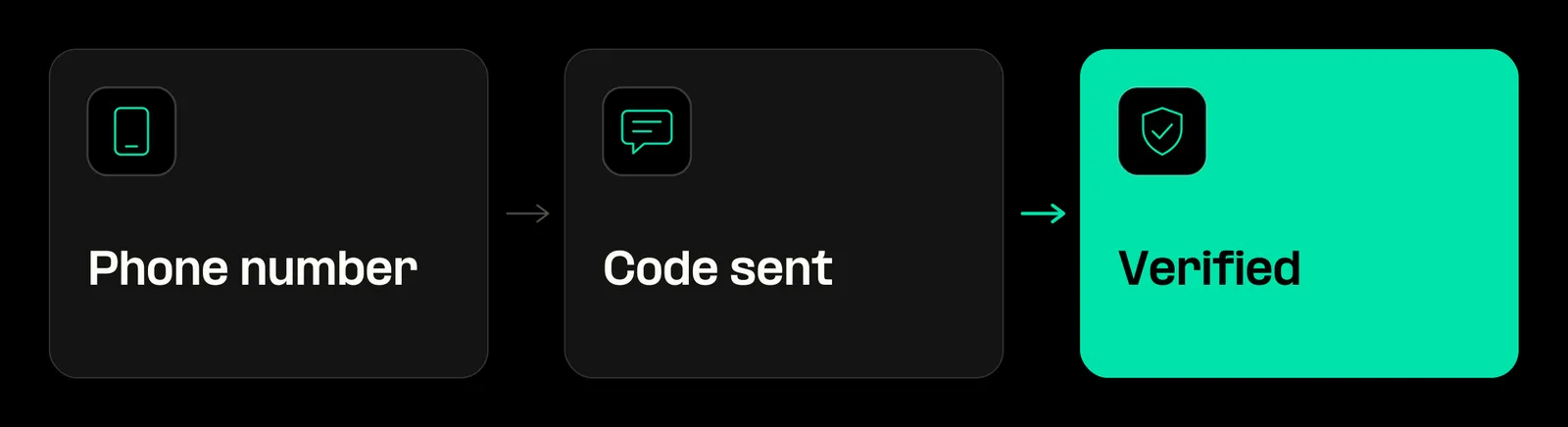
A phone verification API is a programmable service that confirms a user controls a phone number, usually by delivering a one-time code over SMS, voice, flash call or WhatsApp and checking the code the user enters, or by validating the number silently through carrier data.
- 1. Telnyx: Best for multi-channel OTP at a published per-verification rate
- 2. Twilio: Best for teams already running messaging on Twilio
- 3. Vonage: Best for enterprises wanting silent network verification with OTP fallback
- 4. Sinch: Best for high-volume senders needing flash call and data verification
- 5. Telesign: Best for fraud-scoring teams combining verification with phone intelligence
- 6. Plivo: Best for cost-sensitive teams needing basic SMS and voice OTP
Phone verification API providers compared
The cards below map the six picks by labelled buyer and main trade-off. Prices sit in each vendor section and in the cost section.
Six picks by buyer and trade-off
Telnyx
Best for
Multi-channel OTP at a published per-verification rate
Key trade-off
No silent network authentication, so a code-free check means flash call on mobile
Twilio
Best for
Teams already running messaging on Twilio
Key trade-off
A verification fee plus a separate channel fee on every send
Vonage
Best for
Enterprises wanting silent network verification with OTP fallback
Key trade-off
Silent authentication depends on carrier coverage, with per-country rates
Sinch
Best for
High-volume senders needing flash call and data verification
Key trade-off
No published rate
Telesign
Best for
Fraud-scoring teams combining verification with phone intelligence
Key trade-off
Risk scoring billed as a separate product
Plivo
Best for
Cost-sensitive teams needing basic SMS and voice OTP
Key trade-off
SMS and voice only
Terms: OTP = one-time code the user types. Flash call = incoming call whose number the app reads. Silent = carrier network check with no user action.
1. Telnyx: Best for multi-channel OTP at a published per-verification rate
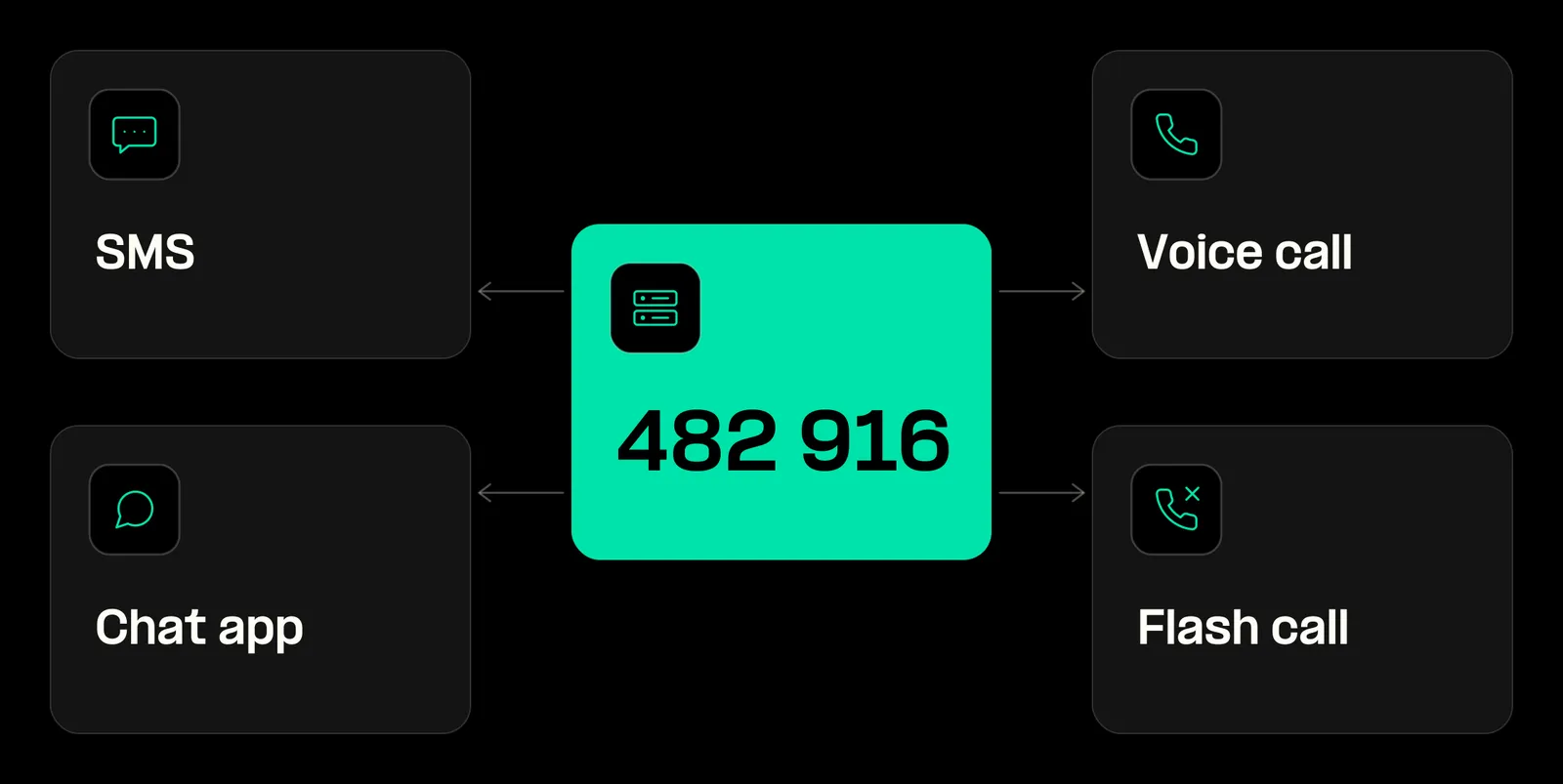
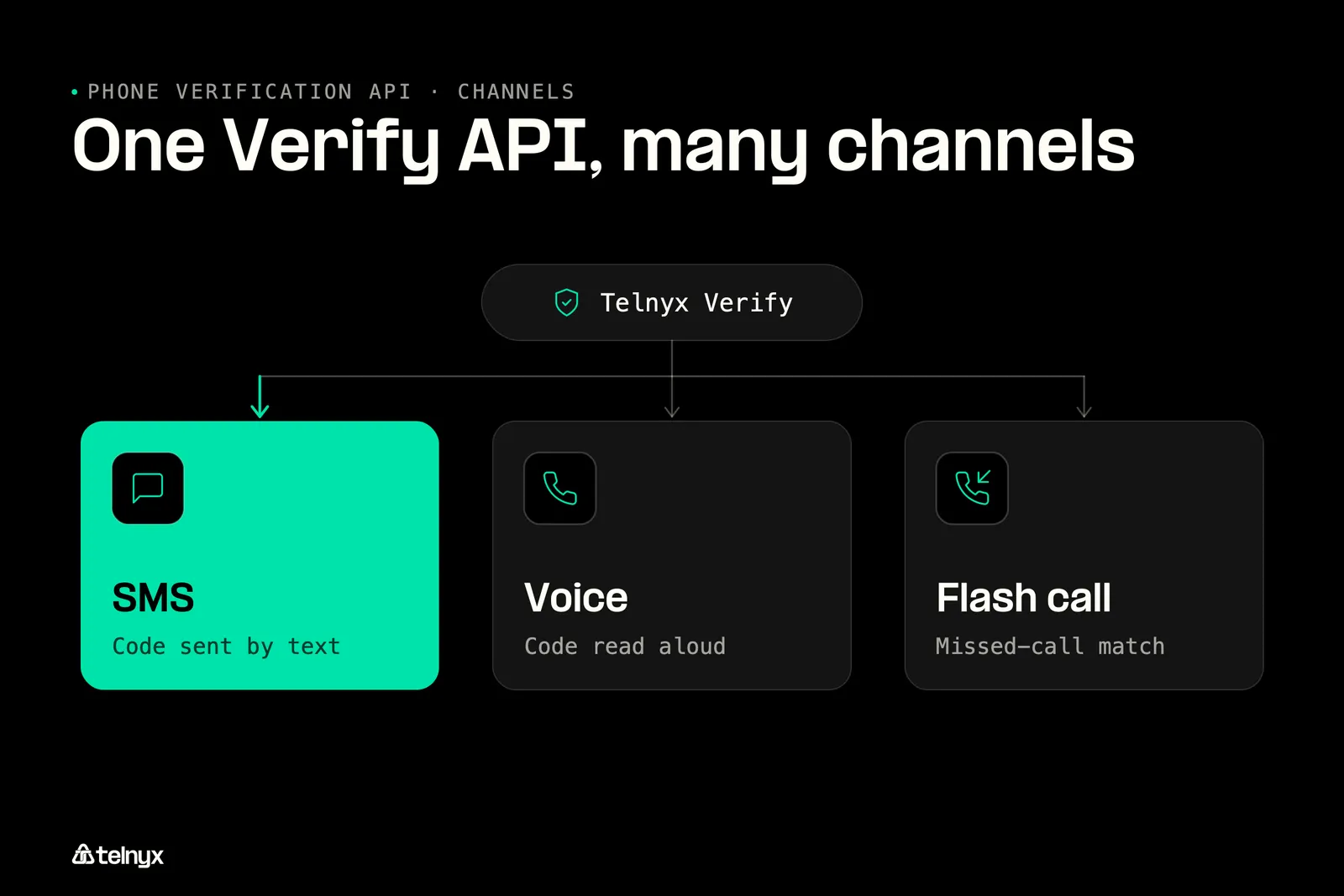
Telnyx's Verify API sends and checks one-time codes from a Verify profile that the developer creates once and attaches to a login or sign-up flow. Telnyx's Verify API delivers one-time codes to 190+ country codes over SMS, voice, flash call and WhatsApp.
Why it's good
- SMS, voice, flash call and WhatsApp run from one Verify profile, so switching a login from SMS to voice is a profile setting.
- Delivery to 190+ country codes, with client-based delivery receipts (DLRs) reported per verification, so a failed send shows up against the login that triggered it.
- The Number Lookup API on the same account returns carrier and line type before a code is sent, so a VoIP number can be refused or routed to voice.
When to use it
The team wants one profile for every channel and a published rate it can model before talking to anyone, and a launch date in new markets that leaves no time for a quote cycle.
When to skip it
- Silent network authentication is not on the product page, so a check with no code entry means flash call on a mobile device.
- Fraud controls beyond lookup and the per-profile timeout are not described, so a team that needs documented SMS-pumping defences should ask before committing.
Cost
Telnyx lists Verify starting at $0.03 per verification with automatic volume discounts, and rates above the starting tier vary by country.
2. Twilio: Best for teams already running messaging on Twilio
Twilio Verify is the default pick for teams whose SMS already runs on Twilio messaging, because the verification service sits on the account and credentials they already hold. It suits a product team that values a single vendor over the lowest per-verification cost.
Why it's good
- Verify covers SMS, voice, WhatsApp, email and push/TOTP from one service, so a team adds a channel without adding a vendor.
- Lookup sells line type and carrier data as a separate product on the same account, which a team can call before it sends a code.
- Fraud Guard for SMS pumping is documented in the Verify product docs, so SMS pumping protection ships inside the verification service.
When to use it
The product already runs on Twilio messaging and the team accepts a second charge per send as the price of keeping one vendor, one console and one invoice.
When to skip it
- Every verification is two charges, the Verify fee plus the per-country channel fee, so the published rate is never the full cost of a login.
- Self-serve accounts have no guaranteed path to a human in sales or support when a test batch turns into a scale-up.
Cost
Twilio lists $0.05 per verification on each successful check, with SMS and voice channel fees billed separately per country, so the all-in cost of one login depends on the destination country and the channel that delivered the code.
3. Vonage: Best for enterprises wanting silent network verification with OTP fallback
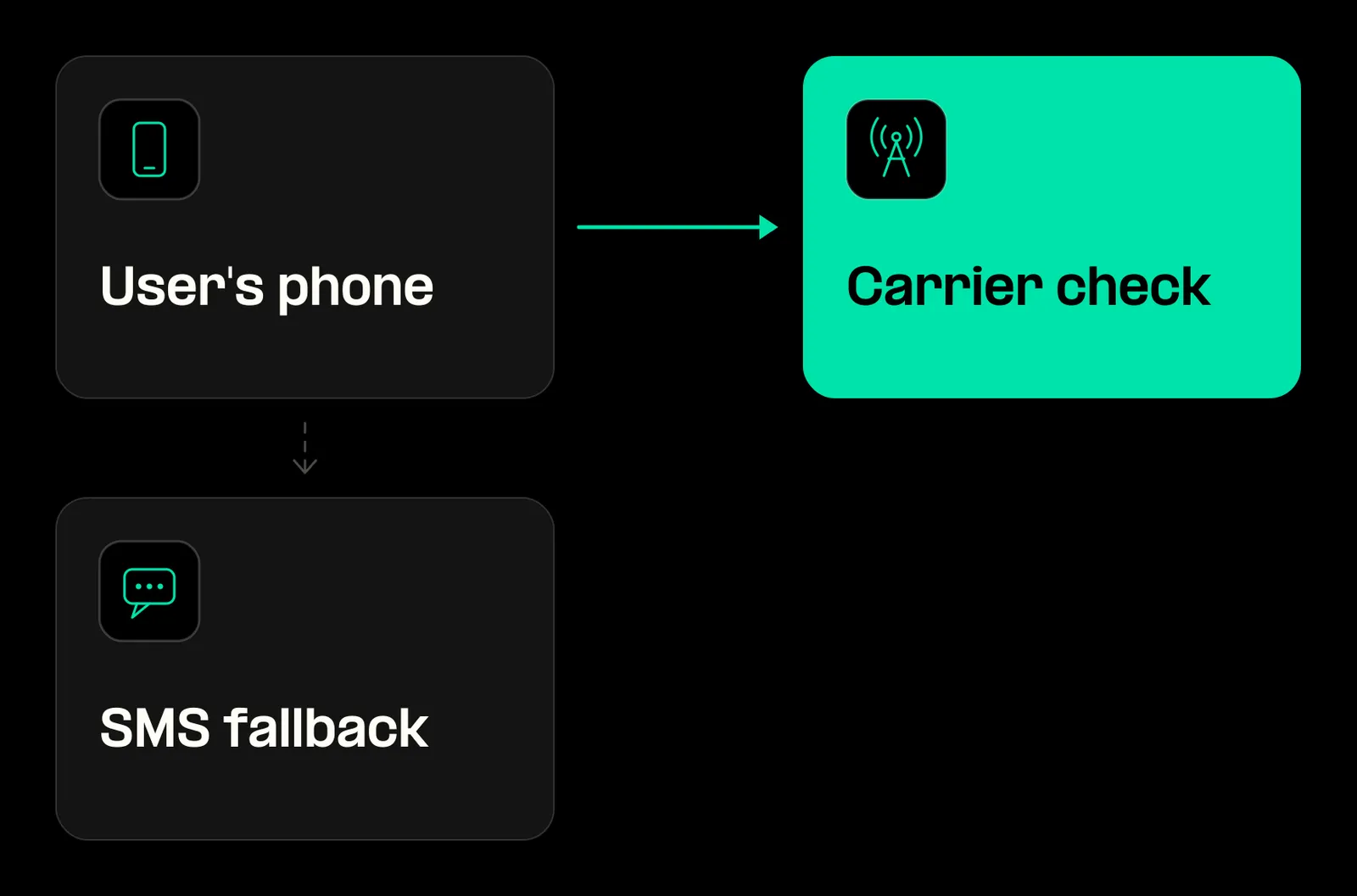
An enterprise that wants users verified without typing anything looks at Vonage Verify, whose product pages describe workflows that place a silent carrier check ahead of SMS, voice and WhatsApp. The silent step runs over the mobile data connection and returns a result with no code typed, and the OTP channels fire only for the users it cannot reach.
Why it's good
- Workflows chain silent authentication, SMS, voice and WhatsApp in a fallback order, as the Vonage docs describe them.
- Silent authentication is documented as a carrier network check that needs a mobile data connection, so a user never types a code when it succeeds.
- Number Insight is a separate product for line type and carrier data, bought and billed apart from Verify.
When to use it
The organisation's carriers support silent authentication in its main markets, it wants OTP only as the fallback, and it has engineers to build and test the SMS path for the users the silent check cannot reach.
When to skip it
- Silent authentication depends on carrier coverage and does not run over Wi-Fi or on a desktop, so the SMS fallback still has to be built and paid for.
- Per-country pricing means a global rollout needs a rate table rather than one number.
Cost
Vonage publishes Verify rates per country on its pricing page, as a country table rather than one headline number, and the rate excludes Number Insight, which is billed as its own product.
4. Sinch: Best for high-volume senders needing flash call and data verification
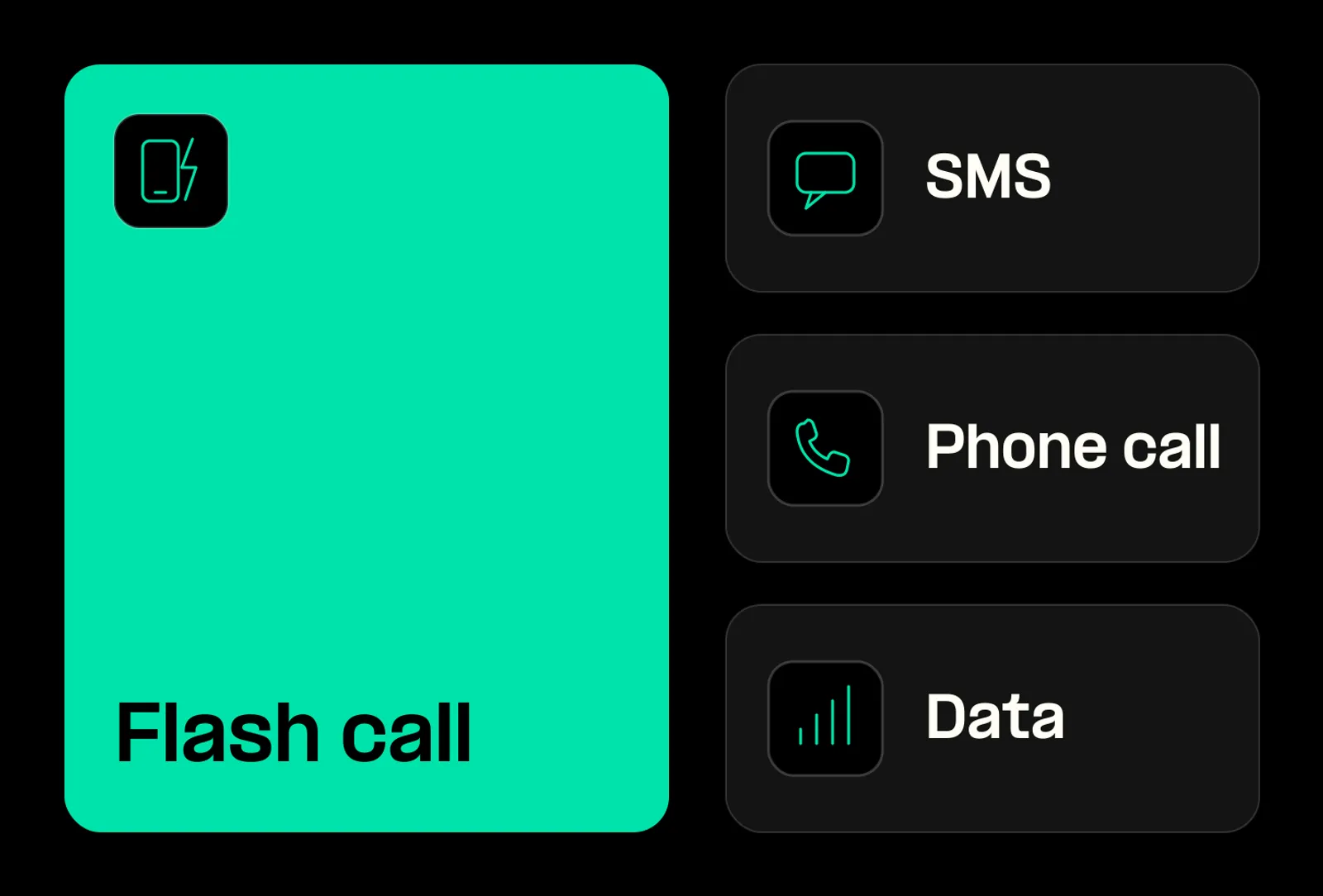
The Sinch Verification API offers four methods behind one endpoint: SMS, flash call, phone call and data verification. Flash call places a call from a known number and the app reads the caller number to complete the check without the user typing a code.
Why it's good
- Four verification methods from one API, so a sender can change the method per user or per market without changing providers.
- Flash call completes without code entry, so a mobile sign-up loses no users to a mistyped or late code.
- Sinch runs its own carrier connections for delivery, covering both the SMS and the voice legs of a check.
When to use it
The buyer's volume justifies a negotiated contract, most users verify on a mobile device where the SDK can run, and the team can wait for a quote before modelling cost.
When to skip it
- No published rate, so cost cannot be modelled before a sales conversation, and a side-by-side against vendors with a list price waits for a quote.
- Flash call and data verification need a mobile device and the Sinch SDK, so a web-only flow falls back to SMS or phone call.
Cost
Not published. Sinch sells verification through its sales team, so the per-verification rate, any volume tiers and what the rate excludes come out only in a quote.
5. Telesign: Best for fraud-scoring teams combining verification with phone intelligence
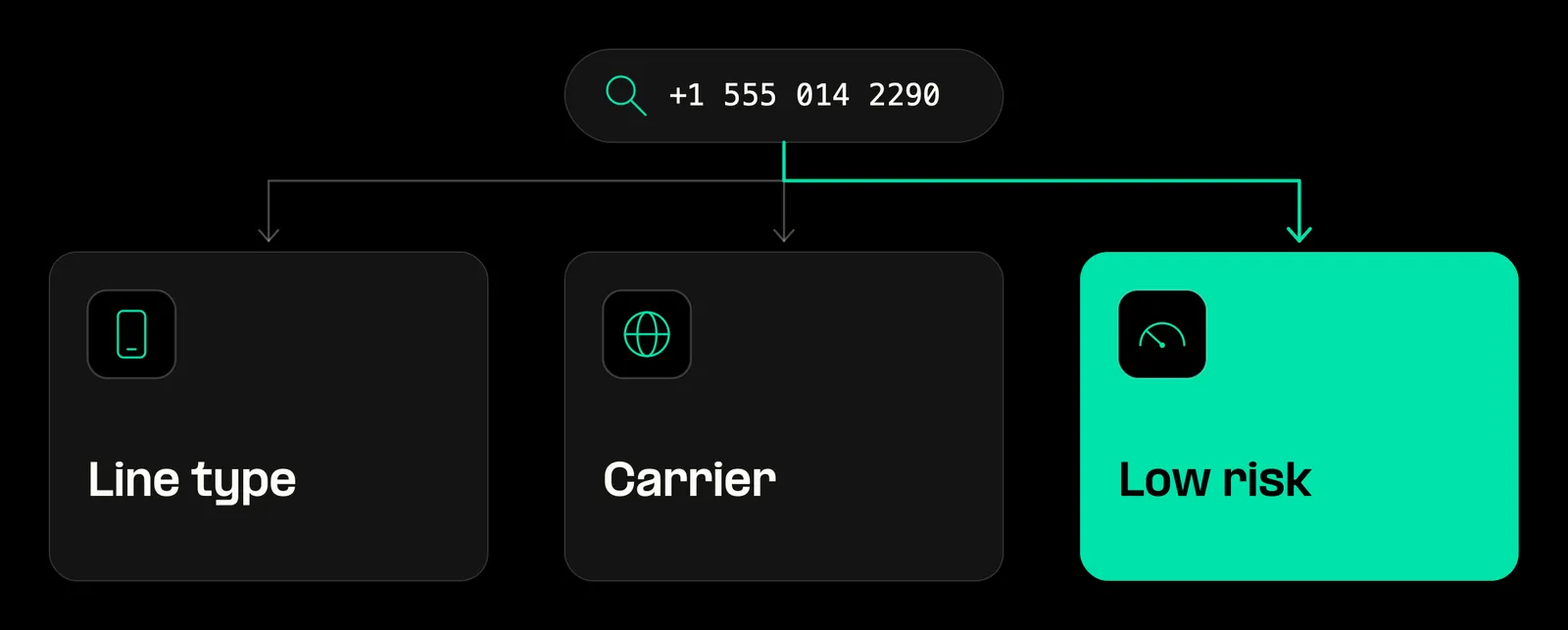
A trust-and-safety team whose problem is fraudulent sign-ups rather than code delivery looks at Telesign, which pairs its Verify API with Phone ID risk data. It suits a team that will score every number before deciding whether a code goes out at all.
Why it's good
- The Verify API delivers one-time codes over SMS, voice, WhatsApp and other messaging channels, per the Telesign product page, so a team that adds scoring still gets the same channel choice as a plain OTP product.
- Phone ID returns line type, carrier and a risk score on the number, so the sign-up flow can decide on the line before a code is sent.
- Intelligence products score the number for fraud before verification runs, so a bad number never costs a delivery.
When to use it
The team's main cost is fraud losses rather than OTP spend, it will pay for scoring on every number as a line item of its own, and it has someone to model the two bills together before signing.
When to skip it
- No published rate for verification, so a quote is needed before any per-verification comparison with vendors that publish a figure.
- Risk scoring is a separate product billed separately from verification, so the two bills need modelling together before the cost per sign-up is known.
Cost
Not published. The Telesign site routes verification pricing through a sales contact, and how the risk score is computed is not public either.
6. Plivo: Best for cost-sensitive teams needing basic SMS and voice OTP
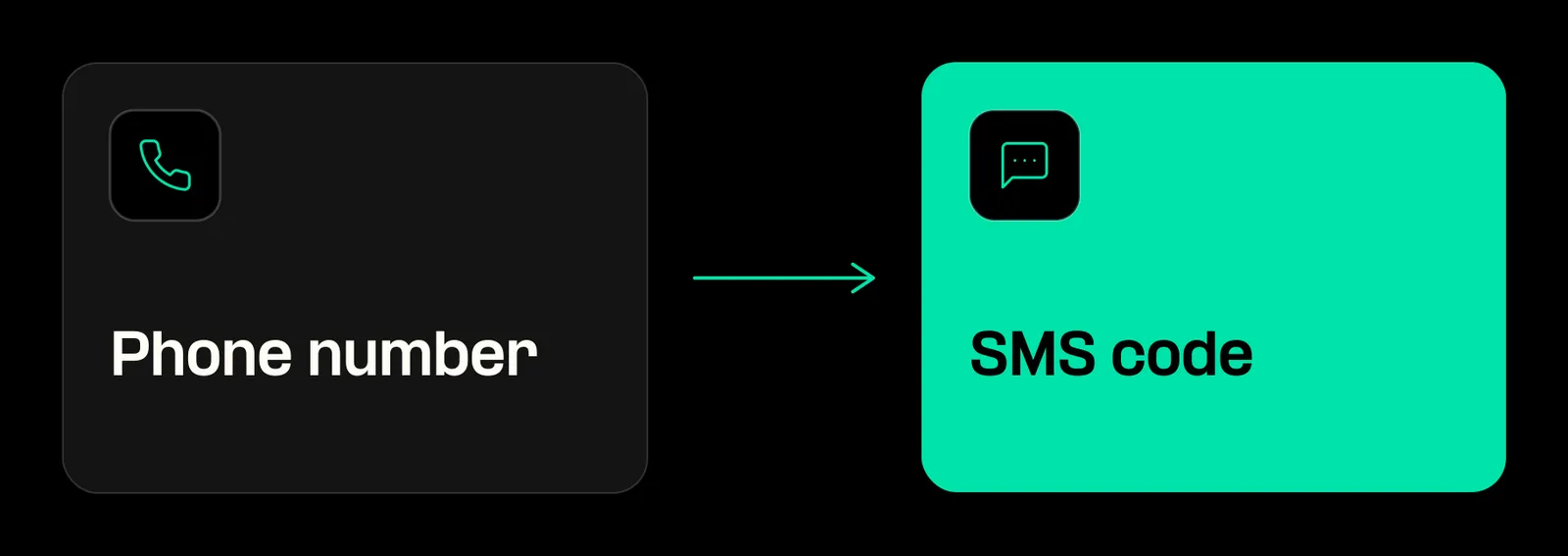
Plivo Verify is the lean option, with SMS and voice OTP and a lookup product alongside, aimed at teams optimising per-message cost in a handful of countries. It suits a product that needs only SMS and voice codes and sends mostly to a few destinations.
Why it's good
- The Verify API delivers one-time codes over SMS and voice from one integration, with generation, delivery and validation handled by the API.
- Lookup sells carrier and line type data as a separate product, so a team can filter landlines and unreachable numbers before it pays to send a code.
- Fraud Shield for SMS pumping is documented in the Verify docs as the control against artificially inflated traffic, the pattern that drives up OTP spend on an unprotected signup form.
When to use it
The product sends to a few countries, needs only SMS and voice codes, and the team will trade channel breadth for the lowest published rate in those destinations.
When to skip it
- No flash call, WhatsApp or silent channel in the Verify product, so a code-free login flow is off the table and every verification costs a message or a call.
- Coverage must be checked per destination before a new market launches, since there is no single published country count to rely on.
Cost
Plivo lists Verify pricing per country rather than as one headline rate, so a login costs the published figure for its destination, with Lookup billed separately.
Free phone number verification API options and their limits
None of the six has a free tier for sending codes. Each offers a trial instead: a small credit, and codes go only to numbers the developer has verified first.
Free trial on each phone verification API
| Provider | What is free | Limits |
|---|---|---|
| Telnyx | $5 testing credit | Verify sends SMS codes only, to one verified number, up to 50 verifications a day |
| Twilio | 40 free verifications | Up to five verified numbers, the trial sender and template, and a 30-day trial |
| Vonage | €2 free credit, no card | SMS to up to five test numbers, voice calls only to the registered number, and a demo tag on every trial SMS |
| Sinch | $2 credit on a US account | Up to five verified numbers and 1 SMS a second |
| Telesign | $5 in test credit, no card | SMS Verify, Phone ID and Intelligence, sent only to pre-verified numbers |
| Plivo | $10 in free credit, no card | The credit lasts three weeks, and messages go only to verified sandbox numbers |
A trial proves the integration works, not delivery to real users. Every provider lifts the verified-number limit only after the account is upgraded and topped up.
How much does a phone verification API cost?
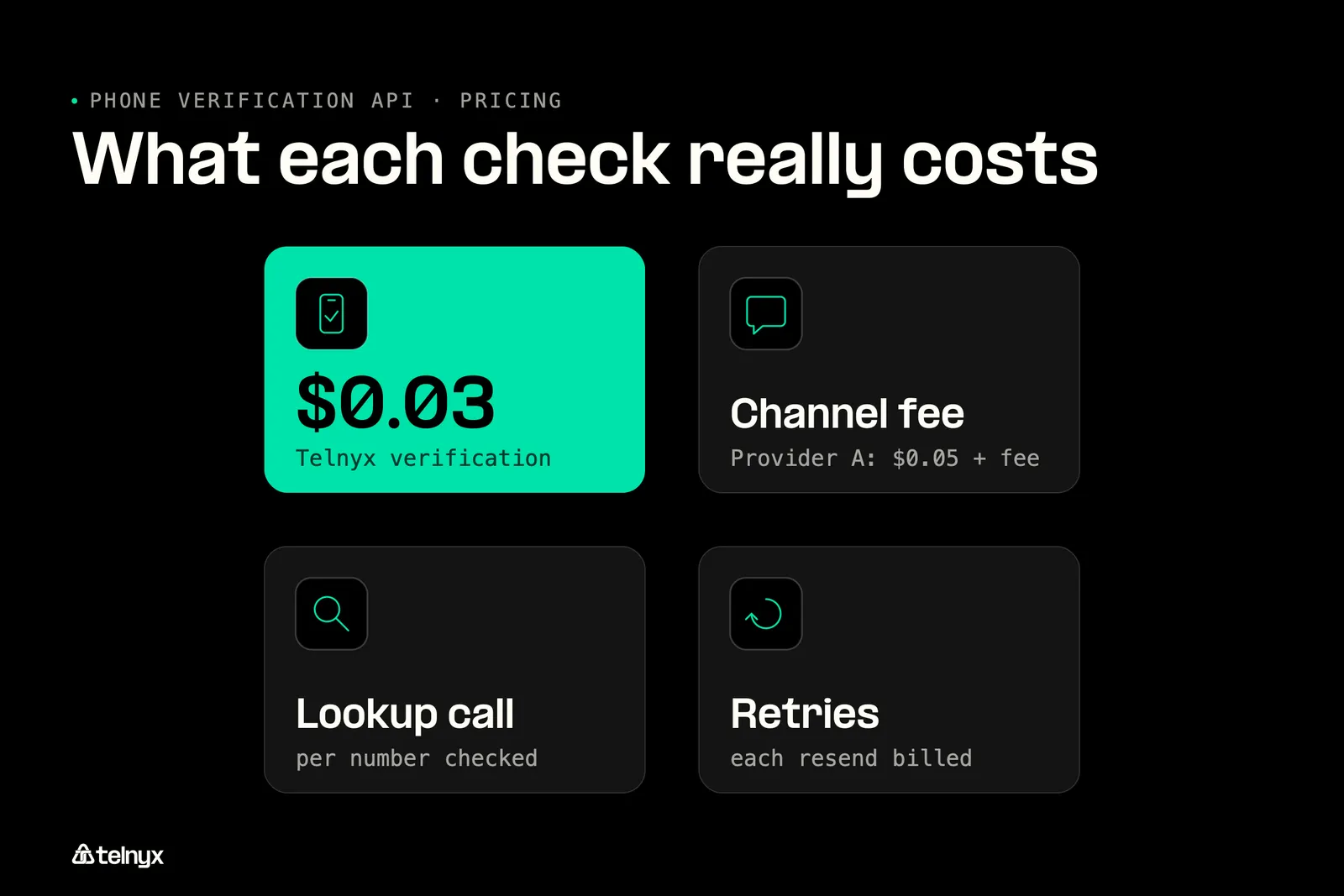
The Telnyx pricing page lists Verify from $0.03 per verification, with automatic volume discounts. The Twilio page lists $0.05 per successful verification and bills the SMS or voice channel fee separately per country.
Sinch and Telesign publish no rate, and Vonage and Plivo publish per-country tables, so four of the six need a quote or a rate table before any estimate exists.
One verification can carry four charges: the verification fee, the channel delivery fee for an SMS, a voice minute or a WhatsApp conversation, a lookup call if the app validates the number first, and a retry after a failed delivery. A single published number rarely covers all four.
| Cost layer | What triggers it | In the headline rate? |
|---|---|---|
| Verification fee | Each verification | Yes, where a vendor publishes one |
| Channel delivery fee | Each SMS, voice minute or WhatsApp message | Twilio bills it separately per country |
| Lookup call | Each number checked before a send | Separate product at every vendor |
| Retries | Each re-send after a failure | Never |
Published rates are not equivalent because each vendor draws the line between these layers in a different place, and the per-country channel fee can exceed the verification fee where SMS termination is expensive.
A rate that looks lower on the pricing page can land higher on the invoice once retries and a lookup on every send are added, so the estimate starts from the flow's own numbers.
- Expected verifications per month, counted at the launch peak rather than the average.
- Share by channel, since SMS, voice, flash call and WhatsApp each carry a different delivery fee.
- Share of destinations outside the home country, where per-country rates apply.
- Retry rate, since every re-send is billed again.
- Whether lookup runs before every send, which adds a call per number and removes sends to invalid ones.
Price every login before launch
Telnyx's Verify API publishes its starting rate and runs SMS, voice, flash call and WhatsApp from one profile, so the estimate takes minutes.
How to use the Telnyx phone verification API
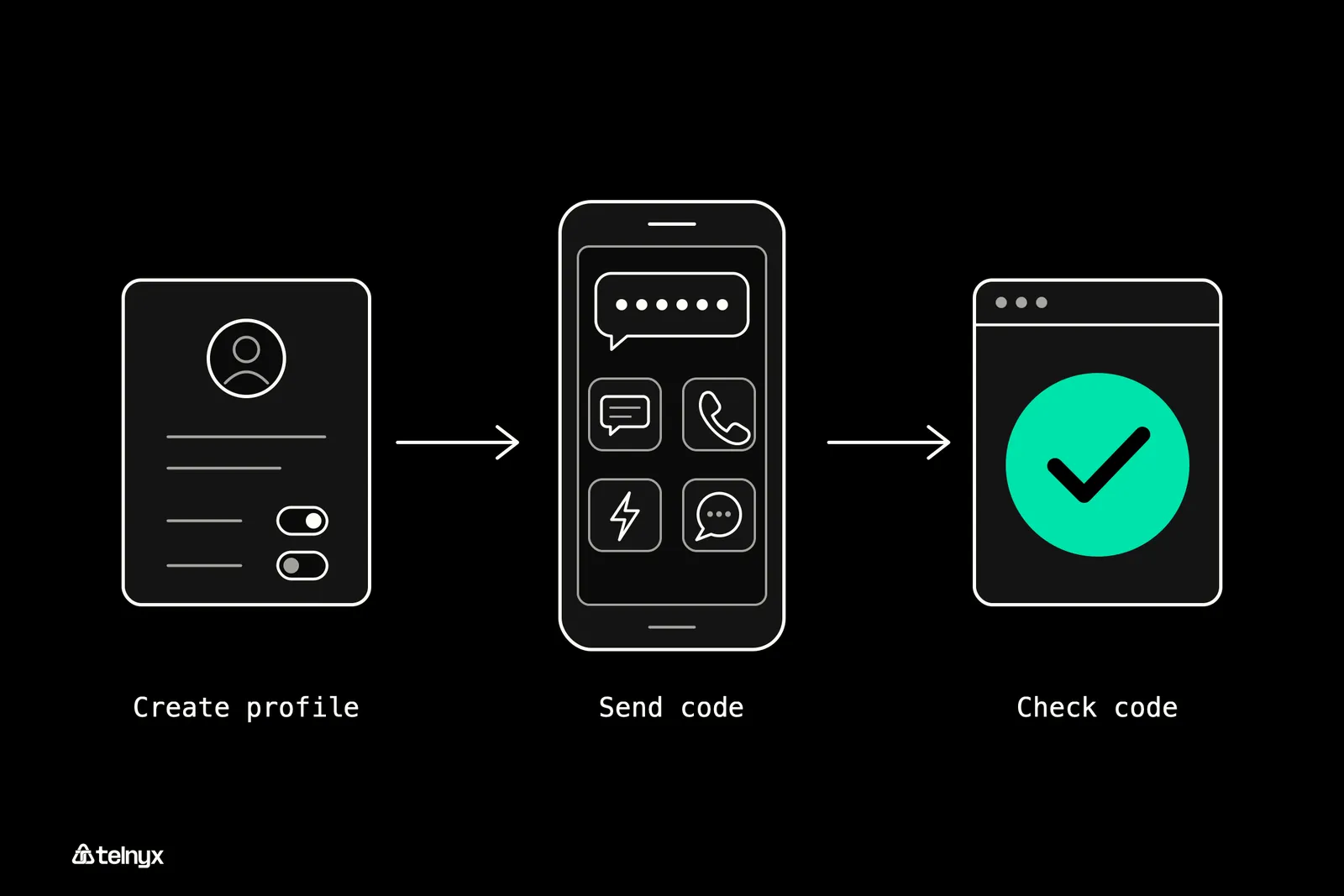
Telnyx's Verify API runs phone verification in three calls: create a Verify profile, send a code on a channel, and check the code the user typed. The app never generates, stores or delivers the code itself, which is the whole point of a verify API as a second login factor, whether the flow guards a login, a sign-up or a checkout in retail and eCommerce.
Every call below carries a bearer token read from an environment variable, never a literal credential.
Step 1: Create a Verify profile
The profile holds the channel settings and the code timeout, and its id goes into every later call, so a team creates it once in the Mission Control Portal or with one request to /v2/verify_profiles, as the Verify API reference documents.
The request below names the profile, sets a five-minute code lifetime and enables messaging, which is the same example the product page shows.
Step 2: Send the verification code
One request to /v2/verifications/sms with the phone_number in E.164 format and the verify_profile_id triggers the code, per the Verify API reference.
The same body goes to /v2/verifications/call for a voice code and to /v2/verifications/flashcall for a flash call, and the profile's WhatsApp channel follows the configuration guide on the product page, the channel that a list of WhatsApp API providers covers in more depth. Telnyx generates the code, delivers it and reports the delivery receipt.
Step 3: Check the code the user enters
The app posts the code the user typed to /v2/verifications/by_phone_number/{phone_number}/actions/verify with the same verify_profile_id, and the response says whether the code was accepted, as the call to verify a code documents.
The app compares nothing itself, so there is no code to store, hash or leak. A rejected response, from a wrong code or one older than the profile timeout, sends the user back to step 2.
Before step 2, one call to Number Lookup on the same account returns the line type, so the app can refuse an invalid or VoIP number before it pays to send a code to it.
Phone verification API FAQ
Shortlist your phone verification API in one sitting
Telnyx's Verify API publishes its starting rate per verification, delivers codes over SMS, voice, flash call and WhatsApp from one profile, and sits beside Number Lookup on the same account, so the cost of every login is modelled before anyone fills in a sales form.
Start with Verify APIShare on Social

Serhii Omelchenko
Global AEO/SEO Manager
Serhii is Global AEO/SEO Manager at Telnyx, based in Amsterdam, he is focused on making communications infrastructure findable and credible across both traditional search and AI-driven discovery. He previously led SEO and GEO strategy for some of the world’s most recognized consu


