
Inference
Top AI inference platforms: how to evaluate providers on real cost
Six checks to predict your inference bill and latency, plus how the top AI inference platforms compare on pricing.

By Eli Mogul
Takeaways
The top AI inference platforms fall into five types. Score each on six checks to predict your production bill and latency: GPU location, pricing unit, switching effort, data retention, scaling, and model lineup.
- Telnyx runs open-weight models in-region across the Americas, Europe, MENA, and APAC on GPUs it owns, with zero data retention and an OpenAI-compatible API.
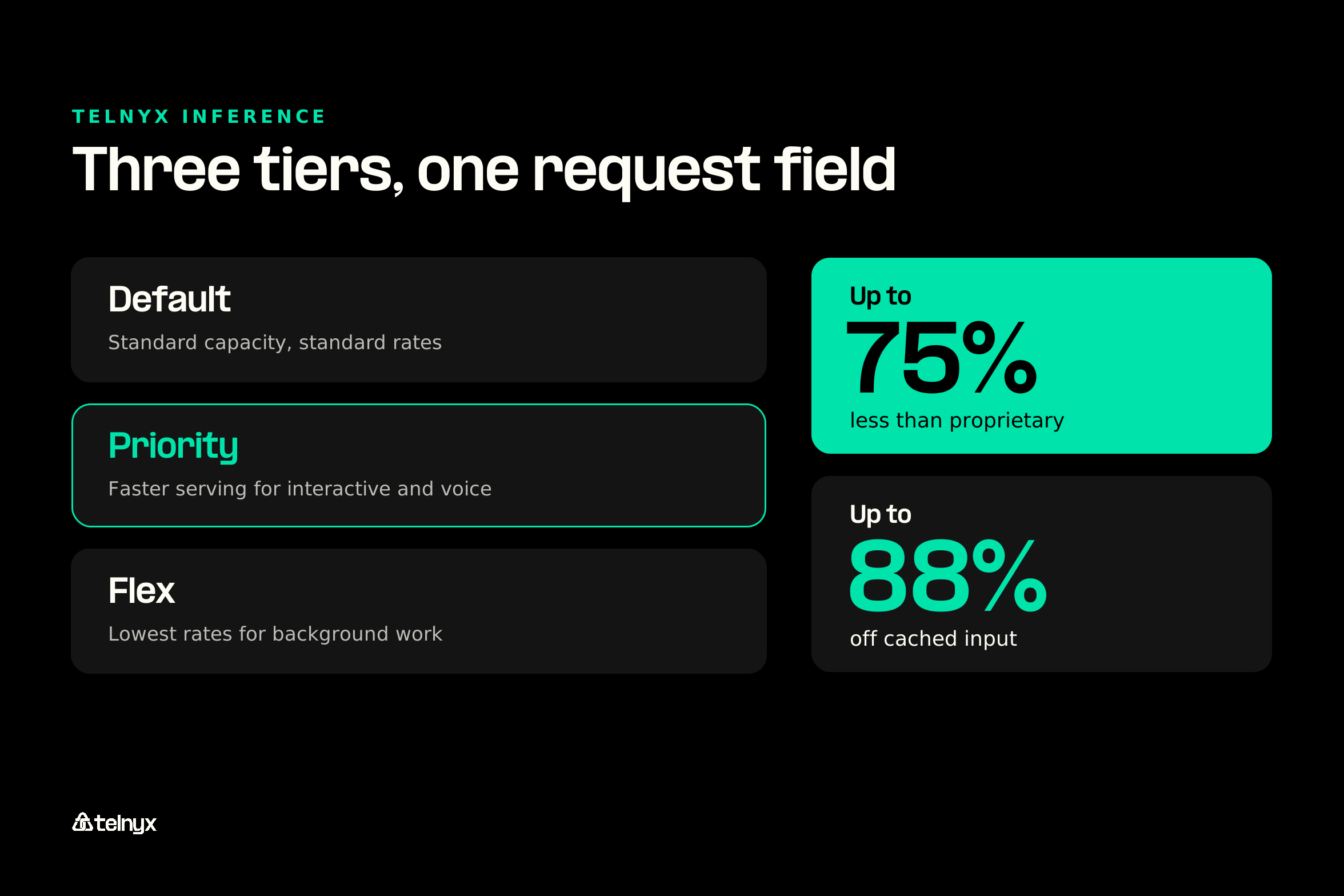
- On Telnyx, open-model inference costs up to 75% less than proprietary alternatives, with cached input at up to 88% off.
- The Hugging Face Inference API fits when you want to try many open-weight models with one token and can manage where each request runs.
What is AI inference, and why does your provider matter?
AI inference is your trained model answering live requests. Your provider decides where that work runs, what each request costs, and where your data goes. A demo hides all three. Production sends thousands of requests from everywhere, and the provider's choices show up in your p95 and on your invoice.
Inference vs training: what changes once the model is live
Training is a batch job you run occasionally. Inference is an always-on workload, so the questions you ask a provider change. For the mechanics, start with LLM inference explained.
- When it runs: training runs in batches. Inference runs on every user request.
- What it needs: training needs throughput. Inference needs low latency and autoscaling.
- How you pay: training bills cluster time. Inference bills per token or per request.
Where production latency and cost actually come from
Every request makes the same trip: user to endpoint, endpoint to GPU, first token, then the stream back. Model speed decides one of those four legs. The other three are network round trips, and they show up in the gap between TTFT vs end-to-end latency. If your provider's GPUs sit in another region, no model upgrade wins that time back.
"We often obsess over LLM inference speeds, but in Voice AI, the network is often the silent killer." Ian Reither, COO at Telnyx |
Telnyx runs inference in-region across the Americas, Europe, MENA, and APAC on GPUs colocated with its network. There are no inter-provider hops and no cross-border routing, and zero data retention keeps your prompts and outputs where your users are.
Run open models next to your users
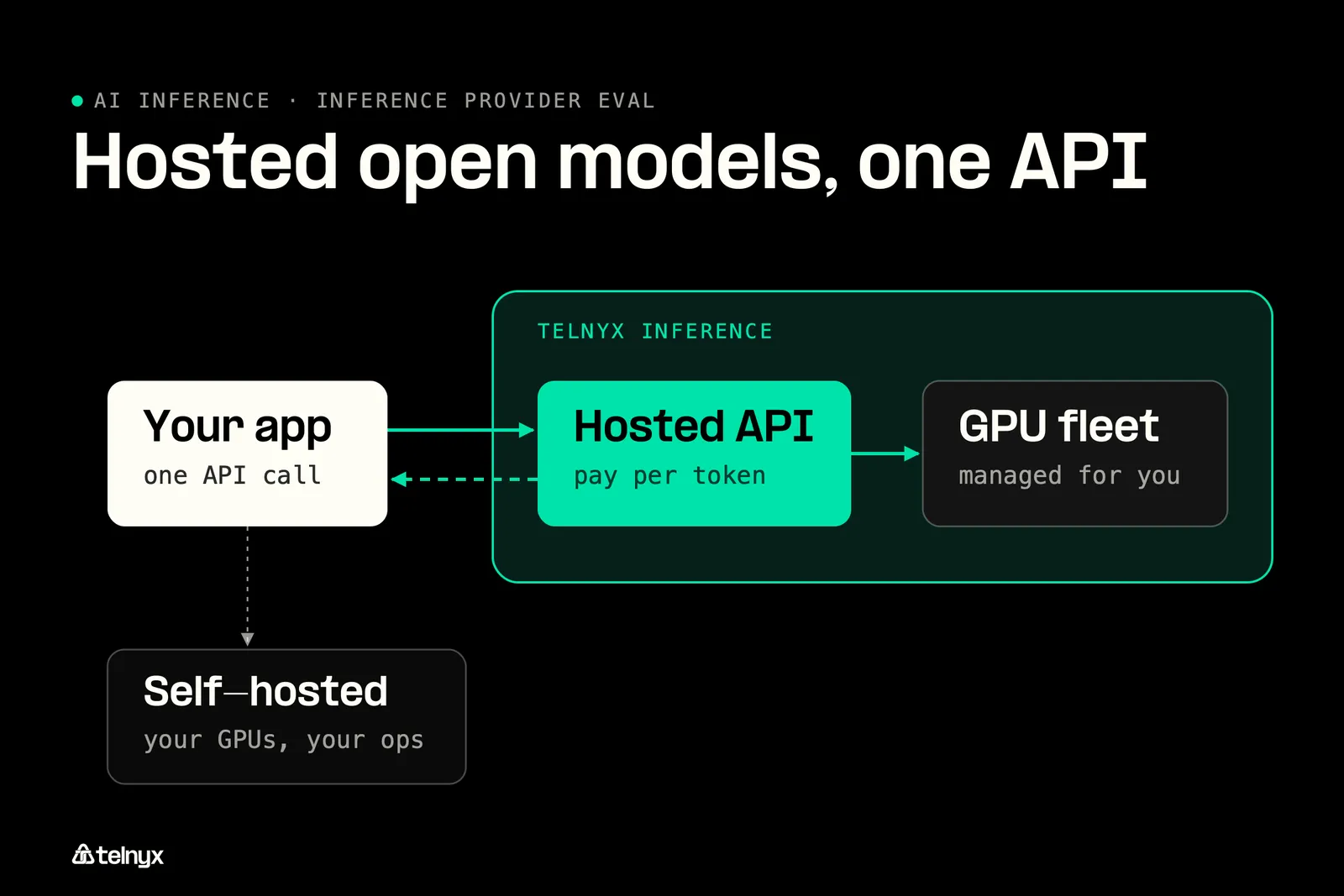
Telnyx Inference serves open-weight models on in-region GPUs behind an OpenAI-compatible API, with zero data retention.
Run open models in-region for less
Get open-model inference at up to 75% less than proprietary alternatives, on Telnyx-owned GPUs with zero data retention.
How to evaluate an AI inference platform before you commit
Six checks tell you more about next quarter's invoice than any feature matrix. Each covers what to ask and what Telnyx publishes for it.
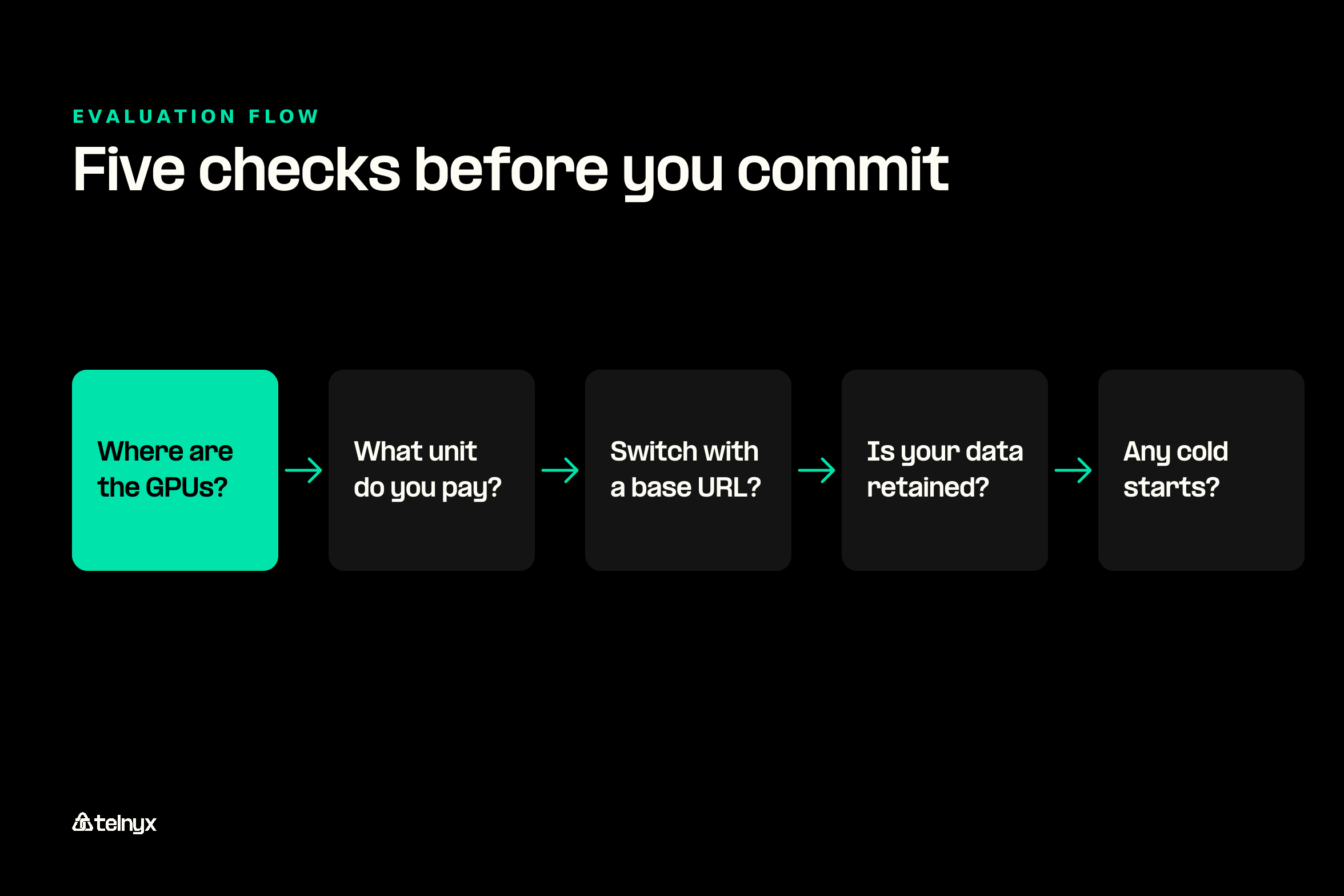
Check 1: where do the GPUs sit relative to your users?
Ask where the GPUs run. A user on another continent pays extra round trips on every request, and streamed responses feel it before the first token. Telnyx runs in four regions on GPUs colocated with its own network. If your users cluster in one market, see what edge inference does for response times.
Check 2: what unit do you pay in, and what is not on the price sheet?
Per-token pricing needs forecasting as volume grows. Per-GPU-hour pricing is predictable, but you pay for idle capacity. List the charges outside the headline price:
- Data transfer and egress fees
- Charges tied to scaling events
- GPU rental fees or compute surcharges
- Minimum commitments
- A separate rate for a low-latency tier
Telnyx bills per token by model and service tier, with cached input up to 88% off and no GPU rental fees, compute surcharges, or minimums. Price the faster Priority tier as its own line. For the billing model in plain terms, read about inference as a service.
Check 3: how hard is it to switch providers?
OpenAI compatibility works as an exit door. If your SDK keeps working after a base URL and credential change, a proof of concept takes an afternoon, and so does a later move. Telnyx exposes OpenAI-compatible endpoints, so this request uses the chat completions format you already send to an LLM API. The Inference API docs cover SDK setup:
Check 4: what happens to your data after the response?
Ask whether the provider keeps your prompts and outputs. Anything it retains becomes a compliance review that can stall a launch. Telnyx keeps zero data retention and does not train on your data, which matters most for healthcare AI solutions and anything else that touches personal records.
Check 5: how does it scale, and what does a cold start cost you?
Some providers make you reserve capacity. Others spin up workers on demand, which adds a cold start after quiet periods. Telnyx autoscales from 0 to 1000s of requests per second with no cold starts. To trade speed for rate, change the service_tier field to Priority or Flex instead of adding a second provider.
Check 6: will the model lineup still fit in 12 to 24 months?
Open-weight models improve every quarter, so ask how fast new releases go live. Telnyx adds models from z.ai, DeepSeek, Minimax, and more as they launch. On Telnyx AI Assistants, you can also bring a custom LLM from your own endpoint.
Tip: Run the six checks on one real workload. Compare providers on time-to-first-token, cost per million tokens, and p95 under a traffic spike.
Top AI inference platforms compared by type and pricing model
The platform type sets your pricing unit and your lock-in, so pick a type first, then compare vendors inside it.
Which inference setup fits your workload?
- Voice agent, callers on several continents: run open models on Telnyx Inference nearest each caller. GPUs in four regions cut cross-border round trips before the first token.
- Paying proprietary rates on a live app: switch to an open-weight model on Telnyx Inference. It costs up to 75% less, and repeated prompts get cached input at up to 88% off.
- Prompts carry regulated customer data: keep requests on Telnyx Inference in your users' region. Zero data retention means prompts and outputs are never kept after the response.
- Code already built on the OpenAI SDK: point your existing client at Telnyx Inference. Its API is OpenAI-compatible, so moving providers takes few code changes.
- Still shortlisting dozens of open models: prototype on the Hugging Face Inference API with one token. Move to an in-region provider once you know which model ships.
Top AI inference platforms by type and pricing unit
| Platform | Type | Pricing unit and best for |
|---|---|---|
| Telnyx Inference | Serverless open-model API | Per token, up to 75% less than proprietary, cached input up to 88% off. Best for open models in-region with no infrastructure |
| Fireworks AI | Serverless open-model API | Per token. Best for fine-tuned open models |
| Together AI | Serverless open-model API with dedicated GPUs | Per token or per GPU-hour. Best for mixing serverless and dedicated capacity |
| AWS SageMaker | Hyperscaler managed | Per instance-hour, or by compute time on serverless. Best for AWS-native teams |
| Amazon Bedrock | Hyperscaler managed | Per token. Best for serverless model access on AWS |
| Google Vertex AI | Hyperscaler managed | Per token for hosted models. Best for GCP teams that want Gemini |
| Baseten | Code-first GPU platform | GPU time. Best for hosted, hybrid, or self-hosted deployments |
| Modal | Code-first GPU platform | Per-second GPU billing. Best for bursty workloads |
| BentoML | Code-first GPU platform | Your own cloud or on-prem compute. Best for portability |
| OpenAI and Anthropic APIs | Foundation lab API | Per token. Best for pilots and proprietary models |
| Hugging Face Inference Providers | Open-model router | Pay as you go at partner rates. Best for trying many models with one token |
| vLLM and NVIDIA Dynamo | Self-hosted engine | Free software on your own compute. Best for teams that already own GPUs |
Pricing units reflect vendor pages as of October 2026.
Serverless open-model APIs: Telnyx, Fireworks AI, Together AI
Telnyx Inference serves curated open-weight models on GPUs Telnyx owns, in-region, behind an OpenAI-compatible API. Three service tiers share one API. Default is standard capacity at standard rates. Priority is faster capacity for interactive work such as voice orchestration, useful if you're comparing top voice AI providers, and it is live on select models. Flex has the lowest rates for background jobs and is available in the US on select models.
The trade-off is scope: Telnyx serves open-weight models only, so proprietary frontier models stay with their labs. Throughput results are in the GLM 5.2 provider benchmarks. Fireworks AI and Together AI also sell per-token open-model access, with fine-tuning and dedicated options.
- Best for: open-weight models with no GPUs to manage
- Watch for: which regions and tiers cover your model
Hyperscaler managed inference: AWS SageMaker, Amazon Bedrock, Google Vertex AI
These run inference inside a cloud you may already pay for. Regulated teams often start here because the contract already passed review. In banking or payments, compare that path with Telnyx finance solutions first.
- Best for: teams committed to one cloud
- Watch for: setup time and single-cloud dependence
Code-first GPU platforms: Baseten, Modal, BentoML
These give you control over the serving stack: your own cloud, on-prem or hybrid, and your own batching settings.
- Best for: teams that need models inside their own VPC
- Watch for: engineering time and reserved GPUs that bill while idle
Foundation model lab APIs: OpenAI, Anthropic
These are the fastest path to a pilot and the only way to call their proprietary models. Most prototypes start here, and the production bill is often the first sign to look again.
- Best for: pilots and proprietary frontier models
- Watch for: cost at scale and little control over where requests run
Self-hosted engines: vLLM and NVIDIA Dynamo
vLLM on GitHub is the open-source engine many hosted platforms build on. NVIDIA Dynamo adds distributed serving across many GPUs.
Note: The software is free, but the GPUs and upgrades are yours to run. Our guide to AI inference hardware covers the chips and placement decisions.
When is the Hugging Face Inference API the right option?
It's the right option when you want to try many open-weight models through one token and one bill, and you have engineers to manage where requests run.
What the Hugging Face Inference API is good at
Hugging Face Inference Providers routes requests to partners such as Together, Fireworks, and Groq, picking the fastest by default or the cheapest on request. It offers an OpenAI-compatible endpoint and pay-as-you-go billing at partner rates. If you fine-tune often, see how a fine-tuning API fits.
The trade-off: region, latency, and retention depend on whichever partner serves the request.
When a hosted open-model API is the better fit
The six checks usually point to one of two cases:
- Pick Hugging Face when model work is your product and you'll manage provider choice yourself.
- Pick a hosted API such as Telnyx when you need models served fast in your users' region. Telnyx hosts open-weight models on GPUs we own, with zero data retention and no infrastructure to manage.
Note: Both run open-weight models. The difference is who runs the GPUs and where. The current Telnyx lineup is in the supported models list.
Top AI inference platforms FAQ
What's the best AI inference platform for businesses?
It depends on your workload and users. Pilots fit a lab API, single-cloud teams fit their hyperscaler, and teams that want open-weight models in-region without running GPUs fit a serverless API such as Telnyx.
What is AI inference, and why does it matter for production?
It's a trained model answering live requests. In production, your provider's GPU location, pricing unit, and retention policy set your latency, bill, and compliance exposure.
Are there open-source AI inference platforms?
Yes. vLLM, NVIDIA Dynamo, and BentoML are open source. The software is free, but you pay for the hardware and upkeep.
What providers offer GPU support for AI workloads?
AWS and Google Cloud rent GPU instances, Baseten and Modal bill GPU time, and serverless APIs such as Telnyx put GPUs behind per-token pricing.
When should you consider specialized inference hardware?
When you run steady, high-volume traffic on fixed models and have a team to operate it. Below that, a serverless API usually costs less.
Run all six checks with one base URL
Predict your production bill and latency before you commit. Point your OpenAI SDK at Telnyx Inference and run open-weight models on in-region GPUs with zero data retention, at up to 75% less than proprietary alternatives.
Start buildingShare on Social


