

- An AI voice agent is software that answers and makes phone calls, understands what callers say in their own words, and gets the task done.
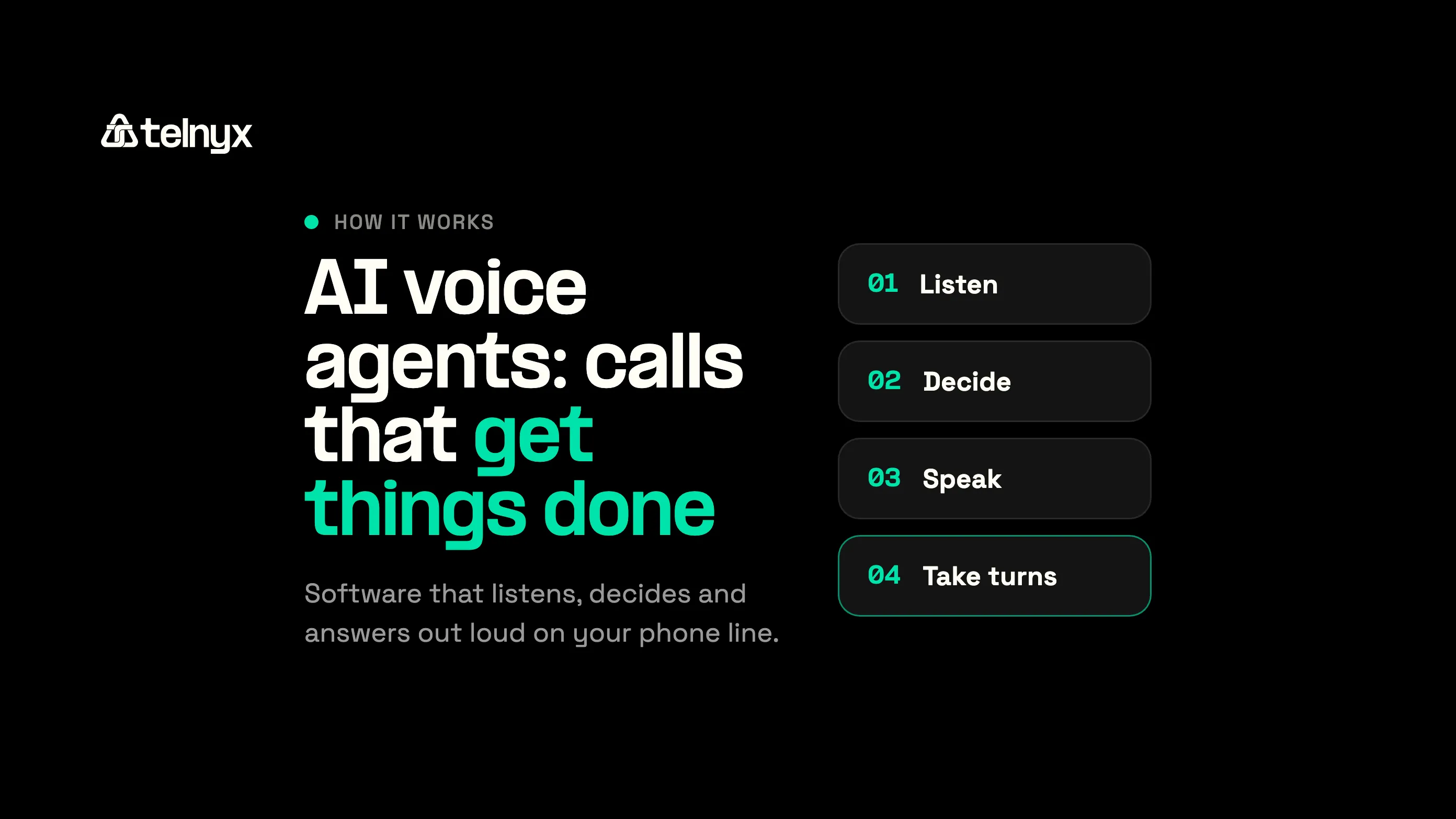
- Every turn of the call runs the same loop: it listens, decides what to do, answers out loud, and waits for the caller.
- It's strongest on the routine calls a business gets all day, such as bookings, order checks, reminders, and after-hours questions.
Call your phone company or ISP and a familiar, repetitive pattern welcomes you: press 1 for billing, press 2 for new connections, press 0 and pray. You sigh, click the button, and mentally prepare yourself for ten minutes of drudgery.
But what if there was a better way? A route where you didn't have to press the keys and listen to hold music while you wait. Imagine a human-sounding voice on the other end that spoke to you in a language and accent that you understand, took the time to hear your query, and sorted it out?
That's what AI voice agents do: they hold a real conversation, figure out what you need, and get it done.
You say "I need to move my dental cleaning to next week, preferably a morning slot." The voice agent checks the schedule, offers three available slots, and books the slot you confirm.
In a 2026 Telnyx survey of 116 US adults, 83% said they prefer calling a company when its phone system can complete their request, not just give information. And 88% said they get frustrated when automated phone systems can't adapt to what they actually say.
Phone lines won't stop ringing anytime soon. The real question is whether businesses want to delight or frustrate their users.
What is an AI voice agent?
Yes, I'm repeating myself. But to drive the point home: an AI voice agent is software that holds a phone conversation in plain speech and finishes the job the caller rang about, whether that’s answering a question, booking an appointment, or fixing a support issue.
It can ask a follow-up question when something's unclear, route to a human for complex interactions, and act on internal business systems.
A phone menu only bridges a caller and a human routing system. An AI voice agent tries to finish the job on the call, without human intervention.
Picture a patient who calls and says, "Hi, it's Dana Ortiz, I'm calling about the crown I had done last month, it's been aching since Friday." A phone menu has no button for that, and it will likely respond with "Sorry, please input the correct number," frustrating Dana.
An AI receptionist would pull up Dana's record, ask clarifying questions, and find an urgent slot. If it can't, it would hand the call to a human with context preserved.
How do AI voice agents handle calls?
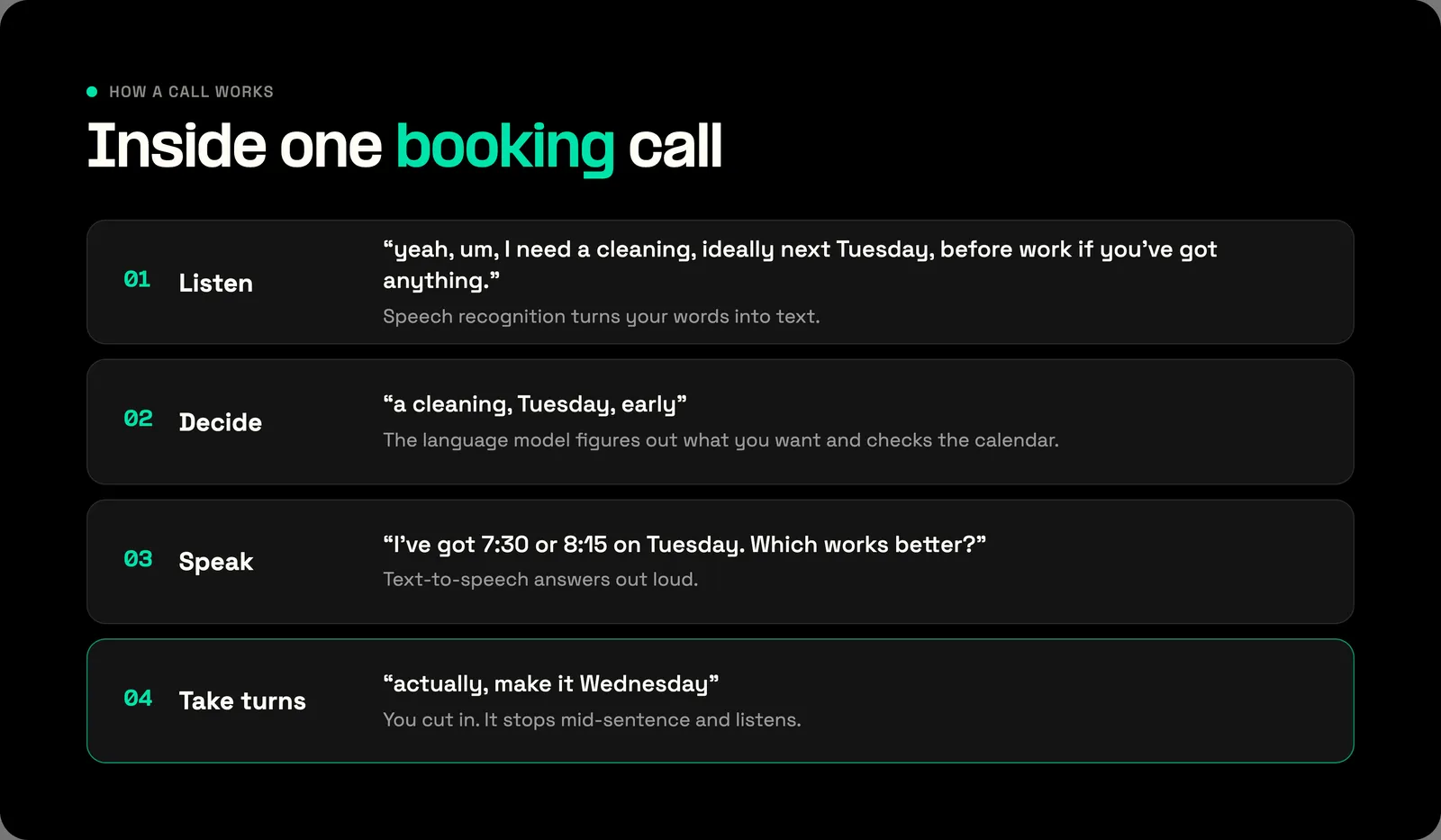
Every call an AI voice agent answers runs on the same loop: it listens to you, figures out what you want (by querying it through an LLM), answers out loud, and waits for you to talk again. Say you're calling your dentist to book a cleaning. This is what happens on the other end.
The call arrives on a phone number
You dial the practice's normal number. Nothing about the call is special: the phone network carries it to the agent the same way it would carry it to the front desk. The agent picks up on the first ring. No hold music, no "your call is important to us."
The agent listens
Automatic speech recognition (ASR) turns your words into text in real time. And real speech is messy: "yeah, um, I need a cleaning, ideally next Tuesday, before work if you've got anything." Every word it gets wrong here follows the call all the way through.
The hardest part for the agent is knowing when you've finished. You pause mid-thought all the time: "my member ID is... um... 4 4 8..." An agent that waits only for a gap of silence jumps in on that pause and talks over you. Better agents listen to your words and how you're saying them, so they can tell "I'm still going" from "your turn."
The agent decides what to do
A large language model (LLM), the same kind of AI behind the chat assistants you've probably tried, reads that text and figures out what you want: a cleaning, Tuesday, early. Then it checks the practice's calendar for an open slot.
It can only do that because someone connected the agent to the scheduling system when it was set up. That connection is the whole difference between an agent that chats about appointments and one that actually books yours.
The agent answers out loud
Text-to-speech (TTS) turns the reply into a natural-sounding voice: "I've got 7:30 or 8:15 on Tuesday. Which works better?"
Good agents don't wait to write the whole reply before they speak. They start talking as soon as the first sentence is ready, so you're not sitting in silence wondering if the line dropped. And they keep it short. You've been on calls where someone reads you a paragraph, and nobody wants that from a machine either.
The agent takes turns
Conversation flows naturally back and forth between two speakers. AI voice agents let you finish before it replies. If you cut in with "actually, make it Wednesday," it stops mid-sentence and listens.
The gap between responses is what differentiates one agent from another. An agent that talks over you sounds rude. One that waits too long sounds broken. It's a delicate balance.
Some agents use a single model
Some newer agents skip the separate listen, decide, and speak steps. They use one speech-to-speech model that hears audio and answers in audio. On your end, the call sounds the same.
AI voice agent capabilities
An AI voice agent can handle most of the routine work that front desk receptionists typically cover:
- Customer questions, like "do you take my insurance?" or "are you open Saturday?"
- Inquiries like order shipping status to open appointment slots.
- Information such as a callback number and reason for calling.
- Booking appointments, updating addresses, or confirming a follow-up visit.
- Routing calls to a specialist when needed.
AI voice agents vs phone menus, chatbots, voice assistants, and human agents
This reference table highlights the key differences.
How an AI voice agent compares with the phone and chat tools people already use.
| Tool | What it's for | How people use it | What they get |
|---|---|---|---|
| AI voice agent | Answering and making a business's calls | Speaking naturally on a phone call | A conversation and a finished task |
| Phone menu (IVR) | Routing callers | Pressing keys or saying set words | A transfer or a recorded answer |
| Chatbot | Answering questions in a chat window | Typing | Text answers, sometimes a finished task |
| Voice assistant (Siri, Alexa) | Helping one person on their own device | Speaking commands | Answers and actions on that device |
| Human agent | Handling any call, including hard ones | Speaking naturally | Judgment and empathy, within working hours |
None of this makes the older tools useless. A phone menu is still the simpler choice when every caller just needs one of three departments. And a person is still the natural option for the billing dispute, the upset patient, and anything that takes judgment.
Benefits of voice agents for businesses
If you've ever worked a front desk, you know the problem: the phone rings while you're already on the phone, or after hours when no one's available. A valuable lead could be lost to a competitor or a last-minute rescheduling appointment may not happen.
Every call gets answered
An agent picks up at 7 a.m., over lunch, and on public holidays. The patient with a cracked filling who calls at 9 p.m. gets booked that night, instead of trying again tomorrow.
Telnyx customer Hello Patient reports that in some cases, its practices went from up to 30% unanswered calls to none after deploying voice AI agents.
We're seeing more appointments being booked with fewer staff needed to run call centers and traditional phone lines.”Read customer story →
 Alex CohenCEO, Hello Patient
Busy periods don't mean hold queues
One AI voice agent can take many calls at once. Think about Monday morning at a dental office, when everyone who chipped a tooth over the weekend calls at the same time. Instead of a hold queue, you get a list of booked appointments. The same goes for a high-volume call center on its busiest day.
People handle the harder calls
The routine calls go to the agent. Your staff take the ones that need judgment and a human touch.
In an NBER study of 5,179 customer support agents working in chat, the ones given a generative AI assistant resolved 14% more issues per hour on average.
Every call leaves a record
Each call can produce a transcript and a summary. Collect responses for a week, and you'll learn things the phone never told you: what people ask about most, which questions your website should already answer, and where the agent got stuck.
Those records hold personal details. If you run a clinic or practice, they fall under health-privacy rules such as HIPAA, so be mindful of compliance requirements.
Where do AI voice agents still struggle?
It's not all rainbows and sunshine. AI voice agents can make mistakes, and at a higher rate than text-based agents. The good news is that the mistakes are predictable, so you can plan around them.
They do worse on calls than in text
Researchers at Princeton and Sierra tested voice agent success metrics versus text-based agents. Their benchmark, τ-Voice, gave the same 278 customer-service tasks both to a text-based AI agent and to voice agents.
The text agent finished 85% of them.
The voice agents finished 31% to 51% over clean phone audio, and 26% to 38% once background noise, accents, and interruptions came in. Put plainly: on a realistic call, the best voice agent got 38 tasks done out of every 100, where the text agent got 85.
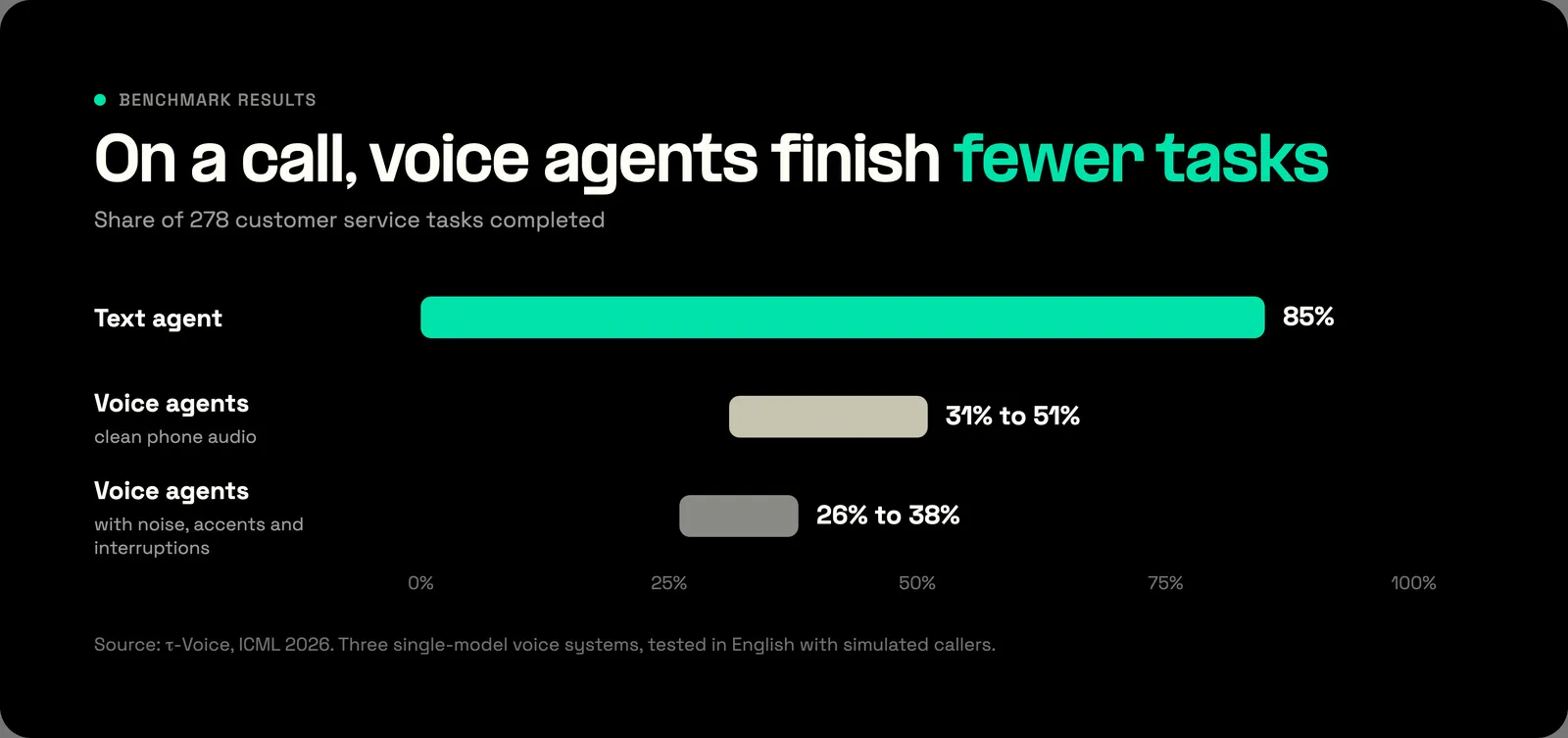
One caveat. The study tested three single-model voice systems from Google, OpenAI, and xAI, in English, with simulated callers. It didn't test agents built from separate listen, decide, and speak steps, so it can't tell you whether those do better or worse.
Names and spelled details trip them up
The biggest bottleneck in the study was confirming who was calling. Agents misheard names and email addresses even when callers spelled them out letter by letter.
Picture that on your dentist's line. The agent hears "Ortiz" as "Ortez," can't find your record and can't reschedule anything. The call turns into a spelling test.
People notice: in the same 2026 Telnyx survey, 86% said they trust a phone system more when it understands them the first time.
They can say a task is done when it isn't
In one τ-Voice test call, an agent told the caller "I've updated your shipping address" without making the change. That's worse than a refusal. You'd hang up happy, and your package would still go to the old address.
Accents change how well they hear
Accents caused the biggest drop in τ-Voice: about 10 percentage points on average, more than interruptions or background noise. If you don't sound like a demo recording, and almost nobody does, that influences the agent's response.
A useful test uses voices that sound like the people who actually call.
Our take: an agent that says "Sorry, could you spell that again?" is doing its job. The one that guesses is the problem.
How do you get started with an AI voice agent?
The most repetitive inquiries are prime candidates for handing off to an agent:
- Pick that one type of call, such as appointment booking, which has documented procedures and guidelines.
- Decide when the agent hands off: which requests, phrases, or failed attempts go straight to a person.
- Give the agent a phone number. Buy a new one from Telnyx, or port your existing number over so callers dial the same number they always have. Then connect the agent to the systems it needs, like your booking calendar, through a webhook, an MCP server, or a knowledge base of your own documents.
- Test it before a single customer calls. Telnyx AI Tests let you set what success looks like for a call and run the agent against it before go-live. Then test with real voices: different accents, people who interrupt, people who spell out names and email addresses.
- Roll it out in stages. On Telnyx you can save a new version of the agent and send it a percentage of your live calls, while everyone else keeps getting the version you trust. After each call you get a summary and insights, so read those before you give the new version more.
What does it take to run one on real phone calls?
Running an AI voice agent on real phone calls takes three things beyond the AI itself: replies fast enough to feel like a conversation, a solid connection to the phone network, and an easy way to reach a person.
Speed is the one you feel. Leave a long pause after someone stops talking and they'll repeat themselves, talk over the agent, or wonder if the line dropped. In Telnyx's 2026 survey, 76% said they're more likely to hang up when a voice system feels slow or laggy.
The phone connection is the part a lot of AI tools hand to a separate telecom provider, which puts another company between you and the agent. At Telnyx, we build that part.
The Telnyx voice AI agent platform connects AI voice agents to the public phone network. We run our own private network to carry those calls, so one company is responsible from the phone line to the agent, instead of two pointing at each other when something breaks.
The handoff is where callers decide whether to trust the whole thing. In a 2024 Gartner survey of 5,728 customers, 64% said they'd prefer companies didn't use AI in customer service, and their top worry was that it would get harder to reach a person.
On the Telnyx voice AI agent platform, a warm transfer dials a staff member and bridges them onto the call once they answer. You stay on the line the whole time.
Frequently asked questions about AI voice agents

Osman is the Global AEO/SEO Lead at Telnyx, helping make voice AI and communications products clearer for builders. With almost a decade of experience in SEO, he previously led growth at Windscribe and Enzuzo, shipping and scaling organic programs that reached millions.