
Voice
What is a VoIP phone and how does it work?
A VoIP phone makes calls over the internet instead of copper lines. Learn how VoIP phones work, the types available, and how to pick a provider.

By Eli Mogul
Takeaways
- A VoIP phone converts your voice into data packets and sends calls over the internet instead of traditional copper phone lines.
- VoIP phones come in four forms: hard phones (desk phones), softphones (apps), mobile VoIP apps, and analog phones connected with ATA adapters.
- Calls are set up with SIP and carried with RTP, then compressed by codecs like G.711 and Opus.
- Good call quality needs latency under 150ms, jitter under 30ms, and packet loss under 1%.
- VoIP phone service often costs 40% to 60% less than landline service and scales with a software change instead of new wiring.
What is a VoIP phone
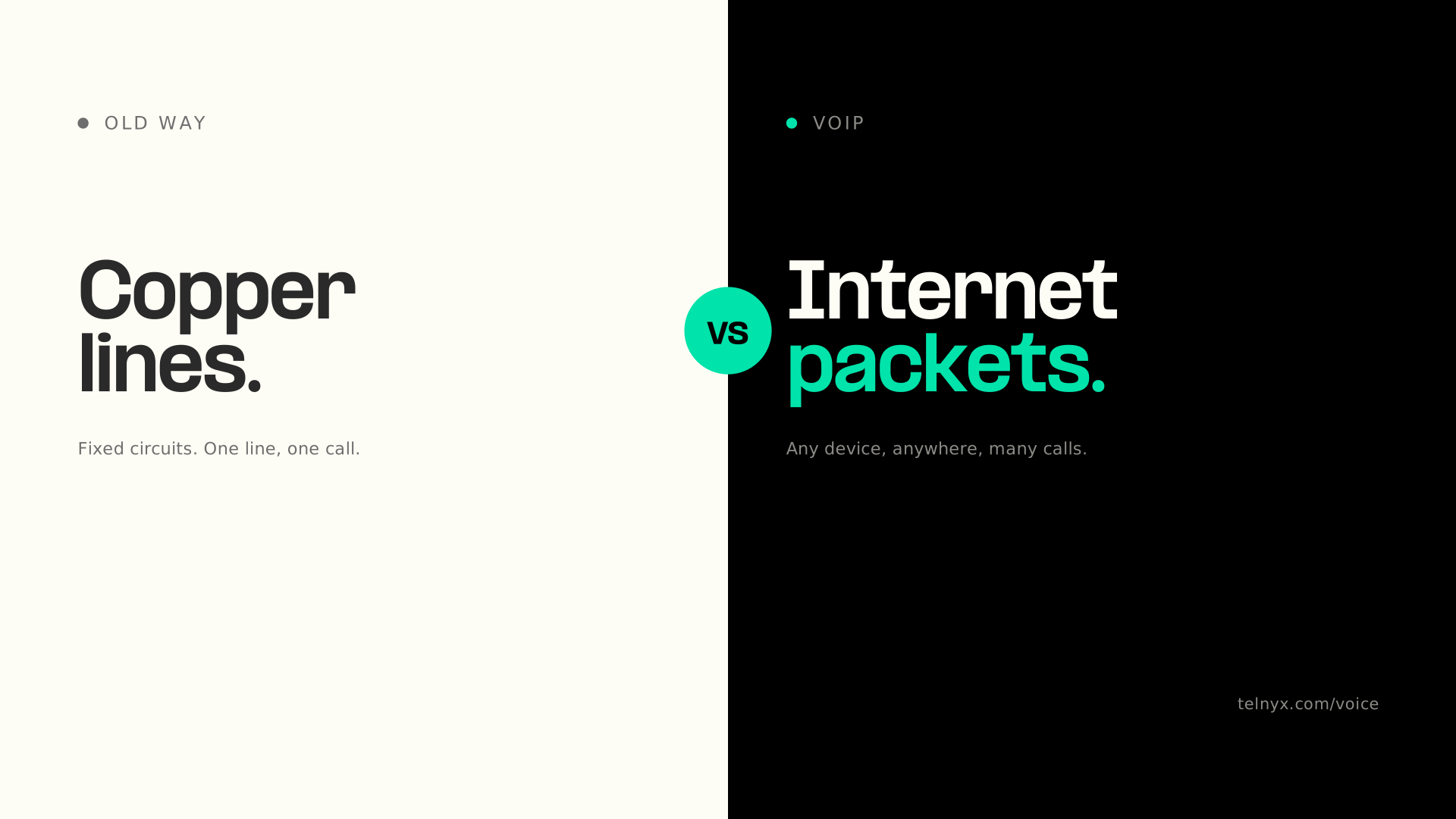
A VoIP phone is any device that places and receives calls over an internet connection using Voice over Internet Protocol, rather than the analog Public Switched Telephone Network (PSTN). Instead of sending your voice as an electrical signal down a dedicated copper circuit, a VoIP phone turns it into digital data and routes it across IP networks, the same networks that carry your email and video calls.
The terms VoIP phone, IP phone, and internet phone all describe the same thing. If someone asks what an IP phone is, the short answer is that it is a VoIP phone: a device that calls over Internet Protocol. The name changes, but the technology does not.
A VoIP phone can be physical hardware or software. What defines it is how the call travels, not what the device looks like. A desk phone, a laptop app, and a smartphone can all be VoIP phones as long as the call rides over the internet.
Every VoIP phone needs a VoIP number to send and receive calls. Unlike a landline number, a VoIP number is assigned to a user or an account rather than a physical location, which is why the same number can follow you from your desk to your laptop to your phone. Telnyx provisions local, toll-free, and mobile numbers in 130+ countries instantly through the Mission Control Portal or API, so you can put a number on a device in minutes. If you are outfitting a whole team, the business phone system solution pairs those numbers with calling features out of the box.
Types of VoIP phones
VoIP phones fall into four categories. The right one depends on how people work and how many handsets you already own.
Hard phones are physical desk phones with an Ethernet port and SIP firmware, made by vendors like Poly, Yealink, and Grandstream. They look like traditional office phones and suit call-heavy desk roles that want a dedicated handset.
Softphones are desktop or browser apps that turn a computer into a phone. There is no hardware cost, and you can provision a new user in minutes. They fit remote and hybrid teams that live on their laptops.
Mobile VoIP apps bring business calling to iOS and Android over Wi-Fi or cellular data, kept separate from the employee's personal number. They work well for field staff and anyone who takes business calls on the move.
ATA adapters convert existing analog phones and fax machines to VoIP. An analog telephone adapter sits between the old handset and the network, which makes it the cheapest migration path for offices with legacy equipment.
| VoIP phone type | Best for | Typical cost |
|---|---|---|
| Hard phone (desk phone) | Call-heavy desk roles that want a dedicated handset | $50 to $300 per device |
| Softphone (desktop or browser app) | Remote and hybrid teams on laptops | No hardware cost |
| Mobile VoIP app | Field staff and mobile workers | No hardware cost |
| ATA adapter | Offices reusing analog phones or fax machines | $30 to $100 per adapter |
Pricing varies by provider and is subject to change. Figures reflect typical market rates as of 2026.
Get a VoIP number in minutes. No hardware required, no wiring, no waiting. Provision a local, toll-free, or mobile number through the Telnyx Mission Control Portal or API and start taking calls on any device. Get a number
How does a VoIP phone work
A VoIP phone digitizes your voice, compresses it with a codec, splits it into packets, and routes those packets over IP networks to the recipient, where they are reassembled into audio. The whole process happens in milliseconds, which is why a well-run VoIP call sounds as natural as a landline call.
Two protocols do the heavy lifting, and it helps to keep them separate in your mind. Session Initiation Protocol (SIP) sets up, manages, and ends the call. Real-time Transport Protocol (RTP) carries the actual audio once the call is connected. SIP is the signaling layer defined in RFC 3261. It negotiates who is calling whom, which codec both sides will use, and where the media should flow. RTP is the delivery layer that streams the voice packets between the two devices.
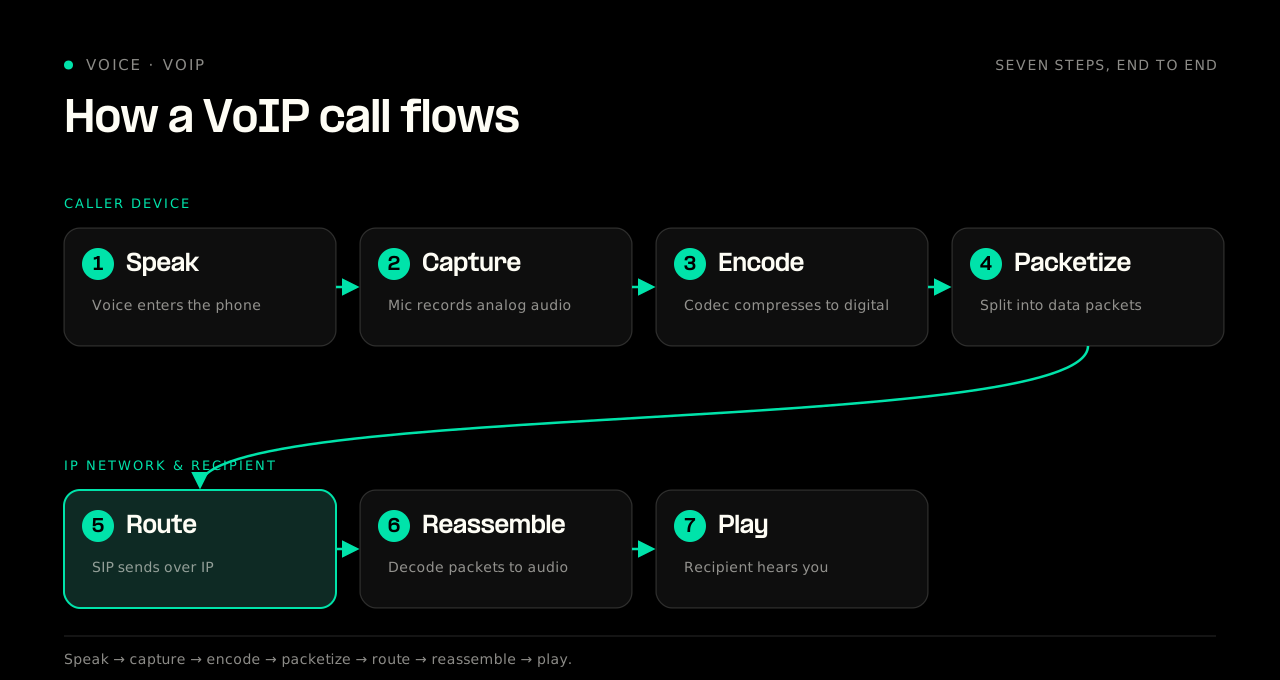
Here is the call flow, step by step:
- Registration. Your VoIP phone tells the provider's server it is online and ready at a specific address.
- Invitation. When you dial, your phone sends a SIP INVITE message toward the person you are calling.
- Negotiation. The two devices agree on a shared codec, bitrate, and encryption before any audio moves.
- Media flow. Voice travels over RTP as a stream of packets in both directions for the length of the call.
- Teardown. When someone hangs up, SIP sends a message to end the session and free the resources.
Codecs decide how your voice is compressed, and that choice trades bandwidth against audio quality. According to TechTarget, G.711 delivers uncompressed toll quality at 64 kbps, while G.729 squeezes the same call into about 8 kbps for bandwidth-constrained links. G.722 is a wideband, HD codec that carries clearer speech at a similar footprint to G.711, and Opus adapts its bitrate on the fly, which makes it the modern default for high-quality voice.
| Codec | Bandwidth | Best for |
|---|---|---|
| G.711 | 64 kbps | Toll-quality calls with bandwidth to spare |
| G.722 | ~64 kbps (HD) | Wideband, high-clarity speech |
| G.729 | ~8 kbps | Low-bandwidth or high-density links |
| Opus | 6 to 510 kbps (adaptive) | Variable networks that need HD when possible |
The network path matters as much as the protocol. Calls that stay on a private backbone avoid the congestion and unpredictable routing of the public internet, which is where quality problems usually start. Telnyx routes calls over its own global private network and colocates media servers in every region, so packets take the shortest, least congested path. That control over the VoIP network is also what makes accurate VoIP origination possible, because the carrier owns both the numbers and the routes they run on. Telnyx's Voice API handles call control across 130+ countries on a carrier-owned network, giving developers programmatic command of live calls over that private backbone.
VoIP phones vs traditional phones
The core distinction is simple: landlines send analog signals over dedicated copper circuits, while VoIP sends digital packets over shared IP networks. That single difference cascades into cost, flexibility, and features.
| Factor | VoIP phone | Landline |
|---|---|---|
| Monthly cost | Commonly $15 to $30 per user | Often $50 or more per line |
| Setup | Software provisioning in minutes | Physical wiring and install |
| Scalability | Add lines with a software change | New circuits and hardware |
| Portability | Number follows the user anywhere | Number tied to a location |
| Features | Voicemail transcription, recording, IVR included | Extra cost per feature |
| Power dependency | Needs internet and power | Works during a power outage |
| Call quality | Depends on network path | Consistent on copper |
| International rates | Billed at data rates | Premium long-distance charges |
On cost, VoIP business lines commonly run $15 to $30 per user per month against $50 or more for a comparable landline once you add features and long distance, a gap that neutral reviewers at TechnologyAdvice attribute to VoIP reusing your existing internet connection instead of a separate network. International calls are billed at data rates rather than premium per-minute tariffs.
Portability is the other clear win. A VoIP number travels with the user rather than a wall jack. There is a distinction worth knowing: fixed VoIP numbers are tied to a physical address, while non-fixed VoIP numbers are not, which is what lets someone in one country hold a number registered in another.
There is one honest tradeoff. Landlines keep working in a power outage because the copper line carries its own current, while a VoIP phone depends on both internet and power. That limitation is manageable, and we cover the fixes below.
VoIP phone call quality
Three network metrics determine whether a VoIP call sounds clear or choppy. Keep latency under 150ms one way, jitter under 30ms, and packet loss under 1%. Cross those thresholds and callers start to notice delay, garbled words, or dropped syllables. As network monitoring firm NetBeez documents, even 1% to 2% packet loss is enough to degrade a call audibly, and jitter is often the first metric to slip on a busy Wi-Fi network, which is why a jitter buffer is built into most VoIP endpoints to smooth out packet arrival times.
Quality is often scored with Mean Opinion Score (MOS), a 1 to 5 rating of how a call sounds. Anything at 4.0 or above is business grade. The PSTN toll-quality benchmark sits around 4.4, and HD codecs like Opus can match or exceed it under good conditions, per Broadcom's reference on interpreting MOS.
You can protect quality with a few practical steps. Use wired Ethernet instead of Wi-Fi where you can, turn on Quality of Service (QoS) settings on the router to prioritize voice traffic, and make sure you have enough upload bandwidth. Plan for roughly 100 kbps of upload per concurrent call as a baseline, a figure that broadband analysts at Amvia recommend padding with headroom for HD voice and overhead. The largest quality lever, though, is the carrier. Quality is mostly determined by the network path, and a reseller cannot control routes it does not own. Telnyx owns its network end to end, which is why call quality stays consistent rather than depending on whichever wholesale route was cheapest that day.
Benefits and limitations of VoIP phones
The benefits are why most businesses have already moved. VoIP phone service commonly costs 40% to 60% less than a landline, needs no physical infrastructure, and lets you add or remove lines in software. Features that landlines charge extra for, such as voicemail transcription, call recording, IVR, and call analytics, are usually built in. And because the number follows the person, VoIP supports remote and hybrid work in a way copper never could.
The limitations are real, and it is fairer to state them plainly than to hide them. A VoIP phone depends on internet and power, so an outage takes it down. Emergency calling requires a registered E911 address for each number, because the network cannot infer your location the way a fixed copper line can. Call quality varies with network conditions. And non-fixed numbers can face more spam-label scrutiny.
Each limitation has a mitigation. Configure failover routing so calls roll to a mobile number when the internet drops. Put the router and modem on a battery backup so a short outage does not cut service. Register accurate E911 addresses at signup and update them whenever someone moves, which the FCC-mandated rules require of interconnected VoIP providers. E911 service itself depends on both internet and power, so configure failover routing to a mobile number to keep emergency calling available during an outage. And maintain clean calling patterns to reduce spam flags.
This is also where the phrase "VoIP caller" on caller ID comes from. When a call shows up labeled that way, it means the calling number is internet-based rather than tied to a physical line. It is a number type, not a spam verdict. Some VoIP calls do get flagged, and the reason usually traces back to caller ID authentication. Under the STIR/SHAKEN framework, carriers attach a digital signature and attestation level to each call, and calls with weaker attestation or heavy, unanswered volume are more likely to be labeled. A legitimate business number with full attestation is far less likely to be flagged.
How to switch to a VoIP phone
Switching is a five-step process, and none of the steps require a technician visit.
- Check your internet bandwidth. Confirm you have roughly 100 kbps of upload per concurrent call, plus headroom.
- Choose a provider. Weigh network ownership, pricing, coverage, and developer tooling (covered in the next section).
- Get or port a number. Provision a fresh number or bring your existing one over.
- Pick your device type. Decide between a hard phone, a softphone, or an ATA adapter for legacy handsets.
- Configure and test. Register the device, place test calls, and check quality before you cut over.
Number porting lets you keep your existing business numbers, and the process is more predictable than most people expect. The FCC requires simple ports to be completed in one business day, and your service keeps running during the port. Telnyx supports self-service porting through the Mission Control Portal, so you can get a VoIP number or move an existing one without opening a ticket.
Teams replacing a legacy PBX have an easier path than a full rip and replace. SIP trunking connects existing PBX hardware to VoIP service without swapping out handsets, so you modernize the connection while keeping the equipment your staff already knows. Telnyx SIP trunks run on owned network infrastructure with per-second billing.
Choosing a VoIP phone provider
Not all VoIP providers are built the same, and the differences show up in quality, price, and accountability. Weigh providers on six criteria: network ownership, pricing transparency, global coverage, API and developer tooling, support quality, and uptime SLAs.
The single most useful question to ask any provider is whether they own their network or resell someone else's routes. Ownership determines quality control, pricing, and who is accountable when something breaks. A provider that owns its backbone can guarantee a route. A reseller can only pass along whatever it bought. Look for transparent pricing too, since per-second billing without hidden fees is a good sign that a provider is not padding the bill.
This is where Telnyx is built differently. One platform covers phone numbers, SIP trunking, and programmable voice, from telephony to inference, on one API and one bill. Telnyx is a licensed carrier that owns its global private network and colocates GPU infrastructure alongside its points of presence, which is what lets it run low-latency voice and Voice AI on the same network that carries the call. Telnyx also provides A-level STIR/SHAKEN attestation as the originating carrier, which means your calls are verified at the source rather than spam-filtered downstream. The result is a single provider you can grow with, from a first VoIP number to voice AI agents, without stitching together vendors.
FAQ
What is the difference between a VoIP phone and a regular phone? A VoIP phone sends calls as data over the internet, while a regular phone sends analog signals over copper lines. In practice, the VoIP phone costs less, keeps the same number wherever you go, and includes features like voicemail transcription that landlines charge extra for.
Do VoIP phones need internet to work? Yes. A VoIP phone needs a stable connection with roughly 100 kbps of upload per concurrent call. Mobile failover can route calls to a cellular number when the connection drops, and analog phones connected through an ATA adapter still depend on that same internet link.
What does VoIP caller mean on caller ID? It means the incoming number is internet-based rather than tied to a physical line. It is a number type, not a spam label. Some VoIP calls get flagged when they carry weak caller ID authentication or heavy unanswered volume, but a properly authenticated business number usually comes through clean.
Is a VoIP phone free? Softphone apps are often free to download, but business calling requires a paid number and service plan. Expect roughly $15 to $30 per user per month for a business line, which still lands well below the $50 or more a comparable landline typically costs.
Can I keep my existing number when switching to VoIP? Yes, through number porting. Your service keeps running during the move, and the FCC requires simple ports to finish in one business day. You provide your current number to the new provider, who handles the transfer.
What is an IP phone? An IP phone and a VoIP phone are the same thing: a device that places calls over Internet Protocol. Both terms exist because "IP phone" often refers to the physical desk handset, while "VoIP phone" is used more broadly, but the underlying technology is identical.
Move your calling to VoIP with Telnyx
Telnyx owns the entire stack, from telephony to AI. One platform, one API, one bill. Provision numbers, connect SIP trunks, and build programmable voice on a private global network that Telnyx runs end to end, then extend it into Voice AI when you are ready. Talk to an expert about moving your calling to VoIP, or get started with a number today.
Share on Social


