
Insights and Resources
Call Sentiment Analysis How It Works and Why It Matters
Learn how call sentiment analysis works, the customer insight use cases it unlocks, and the tools and providers that turn every call into action.

By Eli Mogul
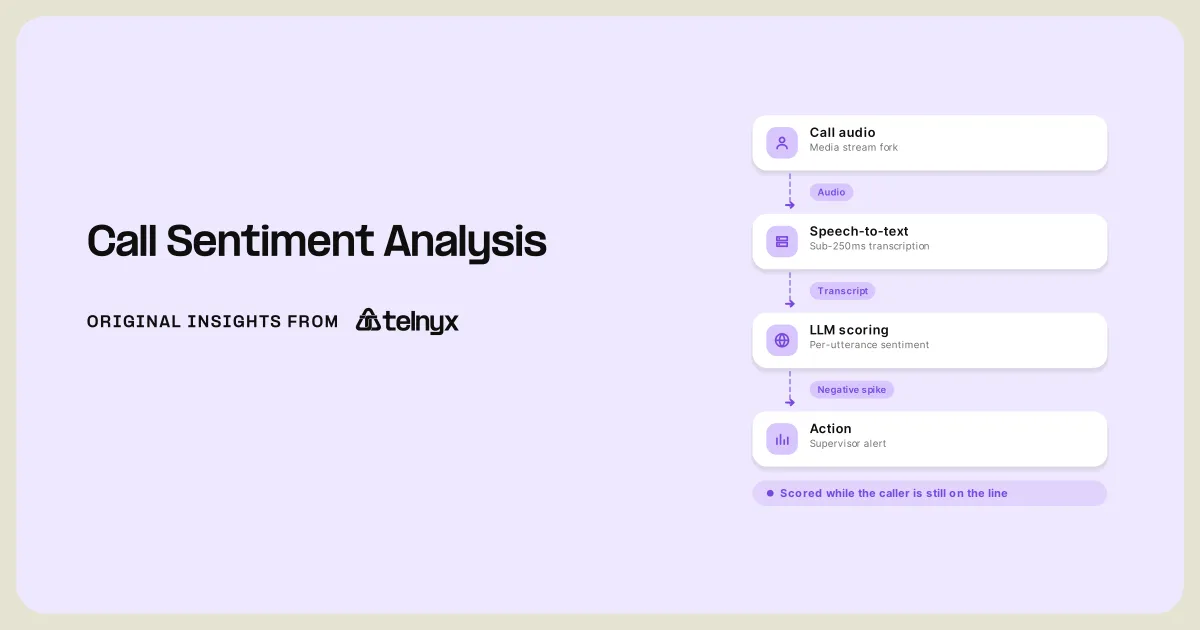
Call sentiment analysis is the use of AI transcription and natural language processing (NLP) to detect customer emotion in phone conversations. The system converts speech to text, scores the language for positive, negative, or neutral sentiment, and surfaces signals like frustration, distress, or intent to cancel. The output gives contact centers a measurable read on how every caller feels, on every call, without a human listening in.
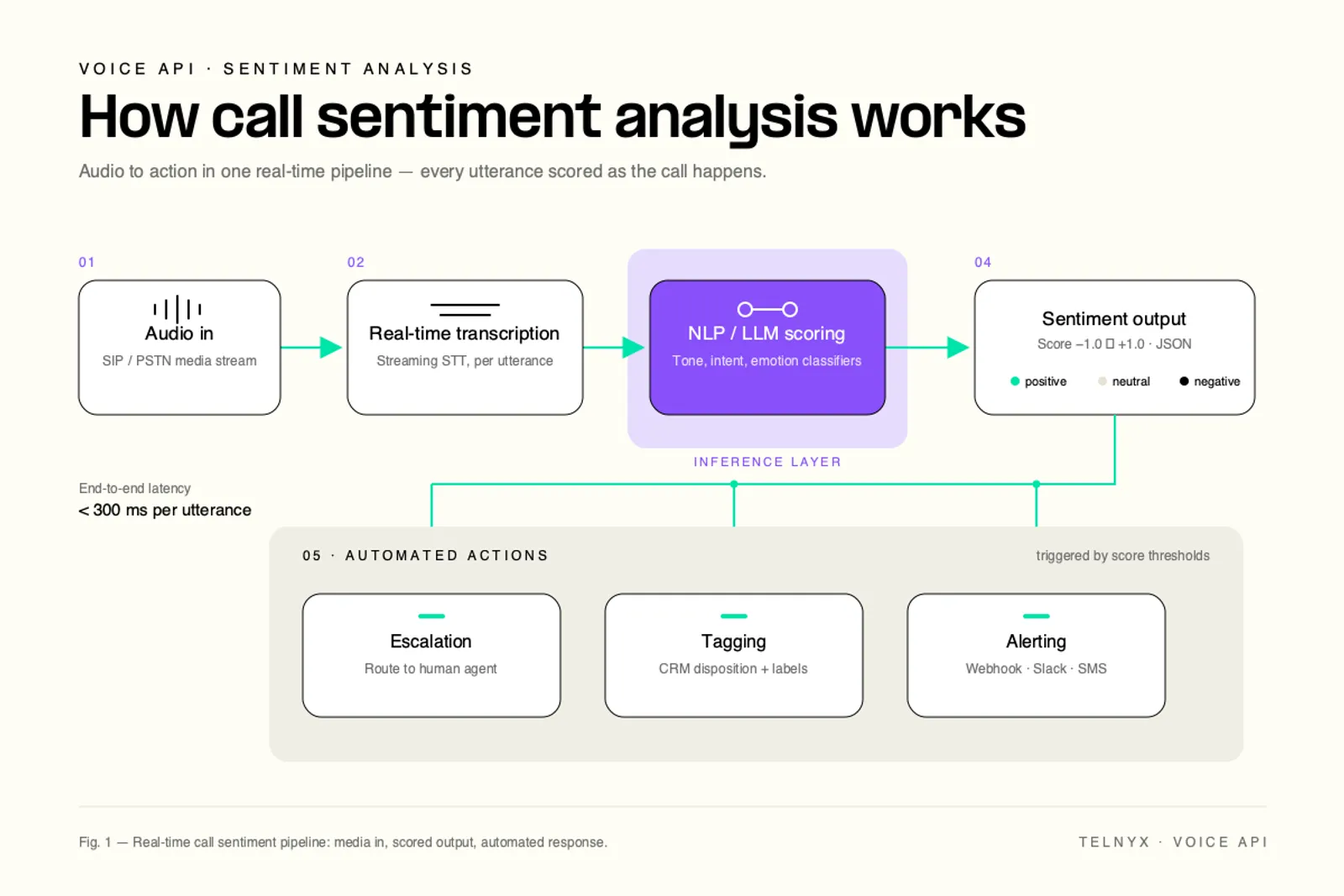
The concept is simple. The engineering is where implementations succeed or fail. Sentiment scores are only useful if they arrive fast enough and accurately enough to drive a decision, whether that decision is a supervisor stepping in mid-call or a QA team spotting a broken script across ten thousand recordings.
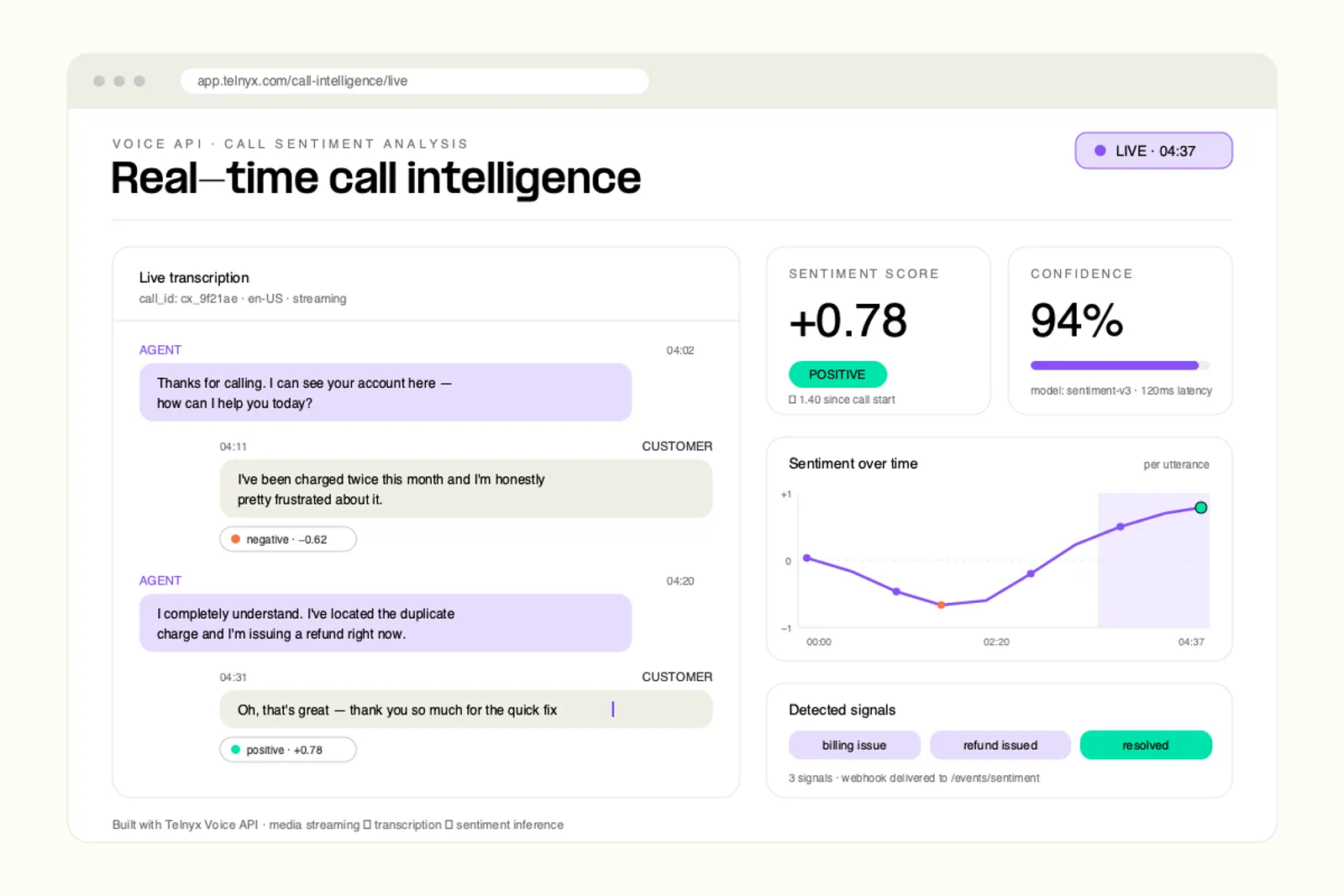
The sentiment analysis pipeline from audio to insight
Every call sentiment analysis system runs the same basic pipeline:
- Audio capture. The call originates on programmable phone numbers, available in 140+ countries with instant activation, and the media stream is forked to the analysis layer.
- Speech-to-text transcription. A Speech-to-Text API converts audio to text, typically with sub-250ms latency when the STT engine runs co-located with the telephony infrastructure.
- NLP or LLM sentiment scoring. A language model classifies each utterance as positive, negative, or neutral, and extracts emotion signals (anger, distress) and intent signals (cancellation, escalation request).
- Output and action. Scores are attached per utterance and rolled up per call, then routed to dashboards, CRM records, or automated triggers like alerts and escalations.
The per-utterance granularity matters more than the per-call rollup. A call that starts hostile and ends positive is a save worth studying. A call that starts neutral and ends hostile is a coaching moment. A single averaged score hides both.
Real-time vs. post-call sentiment analysis
Most established analytics suites process recordings after the call ends. Transcripts are batched, scored overnight, and surfaced in dashboards the next morning. That retrospective view is useful for trend analysis and QA, but it cannot rescue a single conversation. By the time a supervisor sees the red flag, the customer has already hung up and possibly churned.
Real-time sentiment analysis scores the transcript as the caller speaks. When negative sentiment spikes, the system can alert a supervisor, trigger a warm transfer, or adjust an AI agent's behavior mid-conversation. The deciding factor between these two modes is latency. A pipeline that takes three seconds to transcribe and score an utterance is post-call analytics wearing a real-time costume.
| Dimension | Post-call analytics | Real-time analysis |
|---|---|---|
| When insight arrives | Hours to a day after the call | During the call |
| Primary action | Reporting, QA, trend analysis | Escalation, intervention, live coaching |
| Latency requirement | Minutes are acceptable | Sub-second, end to end |
Every hop between vendors adds delay. When telephony, transcription, and inference run on separate providers connected over the public internet, the latency floor sits well above what live intervention requires. Real-time sentiment analysis is an infrastructure problem before it is an AI problem.
Act on sentiment during the call, not after itTelnyx Voice AI runs telephony, transcription, and inference on one co-located stack with sub-500ms typical response latency. Explore Voice AI and build sentiment-aware call flows on a single platform.
Try Voice AICustomer insight use cases for voice sentiment analysis
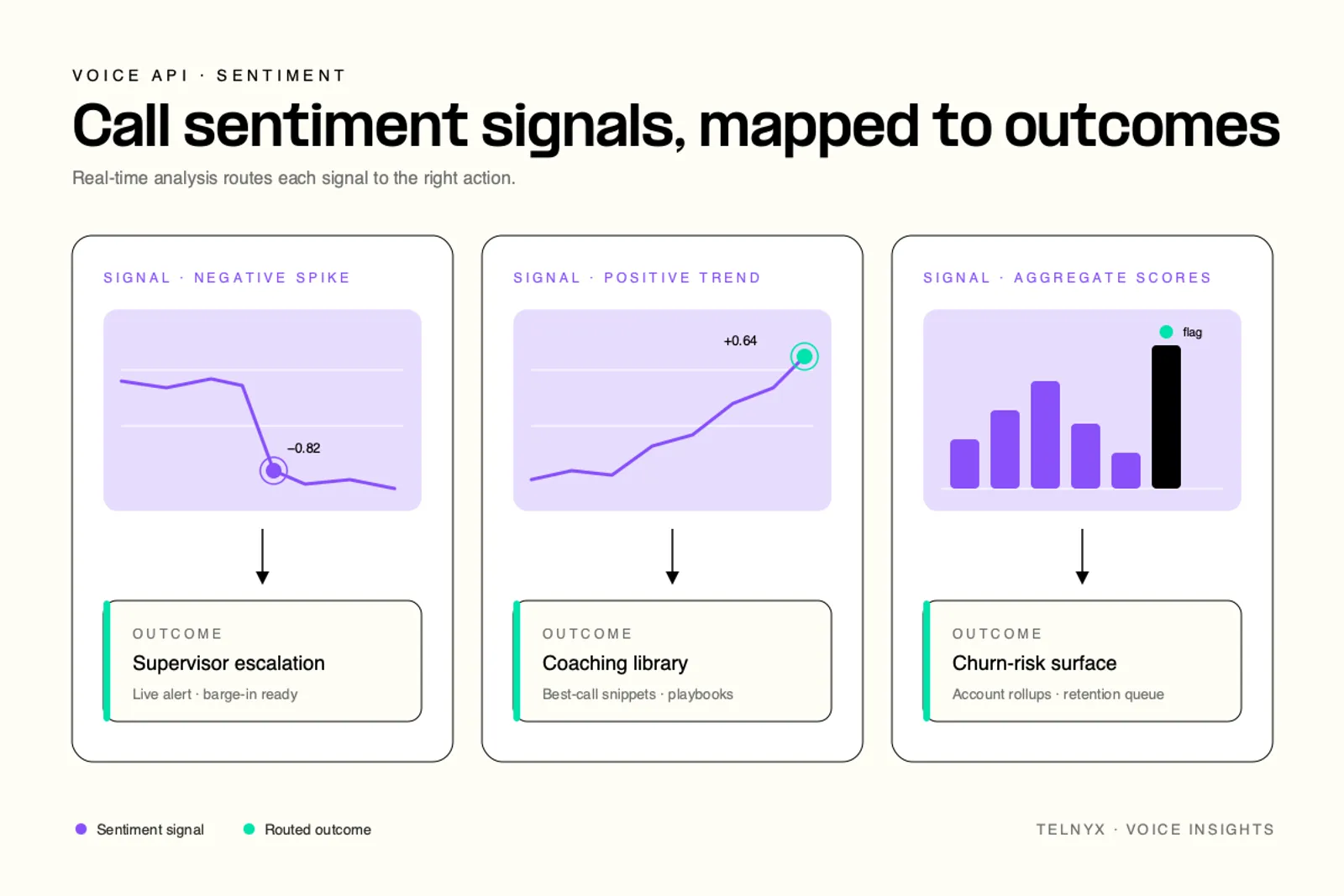
Voice AI sentiment analysis pays for itself when each signal maps to a specific action and a measurable outcome. The applications below are the ones that move CSAT, handle time, churn, and compliance risk.
Strengthening the customer experience
The clearest application is live escalation. When a caller's sentiment turns hostile, the system flags the call and routes it to a senior agent or supervisor before the situation escalates. According to PwC's 2025 Customer Experience Survey, 29% of consumers have stopped using or buying from a brand because of poor customer experience. Catching that experience while it is still recoverable is worth more than any report explaining it afterward.
Sentiment data also sharpens churn prediction. A customer whose last three calls trended negative is a churn risk regardless of what they said in a survey they probably ignored. Feeding per-call sentiment scores into a retention model gives success teams a ranked list of accounts to save this week. That's a live retention tool, not a postmortem next quarter.
Improving agent performance and coaching
Traditional QA samples 1-2% of calls, and reviewers score them by hand. Sentiment analysis scores 100% of calls automatically, so coaching is based on the full picture instead of a lucky or unlucky sample. Managers can see which agents consistently turn negative openings into positive closes and study what they do differently.
The metric that matters here is sentiment delta, not absolute sentiment. An agent who inherits angry billing calls will always score lower on raw sentiment than one who handles order confirmations. Measuring the change in sentiment from the first minute to the last isolates agent skill from queue difficulty, which makes the coaching conversation fair and the improvement measurable in handle time and repeat-call rate.
Operational insights and compliance monitoring
Aggregated across thousands of calls, sentiment data becomes root-cause analysis. If negative sentiment clusters around a specific product line, policy mention, or IVR path, the problem is upstream of the contact center, and the data proves it. That turns the support queue from a cost center into the fastest feedback loop the product team has.
For regulated industries, the stakes are higher than CSAT. Healthcare platforms, including behavioral health and EMR systems, need transcription and analysis that respects HIPAA obligations, which means controlling where audio is processed and where transcripts live. In those environments, sentiment analysis doubles as a safety layer. Detecting caller distress on a patient support line can trigger an immediate escalation to a clinician, and monitoring for required disclosures on every call replaces spot-check compliance audits with continuous coverage. For a working example, see this call intelligence dashboard with live transcription and sentiment scoring in Python.
Tools and providers for call sentiment analysis
The provider market splits into two camps. Contact-center analytics suites, such as CallMiner, Observe.AI, and NICE, deliver polished post-call dashboards, conversation intelligence, and QA workflows out of the box. They are strong choices for teams that want retrospective insight without writing code. API-first platforms take the other path, exposing transcription, inference, and call control as building blocks so teams can wire sentiment detection directly into live call flows. Gartner customer service research tracks steady growth in analytics adoption across service organizations, and the real decision most buyers face is which camp fits their latency and control requirements.
What to look for in a sentiment analysis provider
Concretely, evaluate:
- Transcription accuracy on your audio, including accents, crosstalk, and domain vocabulary, not on a clean benchmark set.
- End-to-end latency measured from spoken word to sentiment score on a live call.
- Real-time vs. batch support. Confirm the provider streams scores mid-call rather than processing recordings afterward.
- Language support for every market you serve.
- Integration surface, including webhooks, streaming APIs, and CRM connectors.
- Data residency and compliance, especially HIPAA eligibility and regional processing for regulated workloads.
- Stack ownership. Ask whether the provider runs its own network and inference infrastructure or chains third-party services together. Every vendor boundary adds latency, failure points, and a support queue you do not control.
Building real-time call sentiment analysis with an API
For teams that want sentiment logic tailored to their own escalation rules, the build path is shorter than most expect. The pattern is a webhook server that receives live transcription events, scores each utterance with an LLM, and acts when the score crosses a threshold. The example below monitors call transcripts in real time and auto-escalates to a supervisor when negative sentiment or distress is detected, with the alert delivered through the Telnyx SMS API, which handles 10DLC and toll-free compliance out of the box.
The full working example, including the webhook handlers that receive transcription events and place the supervisor call, is available in the Telnyx code examples repository. Because transcription and inference both run on the Telnyx network, the loop from spoken word to escalation completes fast enough to matter on a live call. There is no third-party STT hop, no separate LLM vendor, and no public-internet round trip between them.
The same architecture extends past escalation. The scored transcript can update the CRM in real time, feed a live coaching prompt to the agent's screen, or tag calls for the QA queue. Once sentiment is a stream instead of a report, every downstream system gets smarter.
Share on Social


