
Insights and Resources
Edge deployment architecture and how it works
Learn what edge deployment is, how it differs from cloud deployment, and how to run AI and applications at the edge for low-latency performance.

By Eli Mogul
Takeaways
- Edge deployment means running applications and AI models on infrastructure physically close to users and data sources instead of a centralized data center, cutting round-trip latency to milliseconds.
- Moving workloads to the edge reduces response times, egress costs, and bandwidth consumed by shipping raw data to a distant cloud region.
- Deployment targets span a spectrum, from IoT edge devices and on-prem servers to carrier-network PoPs with GPUs that can run real AI inference.
- For real-time workloads like voice AI, the network path consumes as much of the latency budget as inference does, so the network layer matters as much as compute.
- Production AI is the fastest-growing edge deployment use case, with teams often moving models from pilots to live traffic on 2-3 month timelines.
What is edge deployment?
Edge deployment is the practice of running applications, services, or AI models on infrastructure located physically close to end users and data sources rather than in a centralized data center. Instead of every request traveling to a single cloud region and back, the workload runs at a nearby point of presence, an on-premises server, or the device itself.
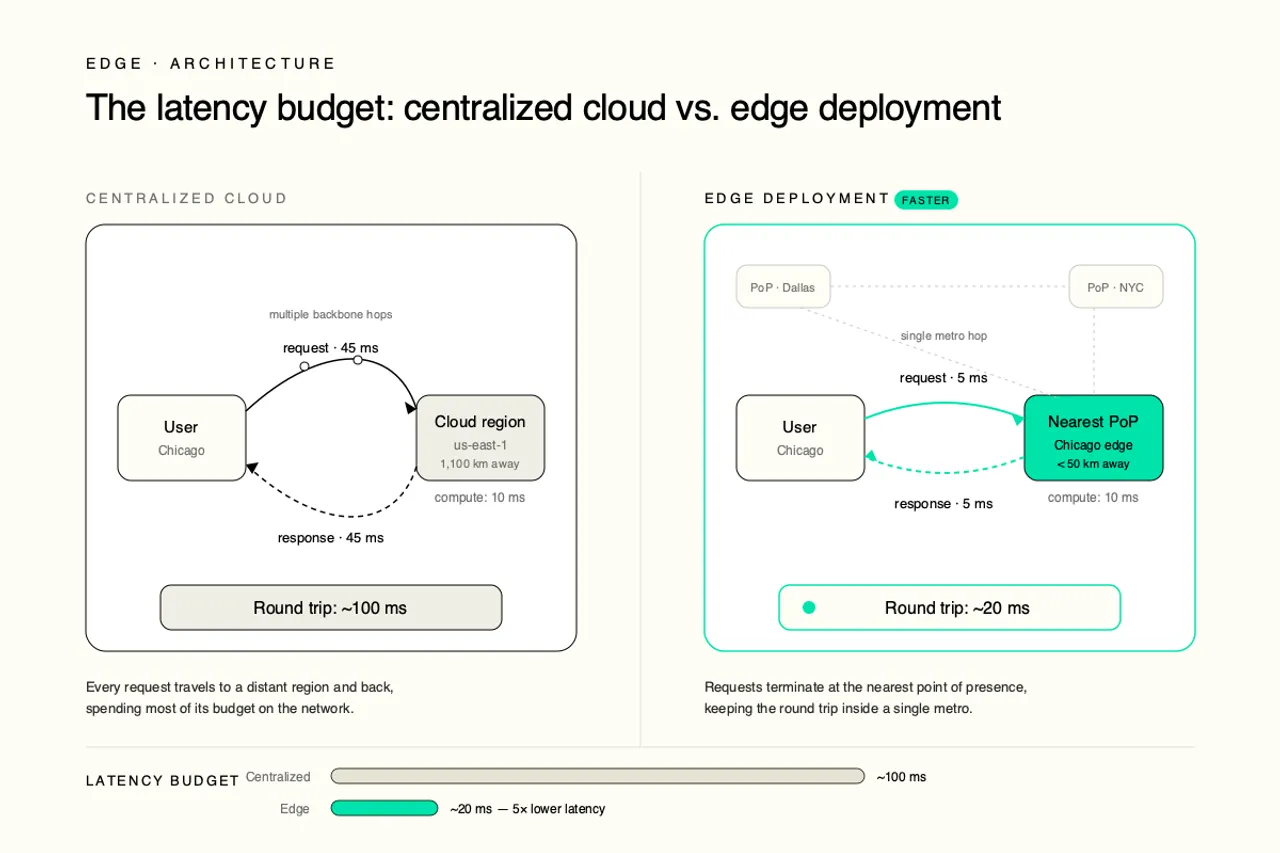
The reasons teams move workloads to the edge are concrete. A request that crosses an ocean to reach a cloud region spends real milliseconds in transit before any processing starts. Data that leaves a region triggers egress fees. And data that crosses a border can trigger residency and compliance obligations that a centralized architecture cannot satisfy.
Note: Edge deployment is a deployment model, not a single product. Teams typically choose between running workloads in their own VPC, in a public cloud region, or on a provider's managed edge platform. Evaluate providers on which of these models they actually support, because production requirements often demand more than one.
What is edge deployment in AI?
In AI, edge deployment means taking a trained model and running inference at edge locations or on edge devices, near the person or system generating the request. Training still happens in large centralized clusters. Inference moves outward. The payoff is threefold: lower response latency, data locality (audio, video, and sensor data get processed where they originate), and resilience, because a regional outage does not take down every location at once.
This has stopped being an experiment. AI workloads that started as internal pilots now answer live customer calls, monitor regulated conversations in real time, and run agent tools in production.
The edge AI use cases we see are moving away from MVPs or pilot implementations to actual real-world deployment in production settings." Abhishek Sharma, Senior Technical Marketing Manager @ Telnyx
Edge deployment vs. cloud deployment
Centralized cloud deployment still wins for training, batch processing, and workloads where a 300ms round trip does not matter. Edge deployment wins when latency, bandwidth, or data residency drive the architecture. The full tradeoff analysis is covered in our guide to edge computing vs cloud, but the short version fits in a table.
| Factor | Cloud deployment | Edge deployment |
|---|---|---|
| Latency | 100-300ms round trips across regions | Single-digit to low double-digit ms to nearest PoP |
| Data movement | Raw data ships to the region, egress fees apply | Data processed locally, only results move |
| Residency | Data crosses borders by default | Processing stays in-region |
| Best for | Training, batch jobs, storage | Inference, voice, real-time apps |
Run your workloads at the edgeDeploy functions to global edge PoPs with Telnyx Edge Compute and get sub-200ms RTT in many markets, co-located with telephony and AI inference.
Explore Edge ComputeEdge computing: the foundation of edge deployment
Edge deployment sits on top of edge computing, the distributed model where processing happens at points of presence near data sources instead of in a handful of hyperscale regions. Gartner's edge computing definition frames it as placing information processing close to where things and people produce or consume that information. The practical effect is that the distance between a user and the compute serving them shrinks from thousands of kilometers to tens.
The building blocks are PoPs distributed across metros, a routing layer that steers each request to the nearest healthy node, and a deployment system that pushes the same code or model to every location. A deeper breakdown of these layers is in our guide to edge computing architecture.
How edge computing works
When a request comes in, anycast routing or DNS-based steering directs it to the closest PoP. The function or model running there handles the request locally. If the workload needs data that lives elsewhere, the platform decides what to cache at the edge and what to fetch from origin.
The request path: User request → routed to nearest PoP → processed locally (function or inference) → response returns. The round trip never leaves the metro unless it has to.
The design principle borrowed from CDN-era platforms holds: functions should run near their data source. But compute proximity is only half the story. Most edge platforms rent their network path from someone else, which means the last mile and the carrier interconnect sit outside their control. For a static asset that is fine. For a live phone call it is not.
Why proximity to data matters
Every real-time application has a latency budget. A voice conversation starts to feel broken when responses take much longer than a second, and that budget gets consumed by two things: inference time and transit time. Teams building voice assistants tune their models relentlessly and then lose the budget on the wire. A request from Sydney to a US-East region and back can spend roughly 200ms in transit before a single token gets generated.
We often obsess over LLM inference speeds, but in Voice AI, the network is often the silent killer." Ian Reither, COO @ Telnyx
This is why edge computing solves the whole latency budget, not just the inference slice. When speech-to-text, the LLM, and text-to-speech run co-located with the telephony PoP that carries the call, transit time between stages collapses to near zero. It is the architecture behind Telnyx Voice AI, which delivers sub-500ms conversational responses because audio enters the network and never leaves it until the answer is ready.
Edge devices and deployment targets
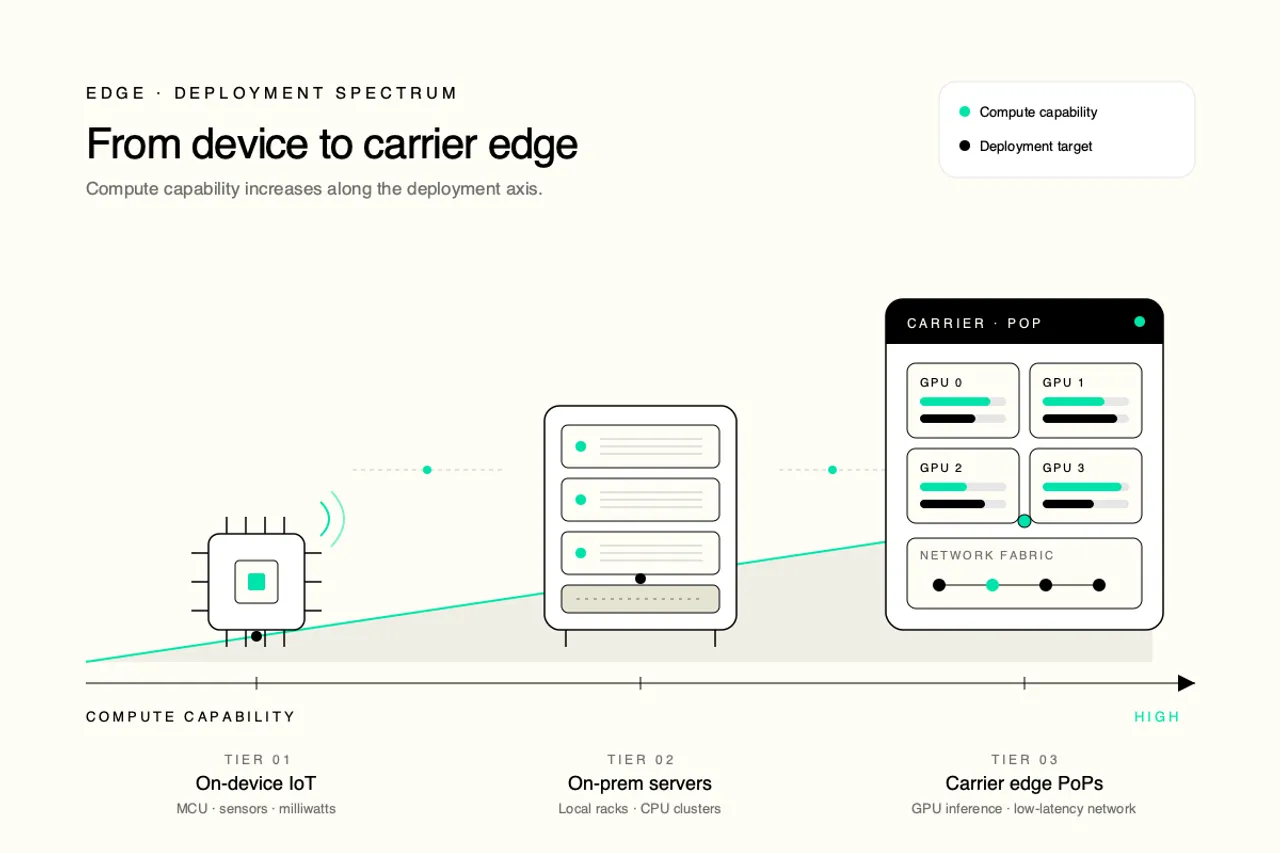
Edge deployment is not one target. It is a spectrum that runs from a sensor on a factory floor to a GPU rack inside a carrier PoP, and picking the wrong point on that spectrum is one of the most common ways AI projects stall between pilot and production. Real-world patterns across industries are covered in our edge computing examples.
Rule of thumb: The further left on the spectrum (on-device), the lower the network latency but the smaller the compute. The further right (managed edge PoPs), the more compute available while keeping latency in the tens of milliseconds.
Common types of edge devices
The main categories of edge devices and deployment targets:
- IoT sensors and embedded hardware. Microcontrollers and single-board computers running quantized models. Zero network latency for local decisions, but severely limited compute and painful fleet management.
- Gateways. Aggregation points that collect data from nearby sensors and run light preprocessing or filtering before anything hits the network.
- On-premises edge servers. Rack hardware in a store, hospital, or plant. Full control and strict data locality, but you own procurement, patching, and physical security.
- Telco and carrier edge PoPs. Compute deployed inside carrier networks, the model standardized by ETSI as multi-access edge computing. Low latency to end users plus data-center-class hardware, including GPUs.
- Managed edge platforms. Provider-run PoPs where you deploy code or models without touching hardware at all.
Choosing the right deployment target
Selection comes down to five criteria: latency requirements, compute needs (CPU-only versus GPU inference), data residency, management overhead you can absorb, and how many locations you need to scale across.
| Target | Best for | Tradeoff |
|---|---|---|
| On-device / IoT | Local decisions, offline operation | Tiny models only, hard fleet management |
| On-prem servers | Strict residency, single-site control | You run the infrastructure yourself |
| Carrier edge PoPs with GPUs | Real AI inference at low latency | Requires a provider that owns the network |
| Managed edge platforms | Fast deployment, no ops burden | Limited hardware control |
For AI workloads, carrier-network edge PoPs with GPUs are the sweet spot. A modern LLM or speech model will not fit on a sensor, and an on-prem GPU cluster takes months to procure. A carrier PoP puts serious compute a few milliseconds from the user, with the network path and the inference hardware under one roof.
How to deploy applications at the edge
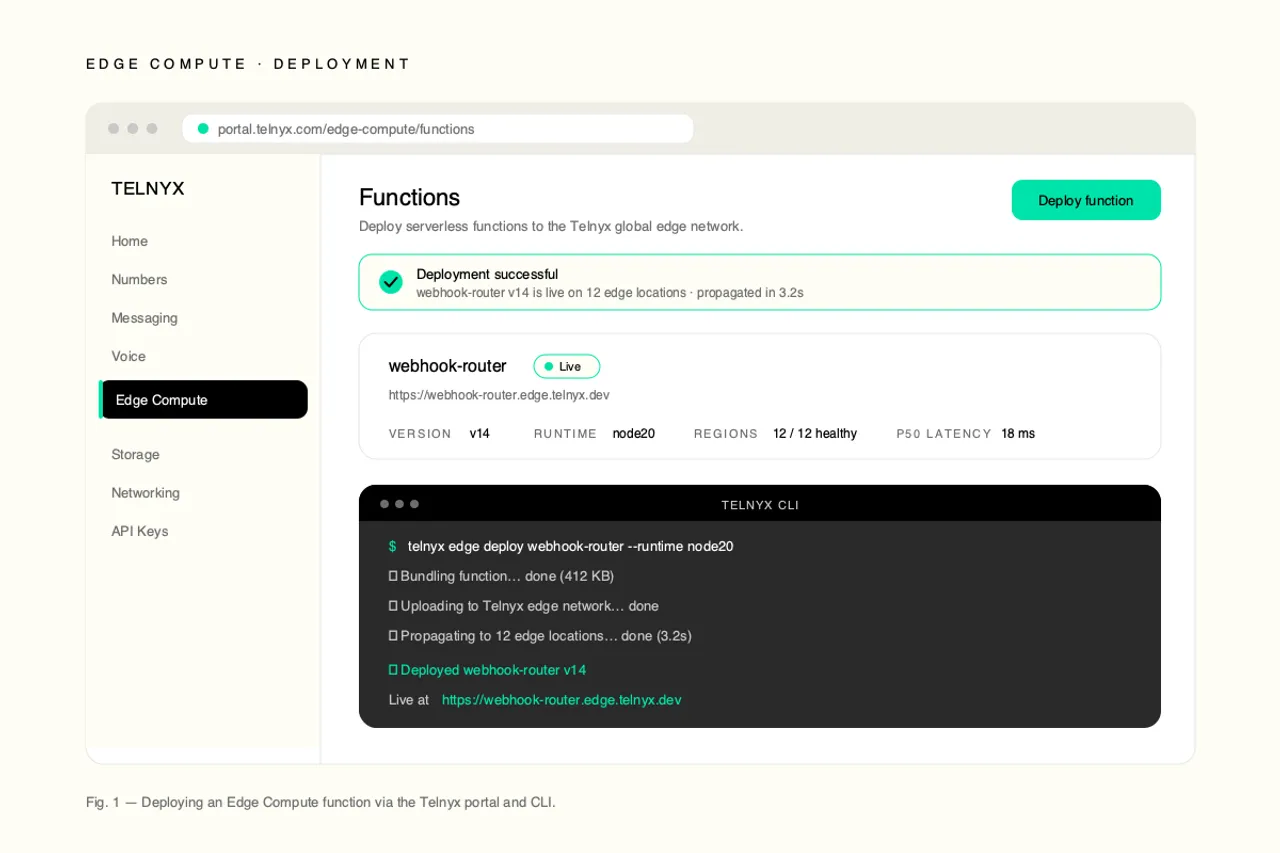
Deploying at the edge used to mean racking hardware or stitching a CDN function platform to a separate AI provider and a separate telephony vendor. With edge functions on a platform that owns the underlying network, the workflow shrinks to three steps: write a function, deploy it to global PoPs, and connect it to your voice and AI workloads. Teams that need a working call flow in production within two or three months cannot spend the first month on infrastructure procurement, and with this model they do not have to.
Telnyx is different. We started at Layer 0. Carrier licenses, private backbone, GPUs at the edge. That means less than 200ms RTT in global markets, deterministic call control, and compliance(-friendly architecture) baked in. No waiting in someone else's support queue." Ian Reither, COO @ Telnyx
That single-platform lifecycle looks like this:
Edge deployment lifecycle on one platform: Write function → deploy to global edge PoPs → request routes to nearest node → co-located AI inference runs → response returns. Sub-200ms RTT in many markets, versus stitching compute, network, and AI across separate providers.
Deploying an AI backend at the edge
A common first workload is the backend for a voice assistant. The AI Assistant needs somewhere to fetch dynamic variables at call start and somewhere to send webhook tool calls mid-conversation. Normally that means standing up and hosting a separate server. With Edge Compute, the function is the server:
The full working example, including webhook tool call handling, is in the Go backend repo. Deploy it once and it runs at every PoP, next to the telephony layer carrying the call.
Deploying an MCP server for AI agents
The same pattern works for agent tooling. An MCP server deployed to Edge Compute can expose Telnyx APIs as tools any AI agent can call: send a message, search available numbers, run inference.
The complete deployment walkthrough is in the MCP server repo. For a full production pattern that combines everything covered in this article, the AI receptionist example answers every inbound call using Telnyx Voice, AI Inference, and Edge Compute, matching callers against Merge HRIS records:
When processing caller data against employee or CRM records, ensure your implementation complies with applicable data privacy regulations (e.g., GDPR, CCPA) and that data subjects have been informed. The full receptionist implementation is in the AI receptionist repo. Every piece of it, call control, inference, and the edge function, runs on one platform with one API and one bill.
FAQ
Ship your edge deployment in minutes, not monthsWrite a function, deploy it to global edge PoPs, and connect it to voice and AI workloads on one platform. Telnyx Edge Compute runs co-located with telephony and GPUs for sub-200ms RTT in many markets.
Start building todayShare on Social