
Inference
GLM 5.3 Flash benchmark: Telnyx vs Modal
The same GLM 5.3 Flash model can behave differently across APIs. Compare Telnyx and Modal Shared on latency, output speed, and token pricing.

Takeaways
On GLM 5.3 Flash, Telnyx finished responses faster and cost less, while Modal Shared started visible answers more consistently.
- Telnyx had lower median completed-response latency in all eight workload and concurrency cells.
- Telnyx had higher median generation speed in all eight cells, about 2.1 times Modal Shared.
- Telnyx cost 70% less at published token rates.
- Modal Shared had lower p95 time to first visible answer in seven of eight cells.
Choosing an inference API is a serving decision as well as a model decision. Even when two providers expose the same open-weight model through compatible APIs, their queueing, prefill, decoding, networking, and pricing can produce a different experience for users and agents.
We compared the exact model ID zai-org/GLM-5.3-Flash on Telnyx Inference and Modal Shared. Both are managed, pay-per-token services, so this is a like-for-like comparison for developers who want hosted inference without operating GPUs. The model ID, fresh prompts, reasoning effort, output limits, streaming method, and request schedule were held constant.
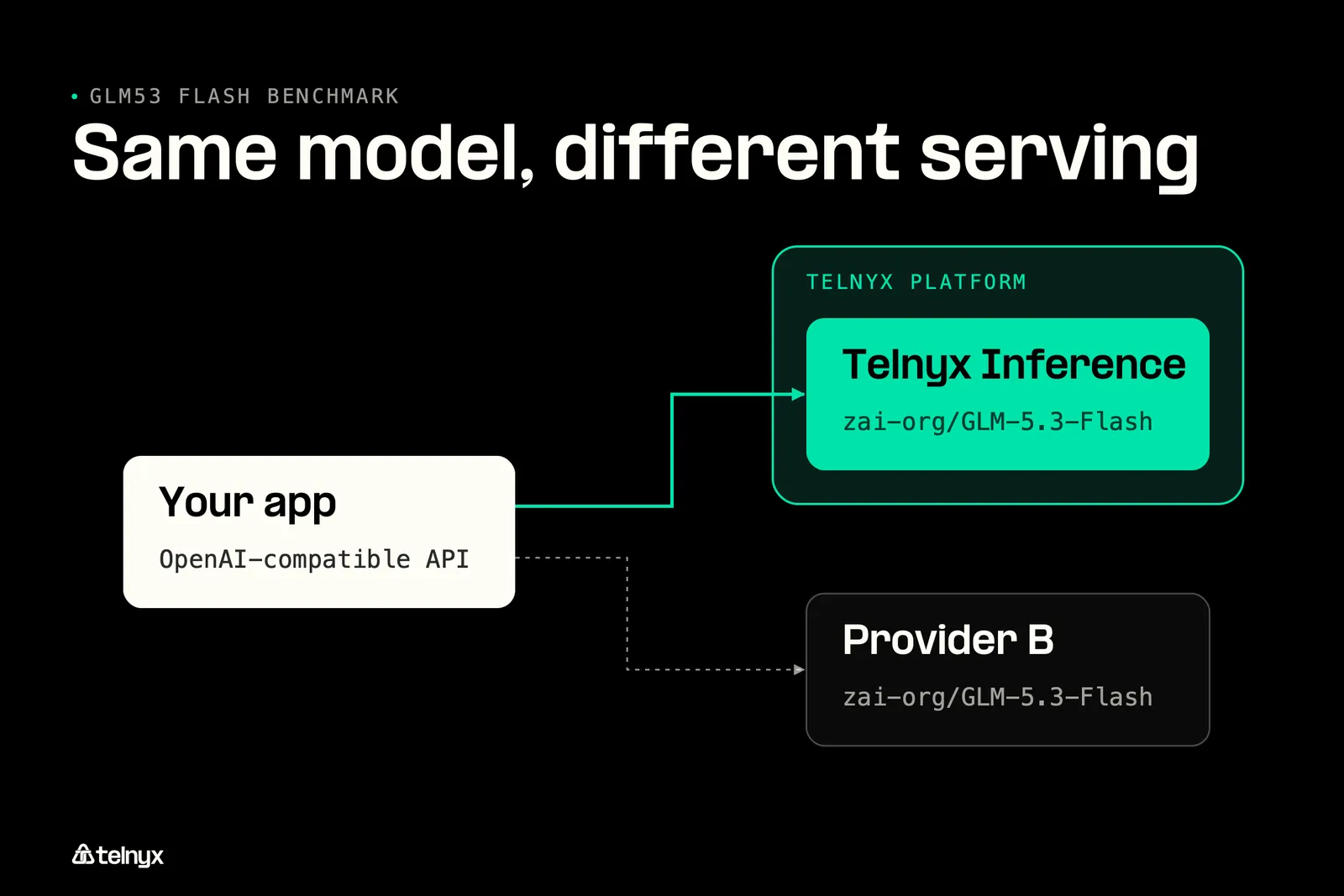
This analysis adds a narrower concurrency study to our earlier Flash provider benchmark. It isolates Telnyx and Modal Shared across four workload shapes at concurrency 1 and 10, with 480 measured requests in the primary comparison.
GLM 5.3 Flash results in brief
Telnyx led on completed responses, while Modal Shared led on tail time to first visible answer. Applications that need a finished answer care about end-to-end latency and generation rate. Interactive interfaces also care about how consistently visible text starts appearing.
| Provider | Successful requests | p50 E2E latency |
|---|---|---|
| Telnyx Inference | 240/240 | 4.92s |
| Modal Shared | 240/240 | 8.75s |
| Provider | p95 E2E latency | p50 output speed |
|---|---|---|
| Telnyx Inference | 11.91s | 138.1 tok/s |
| Modal Shared | 20.62s | 66.2 tok/s |
| Provider | p50 first activity | p50 visible answer |
|---|---|---|
| Telnyx Inference | 0.98s | 1.03s |
| Modal Shared | 1.12s | 1.32s |
These pooled values summarize all fresh-prompt requests. The charts below preserve the individual workload and concurrency cells because a pooled number can hide differences between short, long-context, and generation-heavy requests.
Run GLM 5.3 Flash on Telnyx Inference
Call the same open-weight model through an OpenAI-compatible API, with faster completed responses and lower token prices in this benchmark.
GLM 5.3 Flash completed faster on Telnyx
End-to-end latency measures the complete request, from sending the prompt until the streamed response finishes. It is the metric an agent feels when it cannot take its next action until the answer is complete.
Telnyx recorded lower p50 end-to-end latency in all eight cells and lower p95 end-to-end latency in six of eight. Across the pooled requests, Telnyx's p50 E2E was 4.92 seconds, compared with 8.75 seconds on Modal Shared. Its pooled p95 was 11.91 seconds, compared with 20.62 seconds.
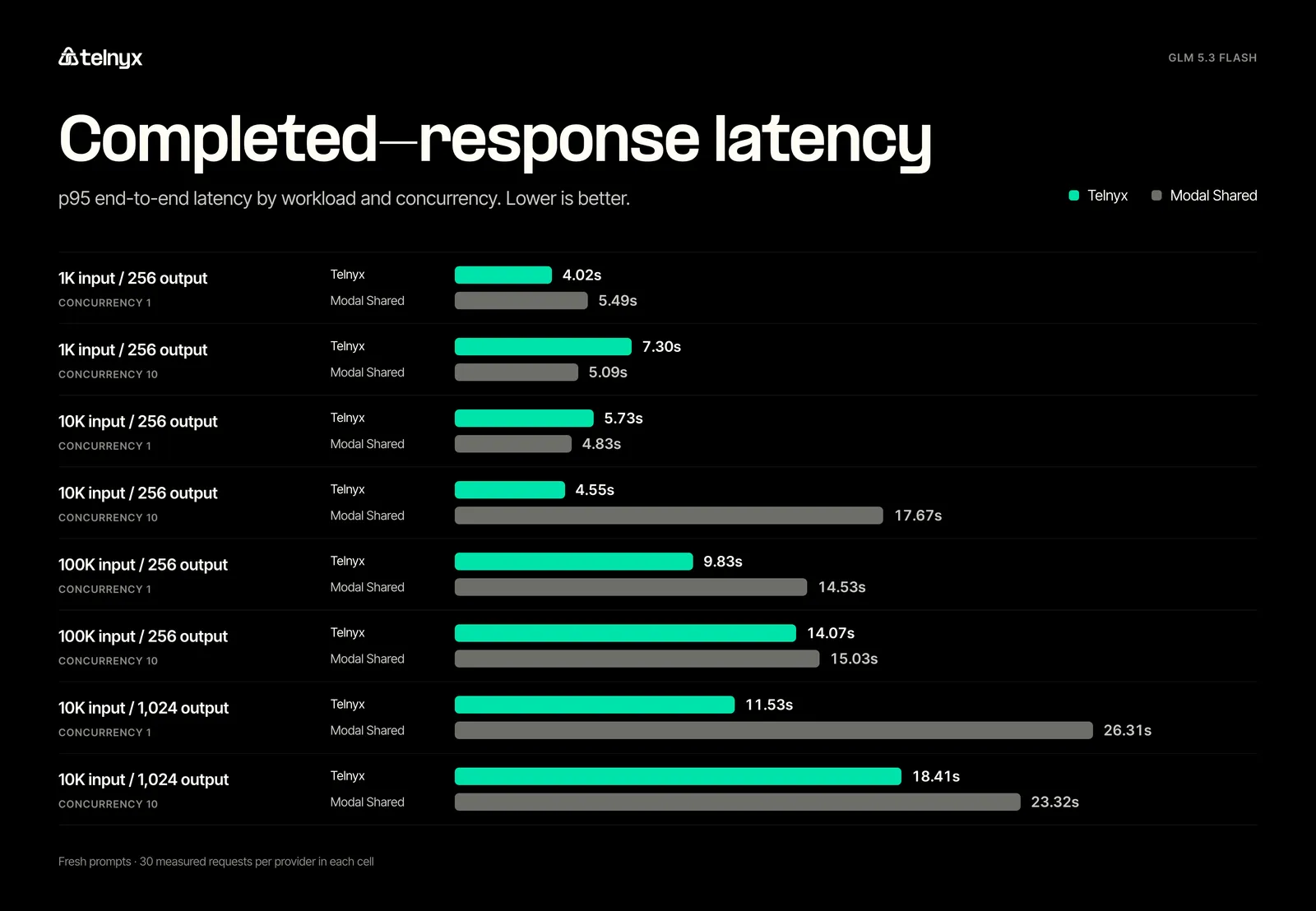
The two p95 exceptions were the 10K-input workload at concurrency 1 and the 1K-input workload at concurrency 10. The result is strong, but it is not a claim that Telnyx led every tail-latency cell.
Generation speed favored Telnyx in every cell
Once visible answer text begins, output speed helps determine how long a user or downstream agent waits for the rest. Telnyx had higher p50 output throughput in all eight test cells.
Across the pooled requests, Telnyx generated 138.1 output tokens per second, compared with 66.2 tokens per second on Modal Shared. That is about 2.1 times the median output rate. The corresponding median time per output token was 7.24 milliseconds on Telnyx and 15.10 milliseconds on Modal Shared.
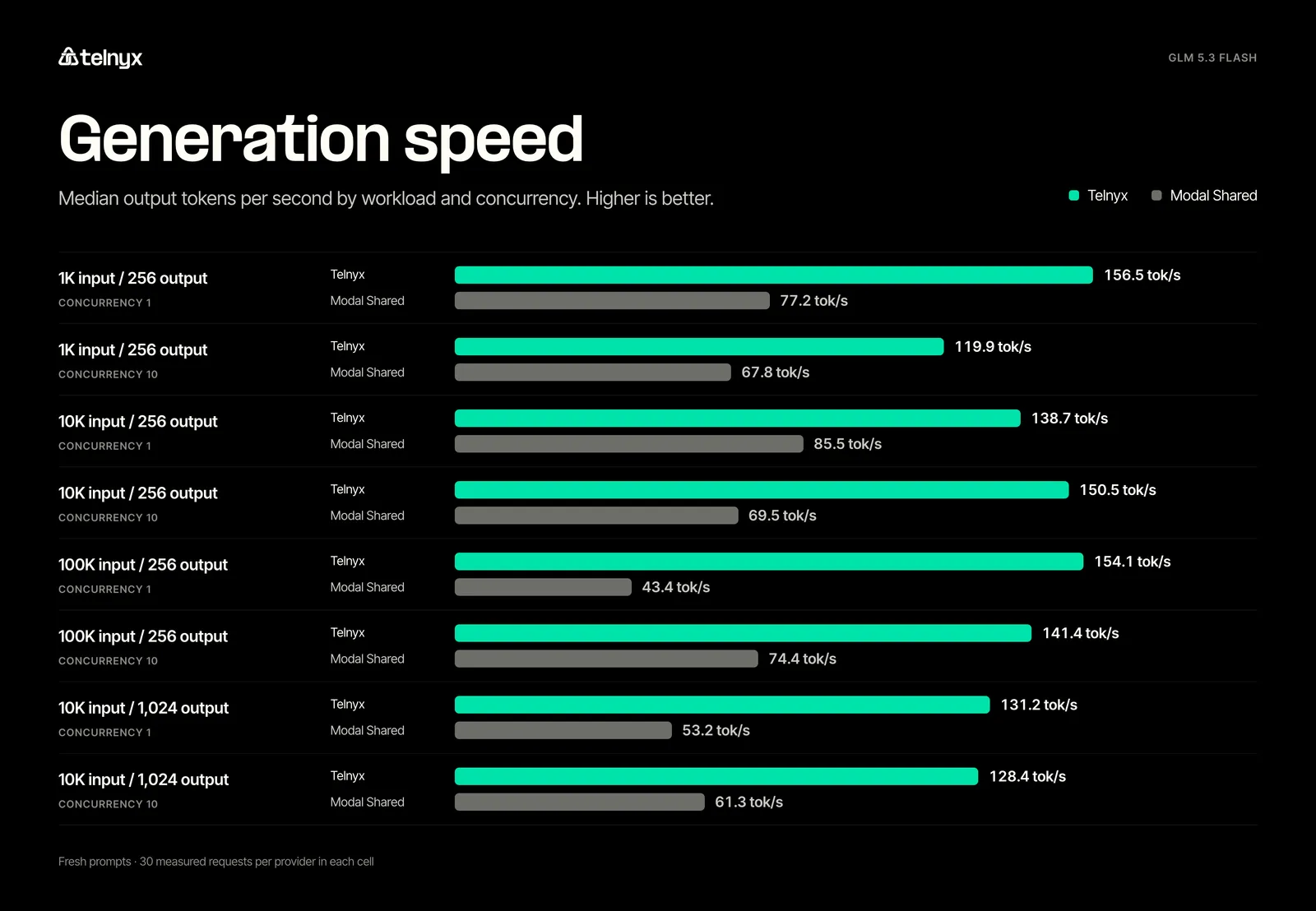
The difference appeared in short, long-context, and generation-heavy profiles, rather than depending on one workload shape.
Modal started visible answers more consistently
Reasoning models can emit internal reasoning before they emit answer text. We therefore measured two different starting points:
- First activity: when the model emitted its first non-empty streamed output, including reasoning.
- First visible answer: when answer text that an application could display first appeared.
Telnyx had lower p50 time to visible answer in five of eight cells. Modal Shared had lower p95 time to visible answer in seven of eight cells. In plain terms, Telnyx usually finished the complete answer sooner, while Modal more often had the better tail result for starting visible text.
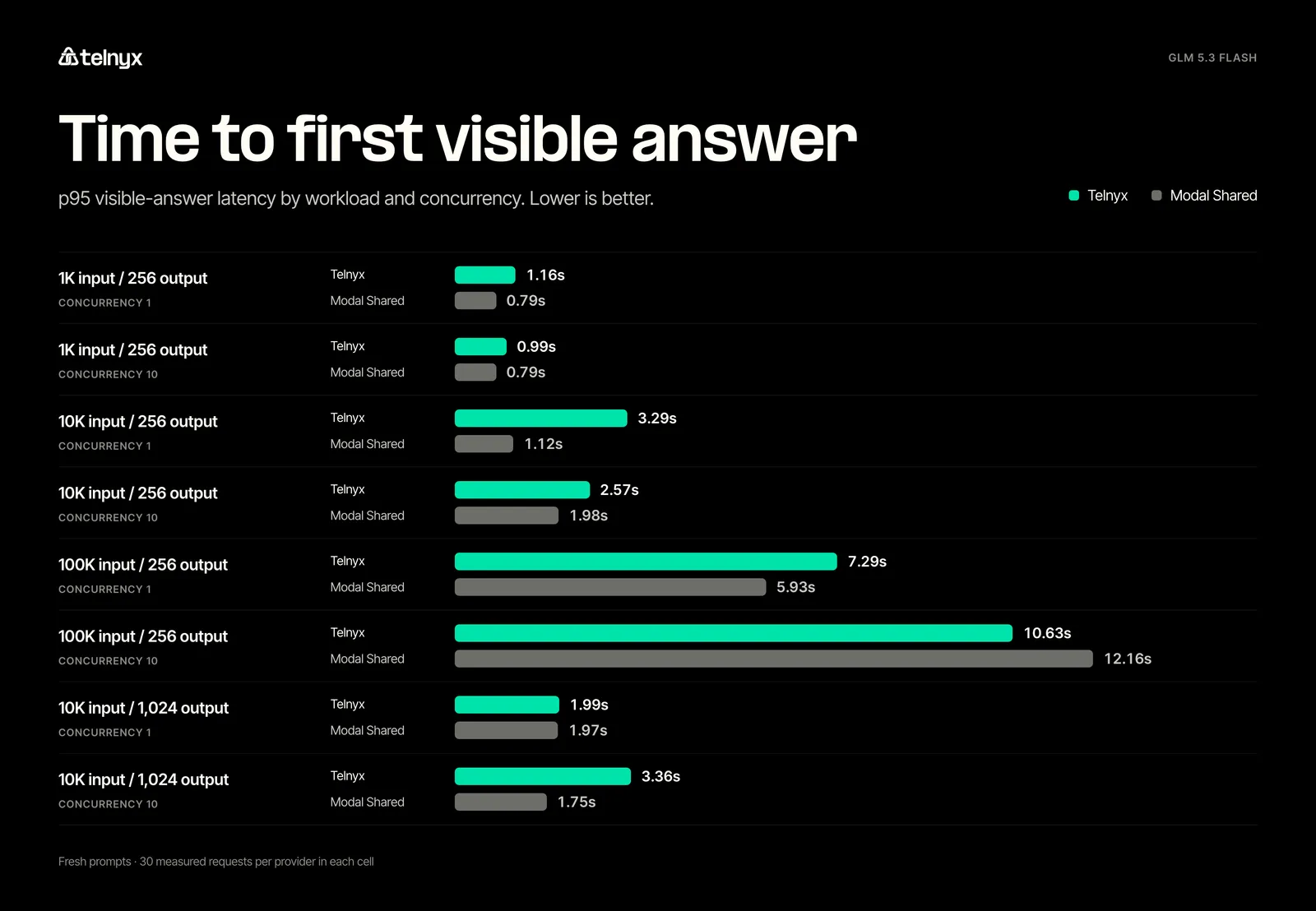
This is why first-answer and completed-response latency should remain separate. Combining them into one score would hide a real tradeoff.
GLM 5.3 Flash pricing favored Telnyx
Published pay-as-you-go rates showed the same ratio for uncached input, cached input, and output tokens.
| Provider | Input / 1M | Output / 1M |
|---|---|---|
| Telnyx | $0.135 | $0.450 |
| Modal Shared | $0.450 | $1.500 |
| Provider | Cached input / 1M |
|---|---|
| Telnyx | $0.027 |
| Modal Shared | $0.090 |
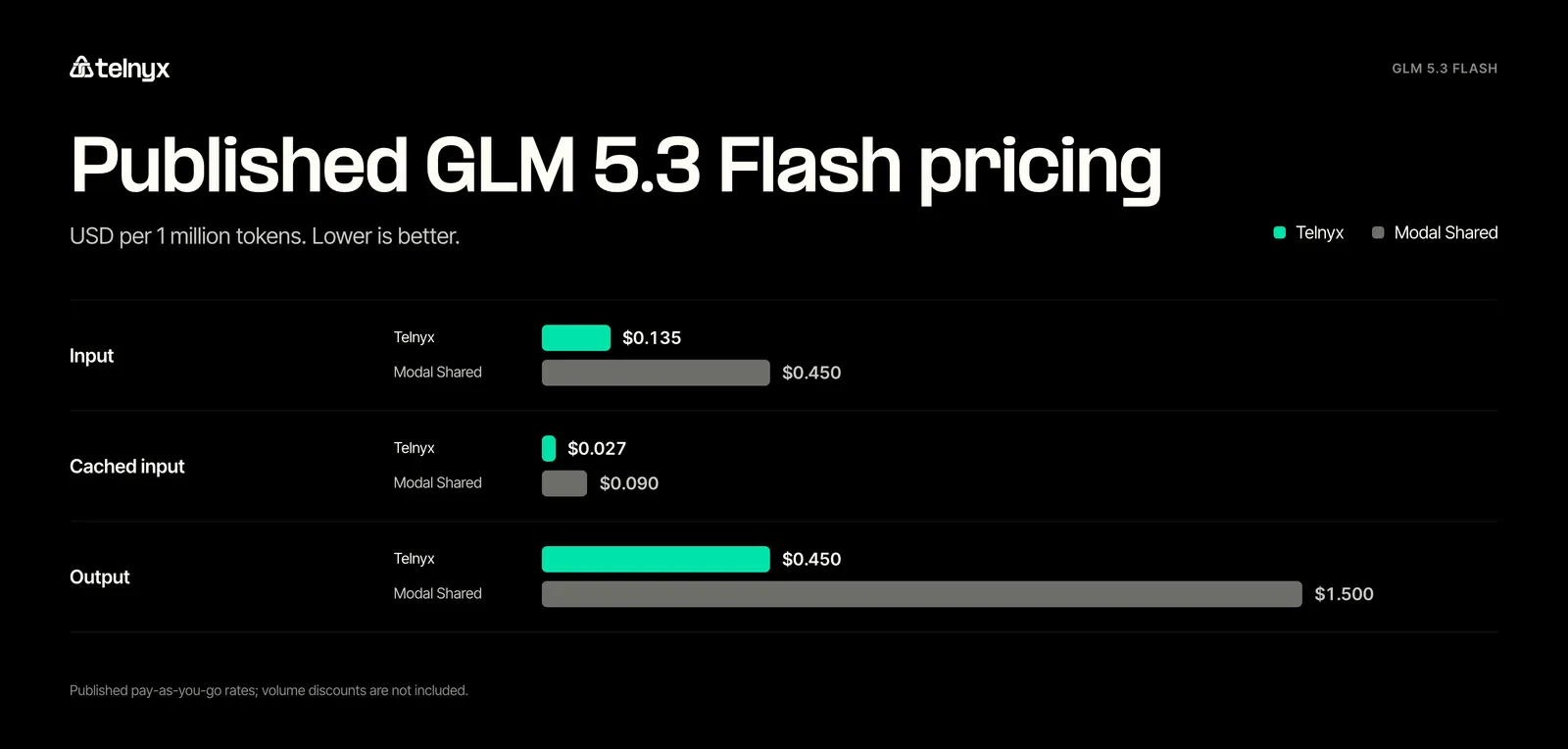
Applying those published rates to the tokens reported by the benchmark produced an estimated workload cost of $2.20 on Telnyx and $7.34 on Modal Shared, or 70% less on Telnyx. These are token-based estimates, not reconciled invoices, and they exclude volume discounts.
How we benchmarked GLM 5.3 Flash
We used zai-org/GLM-5.3-Flash with reasoning_effort: low on both providers. Requests streamed through OpenAI-compatible chat-completions APIs from the same benchmark environment.
| Workload | Approximate input | Maximum output |
|---|---|---|
| Short interactive | ~1K tokens | 256 tokens |
| Medium context | ~10K tokens | 256 tokens |
| Long context | ~100K tokens | 256 tokens |
| Generation-heavy | ~10K tokens | 1,024 tokens |
For every provider and workload, we used fresh prompt variants, identical settings, concurrency 1 and 10, and three excluded warm-up requests. We then collected 30 measured requests in every workload and concurrency cell. The primary comparison contains 240 measured requests per provider, and both providers completed all 240 with visible answer content.
Failures remain part of the raw benchmark data and would be excluded only from latency percentiles. In this primary comparison, there were no failed or no-answer requests to exclude.
What this benchmark does not claim
- It measures GLM 5.3 Flash under these workloads and settings, not every model or application.
- It compares Modal Shared, not Modal Dedicated or a custom Modal deployment.
- It does not test concurrency 50 or 100. The tested Modal Shared endpoint had a concurrency limit of 16. Modal documents that excess requests return HTTP 429. Testing above that limit would measure access policy, not serving performance.
- It makes no prompt-cache performance claim. Neither API reported cached-token evidence during the shared-prefix condition.
- Observed latency includes the network path from the common benchmark environment to each provider.
- Each chart cell contains 30 requests. Its p95 is an interpolated percentile from those observations, not an SLA.
- Matching model IDs do not prove identical provider-side precision, batching, or serving configuration.
What developers should take away
The same advertised model ID did not produce interchangeable application behavior. In this comparison, Telnyx was strongest on completed-response latency, output generation speed, and published token pricing. Modal Shared was strongest on p95 first-visible-answer latency in most cells.
For coding agents, document pipelines, and other workflows that wait for a full result, Telnyx's E2E and output-rate results are the more relevant signals. For chat interfaces that optimize for the first visible words, the TTFA distribution deserves equal attention. Developers building contact center agents should measure both because each turn must start promptly and finish before the next action.
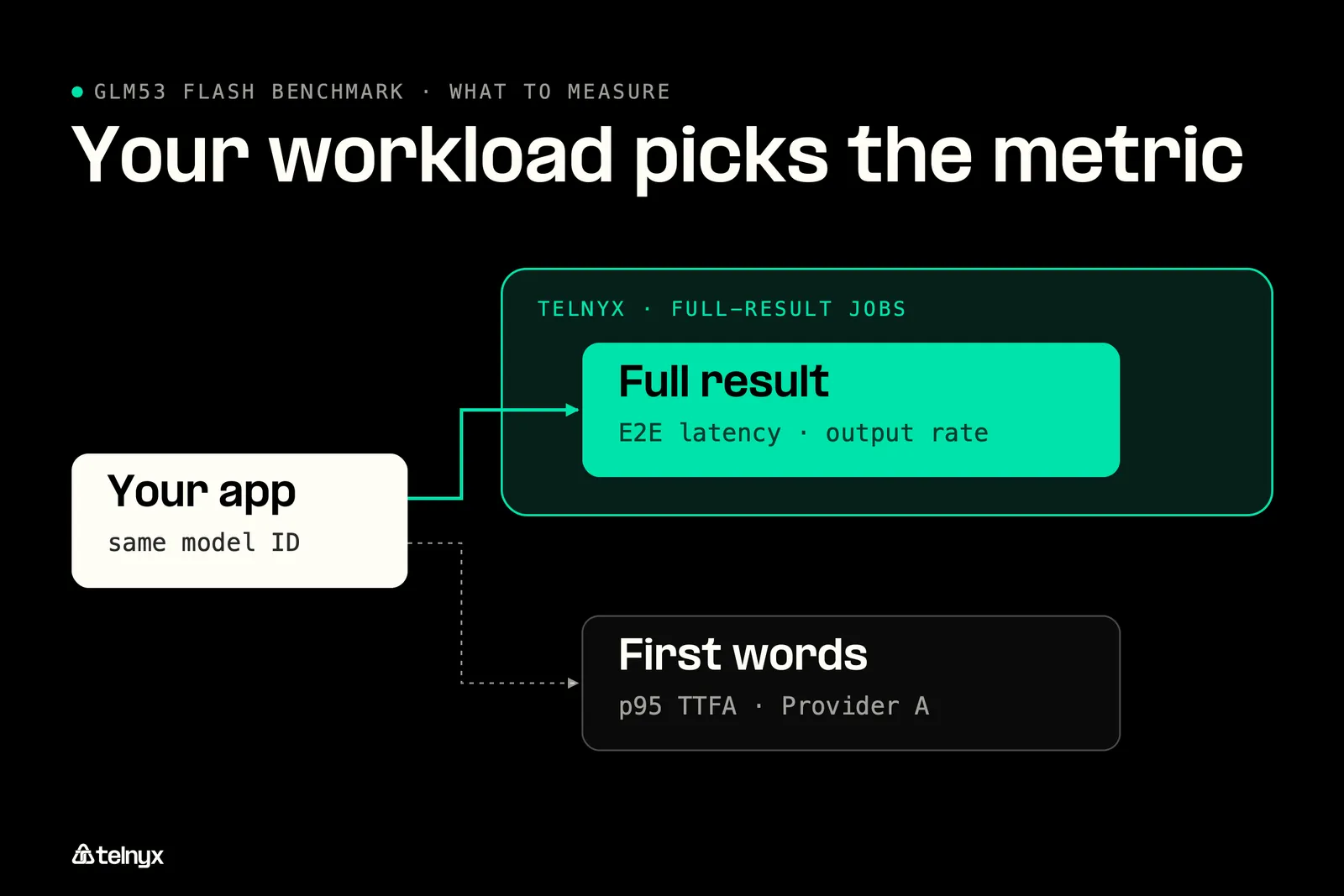
The useful test is your own. Run representative prompts through Telnyx Inference, preserve failures, and track first activity, first visible answer, completed response, and output speed separately. Teams that need scoped access and spend controls can add AI Gateway without changing the underlying model call.
Benchmark GLM 5.3 Flash with your own prompts
Run representative prompts through Telnyx Inference and track first activity, first visible answer, completed response, and output speed separately.
Start testingRelated Telnyx resources
- Flash provider benchmark
- GLM 5.3 benchmark
- Multi-turn model benchmark
- Inference infrastructure guide
- Latency metrics guide
Sources
- Telnyx model catalog
- Telnyx pricing
- Modal model page
- Modal endpoint limits
Share on Social
Sonam is a San Francisco-based developer advocate, originally from India. She has completed 2 Master's Degrees and her PhD in Data Science from the Harrisburg University of Science & Technology. Previously, Sonam worked for the startups Ozmosi and aiXplain. In her free time, you


