
Conversational AI
Open weight models: what they are and how to use them
The industry now favors "open weight" over "open source" because most models marketed as open source release only weights...

By Eli Mogul
Last updated: July 20, 2026. Model specs and licenses change often, so we refresh this guide and its model table on a regular cadence.
Takeaways
- Open weight models are AI models whose trained parameters (weights) are published for anyone to download, run, and fine-tune, even when the training data and code stay private.
- The term "open weight" is replacing "open source" because most models marketed as open source release only weights, not the datasets, training code, or evaluation methods that true open source requires.
- Licenses vary widely. Apache 2.0 (Mistral, Qwen) allows unrestricted commercial use, while the Llama Community License adds a 700 million user cap and Modified MIT licenses add attribution clauses.
- Most frontier open weight models now use a Mixture-of-Experts (MoE) design, activating a fraction of their parameters per request. MiniMax M3 activates 23 billion of its 428 billion, which lowers the hardware cost of running them.
- You can run open weight models three ways: self-hosted on your own GPUs, rented on cloud GPUs, or through a managed API. Telnyx runs them on owned, carrier-grade infrastructure through one OpenAI-compatible endpoint.
What are open weight models
Open weight models are AI models whose trained weights, the numerical parameters a model learns during training, are publicly available for download and use. Anyone can run these models on their own hardware, fine-tune them on new data, and deploy them in production. What open weight models do not always include is the training data, the training code, or the evaluation metrics behind the model. You get the finished parameters, not the full recipe.
That distinction creates three categories. Proprietary models like GPT-4 and Claude publish nothing. You reach them only through an API. Truly open source models publish everything: weights, training code, and datasets. Open weight models sit in the middle. They hand you the weights and a license, and little else.
The industry now favors "open weight" over "open source" because most models marketed as open source release only weights, not the full reproducible stack of data and training code. The Open Source Initiative draws the same line, and independent analysis of releases like OpenAI's gpt-oss has pushed the field toward more precise language. Licensing terms matter here too. A permissive license like Apache 2.0 governs how you can use the weights, but it does not force a vendor to publish training data. When you evaluate a model, read the license first and the marketing second.
Open weight vs open source vs proprietary models
The three categories differ in what they publish, what you can audit, and how you can use the result commercially. The table below breaks down the practical differences.
| Attribute | Open weight | Open source | Proprietary |
|---|---|---|---|
| Weights published | Yes | Yes | No |
| Training data and code | Rarely | Yes | No |
| You can self-host and fine-tune | Yes | Yes | No |
| Auditability | Partial | Full | None |
| Example models | Llama, DeepSeek, Qwen | BLOOM, OLMo | GPT-4, Claude |
Licensing is where open weight models get complicated. The most permissive option is Apache 2.0, which allows commercial use, modification, and redistribution with no user cap. Mistral and Qwen ship under it. A middle tier adds conditions. The Llama Community License permits commercial use but revokes the free grant for any company serving more than 700 million monthly active users, who must then negotiate a separate license with Meta. Modified MIT licenses, used by models like Kimi K2, stay permissive but require you to display the model name in your product's interface once you pass 100 million monthly active users or 20 million dollars in monthly revenue.
Run open weight models without managing GPUs. The Telnyx AI Inference API hosts open weight models on infrastructure Telnyx owns and operates. It is OpenAI-compatible, so you switch models by changing one parameter, and there is no setup fee and no monthly minimum.
Best open weight models available now
A capable open weight model drops almost every week, and benchmarks are inconsistent across releases. The list below focuses on models with published weights, clear licenses, and a defined strength. The specifications (parameter counts, active parameters for MoE models, context windows, and licenses) come from official model cards and reflect each card at the time of writing, so verify current details before you deploy. Benchmark numbers change often, so treat any single score as a snapshot, not a verdict.
| Model | Parameters (total / active) | Context | License | Best for |
|---|---|---|---|---|
| DeepSeek V4 | 1.6T / 49B (Pro), 284B / 13B (Flash) | 1M | MIT | Math, STEM, and coding |
| GLM-5.2 | 744B / 40B (MoE) | 1M | MIT | Long-context agents and coding |
| Kimi K2.6 | 1T / 32B (MoE) | 256K | Modified MIT | Agentic coding and agent swarms |
| Qwen3.5 | MoE, 3B active (35B-A3B) and larger | 256K | Apache 2.0 | Multilingual, vision, and reasoning |
| MiniMax M3 | 428B / 23B (MoE) | 1M | MiniMax Community | Multimodal agentic coding |
| GPT-OSS (120B and 20B) | 117B / 5.1B and 21B / 3.6B (MoE) | 128K | Apache 2.0 | Reasoning on modest hardware |
| Llama 4 (Scout, Maverick) | 109B / 17B and 400B / 17B (MoE) | 10M (Scout), 1M (Maverick) | Llama 4 Community | General multimodal with wide tooling |
| Mistral Small 4 | 119B / 6B (MoE) | 128K | Apache 2.0 | Lightweight unified small model |
| Gemma 4 (up to 31B) | Up to 31B dense | 128K | Apache 2.0 | On-device multimodal workflows |
DeepSeek V4
DeepSeek V4 shipped April 24, 2026 under the permissive MIT license in two variants: V4-Pro at 1.6 trillion total parameters with 49 billion active, and the lighter V4-Flash at 284 billion total with 13 billion active. Both default to a 1M-token context. V4 posts one of the highest open weight scores on SWE-bench Verified and leads open models on math and STEM work. See the DeepSeek V4 release notes for the full breakdown. Who should use it: teams that want frontier reasoning and coding without per-token API pricing.
GLM-5.2
Zhipu AI's GLM-5.2, released June 16, 2026 under an MIT license, runs 744 billion total parameters with roughly 40 billion active and a 1M-token context window. It ranks as the leading open weight model on the Artificial Analysis Intelligence Index, and its shared-indexer design keeps that long context practical to run. Who should use it: teams building long-running agents that need to hold large codebases or documents in context.
Kimi K2.6
Moonshot AI's Kimi K2.6 is a one trillion parameter MoE model that activates 32 billion parameters per token, published under a Modified MIT license with a 256K context window. It is tuned for agentic coding and agent swarms, coordinating hundreds of sub-agents across thousands of steps, with weights on the Kimi K2.6 model card. Who should use it: teams building agents that reason across long tool-call chains rather than single prompts.
Qwen3.5
Alibaba's Qwen3.5, released February 2026 under Apache 2.0, unifies the Qwen vision-language line into one model family, with MoE variants like the 35B-A3B that activate only 3 billion parameters. It supports more than 200 languages and matches or beats the earlier Qwen3-VL models on reasoning, coding, and visual understanding, as detailed in the Qwen vision-language technical report. Who should use it: teams that need multilingual, vision, or OCR work with a fully permissive license.
MiniMax M3
MiniMax M3, released June 1, 2026, is a natively multimodal MoE model with roughly 428 billion total parameters and only 23 billion active per token, accepting text, images, and video with a 1M-token context. It targets agentic coding and tool use, and its weights ship under the MiniMax Community License, which requires attribution for commercial use and prior authorization for larger deployments, as The Decoder reported. Who should use it: teams that want multimodal agentic coding at a low active-parameter cost, with the license terms in mind.
GPT-OSS (120B and 20B)
GPT-OSS is OpenAI's first open weight release, published August 5, 2025 under Apache 2.0, as OpenAI announced. The 120B model activates 5.1 billion parameters and runs on a single 80GB GPU, while the 20B model activates 3.6 billion and fits on edge devices with 16GB of memory. Both support 128K context and ship natively quantized. Who should use it: teams that want OpenAI-quality reasoning they can run on their own hardware.
Llama 4 (Scout and Maverick)
Meta's Llama 4 is its first MoE and natively multimodal generation. Scout runs 109 billion total parameters with 17 billion active and a record 10M-token context, small enough for a single H100, while Maverick reaches 400 billion total with 17 billion active and a 1M-token context. Both run under the Llama 4 Community License, which allows commercial use but caps the free grant at 700 million monthly active users. The larger Behemoth model was previewed but never publicly released. Who should use it: teams that value tooling maturity and a proven multimodal baseline.
Mistral Small 4
Mistral Small 4, released March 16, 2026 under Apache 2.0, is a 119 billion parameter MoE that activates only 6 billion per token and unifies Mistral's reasoning, vision, and coding models into one system. Mistral released it as a fully permissive model with no usage restrictions. Who should use it: teams that need a fast, private, versatile model at a low active-parameter cost.
Gemma 4 (up to 31B)
Google's Gemma 4, released April 2, 2026, moved to the Apache 2.0 license and dropped the custom terms and prohibited use policy that governed Gemma 3. The lineup spans from a 2 billion parameter edge model that runs on a phone to a 31 billion parameter dense model, all natively multimodal. See the Gemma 4 announcement for the full lineup. Who should use it: teams building multimodal features that need to run close to the user under a clean license.
How to choose an open weight model
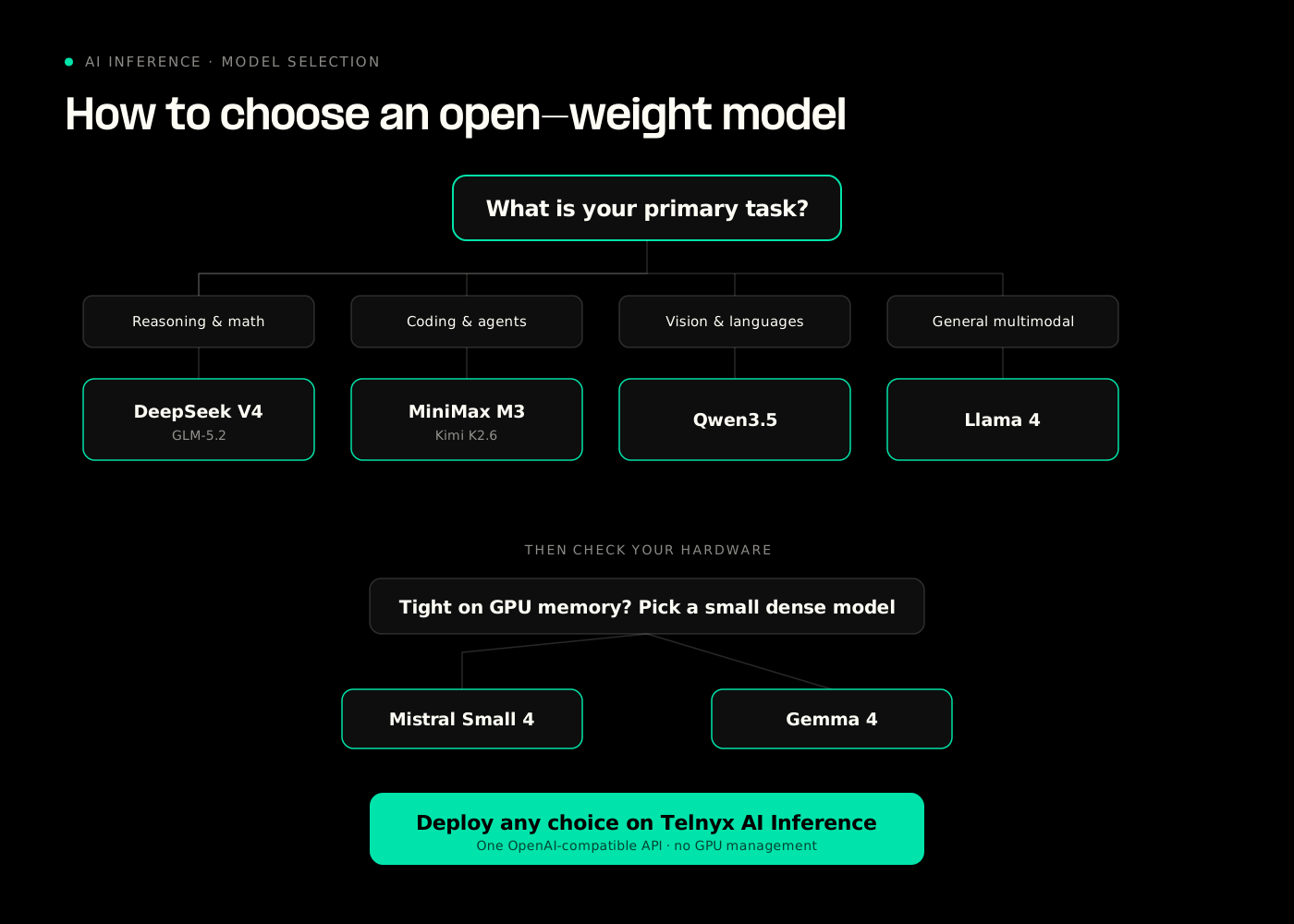
Start with the task, then narrow by hardware and license. Five factors decide most selections.
First, task type. Reasoning and math point to DeepSeek V4 or GLM-5.2. Coding and agent work point to MiniMax M3 or Kimi K2.6. Vision and OCR point to Qwen3.5. General-purpose work points to Llama 4.
Second, hardware budget. For MoE models, the active parameter count drives inference cost more than the total, so a 428 billion parameter model that activates 23 billion runs far cheaper than its headline size suggests. Smaller models like Mistral Small 4 and Gemma 4 are easier to fit on a single GPU.
Third, license restrictions. Apache 2.0 models carry no commercial limits. The Llama Community License adds the 700 million user cap. Modified MIT and vendor-specific terms may add attribution requirements. Match the license to your deployment scale before you commit.
Fourth, context window. Long-document and codebase work benefits from the 256K to 1M windows of DeepSeek V4, GLM-5.2, and MiniMax M3. Shorter tasks run fine on 128K.
Fifth, ecosystem support. Check that the model works with your serving stack, whether that is vLLM, TGI, or llama.cpp, and that quantized versions exist for your hardware. You can compare more than 20 supported models in the Telnyx LLM model library.
How to run inference on open weight models
You have three deployment paths, and they trade control against effort.
The first path is self-hosting. You run the model on your own GPUs with a serving framework like vLLM, TGI, or llama.cpp. This gives you full control and data residency, and it demands GPU procurement, capacity planning, and ongoing optimization.
The second path is cloud GPUs. You rent capacity from AWS, GCP, or Azure and run your own serving stack on top. This removes the hardware purchase, and it leaves you to manage the serving layer and pay cloud markup on the compute.
The third path is managed inference. You call an API and the provider handles the GPUs, serving, and scaling. The Telnyx AI Inference API runs open weight models on GPU infrastructure that Telnyx owns and colocates with its global telephony points of presence, which removes the cloud markup and keeps latency low. Because the endpoint is OpenAI-compatible, switching between an open weight model and a proprietary one is a single parameter change:
One API and one bill replace a stack of separate inference vendors. You keep the flexibility of open weight models and skip the GPU management that usually comes with them.
Open weight models for voice AI
Open weight models can power the full voice AI stack, from speech-to-text to the language model to text-to-speech. The constraint for voice is latency. A natural conversation needs a response in well under a second, and every network hop between the caller and the model adds delay.
Telnyx addresses this by colocating GPU inference with its telephony network, so the model runs next to the point where the call enters the network rather than a region away. When the SIP trunk, the media server, and the model share the same infrastructure, audio does not have to travel across the public internet to a separate inference vendor and back. That shorter path matters because a natural conversational turn has a response budget of only a few hundred milliseconds, and speech-to-text, model inference, and text-to-speech all have to fit inside it. Colocation protects that budget by cutting the network legs that usually consume it. To see which models fit voice workloads, read our guide to open weight Voice AI and how to pair them with carrier-grade infrastructure.
Frequently asked questions
What are open weight models?
Open weight models are AI models whose trained parameters (weights) are publicly available for download and use. Unlike truly open source models, open weight models may not include training data, code, or evaluation metrics. Examples include Llama, DeepSeek, and Mistral.
What is the difference between open weight and open source AI models?
Open source AI models release weights, training code, and datasets publicly. Open weight models release only the trained weights. Most models marketed as open source are actually open weight only, because they do not include training data or full code. The distinction matters for licensing, reproducibility, and auditability.
Are open weight models free to use?
Most open weight models are free to download and run locally. Commercial use depends on the license. Apache 2.0 (Mistral, Qwen) allows unrestricted commercial use. The Llama Community License allows commercial use but restricts entities with over 700 million monthly users. Modified MIT licenses (Kimi K2) stay permissive but require displaying the model name in your interface above 100 million monthly users or 20 million dollars in monthly revenue.
Can I use open weight models in production?
Yes. Companies run open weight models in production using serving frameworks like vLLM, TGI, or llama.cpp on GPU infrastructure. Managed inference providers like Telnyx offer OpenAI-compatible APIs that run open weight models without GPU management. The tradeoff against proprietary APIs is infrastructure effort versus vendor lock-in and per-token pricing.
Which open weight model is best?
It depends on the task. DeepSeek V4 leads in math and STEM reasoning. MiniMax M3 and Kimi K2.6 excel at agentic coding. Qwen3.5 has the strongest multilingual and vision capabilities. GLM-5.2 tops several open weight leaderboards for long-context agents. For general-purpose multimodal use, Llama 4 has the widest ecosystem support.
Build on open weight models with Telnyx
Open weight models give you control over the model, the data, and the deployment. Telnyx makes that control practical by removing the GPU procurement and serving complexity. Run DeepSeek, GLM, Kimi, Qwen, Llama, and more through one OpenAI-compatible AI Inference API, on infrastructure Telnyx owns and colocates with its global network, with no setup fee and no monthly minimum. Switch between open weight and proprietary models by changing one parameter, and keep your entire AI stack on a single platform. Start building on Telnyx AI Inference today.
Share on Social


