
Published 27 Nov 2026
Text-to-speech is software that turns written text into spoken audio. See how it works, where it came from, and what it is used for.
 By Osman HusainGlobal AEO/SEO Lead

Key take aways
Text-to-speech (TTS) powers screen readers, voice assistants, IVR, audiobooks, and voice AI agents by converting text into spoken audio.
- Most text-to-speech systems work in three steps: they decide how the text should be said, plan the sound, then build the audio.
- Electronic machines have talked since 1939, and neural models such as WaveNet (2016) made synthetic voices sound far more human.
- TTS powers interactive phone menus and voice AI agents; it is also called speech synthesis.
You call your pharmacy, and a voice reads back your prescription number to confirm. A human played no part in that interaction.
A text-to-speech engine built the voice in real time, reading from text the moment the call needed it.
What is text-to-speech (TTS)?
Text-to-speech (TTS) is software that converts written text into spoken audio. A text-to-speech system first analyzes the text, then a neural model generates a natural-sounding voice, often delivered through an API.
Neural voices can now match human voice recordings in quality. In a Microsoft study, listeners rated NaturalSpeech voices at 4.56 and human voice recordings at 4.58 on the 1-to-5 Mean Opinion Score scale.
What does TTS stand for?
The full form of TTS is text-to-speech, sometimes written text to speech or called speech synthesis. Text-to-speech is the conversion of written text into an audible, spoken voice by a computer. The Cambridge Dictionary lists TTS as its abbreviation.
How does text-to-speech work?
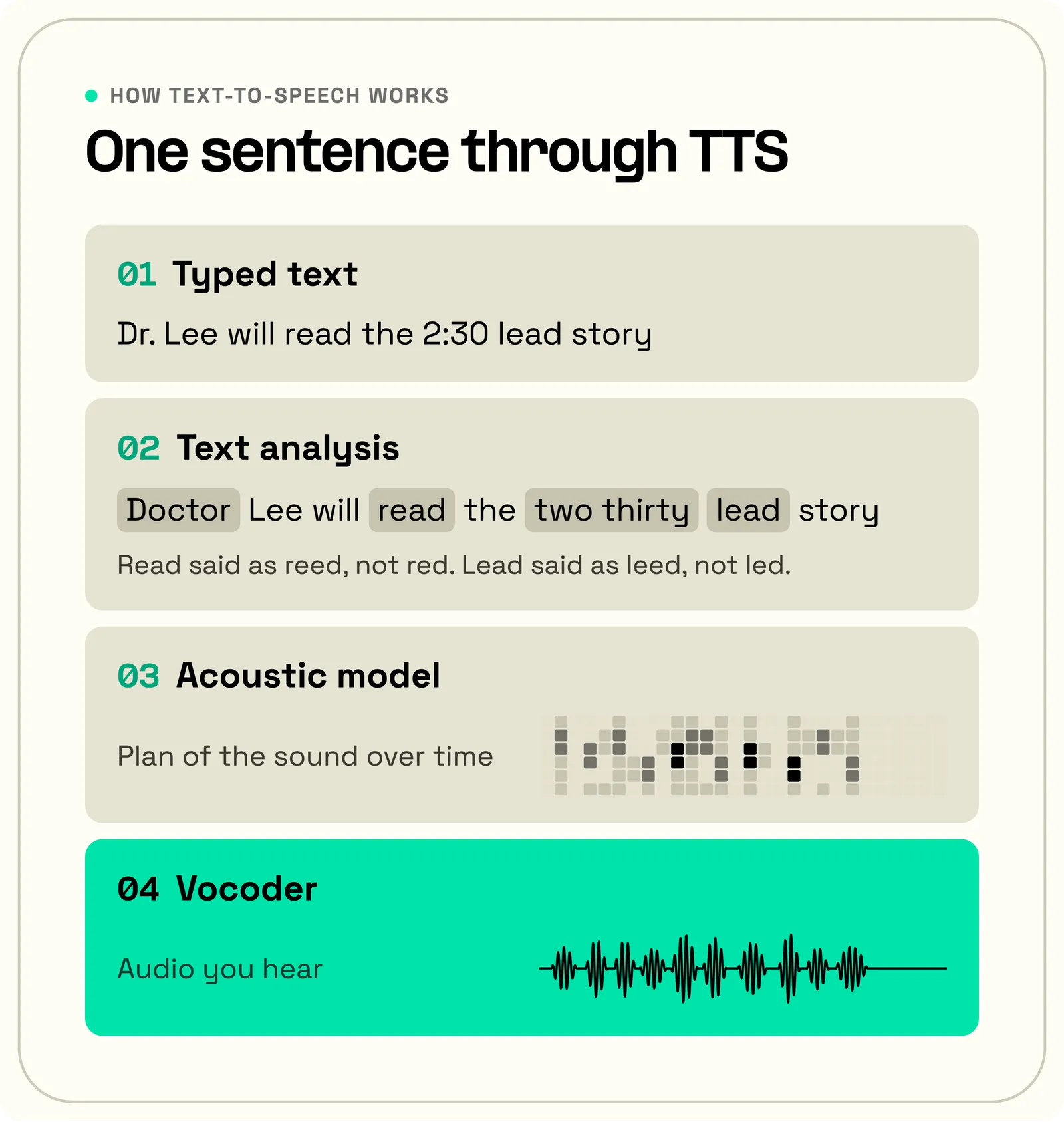
TTS systems work in three steps: text analysis decides what to say and how, an acoustic model plans the sound, and a vocoder builds the audio.
1. Text analysis: from writing to sounds
Text analysis turns writing into phonemesThe smallest sounds that tell one word from another, like the p in pat and the b in bat. and marks their prosodyThe rhythm, stress, and pitch of speech.. In Dr. Lee will read the 2:30 lead story, it expands Dr. to doctor and 2:30 to two thirty. It then picks how to say read (reed, not red) and lead (leed, not led) from the words around them.
Google researchers wrote in 2016 that text normalization, the expansion of numbers and abbreviations, is a major source of lower perceived quality in TTS.
On a 2025 Apple benchmark of 27 normalization categories, the benchmark's baseline normalizer had a word error rateA measure of how many words a system gets wrong, counted against a correct reference text. of 15.48% on US English math expressions and 1.14% on phone numbers. Its error rate on formulas was more than 13 times higher.
Developers can override parts of this stage with SSML, a markup language that controls pronunciation, pauses, emphasis, and speaking rate. SSML lets an application force a brand name or acronym to be pronounced correctly.
For brand and product names, Telnyx's pronunciation dictionaries apply up to 100 word replacements each before speech is generated, on the REST API and WebSocket streaming.
2. Acoustic model: planning the sound
The acoustic model turns those sounds and stresses into a plan for how the audio should change over time. The plan is usually a mel-spectrogramA picture of which frequencies sound at each moment, used as the plan for the audio., representing how frequencies vary over time.
3. Vocoder: building the waveform
The vocoder turns that plan into a waveform, the signal a speaker plays.
Modern neural vocoders generate the waveform directly rather than assembling it from stored fragments, which is why current synthetic voices sound close to human.
When was text-to-speech invented?
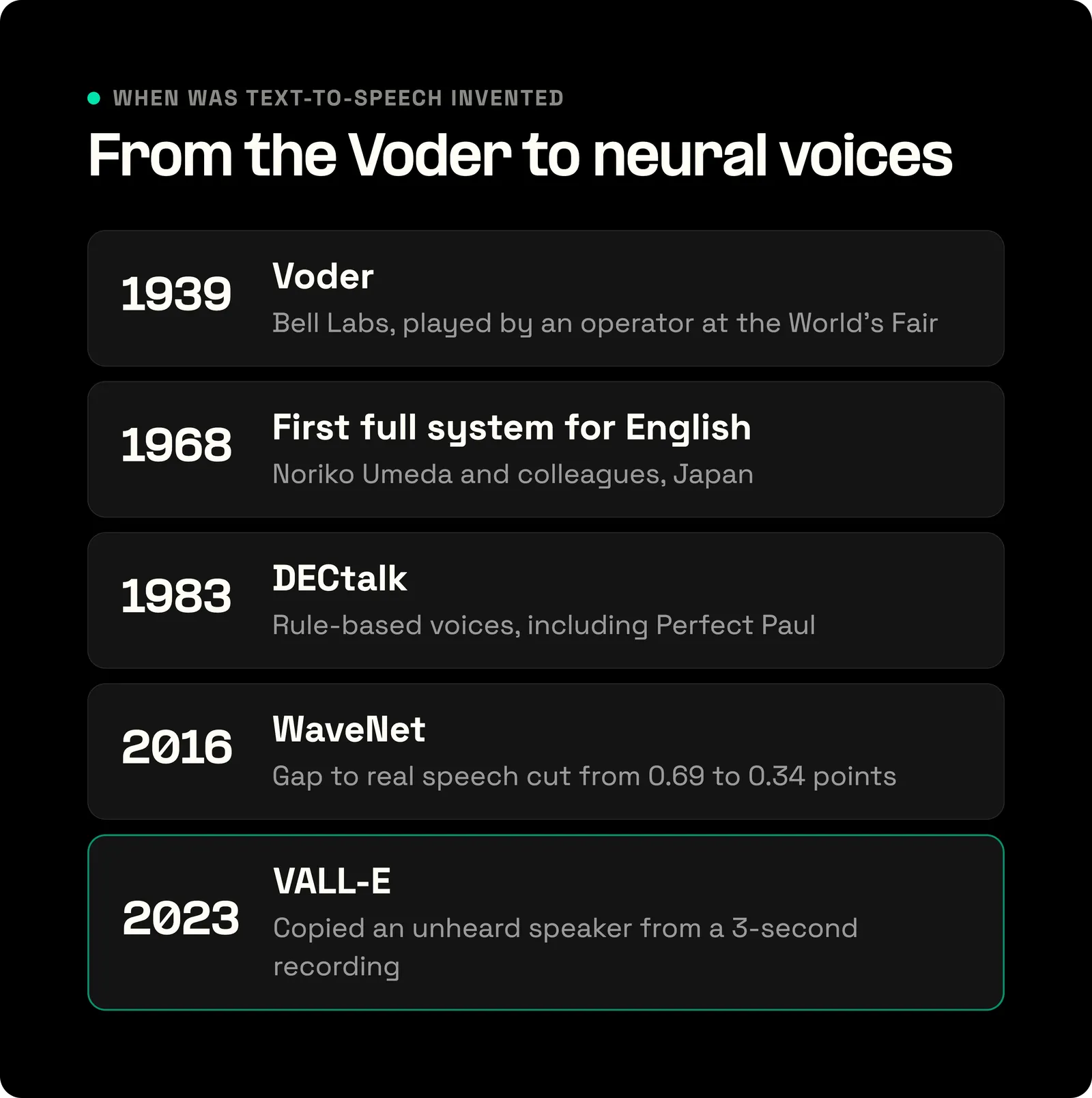
Text-to-speech is older than the computer. The Voder, built by Homer Dudley at Bell Telephone Laboratories and demonstrated at the 1939 New York World's Fair, is widely credited as the first electronic speech synthesizer, played live by a human operator.
The first electronic talking machines (1939 to 1968)
An operator played the Voder like an instrument. Bell Labs' 1939 description lists a small keyboard for the sounds, a wrist switch for voiced sounds, and a foot pedal for pitch. Bell Labs hailed the Voder as the first machine in the world to create speech.
Noriko Umeda and colleagues at Japan's Electrotechnical Laboratory demonstrated the first full text-to-speech system for English in 1968, according to Dennis Klatt's 1987 review.
Rule-based and recorded voices
Rule-based TTS uses hand-written rules for how letters become sounds. Dennis Klatt licensed his Klattalk software to Digital Equipment Corporation in 1982, and DECtalk followed in 1983 with eight preset voices, including a male voice named Perfect Paul.
Recorded voices later became the main approach: concatenative synthesis stitched short clips of a real voice together. Statistical parametric models then predicted the sound from patterns in recordings instead of replaying them.
Neural voices (2016 to now)
Neural text-to-speech moved synthetic voices much closer to real speech. In DeepMind's 2016 WaveNet tests of US English, the gap between real and artifical voices shrank from 0.69 to 0.34 points on the 1 to 5 listener scale.
In 2023, Microsoft's VALL-E copied a speaker it had never heard from a 3-second voice recording, after training on 60,000 hours of English.
What are the types of text-to-speech?
Text-to-speech comes in four main types, one for each generation of the technology: rule-based, concatenative, statistical parametric, and neural.
| Type | How it makes speech | Strengths and limits |
|---|---|---|
| Rule-based | Rules written by linguists shape each sound | Clear on modest hardware; sounds less natural |
| Concatenative | Joins short clips of one recorded voice | Close to the original voice; needs a huge recording database |
| Statistical parametric | Predicts sound features, then a vocoder builds the audio | Needs fewer recordings; can sound muffled or buzzy |
| Neural | Neural networks plan the sound and generate the waveform | Closest to real speech; trains on large speech datasets |
Neural synthesis is the current standard. It learns the relationship between text and sound directly from large speech datasets, which is why its output is more natural and expressive than the others.
Text-to-speech vs speech-to-text
Text-to-speech and speech-to-text run in opposite directions: TTS turns text into a voice, and speech-to-text, also called speech recognition, turns voice into text. They are the two halves of conversational AI.
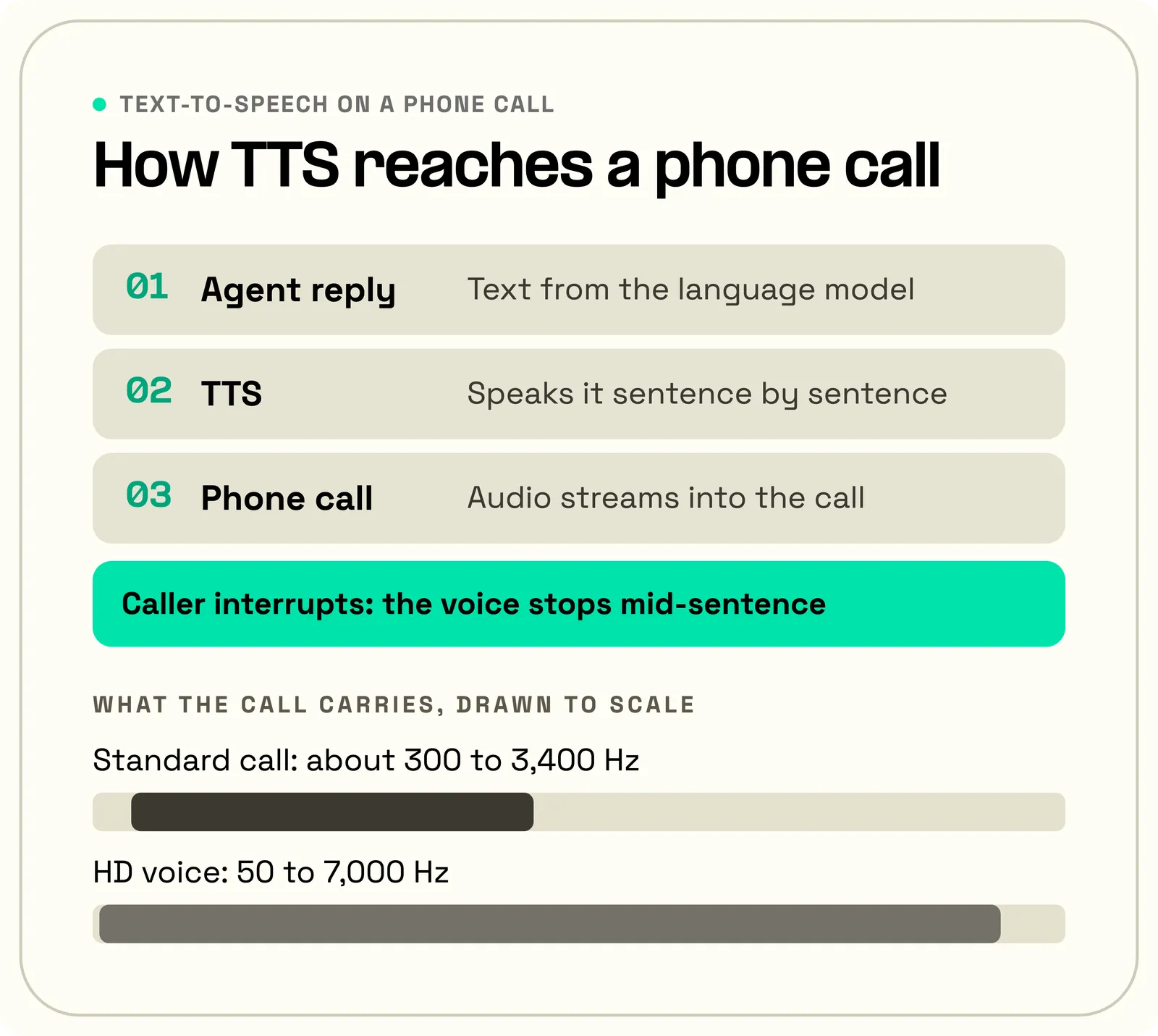
Voice AI agents use both on every turn: speech-to-text hears the caller, a language model decides the reply, and TTS speaks it.
What is text-to-speech used for?
Text-to-speech powers audiobooks, healthcare systems, accessibility software, e-learning, and much more.
Reading and accessibility
Screen readers and reading tools use TTS to read web pages, documents, and messages for people with vision or learning disabilities.
Phone calls and voice AI agents
TTS reads menus, appointment confirmations, and one-time passcodes, giving voice AI agents a method to communicate with users.
Telnyx's Text-to-Speech API plays speech on live calls through the Voice API speak command or TeXML <Say>, and also works over WebSocket streaming and a REST API. Telnyx streams audio over WebSocket as it is synthesized, and one message stops the voice mid-sentence when the caller interrupts.
Across a full turn, from the caller's last sound to the agent's first, Telnyx's benchmark measures about 0.9 seconds, on its own network.
Media, learning, and devices
TTS narrates audiobooks, e-learning courses, and turn-by-turn directions. It also voices characters in games. Telnyx supports custom voice design and voice cloning.
Frequently asked questions about text-to-speech
By Osman HusainGlobal AEO/SEO Lead