
Insights and Resources
B300 GPU rental price per hour in 2026: what you actually pay
B300 GPU rental costs $7.10 to $17.80 per hour in 2026. Here's what each provider charges and when paying per token beats renting.

By Eli Mogul
Takeaways
The B300 GPU rental price per hour in 2026 runs from $7.10 on smaller clouds to $17.80 on AWS on demand. If your workload is inference on an open-weight model, a per-token API can undercut every one of those hours because it bills nothing while a GPU sits idle.
- Spot B300 capacity starts at $3.75 per GPU hour, and a 48-month reservation brings the rate as low as $3.13.
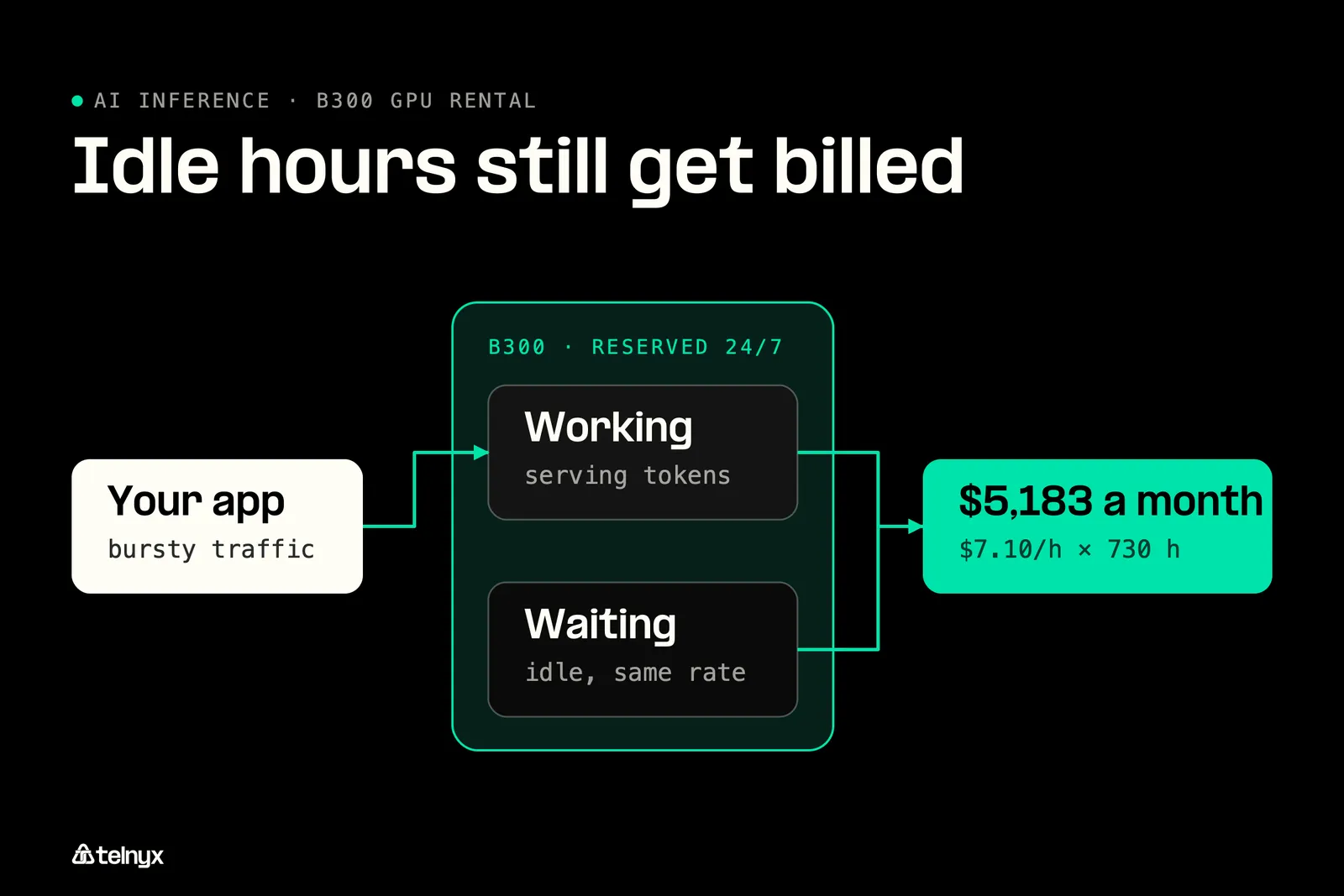
- The hourly rate leaves out egress, storage, interconnect, and idle time. One B300 at $7.10 costs about $5,183 a month running 24/7 before it does any useful work.
- A single B300 costs $50,000 to $60,000 to buy and pays for itself against on-demand rental in roughly 4 to 12 months of 24/7 use, depending on which hourly rate you compare it with.
What is the B300 GPU rental price per hour 2026?
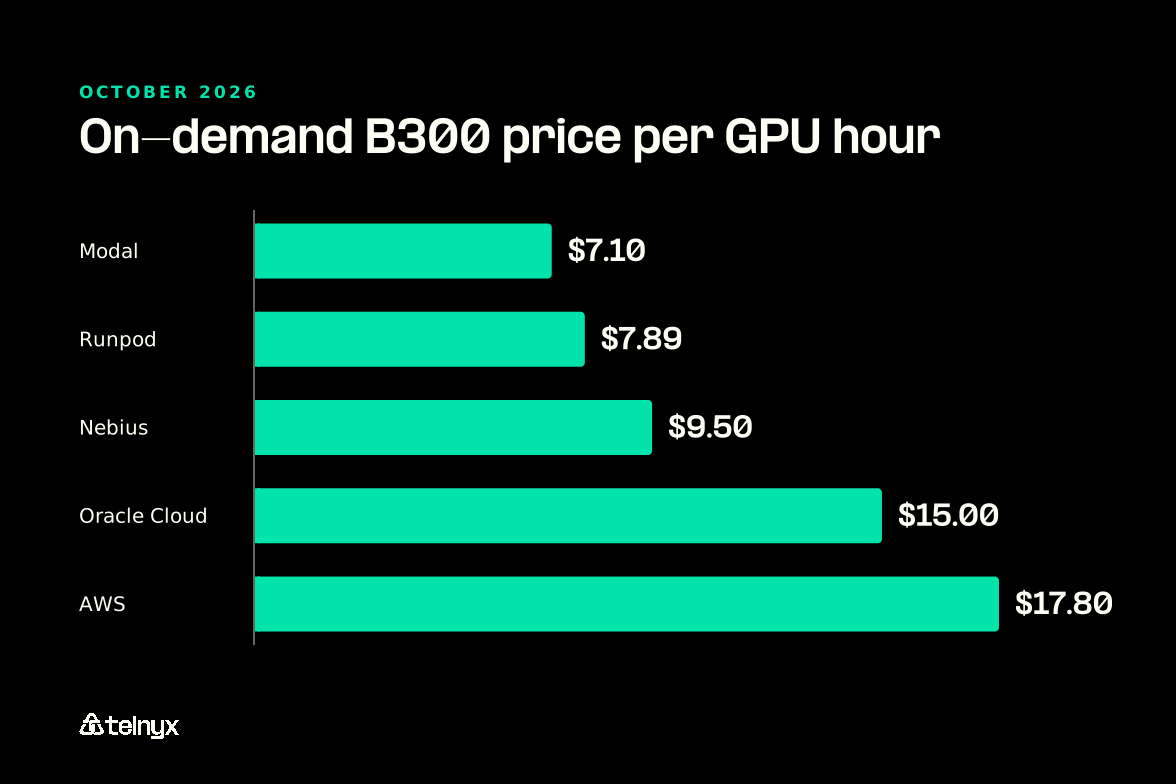
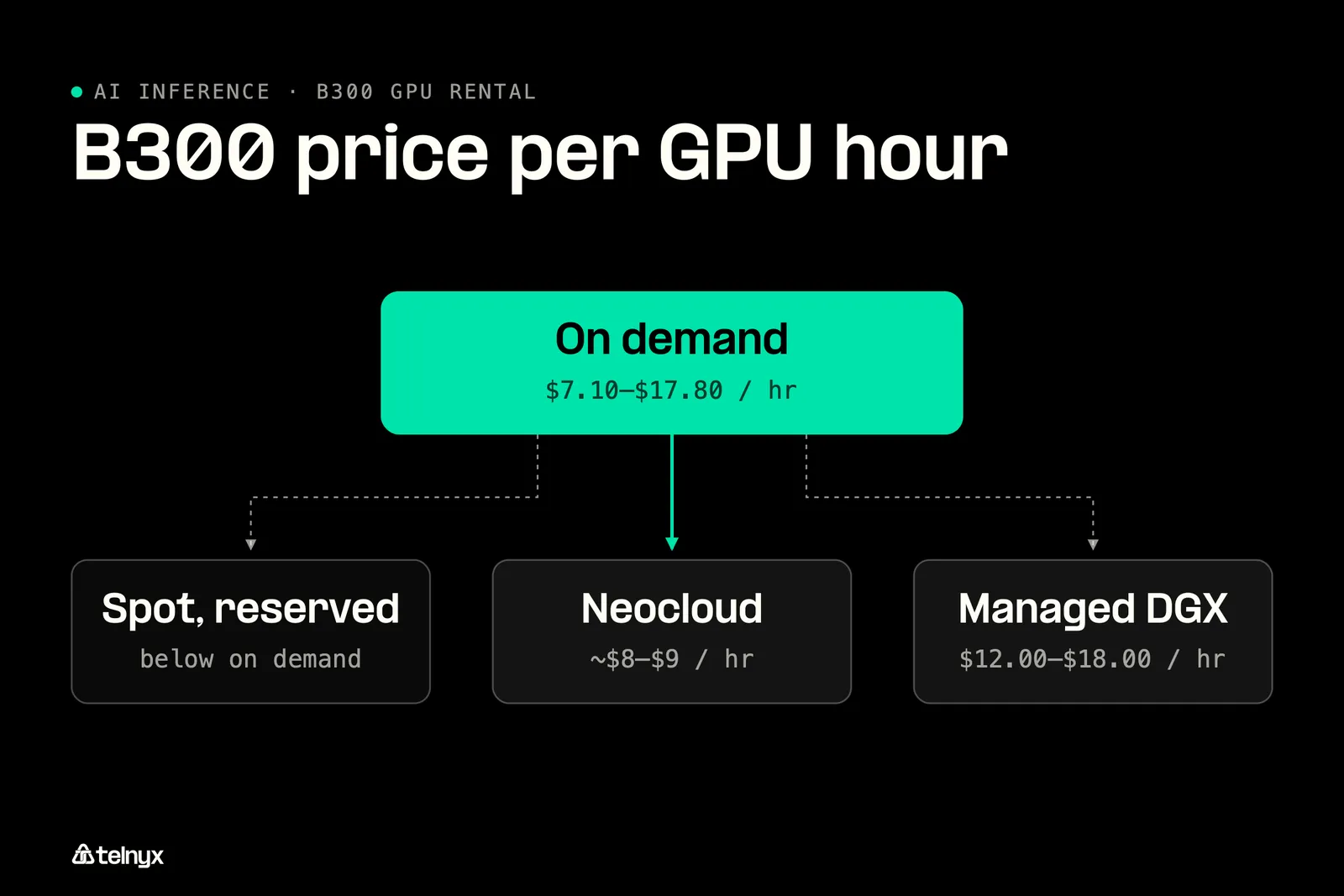
On demand, one NVIDIA B300 costs $7.10 to $17.80 per GPU hour in October 2026, with Modal at the low end and AWS at the high end. Those figures come from public price lists for the 288 GB B300 SXM6 in US regions, in US dollars, with 8-GPU node prices divided by eight so every rate covers one card.
How should you pay for B300 compute?
- Bursty inference on an open-weight model: use Telnyx Inference and pay per token. An idle B300 still bills $7.10 an hour, roughly $5,183 a month.
- Training job that checkpoints often: rent spot capacity from Verda at $3.75 per GPU hour. A reclaimed card only costs the work since your last checkpoint.
- Steady 24/7 load for several years: sign a 48-month reservation at $3.13 per GPU hour, about 56% below Modal's $7.10 on-demand rate.
- Short custom run, need a card today: rent on demand from Modal at $7.10 per GPU hour. AWS charges $17.80 for the same 288 GB card.
- Full utilization and your own rack space: buy the card for $50,000 to $60,000. Running nonstop, it beats on-demand rent within 4 to 12 months.
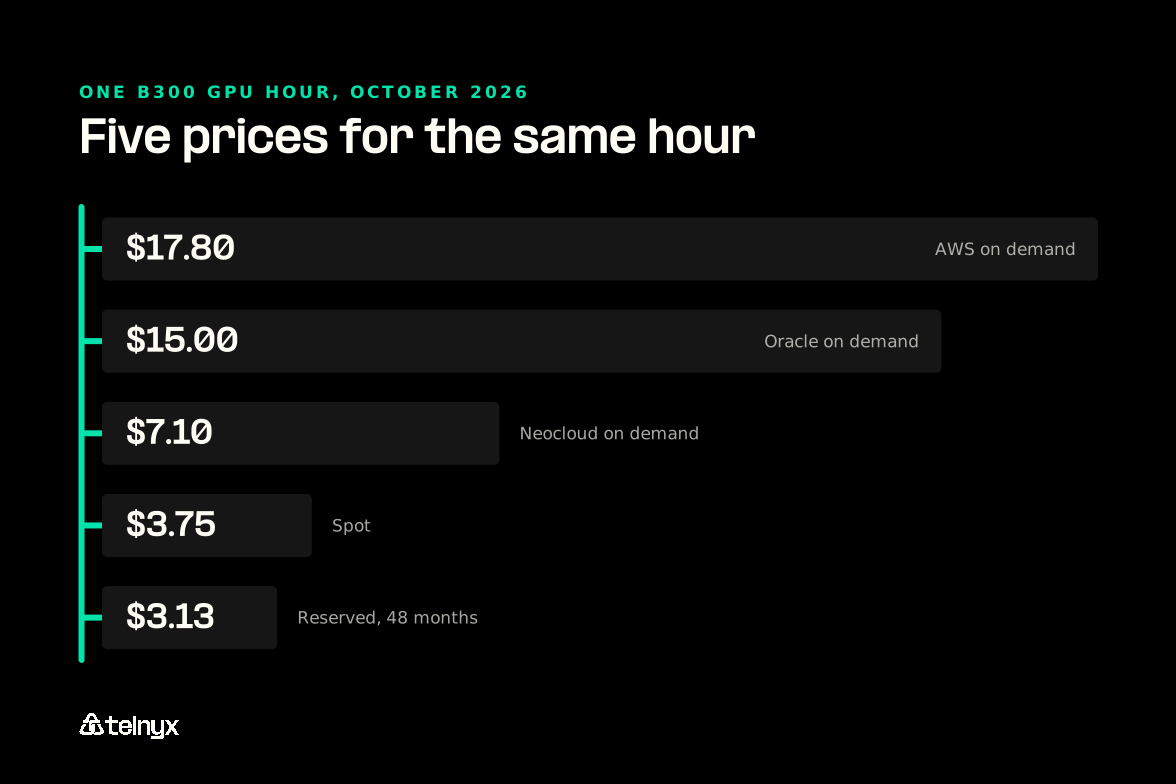
Around that band sits a wider ladder. A 48-month reservation brings the rate as low as $3.13, and spot capacity runs $3.75 at Verda and $4.30 at Nebius. On-demand neoclouds charge $7.10 to $9.50, hyperscalers charge $15.00 to $17.80, and managed DGX B300 stacks charge $12.00 to $18.00. From the cheapest reserved hour to the most expensive on-demand hour, the spread is 5.7x.
How these prices were compiled: On-demand rates come from public price lists only. Every rate is for a 288 GB B300 SXM6 in a US region, in US dollars. Node prices are divided by eight to give a per-GPU rate. Figures are dated October 2026, with earlier August 2026 readings marked where they differ. B300 rates moved fast this year, so treat any figure older than a quarter as a starting point for your own quote. Last reviewed: October 12, 2026.
The on-demand range right now
The floor and the ceiling hide the middle of the market. Two price trackers fill it in: gambit.zone put the median at $7.94 across seven quotes on August 10, 2026, and cloud-gpus.com read $8.71 on demand on September 11, 2026. A typical on-demand B300 hour from a neocloud costs about $8 to $9, so a neocloud quote well above $10 deserves a second look.
Spot, reserved, and managed tiers
Spot is the cheapest way to rent the hour, but the provider can reclaim the card, so it only suits jobs that checkpoint often. At the other end of the commitment scale, the $3.13 reserved rate is less than half of Modal's $7.10 on-demand rate. A gap that wide says more about how scarce on-demand B300 capacity is than about what the hardware costs to run. Managed DGX stacks at $12.00 to $18.00 cost more because the rate bundles networking, support, and an enterprise SLA.
How the price moved through 2026
The on-demand B300 rate roughly doubled in about six months, from around $4.50 per GPU hour to $9.16. The readings below trace that climb:
- Start of the climb: roughly $4.50 per GPU hour on demand.
- August 2026: $7.85 at Nebius.
- August 10, 2026: $7.94 median across seven quotes, per gambit.zone.
- September 11, 2026: $8.71 on-demand reading, per cloud-gpus.com.
- Fall 2026: $9.16 for an on-demand Spheron SXM6.
- October 1, 2026: $9.50 at Nebius.
The two Nebius figures are the trend itself: the same provider charged $7.85 in August and $9.50 on October 1. Early-2026 promotional capacity at $2.45 per GPU hour no longer appears in any named provider's on-demand listing.
See per-token inference pricing if your workload is inference on an open-weight model, before you price a node.
Try Telnyx Inference to run open-weight models on a per-token API that bills nothing while a GPU sits idle.
NVIDIA B300 cloud rental price per GPU hour 2026 by provider
The same 288 GB B300 costs 2.5 times more per hour on AWS than on Modal. Here is every provider with a public on-demand rate, plus the per-token alternative in the same frame.
On-demand B300 rates by provider, October 2026
| Provider | On-demand per GPU hour | Billing and notes |
|---|---|---|
| Modal | $7.10 (Oct 2026) | Single-GPU rate |
| Runpod | $6.94 community, $7.89 secure (Sep 2026) | Two tiers on one platform |
| Verda | $7.50 (Sep 2026) | Spot at $3.75, Finland region |
| Spheron | $9.16 (Sep 2026) | SXM6 on demand |
| Nebius | $9.50 (Oct 1, 2026) | $7.85 in August, spot at $4.30 |
| Oracle Cloud | $15.00 (Oct 2026) | OCI B300 on demand |
| AWS | About $17.80 (Oct 2026) | Sold only as the 8-GPU p6-b300.48xlarge at $142.42 per hour |
| Telnyx | No hourly GPU rental | Serverless inference from $0.30 per million tokens on Telnyx-owned GPUs |
Neocloud rates: Modal, Runpod, Nebius, Verda, and Spheron
Runpod shows how much a single provider's tiers can differ: its community tier at $6.94 and its secure tier at $7.89 sit 14% apart for the same card. Provider tier also matters as much as the chip. A neocloud B300 at $7.10 costs less per hour than an AWS B200 at $14.24, even though the B300 is the newer, larger GPU.
Hyperscaler rates and the full AWS node price
AWS sells B300 capacity only as the p6-b300.48xlarge, an 8-GPU node at $142.42 per hour. Divide by eight and you pay about $17.80 per GPU. AWS also charges egress once you move more than the first free 100 GB of data out each month, a cost most B300 price roundups leave off. Oracle Cloud's $15.00 rate sits just below AWS, and both carry managed networking and enterprise support inside the hourly price.
Providers with no public B300 hourly rate
Four large providers had no public per-hour B300 price in the trackers cited here as of October 2026. Each one sells capacity through a sales conversation:
- Google Cloud: B300 capacity is quoted through sales.
- Azure (ND GB300 v6): sold through quota requests and reservations.
- CoreWeave: capacity comes through a sales quote or a reserved contract.
- Lambda: no public B300 hourly rate listed. Ask for a quote.
Do not plan a budget around a rate you have not seen in writing from one of these providers.
Where to find a B300 GPU rental you can actually start
The smallest unit you can rent and the way time is metered change your effective rate more than the headline price does. Three questions decide what you really pay.
Single GPU or full 8-GPU node
Some providers rent one card. Modal, Runpod, and Nebius all list single-GPU rates. Others sell only the node. AWS sells only the 8-GPU p6-b300.48xlarge, so the floor is eight GPUs whether your job uses them or not. Full-node sellers can also be cheap per card: Excesssupply lists eight B300s at $36 per hour, which works out to $4.50 per GPU. That rate only helps if you can keep all eight busy. If you are weighing dedicated hardware against shared capacity in general, our bare metal vs cloud guide covers the trade-offs.
The node floor: On AWS, the smallest B300 purchase is eight GPUs at $142.42 per hour. A job that needs one card pays for seven idle ones, which makes the effective rate about $142 per useful GPU hour.
Per-second, per-minute, or per-hour billing
For bursty work, metering granularity moves your bill far more than a 50-cent difference in the hourly rate. A 10-minute job billed by the hour costs six times what it costs under per-minute billing. Per-minute billing is the common pattern on smaller neoclouds, but most public price pages do not state their granularity. Confirm the billing increment and the minimum rental term in writing before you compare two rates.
Quotas, waitlists, and reservation lead times
On-demand B300 capacity is thin. Much of the supply is committed to large enterprises on long-term contracts, the hardware needs liquid cooling and 1,400 W per GPU, and hyperscalers gate it behind quota requests. Reservations trade a lead time for the lowest rates, down to $3.13 on a 48-month term. Match the tier to how long your job runs:
- A few hours: an on-demand single GPU with per-minute billing.
- A week of bursty work: on demand with checkpointing, or spot at $3.75 if your job can survive a reclaim.
- Months of steady load: a one-year or longer reservation. Ask for the rate in writing.
- Tokens from an open-weight model: per-token serverless inference, with no node to rent.
What the B300 GPU rental price per hour leaves out
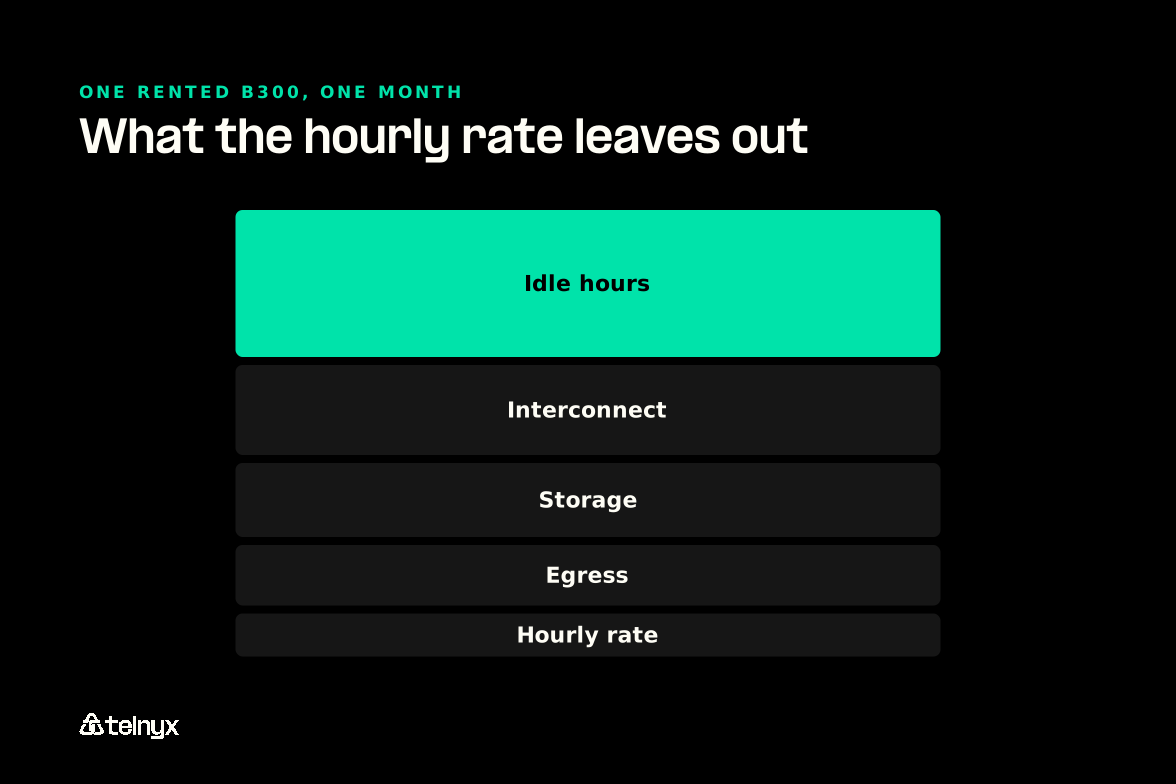
The hourly rate is the floor of your bill. Egress, storage, interconnect, and idle hours all sit on top of it, and none of them appear on a price list.
Egress, storage, and interconnect charges
Four charges stack on top of the hourly rate, in roughly this order:
- Egress: AWS charges for data out after the first free 100 GB each month. Model outputs, logs, and checkpoint copies all count.
- Persistent storage: checkpoints and datasets need somewhere to live between jobs. Compare S3-compatible rates, such as Telnyx cloud storage billing, against what your GPU provider charges.
- Interconnect: a job that spans more than one node pays for the fabric between them.
- Support plans: hyperscaler rates carry managed networking, enterprise SLAs, and support overhead, which is part of why Oracle and AWS sit at $15.00 and above.
Idle hours: the 24/7 bill before any work is done
A rented B300 bills for every hour it is reserved to you, whether the silicon is working or waiting. At 730 hours a month, one B300 at $7.10 costs about $5,183 a month, and at $17.80 it costs about $12,994. Utilization appears on no datasheet, yet it is the number that decides whether that bill buys you anything.
$5,183 a month: the cost of one B300 at $7.10 per GPU hour running 24/7, before it serves a single token.
Shared cloud hardware adds another way to waste paid hours. A noisy neighbor or an upstream outage stalls your job, and the meter keeps running.
"When a provider rents cloud GPUs, every instability in that cloud becomes their customers' problem. We don't have that dependency." Regis David Souza, Staff Software Engineer at Telnyx |
Power and cooling if you take the card in-house
Bringing a B300 in-house replaces the hourly rate with facility costs. Each card draws up to 1,400 W, liquid cooling is mandatory, and there is no PCIe version to drop into an air-cooled server. Most rent-vs-buy math leaves those costs out, so the next section treats its breakeven figures as a best case.
B300 GPU rental price vs buying the card
Buying a B300 costs $50,000 to $60,000 per card, and it pays for itself against on-demand rental in roughly 4 to 12 months of 24/7 use, before power, cooling, and staff.
What a B300 costs to buy in 2026
NVIDIA publishes no list price, and the B300 ships inside integrated systems, so every figure is a reseller quote. A single B300 SXM runs $50,000 to $60,000, with one July 2026 quote near $53,000. Full 8-GPU systems vary more: a DGX B300 read $300,000 to $350,000 in Q1 2026, while HGX B300 reseller quotes in October 2026 ran $550,000 to $650,000. Part of that gap is configuration, DGX against HGX, and part is the same supply squeeze that pushed hourly rates up. The DGX B300 began shipping in January 2026 and requires direct liquid cooling. If you are sizing a multi-node build, see our guide to HGX B300 cluster sizing.
Breakeven in months of 24/7 use
Divide the card price by the hourly rate and you get the hours a rental takes to match the purchase. At 730 hours a month, against a $50,000 to $60,000 card:
- Modal at $7.10: about 9.6 to 11.6 months.
- Spheron at $9.16: about 7.5 to 9.0 months.
- A managed DGX stack at $18.00: about 3.8 to 4.6 months.
What the breakeven leaves out: 1,400 W of power per GPU, liquid cooling, floor space, depreciation, and the staff to run it. Add those and your real breakeven comes later than the months above.
The decision rule is simple. Rent on demand for short or bursty work, reserve for predictable long-running load, and buy only when the load is predictable and runs longer than a reservation term.
Skip the B300 GPU rental and pay per token on owned GPUs
If your workload is inference on an open-weight model, you may not need to rent the card at all. Telnyx Inference runs a curated library of open-weight models on GPUs Telnyx owns, behind an OpenAI-compatible API, in-region across the Americas, Europe, MENA, and APAC, with zero data retention. It autoscales with no capacity planning and no cold starts, and it bills per token with no GPU rental fees, no compute surcharges, and no minimums. The cheapest frontier model, MiniMax-M2.7, costs $0.30 per million tokens, cached input is up to 88% off, and Telnyx prices run up to 75% less than proprietary alternatives. Because Telnyx owns the hardware, there is inference without reseller markup stacked into each token.
"The cheapest frontier model on our platform is MiniMax-M2.7 at $0.30 per million tokens. We're matched with competitors across the board including cached input. But the real story is structural: we own the GPUs and the network, so there's no cloud provider markup baked into every token, no GPU rental fees, no compute surcharges, no minimums. Price follows physics." Regis David Souza, Staff Software Engineer at Telnyx |
When you genuinely need the card
Per-token inference does not replace every GPU workload. Training, fine-tuning, serving a proprietary model, or running a dense 130B-class model you must host yourself all need the 288 GB card. For those jobs, a rental or a reservation from the table above is the right buy.
When per-token pricing wins
A rented B300 bills about $5,183 a month at $7.10 before it serves a token. Per-token pricing bills nothing for idle hours. The lower your sustained utilization, the sooner per-token pricing comes out ahead, and bursty, unpredictable, or early-stage traffic is where the difference shows first. Per-model rates vary, so check current inference API pricing against your expected monthly token volume before you sign a reservation.
Default, Priority, and Flex tiers on one API
Picking a service tier is the per-token version of picking a rental tier. You choose it with one field in the request body, service_tier, instead of adding a second provider.
Default
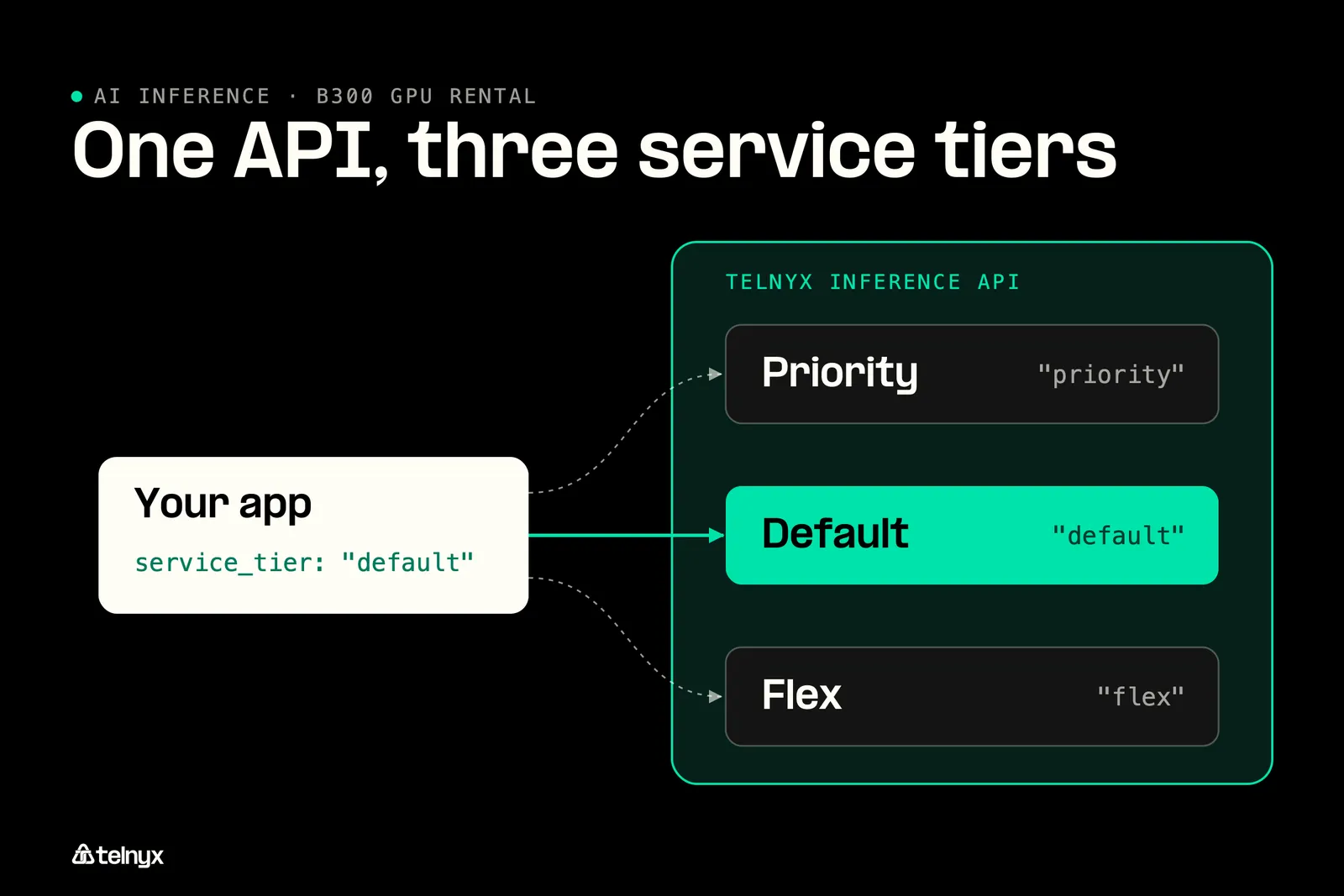
Standard serving capacity at standard rates. Every call uses it when you omit service_tier.
Priority
Faster serving capacity for low-latency interactive and voice work. Live on select models.
Flex
The lowest rates, for throughput work where minutes of latency are acceptable. US, select models.
Moving from a rented node to per-token inference is a base URL change. This request sends one chat message to a hosted open-weight model:
FAQ
What is the NVIDIA B300 cloud price per hour in 2026?
On demand, $7.10 to $17.80 per GPU hour as of October 2026, with Modal at the low end and AWS at the high end. Most neocloud quotes land around $8 to $9. Spot and reserved capacity go lower, and managed DGX stacks run $12.00 to $18.00.
How much does an NVIDIA B300 cost to buy?
About $50,000 to $60,000 for a single B300 SXM, based on reseller quotes, since NVIDIA publishes no list price. Full 8-GPU systems ranged from $300,000 to $350,000 for a DGX B300 in Q1 2026 to $550,000 to $650,000 for an HGX B300 in October 2026.
Is the B300 always more expensive than the B200 in the cloud?
No. On the same provider the B300 usually costs more, but provider tier matters as much as the chip. A neocloud B300 at $7.10 per GPU hour costs less than an AWS B200 at $14.24.
What is the AWS B300 price?
AWS sells the B300 only as the 8-GPU p6-b300.48xlarge at $142.42 per hour on demand, about $17.80 per GPU. Egress charges apply after the first free 100 GB of data out each month.
How cheap can B300 cloud pricing get?
As low as $3.13 per GPU hour on a 48-month reservation, or $3.75 on spot capacity that can be reclaimed. Full-node sellers sometimes come in around $4.50 per GPU if you rent all eight cards. The $2.45 promotional rates seen in early 2026 no longer appear in named providers' on-demand listings.
Size your cluster, then talk to us about GPU capacity
A B300 costs $7.10 to $17.80 an hour whether it is working or waiting. Telnyx bills per token from $0.30 per million on GPUs we own, with no rental fee and no minimum. Sign up and run your first request with a base URL change.
Try Telnyx InferenceShare on Social

%20(1).png?width=96&format=webp)


