
Telnyx
Open Source vs Frontier Models: Which Should You Build Your Agents On?
GLM-5.3 output costs $4.00 per million tokens. GPT-6 Astra costs $50.00. Here's where open-weight models already match frontier models for agents, where closed models still win, and how to route between them.

By Eli Mogul
Takeaways
What are frontier models
Frontier models are the most capable AI models available at a given moment: the systems that set the top scores on reasoning, coding, and agentic benchmarks. The label moves. A model that defines the frontier in January can sit mid-pack by October, because labs ship new releases every few weeks.
Frontier vs non-frontier is not the same as closed vs open
The common shorthand treats "frontier" as a synonym for "closed." That framing no longer holds.
Capability and license are separate axes. A closed model can be small and cheap: OpenAI and Anthropic both sell low-cost models built for classification and routing. An open-weight model can be enormous: Kimi K3 runs 2.8 trillion parameters with a 1M-token context window. Plotting models on both axes produces four groups, and the open-weight frontier group is the one growing fastest.
Open source, open weight and closed: what each term gives you
The terms get used interchangeably in marketing copy, but they grant very different rights. The Open Source Initiative's Open Source AI Definition (OSAID 1.0) sets the strictest bar: a model qualifies only if it publishes its parameters, the complete code used to train and run it, and detailed information about its training data. Few leading models meet all three. Our guide to open-weight models covers the distinction in more depth.
What each model category lets a team do
| Term | What you can do with it | Typical license |
|---|---|---|
| Open source (OSAID 1.0) | Download, run, modify, and retrain from scratch, with full visibility into data and code | Permissive, such as Apache 2.0 or MIT, plus published data information |
| Open weight | Download, self-host, fine-tune, and move between providers; training data and code usually stay private | Apache 2.0, MIT, or a custom license with attribution, revenue, or user-cap clauses |
| Closed frontier | Call the model through the vendor's API only; no weights, no self-hosting | Vendor terms of service |
For the current list of open-weight models available through one OpenAI-compatible endpoint, with context lengths and recommended uses, see the Telnyx inference models catalog.
Route agent traffic across open and frontier models
Treat the model name as configuration and move traffic between models without a redeploy, paying open-weight rates where they fit.
OS vs Frontier models: which should you build on?
Open-weight models now handle most production agent work at a much lower cost. Closed frontier models still hold an edge on a narrow band of hard, expensive-to-get-wrong tasks.
Which model should my agent run on?
- High-volume agent doing routine tool calls: run GLM-5.3 on Telnyx Inference. Output costs $4.00 per million tokens, against $50.00 for GPT-6 Astra.
- One step where a wrong answer is costly: route only that step to GPT-6 Astra. Paying 12.5x more per output token is worth it for the hardest, highest-stakes calls.
- Whole contracts or codebases in one prompt: test Kimi K3 first. It is open weight, carries 2.8 trillion parameters and accepts a 1M-token context window.
- Compliance asks to see the training data: pick a model that meets OSAID 1.0. Most open-weight releases ship weights but keep training data and code private.
- Not sure which model leads next quarter: keep the model name in a feature flag. Swapping GPT-6 Astra for GLM-5.3 later then needs no redeploy.
"My feed is full of people proudly showing off their '10 Billion Token' trophies. What I see: 'I just paid OpenAI a premium for something I could've run with open-source models at 90% less cost.' At this point, OpenAI should engrave them: 'Thank you for your service to our ARR.' Meanwhile, anyone actually shipping with FOSS is too busy saving money to post about it." David Casem, CEO at Telnyx |
Where open source models already clear the bar
Open-weight models perform well on the work that makes up most agent traffic. Our ranking of the best open source LLMs found Kimi K3 and DeepSeek-V4.1-Flash in a statistical tie on an independent evaluation index, with DeepSeek-V4.1-Flash costing a fraction as much per task.
Workloads where open-weight models are a strong default:
- High-volume support triage, summarization, and extraction
- Tool-calling agents with well-defined functions
- Coding agents working inside an existing codebase
- Real-time voice agents, where time to first token matters more than a two-point benchmark gap
Conditions that make open weights the better fit:
- Token volume is high enough that per-token price drives the budget
- Data residency rules decide where inference can run
- The team wants the option to switch providers or self-host later
Where frontier models still win
Closed flagships still lead on some general-intelligence measures and on the longest, most open-ended reasoning tasks. When a single wrong answer costs more than a month of token spend, paying for the strongest available model is often the cheaper choice.
Escalation triggers: when to route a request to a closed frontier model
- The open-weight model failed the same task in workload evals more than once
- The task is long-horizon reasoning where an error is expensive or hard to detect
- The request needs a capability the open model does not support
- A customer contract names a specific vendor
Everything else stays on the open-weight default.
What each costs per million tokens
The price gap between the two camps is widest on a per-token basis.
Standard list prices per 1M tokens, checked October 13, 2026. Telnyx rates from Telnyx inference pricing (Default tier); Anthropic and OpenAI rates from each vendor's published API pricing.
| Model and host | Input per 1M tokens | Output per 1M tokens |
|---|---|---|
| MiniMax-M3 on Telnyx | $0.27 | $1.10 |
| GLM-5.3 on Telnyx | $1.25 | $4.00 |
| Kimi K3 on Telnyx | $2.70 | $13.50 |
| Claude Opus 5.5 (Anthropic) | $4.00 | $20.00 |
| GPT-6 Astra (OpenAI) | $10.00 | $50.00 |
| Claude Fable 5.1 (Anthropic) | $10.00 | $50.00 |
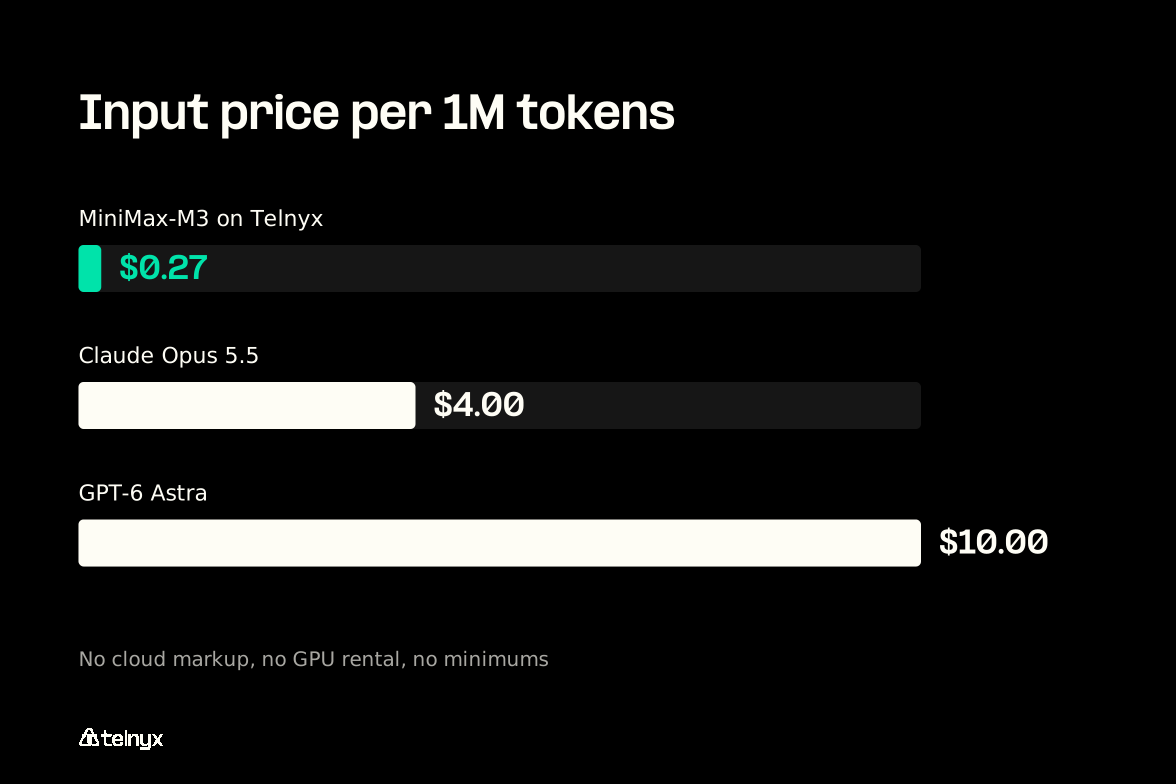
GLM-5.3 costs one-eighth of GPT-6 Astra on input and less than one-twelfth on output. MiniMax-M3 undercuts Claude Opus 5.5 by roughly 15 times on input and 18 times on output.
"We own the GPUs and the network, so there's no cloud provider markup baked into every token, no GPU rental fees, no compute surcharges, no minimums. Price follows physics." Regis David Souza, Staff Software Engineer at Telnyx |
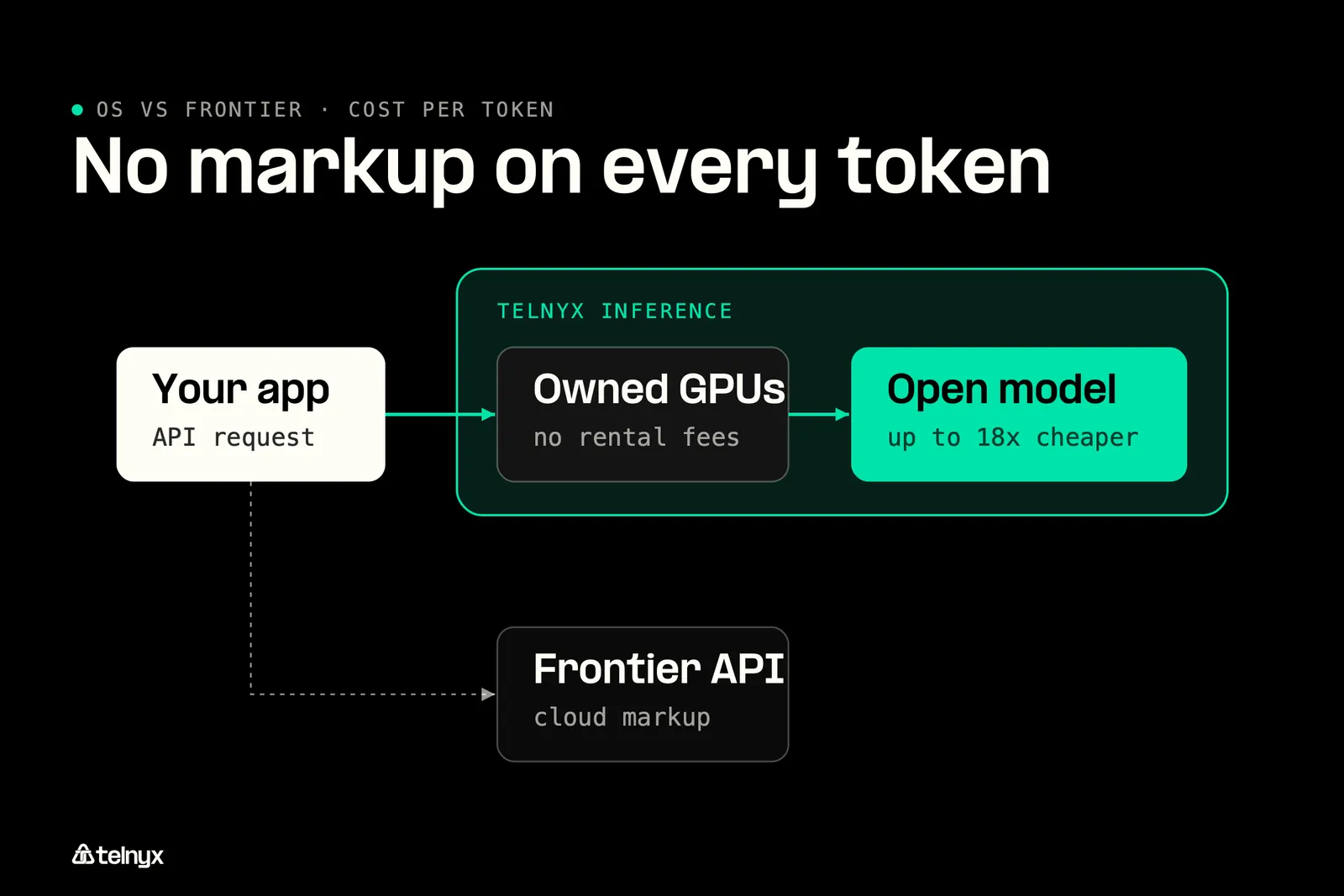
Two caveats apply. Cheaper tokens only help if the model passes the workload's evals, and list price is not total cost: an agent that retries a failed conversation pays twice.
Does open source solve the data sovereignty problem?
Partly. Open weights let a team choose where inference runs, which closed APIs do not. But sovereignty depends on the host, the region, and the retention policy.
Licenses carry their own geography, too. Meta's Llama 4 Acceptable Use Policy withholds the rights to its multimodal Llama 4 models from individuals domiciled in the EU and from companies with a principal place of business there. The restriction does not apply to end users of a product built on those models.
Sovereignty check before shipping
- Where does inference physically run, and can the region be pinned?
- Does the provider retain prompts or train on them?
- Does the model license restrict use in the team's jurisdiction?
Telnyx Inference runs in-region across the Americas, Europe, MENA, and APAC with zero data retention. |
Why the compute efficient frontier keeps moving
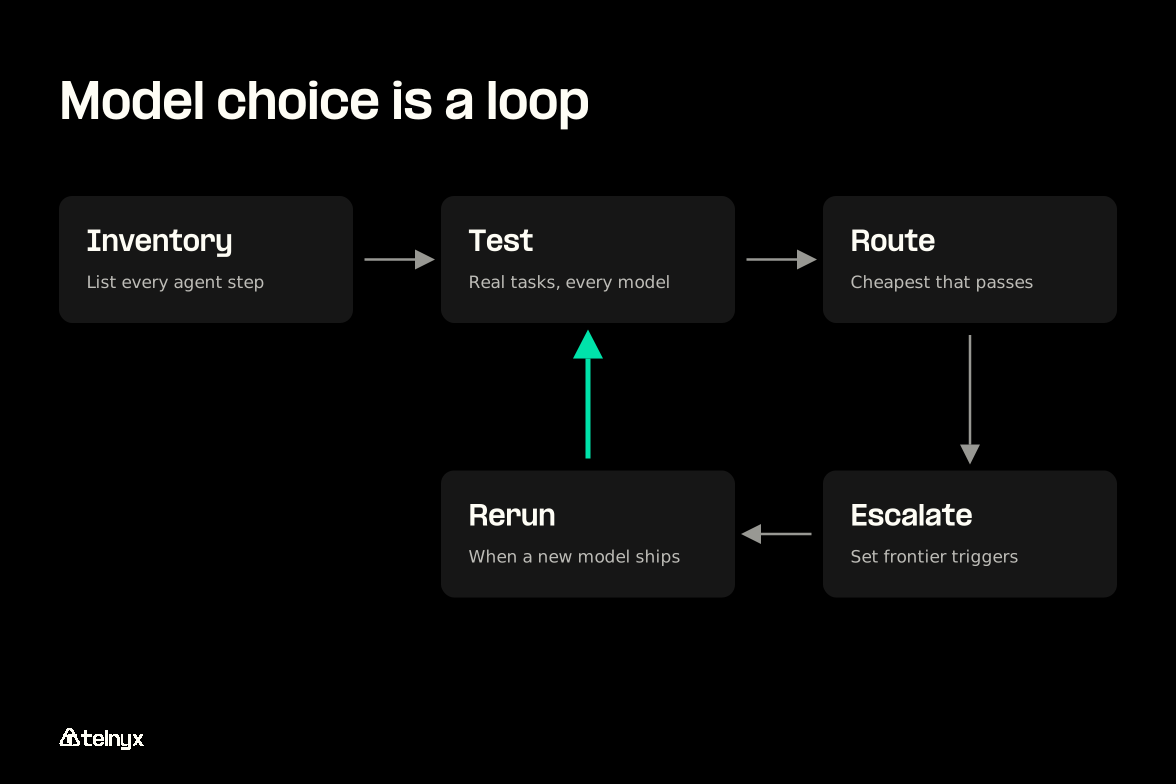
The compute efficient frontier is the set of models that deliver the most capability per dollar. It shifts with every major release: GLM-5.3, Kimi K3, and DeepSeek-V4.1-Flash all shipped open weights between late July and mid-September 2026. A model choice made once and never revisited goes stale within a quarter.
Benchmarks set the prior, your workload sets the decision
Public benchmarks narrow the shortlist but rarely pick the winner. When Telnyx engineers tested three open-weight models across 45 multi-turn agent conversations, the three landed within one objective check of each other, but judged completion separated them clearly. Kimi K3 completed all 30 judge decisions; GLM-5.3 Flash completed 90 percent at the fastest latency profile.
How to read a new model release in five minutes
Six checks separate a useful release from a headline:
- License: Apache 2.0 and MIT carry no conditions; custom licenses can add attribution, revenue thresholds, or approval steps.
- Who ran the benchmark: vendor-reported scores often run higher than independent runs of the same test.
- Which benchmark: pick the one closest to the actual workload, not the one with the biggest number.
- Active parameters: for mixture-of-experts models, active parameters drive serving cost more than total size.
- Context and modalities: confirm the context window and input types match the agent's real inputs.
- Hosted price: check input, cached input, and output rates on the provider's price card.
Switching models without a redeploy
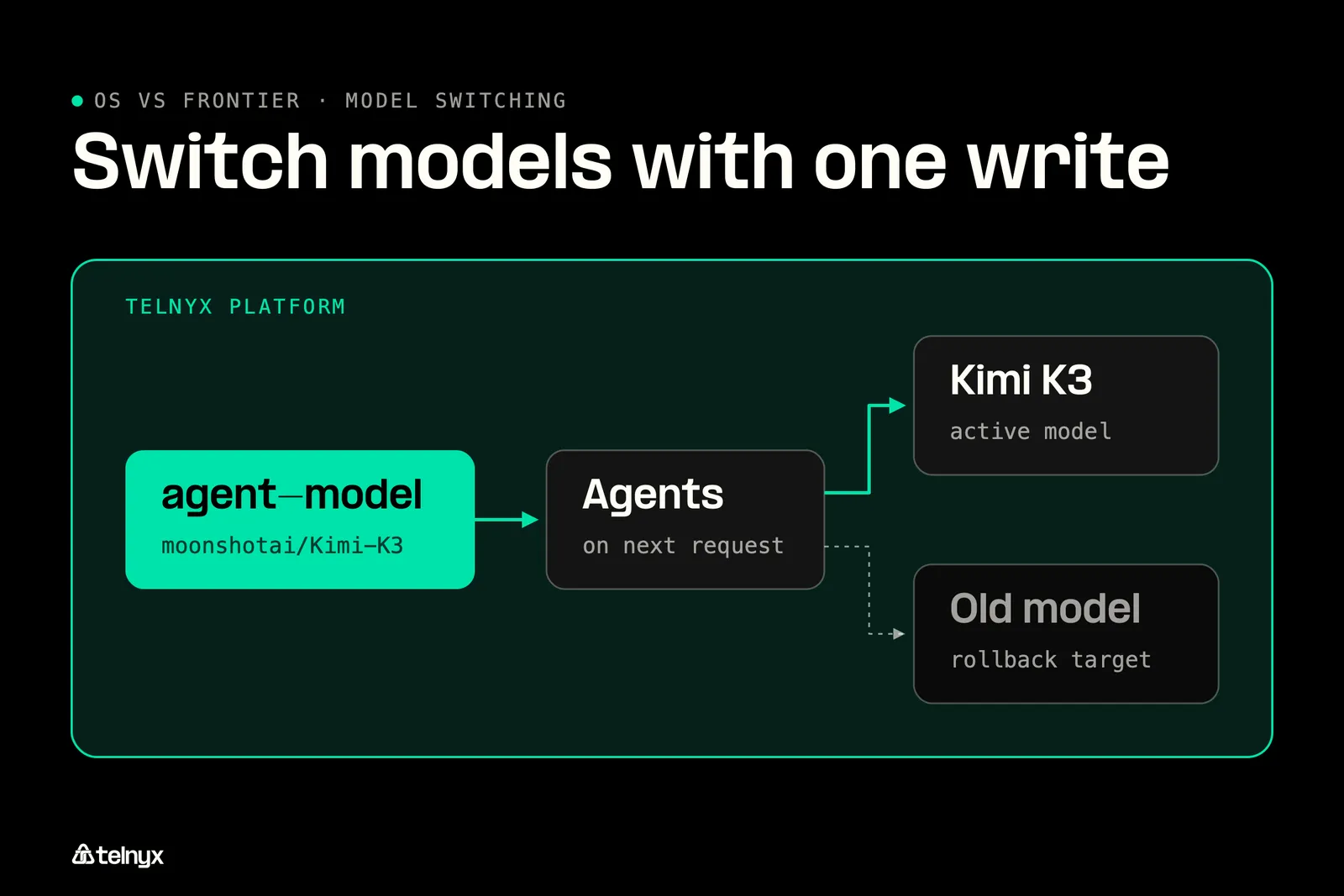
The cheapest way to stay on the efficient frontier is to stop hard-coding the model. Store the model ID in a flag, read it at request time, and change it when evals favor a new release. Telnyx KV is built for this kind of small, read-heavy value.
The Node.js example below reads the active model from a KV namespace over the REST API, then sends a chat completion.
Writing moonshotai/Kimi-K3 to the agent-model key moves every agent to Kimi K3 on its next request. Writing the old value back is the rollback. In production, cache the flag for a few seconds to avoid a KV read on every call.
FAQ
How far behind frontier models are open-weight models on multimodal and video input?
The input gap has largely closed. Kimi K3 and MiniMax-M3 accept text, images, and video, and Qwen3.8-27B handles image and video input on a single GPU. Output quality on complex visual reasoning still varies by task, so test on real inputs before switching. Check license terms as well: Llama 4's multimodal models carry an EU restriction.
How do we move agent traffic from a closed model to an open-weight model without breaking the agents?
Run the open-weight candidate against recorded production conversations first, scoring tool calls, format compliance, and task completion. Then route a small share of live traffic through a feature flag, compare results, and widen the share in steps. An OpenAI-compatible endpoint keeps the client code unchanged.
How does cached input pricing compare between open-weight and frontier models?
Cached input narrows the gap more than uncached rates suggest. At standard rates, Claude Opus 5.5 charges $0.20 per 1M cached input tokens and GPT-6 Astra charges $1.00, while GLM-5.3 on Telnyx charges $0.24 and Kimi K3 charges $0.27. The larger savings for open-weight models come from uncached input and output.
What is the difference between open source and open weight models?
Open source AI, under OSAID 1.0, publishes weights, full training and inference code, and detailed training data information. Open weight models publish the trained weights and a license, usually without the data or training code. Nearly every leading "open" model today is open weight.
Is it cheaper to self-host an open-weight model or use a hosted API?
For most teams, a hosted API costs less until volume is very high and steady. Frontier-class open models need serious hardware: GLM-5.3 realistically needs an eight-GPU node, and Kimi K3's full weights take about 1.56 TB. Self-hosting also adds capacity planning and operations work that per-token pricing does not.
Build agents on frontier-class open models
Frontier capability no longer requires a closed API. Telnyx Inference runs GLM-5.3, Kimi K3, MiniMax-M3, DeepSeek-V4.1-Flash, and more on GPUs Telnyx owns, through one OpenAI-compatible endpoint with in-region serving and no minimums.
Start building with Telnyx Inference → https://telnyx.com/products/inference
Build agents on the right model for each task
Run frontier-class open-weight models at a fraction of closed flagship prices, and save closed frontier models for the hardest, highest-stakes work.
Start routing modelsShare on Social


%20(1).png?width=96&format=webp)


