
Voice
Voice AI Agents Compared on Latency: 2026 Benchmarks
Telnyx had the lowest median latency of five voice AI platforms in a caller-side test over real phone calls. Here's how six platforms compare across four third-party benchmarks.

By Eli Mogul
Updated October 2026
Quick answer: Telnyx had the lowest median latency of five voice AI platforms, 1,296 ms, in Openbenchmarks' caller-side test over real phone calls. ElevenLabs had the lowest p95 in the same test and the fastest mean response time in Cekura's agent-layer benchmark. On question turns alone, the two were within 86 ms of each other under different endpointing settings.
Lower latency means a shorter pause before the agent replies. In the independent tests cited in this guide, Telnyx had the lowest median in the caller-side benchmark, finished third of eight on response time in Cekura's test and posted the fastest carrier leg in TECHSY's, which puts it among the fastest voice AI agent platforms tested.
What is voice AI latency and why does it matter?
Voice AI latency is the delay between the end of a caller's question and the start of the agent's response. It matters because long pauses feel unnatural. At about two seconds of silence, callers think the line dropped and start talking again, right over the agent's reply.
The infrastructure behind each call adds delay: the phone network, speech recognition, the language model, and the voice that speaks the reply. Telnyx's voice AI latency guide covers each step in detail.
Which voice AI platform has the lowest latency?
Telnyx's median latency of 1,296 ms is 444 ms faster than Retell, the slowest of the five platforms that Openbenchmarks tested. ElevenLabs led the same test's tail and another benchmark run by Cekura.
That pooled median combines three question turns with a scripted goodbye. On the question turns alone, Telnyx and ElevenLabs stayed within 86 ms of each other, and each was faster on at least one turn.
| Platform | Best for | Main trade-off |
|---|---|---|
| Telnyx | Phone agents where telephony and AI share one network | Lowest interruption-handling score (4.63 of 5) in Cekura's v1 benchmark |
| ElevenLabs | Steady tail latency and natural-sounding voices | Sells no phone numbers, so the call leg runs on another carrier |
| Bland | High-volume outbound calling campaigns | Its 400 ms homepage figure has no published test method |
| Vapi | Teams that choose and tune every model provider | 41 of 246 Cekura test calls failed to connect |
| Retell | Managed agent building with strong workflow reliability | Slowest caller-side median (1,740 ms) in the Openbenchmarks test |
| Twilio | Adding a team's own AI to an existing Twilio voice stack | Its agent product has no caller-side benchmark yet |
Voice AI latency benchmarks compared side by side
Four third-party voice AI latency benchmarks published results between March and September 2026, but they measured different things.
Openbenchmarks' calls ran through August 1, 2026, Cekura's v1 was last updated September 29, 2026, Tested Media ran in March 2026, and TECHSY ran June 6 to 8, 2026.
Openbenchmarks, Tested Media and TECHSY report a median and a p95 latency, while Cekura reports a mean only. Openbenchmarks and Tested Media both measure the gap from the end of the caller's speech to the start of the agent's, but only Openbenchmarks explains how it detects those moments.
Third-party voice AI latency results. Each column is a separate test with its own scope.
| Platform | Openbenchmarks median / p95 | Cekura v1 mean response time | Tested Media median / p95 | TECHSY median / p95 |
|---|---|---|---|---|
| Telnyx | 1,296 ms / 1,856 ms | 1.82 s | Not tested | 71 ms / 118 ms |
| ElevenLabs | 1,424 ms / 1,768 ms | 1.27 s | Not tested | Not tested |
| Bland | 1,520 ms / 2,248 ms | Not tested | 850 ms / 1,180 ms | Not tested |
| Vapi | 1,558 ms / 2,008 ms | 3.08 s | 720 ms / 1,050 ms | Not tested |
| Retell | 1,740 ms / 2,259 ms | 2.21 s | 680 ms / 920 ms | Not tested |
| Twilio | Not tested | Not tested | Not tested | 89 ms / 161 ms |
Vendors publish their own figures too, and most either measure a narrower slice of the call than the caller hears or do not say where the clock runs.
Vendor-published latency figures and what each one measures.
| Platform | Published figure | What it measures |
|---|---|---|
| Telnyx | Under one second | From the moment a user finishes speaking until they hear the reply; test conditions not published |
| ElevenLabs | About 75 ms | Flash text-to-speech model latency only, not a full turn |
| Bland | 400 ms | Homepage figure, with no published test method |
| Vapi | Below 500 ms p50, below 800 ms p95 | A performance target set on Vapi's engineering blog, not a measured result |
| Retell | As low as about 600 ms | End of user speech to start of agent response |
| Twilio | 491 ms p50, 713 ms p95 | Internal ConversationRelay test, scope not fully disclosed |
Openbenchmarks measured one cause of the gap between the two tables: the latency a platform reported for the same calls ran roughly 490 ms below what the call recording shows at the caller's end. In that comparison, the self-reported figures marked the moment a reply was produced, not the moment the caller heard it. No platform in its test had a caller-side median under one second.
Tested Media's medians sit 670 to 1,060 ms lower than Openbenchmarks' for the same three vendors. Tested Media's study names the same nominal window, end of caller speech to start of agent speech, across 500 production calls per platform in March 2026. It does not publish how or where it detected those events, so the cause of the gap is unknown.
Cekura's means run higher than Openbenchmarks' caller-side medians for Telnyx, Vapi and Retell, and lower for ElevenLabs (1.27 s against 1,424 ms).
What does each voice AI latency test measure?
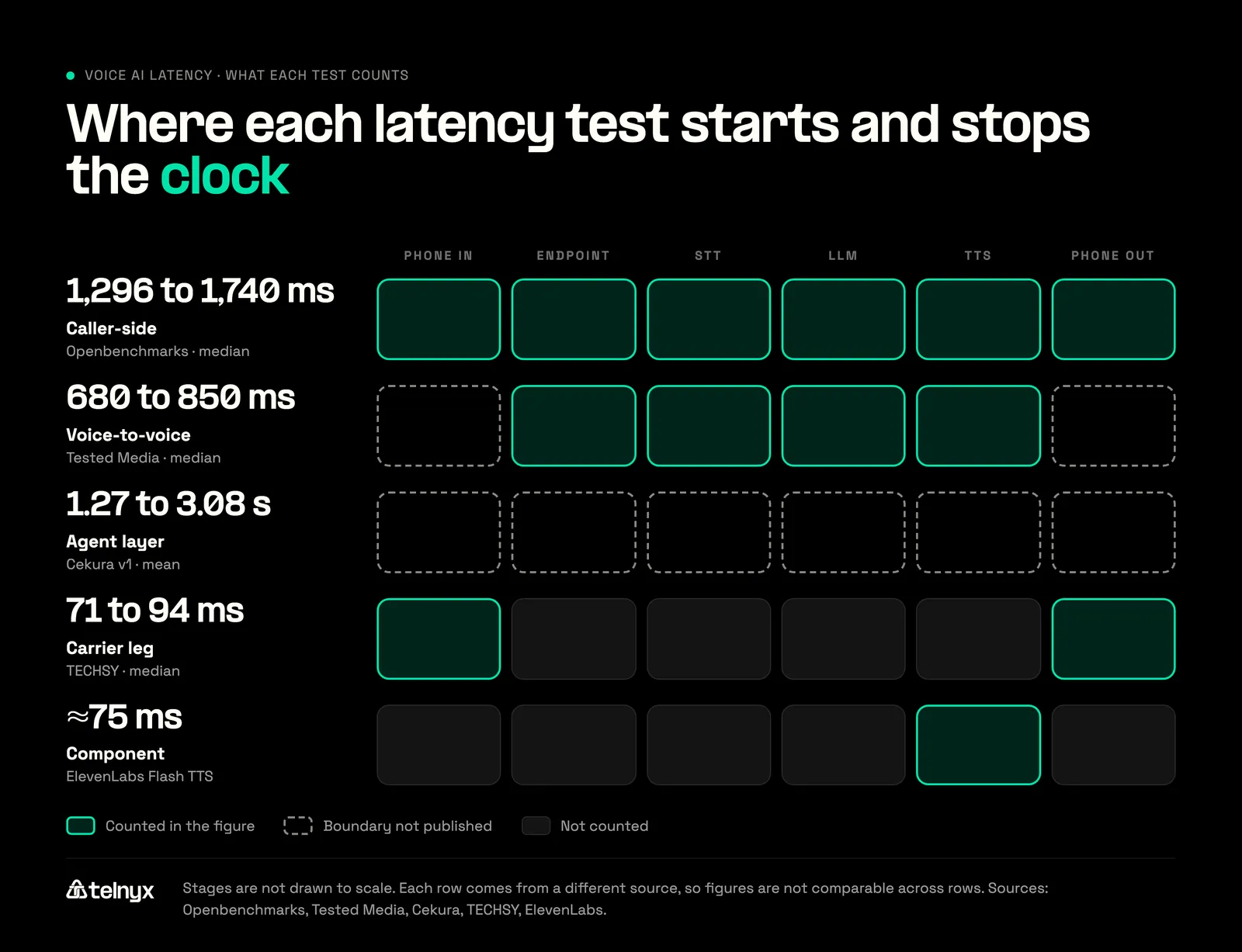
Openbenchmarks, Cekura, Tested Media and TECHSY each measure a different part of a voice AI call. Openbenchmarks times the full pause a caller hears, called time to first audio byte (TTFAB), from a recording of each call. Tested Media times the same pause, from the end of caller speech to the start of the agent's reply, but doesn't publish how it detects those moments. Cekura measures response time at the agent layer without saying exactly where its clock starts, and TECHSY times only the round trip across the phone network.
| Measurement | Clock starts | Clock stops | Used by |
|---|---|---|---|
| Caller-side time to first audio byte (TTFAB) | The caller stops speaking, read from the call recording | The caller hears the agent's first audio | Openbenchmarks |
| Agent-layer mean response time | Not published ("measured at the main-agent layer") | Not published | Cekura v1 |
| Voice-to-voice | End of caller speech | Start of agent speech (detection method not published) | Tested Media |
| Carrier-leg round-trip time (RTT) | Not published (network round trip on the carrier leg only) | Not published | TECHSY |
| Component latency | One stage starts | That stage finishes | Vendor TTS and model figures |
Caller-side latency is the closest published measure of what a caller experiences, because it comes from the caller's end of the recording. Openbenchmarks dialed each agent from a carrier that was not under test (Plivo), recorded both sides of the call on one clock, and found both endpoints with a speech detector instead of a platform timestamp. Turns it could not time cleanly, such as both sides talking at once, were counted and published rather than dropped.
The Openbenchmarks setup carries two caveats. The first is endpointing: the time an agent waits after the caller goes quiet before it treats the turn as finished. Openbenchmarks pinned it to 0.1 s on Telnyx, Vapi and Retell. Bland and ElevenLabs expose no equivalent fixed timer, so they ran their own settings: the run data records a model-based turn detector at "normal" eagerness for ElevenLabs and an interruption threshold of 500 for Bland. Neither maps to a fixed wait, so how much time those settings added is not published.
The second caveat is the model stack. Each platform ran the stack it gives a new account rather than one fixed stack, so the results compare platform defaults, not identical pipelines. Openbenchmarks' published run data records each default.
Default stacks in the Openbenchmarks runs, from its published run data.
| Platform | Language model | Speech-to-text | Voice |
|---|---|---|---|
| Telnyx | Kimi K2.6 | Deepgram Flux | Telnyx Ultra |
| ElevenLabs | Gemini 2.5 Flash | ElevenLabs Scribe (realtime) | ElevenLabs Flash v2 |
| Vapi | GPT-4.1 | Soniox (stt-rt-v5) | Vapi Elliot |
| Retell | GPT-4.1 | Not recorded | Retell Cimo |
| Bland | Tier only ("enhanced"), no model name | Not recorded | Not recorded |
Ranking the lowest-latency voice AI platforms
Voice agent latency differed by up to 444 ms at the median across the five platforms Openbenchmarks dialed, and the ranking shifted once the tail, the agent layer and the carrier leg came into view.
Telnyx led the pooled caller-side median, ElevenLabs led the tail and the agent-layer mean, and Retell led repeatable reliability.
Telnyx
Telnyx's voice AI agent platform co-locates GPU inference with Telnyx's telephony points of presence, so a call's audio stays on one private network for the whole turn. That design fits phone agents where telephony, speech, inference and observability need to sit in one operating environment. Developers build on the same network through Telnyx's Voice API.
Openbenchmarks measured Telnyx at 1,296 ms median and 1,856 ms p95 across 419 usable turns of 432 attempted, the lowest pooled median of five. That median includes a scripted goodbye turn, where Telnyx answered in 1,046 ms; Openbenchmarks describes the one platform with a goodbye near one second, which is Telnyx, as giving a complete reply rather than a false start. Across the three question turns Telnyx's medians were 1,376, 1,426 and 1,344 ms, against 1,429, 1,412 and 1,430 ms for ElevenLabs.
In Cekura's v1 benchmark, Telnyx completed 97.56% of 246 calls, tied for first, with no provider-side issues on any call and a 1.82 s mean response time, third of eight. TECHSY measured its carrier leg at 118 ms p95.
Telnyx publishes a figure of under one second from the moment a user finishes speaking until they hear the reply. On the default stack a new account receives, Openbenchmarks' caller-side test measured 1,296 ms.
The trade-offs are interruption handling and the tail. Telnyx scored 4.63 of 5 on interruption handling, lowest of eight in Cekura v1, and its p95 was 1.43 times its median against 1.24 for ElevenLabs.
ElevenLabs
ElevenLabs fits teams that weigh voice quality and a steady tail latency above everything else.
Its default agent in Openbenchmarks' test ran Gemini 2.5 Flash, ElevenLabs' own Scribe transcription and the Flash v2 voice.
Openbenchmarks measured ElevenLabs at 1,424 ms median and 1,768 ms p95 across 429 usable turns of 432 attempted, the lowest p95 of five. Its tail was the tightest at 1.24 times the median. It was also the most even from turn to turn, holding between 1,412 and 1,430 ms on every turn, with only 3 turns discarded.
In Cekura's v1 benchmark, ElevenLabs had the fastest mean response time of 1.27 s, the highest voice naturalness score at 4.47 of 5, and no provider-side issues on any call. It completed 91.46% of tasks, below Telnyx and Vapi at 97.56%. Its widely cited 75 ms figure describes its Flash text-to-speech model alone, not an agent turn.
Cekura's example of what to improve shows the agent describing a tool call, then carrying on with a result it made up.
The trade-off sits on the phone side: ElevenLabs sells no phone numbers, so Openbenchmarks ran its agent on a Twilio number, and production deployments depend on another carrier for the call leg.
Bland
Bland is built for outbound campaigns that need dialing workflows and call logic at volume. In Openbenchmarks' test its agent answered on Twilio-backed numbers inside Bland's own account, and the run data records only its "enhanced" tier, not the model behind it.
Openbenchmarks measured Bland at 1,520 ms median and 2,248 ms p95 across 429 usable turns of 432 attempted, third of five at the median. It held steady from turn to turn, between 1,508 and 1,545 ms. Its tail was the widest of the five at 1.48 times the median, which put its p95 past the two-second mark where callers start talking over the agent.
Tested Media measured Bland at 850 ms median and 1,180 ms p95 voice-to-voice across 500 production calls in March 2026, with a worst-case turn of 1,650 ms. Bland was not in Cekura's v1 benchmark, so there is no public task-completion or reliability score to set beside its latency results.
Bland's homepage lists a 400 ms figure without the start event, percentile, or test setup behind it. Both third-party tests scored well above that.
Vapi
Vapi fits engineering teams that want to choose the transcriber, language model, and voice for each agent.
Openbenchmarks measured Vapi at 1,558 ms median and 2,008 ms p95, and discarded 50 of its 432 turns, more than any other platform. Openbenchmarks also flagged false starts on Vapi's scripted goodbye turn: on 44 of 89 kept goodbye turns, more than half a second passed between the agent's first sound and its actual reply.
In Cekura v1 Vapi matched Telnyx's 97.56% task completion among calls with outcome evidence. But 41 of its 246 calls never connected, which Cekura counts separately, and its 3.08 s mean response time was the slowest of eight.
Vapi's engineering blog sets a target of under 500 ms p50 and under 800 ms p95, a performance standard rather than a measured result. Its default settings also wait longer than the test did: Openbenchmarks found Vapi shipped with a 0.4 s endpointing wait, stretching to 1.5 s when a sentence ended without punctuation, and pinned it to 0.1 s for the test.
Tested Media measured an optimized Vapi setup at 720 ms median and 1,050 ms p95.
Since the stack is the customer's choice, Vapi's latency depends on the providers selected as much as on the platform itself.
Retell
Retell fits teams that want a managed workflow to build, test, and monitor phone agents.
Openbenchmarks measured Retell at 1,740 ms median and 2,259 ms p95 caller-side across 419 usable turns of 430 attempted, the slowest of five. Its turns were even, between 1,702 and 1,756 ms, so the gap to the leaders held through the whole call. Retell also shipped with a 1,000 ms endpointing wait, which Openbenchmarks pinned to 0.1 s for the test, so a Retell agent on default settings waits longer before each reply than it did in the test.
Retell leads on repeatable reliability. In Cekura v1 it passed 75.61% of scenarios on all three runs, first of eight, and scored a perfect 5 of 5 on interruption handling, with a 2.21 s mean response time.
Retell publishes latency as low as about 600 ms from the end of user speech to the start of the agent's response. Tested Media measured 680 ms median and 920 ms p95 voice-to-voice in March 2026, the lowest of four in that study, with a worst-case turn of 1,250 ms.
Twilio
Twilio suits teams already building on its communications platform that want to connect their AI application to phone calls.
TECHSY ran the same production agent on Twilio, Telnyx and Vonage trunks from one US-East region and measured Twilio's carrier leg at 89 ms p50 and 161 ms p95, against 71 ms and 118 ms on Telnyx. TECHSY lists Twilio's path as public internet rather than a private backbone, and call setup took 470 ms against 380 ms on Telnyx.
Twilio's own agent product has no third-party full-turn result yet. Openbenchmarks lists it as not yet measured, and Cekura and Tested Media did not include it.
Twilio reports 491 ms p50 and 713 ms p95 for ConversationRelay from an internal test that does not fully define which parts of the customer's application and model path it includes.
With the model and application logic outside the voice layer, Twilio's full-turn latency depends on the customer's own stack.
Why the carrier leg matters for voice AI latency
The carrier leg is the one part of the call path every platform crosses twice per turn, once to hear the caller and once to answer. TECHSY's test isolated it by running the same production agent, same code, and same AI stack on three carriers from one US-East region, across 120 outbound calls per carrier from June 6 to 8, 2026.
| Carrier | p50 RTT | p95 RTT | Call setup |
|---|---|---|---|
| Telnyx | 71 ms | 118 ms | 380 ms |
| Twilio | 89 ms | 161 ms | 470 ms |
| Vonage | 94 ms | 152 ms | 510 ms |
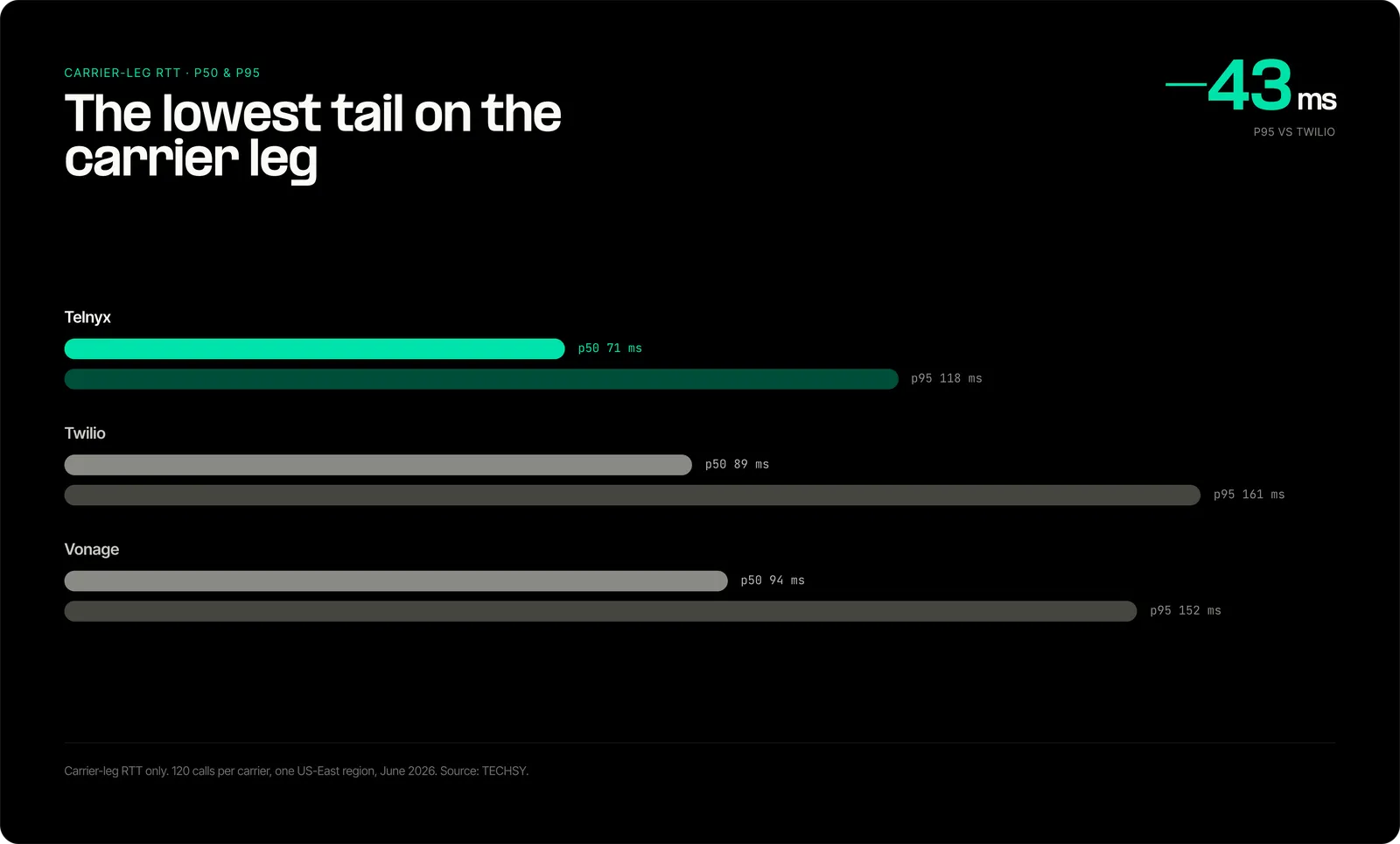
Telnyx's p95 came in 43 ms below Twilio's in that test. On a PSTN call, the carrier leg measured 71 to 94 ms at the median across TECHSY's three carriers, while a full turn measured 1,296 to 1,740 ms at the median caller-side in Openbenchmarks' test. Those two ranges come from different tests, so they show scale, not a precise share.
On a turn that takes about 1.3 seconds at the caller's end, the carrier leg is a small share of the wait, and models, endpointing and synthesis make up most of the rest. It still deserves its own measurement, because it is the slice no prompt change or model swap can recover.
The carrier answering the call also differed across the Openbenchmarks platforms. Telnyx's agent answered on Telnyx's own network. Retell's and Bland's answered on Twilio-backed numbers inside their own accounts, ElevenLabs ran on a Twilio number, and Vapi's upstream carrier was not disclosed.
 | “Full-turn latency tells you a call felt slow, which is helpful, but it makes it tough to diagnose what to fix. Carrier RTT tells you whose fault it is. This matters because you can’t optimize what you haven’t decomposed.” Abhishek Sharma |
What to compare besides latency
A fast agent that fails the caller's task costs more than a slower one that completes it, which is why Cekura's v1 benchmark scored reliability alongside response time. Each provider chose its own configuration, received the same prompt and tools, and ran 82 caller scenarios three times.
Cekura v1 results, September 2026. Task completion counts calls with outcome evidence, so its denominator varies by configuration; calls without provider issues counts every provider-side or connection problem, including calls that never connected.
| Platform | Task completion | Calls without provider issues | Interruption handling (of 5) | Voice naturalness (of 5) | Mean response time |
|---|---|---|---|---|---|
| Telnyx | 97.56% | 100.00% | 4.63 | 4.21 | 1.82 s |
| ElevenLabs | 91.46% | 100.00% | 4.96 | 4.47 | 1.27 s |
| Retell | 93.88% | 98.37% | 5.00 | 4.36 | 2.21 s |
| Vapi | 97.56% | 82.93% | 4.73 | 4.08 | 3.08 s |
| GPT Realtime (speech-to-speech model) | 92.68% | 95.53% | 4.98 | 4.25 | 1.58 s |
| LiveKit (self-hosted framework) | 95.12% | 99.19% | 4.97 | 4.36 | 2.59 s |
| Pipecat (self-hosted framework) | 94.21% | 97.15% | 4.97 | 3.74 | 1.97 s |
| Gemini Live (speech-to-speech model) | 87.80% | 72.36% | 4.97 | Not scored | 3.05 s |
Telnyx tied for the highest task completion and had no provider-side issues on any call, while it scored lowest on interruption handling, Cekura's measure of how naturally an agent handles barge-in and turn changes. Retell led repeatable reliability, passing 75.61% of scenarios on all three runs against Telnyx's 68.29%. A buyer whose callers interrupt often should weight that column heavily.
Voice naturalness is the closest public proxy for how an agent sounds to a caller, and ElevenLabs led it at 4.47 of 5. Neither Cekura nor Openbenchmarks tested accent or dialect coverage, so that comparison still needs a team's own recordings.
Cost is the other dimension Openbenchmarks reported next to latency, measured from each platform's own billing per minute invoiced: Telnyx $0.0500, ElevenLabs $0.0794, Vapi $0.0836, Retell $0.1341 and Bland $0.1408. Telnyx bills a 60-second minimum, so Openbenchmarks also reports its cost per minute actually spent talking: $0.0722.
The top voice AI providers comparison covers pricing, features, and tradeoffs in more detail.
How to run your own voice AI latency test
A team running its own latency benchmark can follow six steps:
- Dial from the same regions that callers originate from, since geography changes every network leg and a result from one region does not carry to another.
- Set the endpointing timer to the same production value on every platform that exposes one, and note which platforms do not.
- Use the prompts, tools and voices the agent will ship with in production.
- Record both sides of each call on one clock, then mark where the caller stops and the agent starts with a voice activity detector such as Silero VAD.
- Report the median, the p95 and the tail ratio (p95 divided by the median), since a low median can hide a long tail.
- Count both failed and discarded turns instead of dropping them, and check that each agent's first sound is its actual reply rather than a false start. Openbenchmarks attempted about 430 turns per platform and reported how many it discarded.
Frequently asked questions about voice AI latency benchmarks
What voice AI agents have the lowest latency?
The voice AI agents with the lowest latency in current benchmarks are Telnyx at the median and ElevenLabs at the tail. In Openbenchmarks' caller-side test of five platforms, Telnyx's pooled median was 1,296 ms and ElevenLabs had the lowest p95, 1,768 ms. ElevenLabs also had the fastest mean response time, 1.27 s, in Cekura's v1 benchmark. On question turns alone the two were within 86 ms under different endpointing settings, so the lowest latency voice AI platform for a deployment comes down to a test on its own call path.
What is the typical latency for a voice AI agent on a phone call?
Voice agent latency on real phone calls typically runs about 1.3 to 1.7 seconds measured at the caller's end. Openbenchmarks recorded medians from 1,296 ms to 1,740 ms across five platforms, and none came in under one second. Platform-reported figures often run lower because they mark when the reply is produced, not when the caller hears it. The voice AI latency guide covers thresholds and definitions.
Why are vendor latency claims lower than benchmark results?
Vendor latency claims and benchmark results usually measure different moments. In Openbenchmarks' test, the latency platforms reported for the same calls ran roughly 490 ms below the caller-side measurement, because the platform figure marked when a reply was produced, not when the caller heard it. Published marketing figures are a separate case: Retell publishes latency as low as about 600 ms against a 1,740 ms caller-side median, and no published source explains that gap.
How do Telnyx and Retell compare on latency?
Telnyx was faster than Retell in both recent benchmarks that tested the two: 1,296 ms against 1,740 ms median in Openbenchmarks' caller-side test, and 1.82 s against 2.21 s in Cekura's v1 benchmark. Retell led Cekura v1 on repeatable reliability (75.61% against 68.29%) and interruption handling (5.00 against 4.63). In Tested Media's March 2026 study, which did not include Telnyx, Retell had the lowest median of four.
How do Telnyx and Vapi compare on latency?
Telnyx recorded lower latency than Vapi in the two recent benchmarks that covered both: 1,296 ms against 1,558 ms median in Openbenchmarks, and 1.82 s against 3.08 s in Cekura v1. The two tied at 97.56% task completion among calls with outcome evidence in Cekura v1, while 41 of Vapi's 246 calls never connected and no Telnyx call had a provider-side issue. Vapi's results depend heavily on the providers a team selects.
How do Telnyx and Twilio compare on latency?
Telnyx's carrier leg measured faster than Twilio's in TECHSY's same-agent test: 118 ms against 161 ms at the p95, and 71 ms against 89 ms at the median. That test covers network round-trip only. Twilio's own agent product has not been measured caller-side, and its published 491 ms p50 for ConversationRelay comes from an internal test.
Does fast text-to-speech guarantee a low-latency voice agent?
Fast text-to-speech does not guarantee a low-latency voice agent, because synthesis is one stage of the call. ElevenLabs' Flash model lists about 75 ms of model latency, while its agent's caller-side median in Openbenchmarks was 1,424 ms. Endpointing, transcription, the model's turn and two phone legs account for the rest of the wait.
Test Telnyx on your own call path
Telnyx had the lowest pooled median in Openbenchmarks' caller-side test and tied for the highest task completion in Cekura's v1 test. Telnyx engineers can help plan a controlled production test of the full call path.
Book a demoShare on Social


