
Voice
The best Vapi alternatives for low latency voice AI in 2026
The best Vapi alternatives for voice AI, compared on latency, telephony ownership, pricing, and compliance. See why Telnyx leads, plus open-source options.

By Osman Husain
Vapi is a popular voice AI tool, but it is essentially an orchestration layer, which stitches together different APIs, LLM agents, and telephony providers to build a working product. This setup suits businesses when first starting out, but both cost and latency start to buckle at scale.
Debugging workflows is a pain, too, since the point of failure could be any of the multiple layers powering it. That's when an alternative to Vapi becomes a pressing need: a voice AI platform that can hold up at production scale, keep latency at a natural human level, and keep costs predictable.
The best Vapi alternatives in 2026, suitable for businesses running real-time voice agents at scale, are:
- Telnyx: owned infrastructure, tested at production-scale
- Retell: no-code phone agents
- Bland: regulated, on-premise deployments
- Twilio: teams already on Twilio
- Synthflow: managed enterprise rollout
- ElevenLabs: voice quality first
- LiveKit: open-source real-time infrastructure
- Pipecat: open-source pipeline framework
What to look for in a Vapi alternative
Five criteria are critical for production-grade voice AI agents: latency under load, telephony ownership, pricing model, compliance posture, and deployment options.
Latency under load. The benchmark is human conversation, where people exchange turns in about a quarter of a second. Latency must be close to this number; otherwise, the pause feels unnatural and off-putting for humans. The global body for telecommunications standards recommends one-way transmission time of 400 milliseconds as the ceiling, with lower latency preferred.
Who owns the telephony. A platform that owns its carrier network controls call quality end to end. A platform that resells telephony inherits someone else's latency and outage risk.
Pricing model. Spend is hard to forecast when billing is split across telephony, speech, and LLM providers. An all-in rate is easier to budget for because it's predictable.
Compliance posture. SOC 2 Type II, HIPAA, and PCI DSS are baseline requirements for healthcare, finance, and enterprise buyers. Since February 2024, the FCC has also held that unconsented AI-generated outbound calls are illegal under the Telephone Consumer Protection Act, meaning both the deployment model and consent handling are critical compliance criteria.
Deployment options. Cloud, VPC, and on-premise each suit different needs, and regulated teams often need a self-hosted path, too.
Vapi alternatives compared
Vapi and 8 alternatives at a glance
| Platform | Best for | Owns telephony | Latency (vendor-reported) | Pricing | Key limitation |
|---|---|---|---|---|---|
| Vapi (baseline) | Prototyping a custom pipeline | No (imports SIP) | Sub-600ms | $0.05/min hosting free tier; $999/mo Pro minimum; provider costs at cost | HIPAA is a $2,000/mo add-on; SLA and SSO are Premier-only |
| Telnyx | Owned-infrastructure voice AI at scale | Yes (Tier-1 carrier) | Sub-200ms RTT | ~$0.06/min all-in on one contract | Not a bring-your-own-everything toolkit |
| Retell | No-code phone agents | No (resold numbers or imported SIP) | Not published | ~$0.087/min at a realistic config | Four separately billed components; $8/concurrent-call beyond 20 |
| Bland | Regulated, on-premise deployments | No (rents telephony) | p50 380ms | $0.12 to $0.14/min plus $299/mo on Build | Not a carrier; proprietary-TTS lock-in |
| Twilio | Teams already on Twilio | Partial (buys termination) | Not published | $0.07/min ConversationRelay plus voice, STT/TTS, and your LLM | Owns no models or inference; needs a WebSocket server |
| Synthflow | Managed enterprise rollout | Partial (provisioned, not owned) | Not published | Enterprise only, from $30,000/year | No self-serve tiers |
| ElevenLabs | Voice quality and audio production | No (rents telephony) | Not published | $0.08/min Agents; LLM and telephony at cost | 40-concurrent-call ceiling even on the $990/mo plan |
| LiveKit | Open-source real-time infrastructure | No (self-managed) | Depends on your stack | Free to self-host; Scale from $500/mo | You own hosting, latency tuning, and telephony |
| Pipecat | Developers wanting the raw pipeline | No (self-managed) | Depends on your stack | Free, open-source | You assemble and host every component |
The 8 best Vapi alternatives in 2026
1. Telnyx: best for owning the network and AI layer
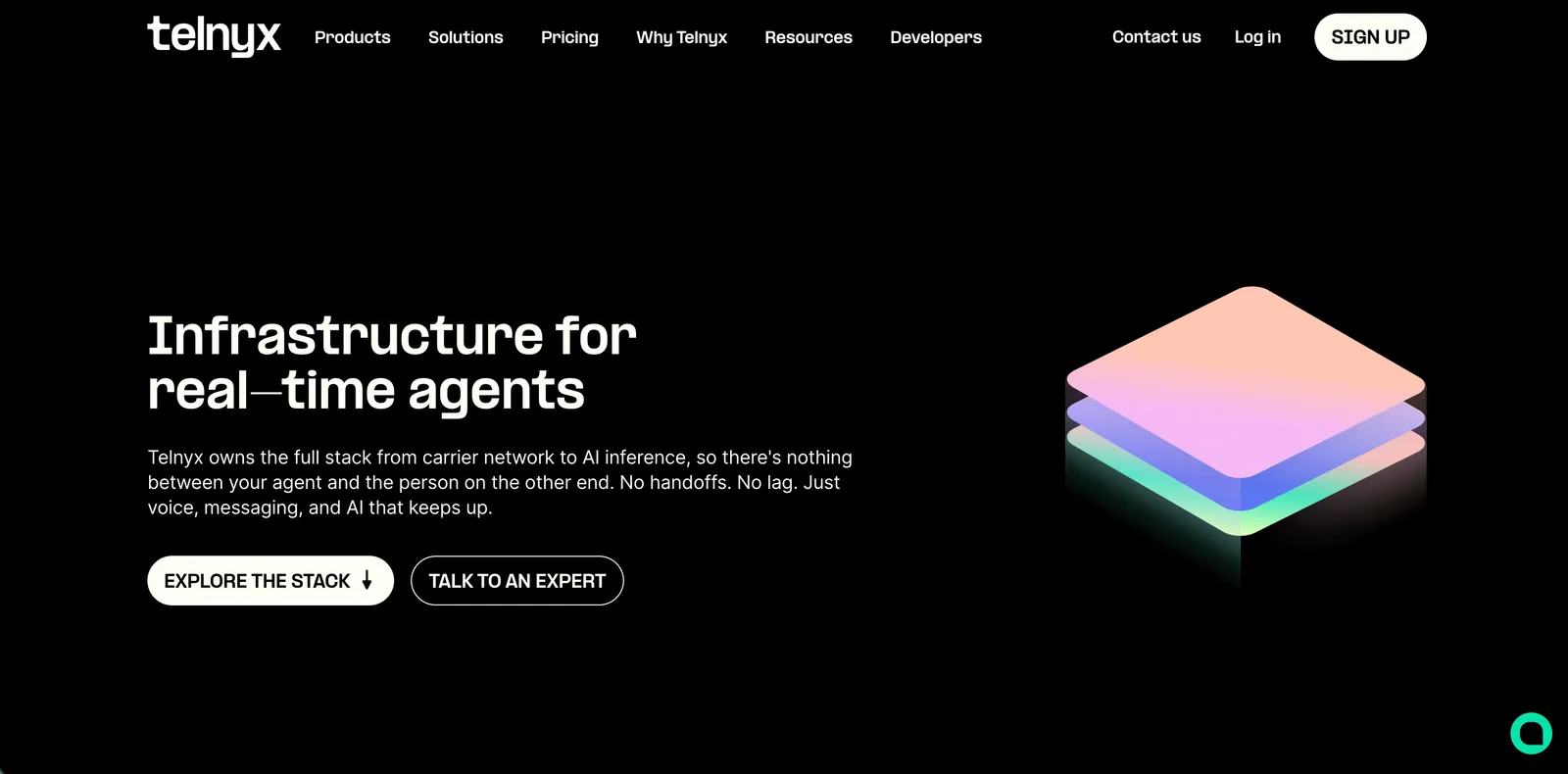
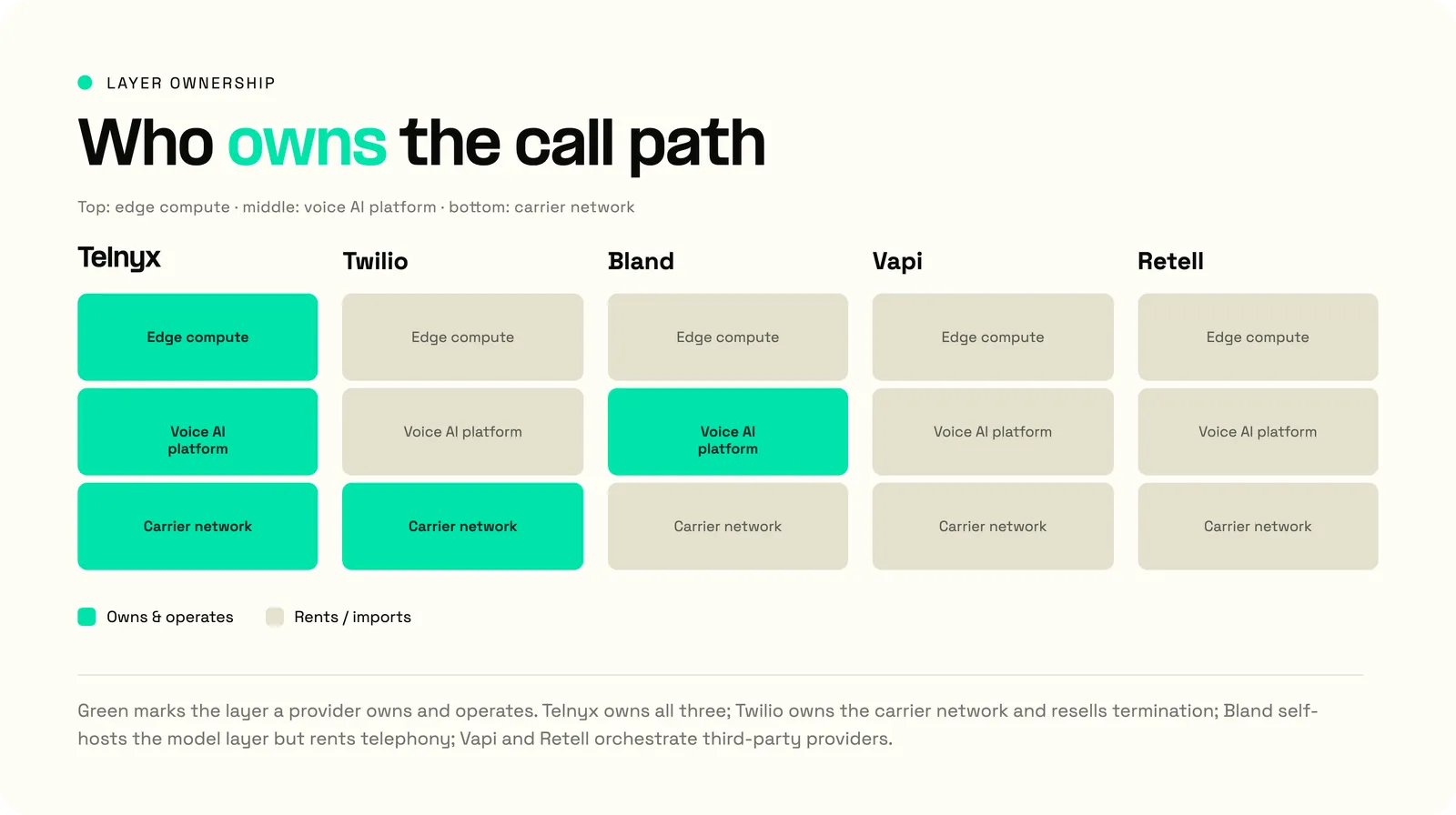
Telnyx owns all three layers a real-time voice call runs on: edge compute, the voice AI platform, and the carrier network. Unlike platforms that orchestrate third-party providers and rent telephony, Telnyx's Voice AI Agents run the whole call path on infrastructure Telnyx owns, removing the external hops that raise latency.
Edge compute puts inference next to the call. Speech-to-text, text-to-speech, and LLM inference run on co-located GPUs, which hold round-trip time under 200 milliseconds.
Best for: teams running real-time voice AI at scale that want the network and the AI layer owned by one provider.
Key features:
- Co-located GPU inference across 20+ global points of presence, run as one operational domain
- Carrier-owned network with STIR/SHAKEN Attestation on calls from owned numbers
- A managed LiveKit path for teams that want the open-source agent model without operating the carrier layer
Limits:
- Less suited to teams that want to bring their own STT, LLM, TTS, and telephony providers and compose them freely
- The no-code builder is thinner than Retell's visual conversation-flow tooling
Pricing: Telnyx's voice engine is $0.05 per minute, bundling orchestration, speech-to-text, and text-to-speech. Production agents land near $0.06 per minute.
Choose Telnyx if you are past the experiment stage and want one predictable contract, an owned call path end to end, and a carrier you hold the relationship with directly.
Build Telnyx Voice AI Agents work on infrastructure you own end to end.
2. Retell: best for appointment and IVR phone workflows
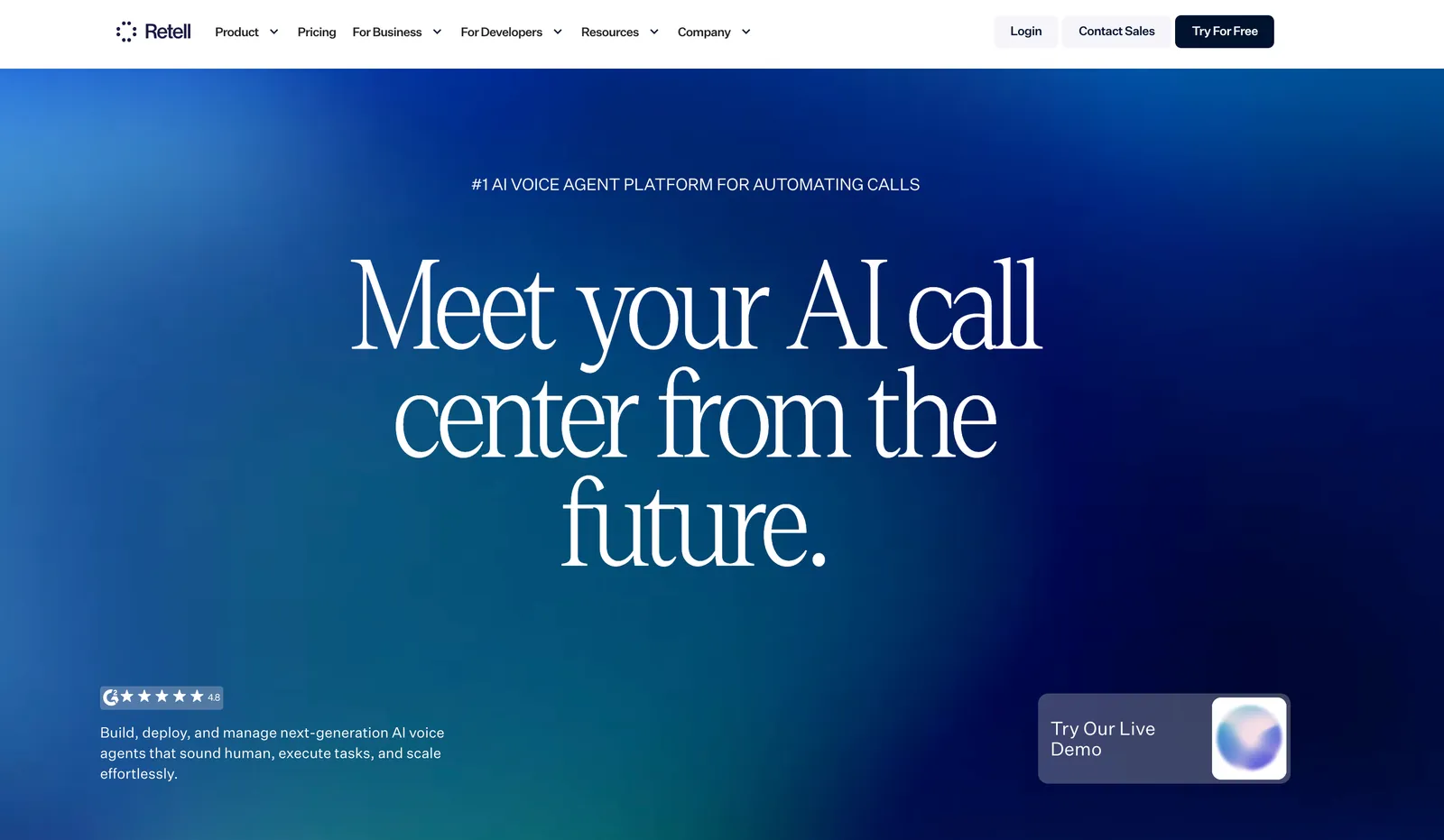
Retell focuses on phone agents that handle real call flows: booking appointments, working through IVR menus, and transferring calls with context. It reads closer to a trained receptionist than a raw API, which is why appointment-driven teams pick it.
Its pricing page is also the clearest illustration on this list of what a rented, multi-vendor stack costs to assemble, because it itemizes four separately billed components.
Best for: appointment-driven and IVR-heavy phone workflows in healthcare, field services, and real estate.
Key features:
- Purpose-built call flows for booking, routing, and warm transfer
- No-code visual builder with productized QA and a 99.9% uptime SLA
- Transparent, itemized pay-as-you-go pricing
Limits:
- Cost is assembled from four line items: $0.055/min infrastructure, $0.015 to $0.040/min TTS, the LLM, and about $0.015/min telephony, before add-ons for knowledge base, denoising, guardrails, and PII removal, the last a paid extra regulated buyers should price in
- Concurrency beyond 20 free calls costs $8 per concurrent call per month, and Retell resells telephony rather than owning it
Pricing: roughly $0.087 per minute at a realistic configuration, rising toward $0.112 with common add-ons (Retell pricing page, September 2026).
Choose Retell if your priority is a no-code phone agent live fast and you can accept resold-telephony latency and itemized billing.
3. Bland: best for regulated, on-premise deployments
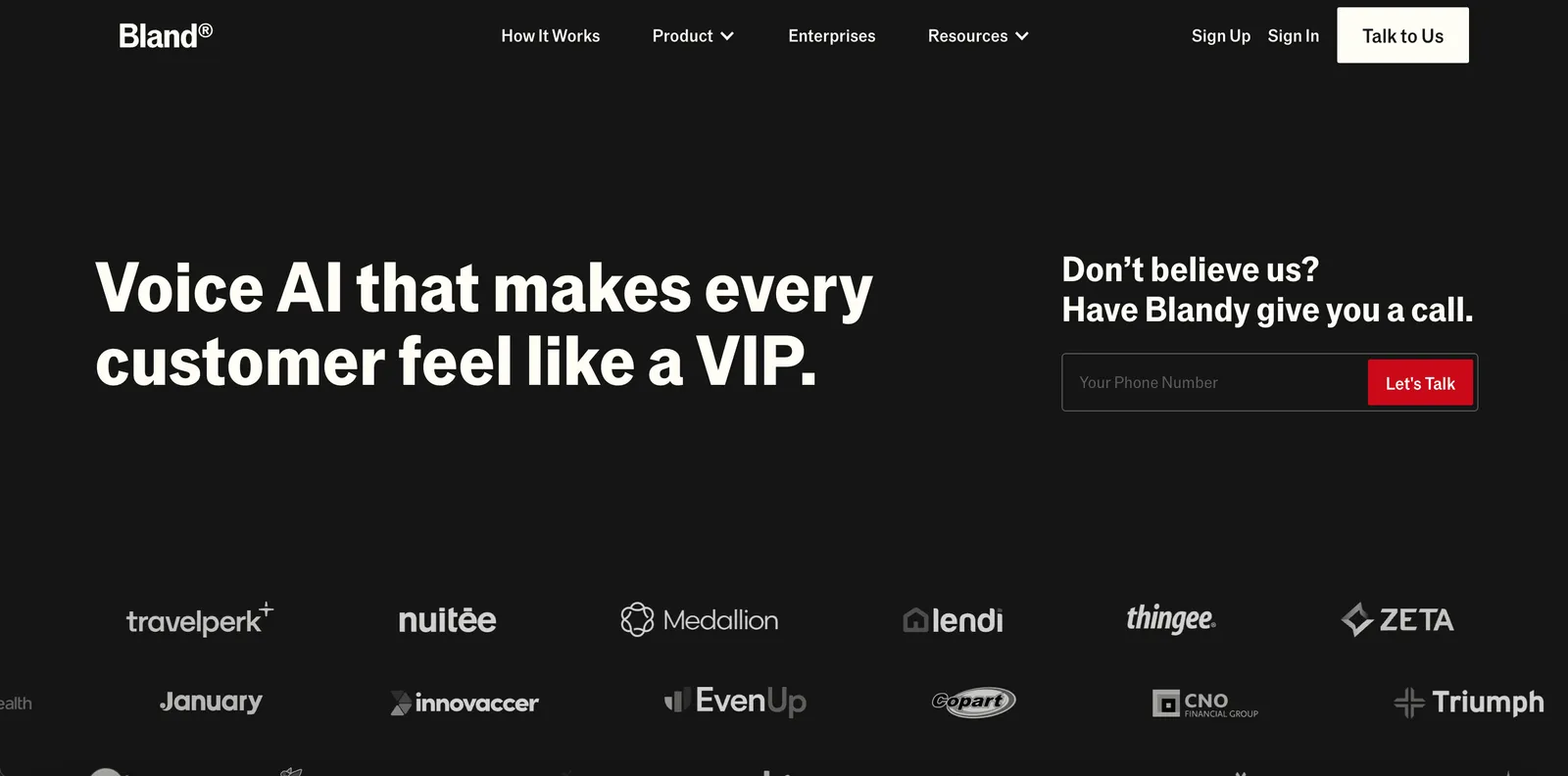
Bland runs voice agents on self-hosted models, transcription, inference, and text-to-speech without relying on third-party AI model providers. That vertical integration makes Bland the closest architectural peer to Telnyx on this list, with one decisive difference: Bland is not a carrier and rents its telephony.
It is also one of the very few vendors that publishes percentile latency.
Best for: regulated industries that need data sovereignty, on-premise deployment, and proprietary control over the model.
Key features:
- Self-hosted model stack with no third-party model pass-through
- Three deployment models: Bland Cloud, "Your VPC" on AWS, GCP, or Azure, and on-premise air-gapped on Enterprise plans only
- SOC 2 Type II, HIPAA, GDPR, and PCI DSS compliance
Limits:
- Not a carrier, so telephony is rented and call quality inherits a third-party network's latency and outage risk
- You run Bland's proprietary TTS, which is a lock-in, and the Build tier caps at 50 concurrent calls
Pricing: $0.14 per minute on Start, or $0.12 per minute on Build plus a $299 monthly platform fee, with a vendor-reported p50 latency of 380 milliseconds.
Choose Bland if data sovereignty and a self-hosted model stack matter most. Otherwise, check out Bland AI alternatives
4. Twilio: best for carrier-grade telephony with any LLM
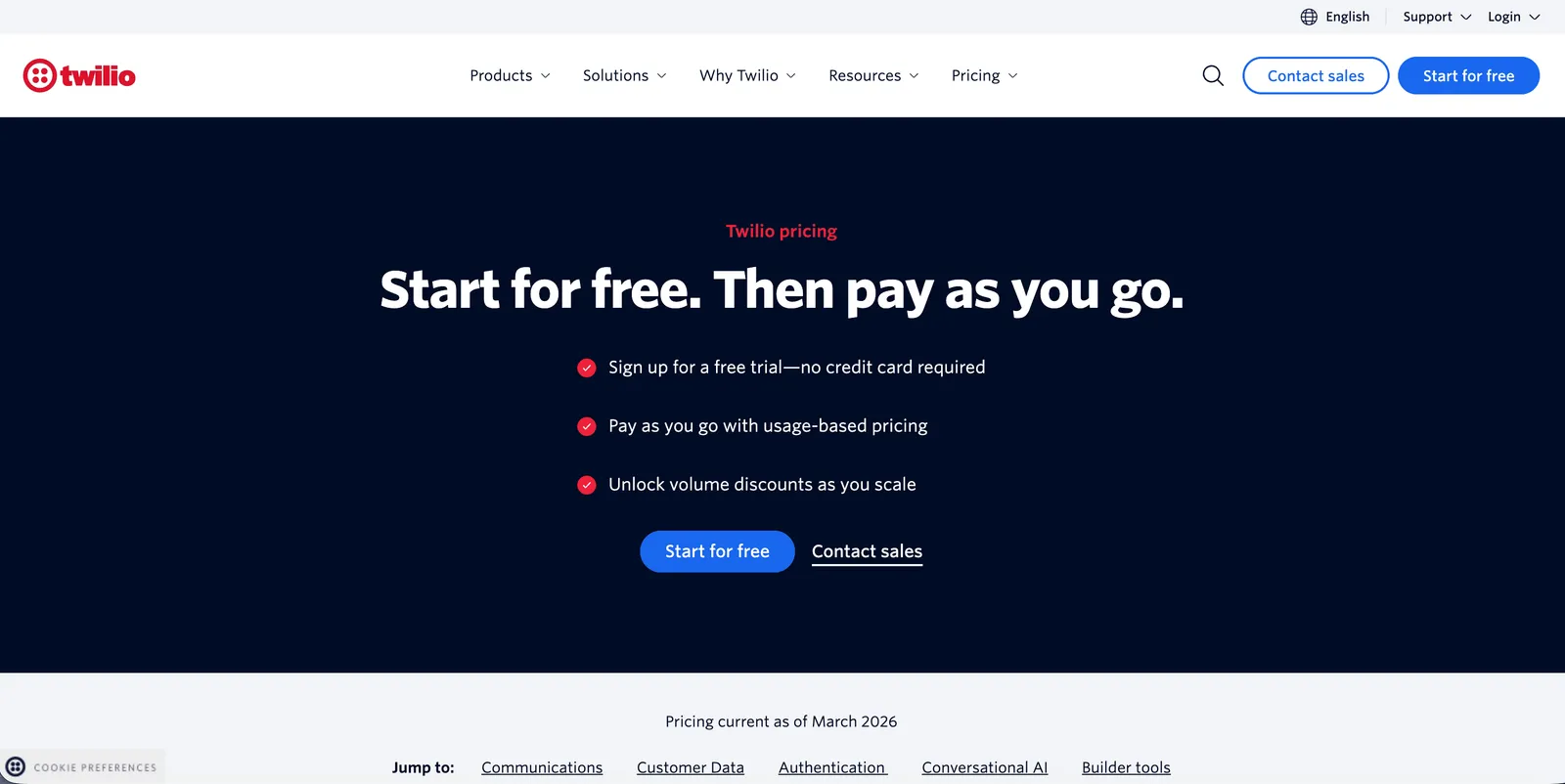
Twilio is the incumbent interconnected telephony platform, and telephony is its entire voice AI story: it buys termination from network service providers and resells it at scale.
What Twilio does not own is the model or the inference. Its ConversationRelay layer runs on cloud infrastructure and requires you to bring your own LLM and stand up a WebSocket server, trading fast agent creation for carrier-grade reach.
Twilio's own SEC filing shows the structural cost of that model. In 2024, it reported 51% gross margin on $4.458 billion of revenue, with delivery costs consisting "primarily of fees paid to network service providers" (Twilio 10-K, FY2024).
Half of every dollar it bills goes to cost, primarily carrier fees. For a line-by-line comparison of the two platforms,
Want to compare? Check out Telnyx versus Twilio.
Best for: enterprises already on Twilio needing carrier-grade telephony, omnichannel breadth, and any-LLM flexibility.
Key features:
- Interconnected telephony platform with global number inventory and PSTN reach
- Omnichannel breadth across voice, SMS, WhatsApp, and email
- ConversationRelay supports any LLM through a managed orchestration layer
Limits:
- Owns no models or inference, so every deployment brings its own LLM and a WebSocket server
- No fast no-code agent path, slow time to first call, and all-in cost is opaque once STT, TTS, and your LLM stack on the ConversationRelay rate
Pricing: $0.07 per minute for ConversationRelay on top of voice ($0.014/min outbound US), STT, TTS, and your own LLM costs, so the all-in figure is materially higher than the headline.
Choose Twilio if you are already deep in TwiML and Twilio omnichannel and want carrier-grade telephony with any model.
5. Synthflow: best for managed enterprise rollouts
Synthflow is a no-code voice AI platform built around a visual flow builder, with telephony provisioned by Synthflow. It now sells only through an enterprise motion, which reshapes who it fits.
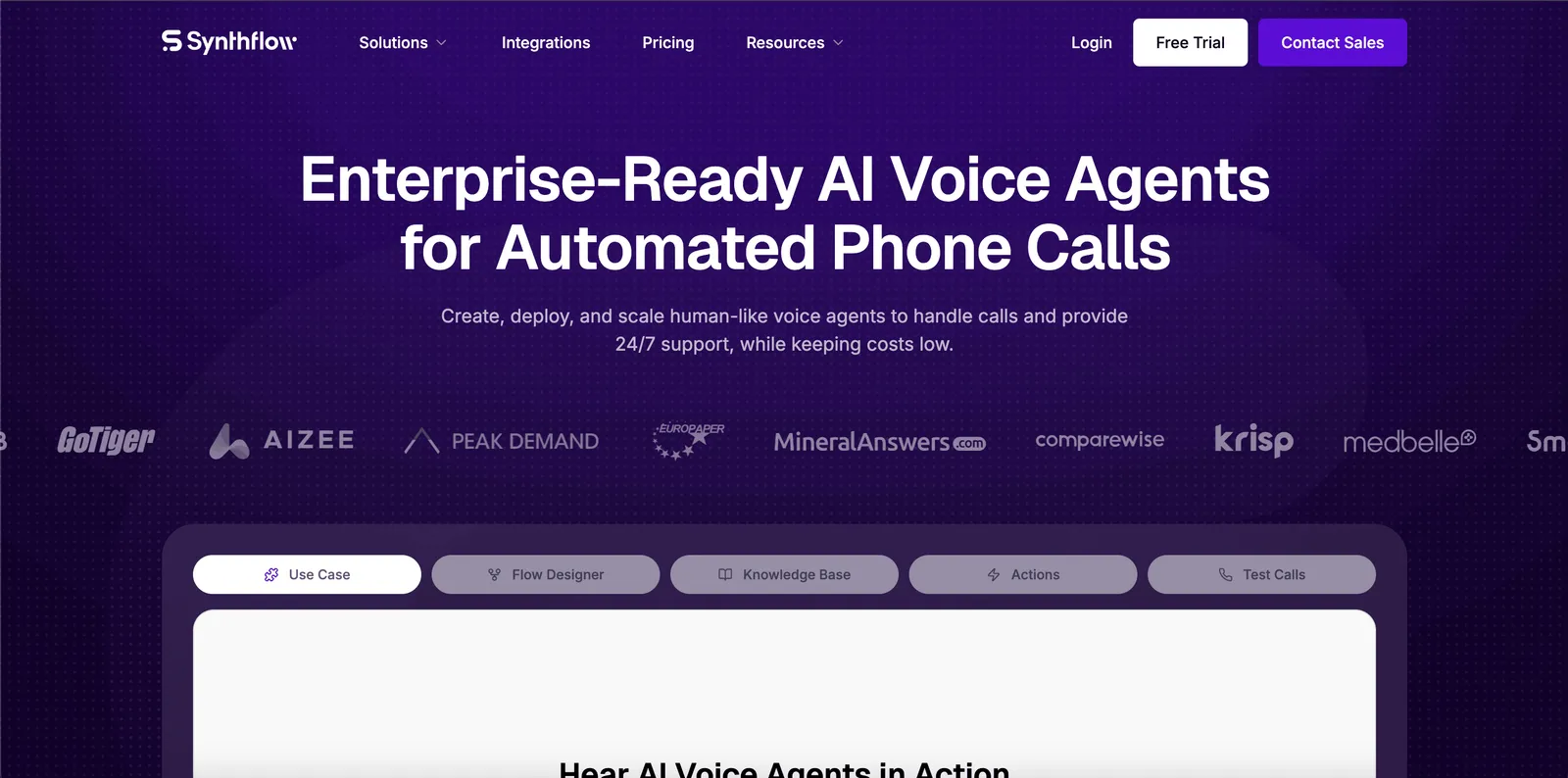
Best for: organizations that want a managed, high-touch rollout and can commit to an enterprise contract.
Key features:
- Visual no-code builder with provisioned telephony
- Enterprise onboarding scoped around call volume, concurrency, telephony setup, and security review
- SOC 2, HIPAA, GDPR, and ISO 27001 coverage
Limits:
- No self-serve tiers remain, so smaller teams and quick pilots are priced out
- Conversations follow a more structured, procedural path than free-form agents
Pricing: enterprise only, starting at $30,000 annually.
Choose Synthflow if you want a managed enterprise rollout and can commit to an annual contract.
6. ElevenLabs: best for voice quality and audio production
ElevenLabs offers more voices and accents than any other provider on this list. In a controlled listening study, its synthesis showed no statistically significant difference from real human speech on perceived naturalness.
Its agent platform grounds responses in your own data and connects to a broad set of tools.
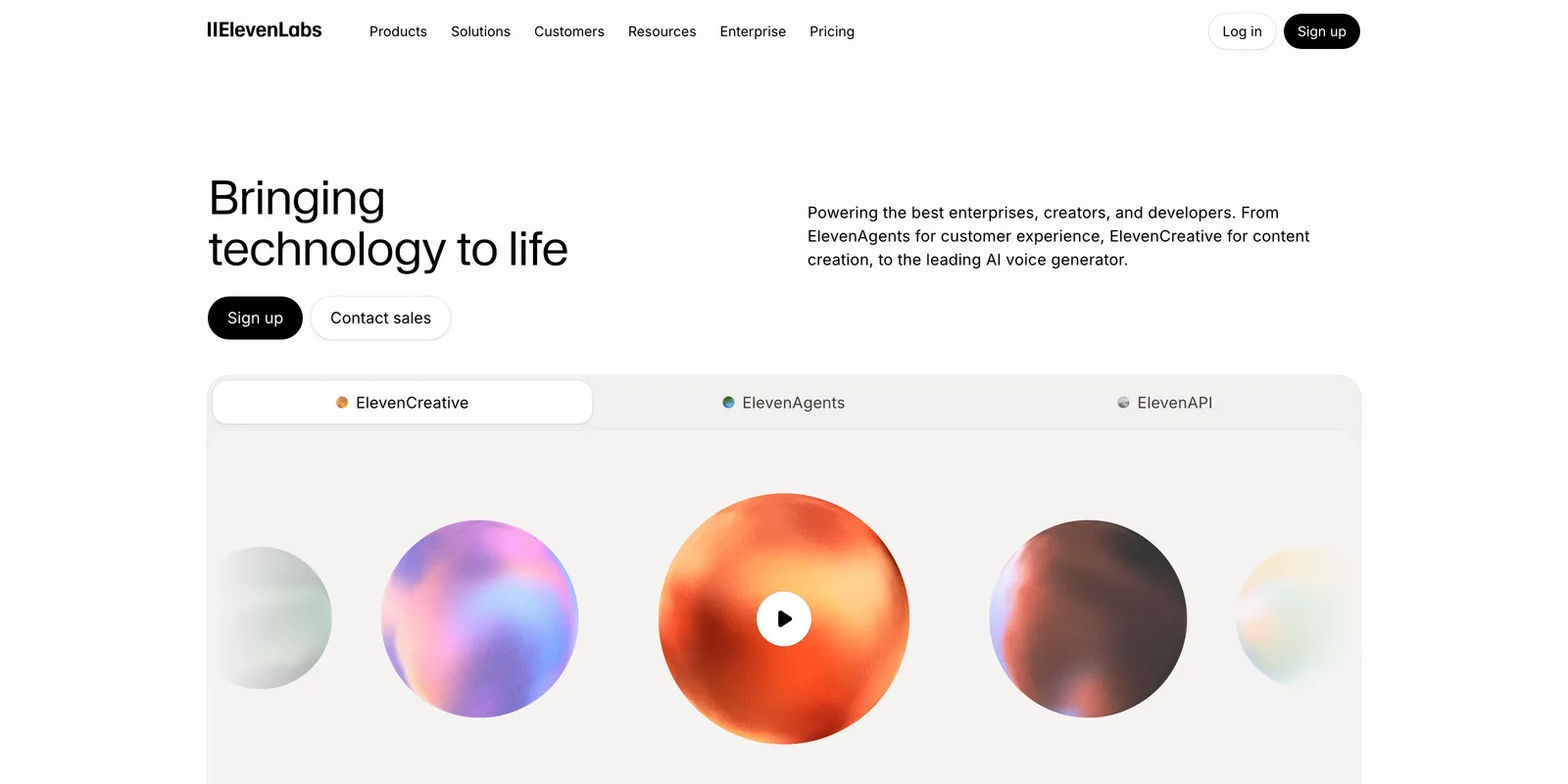
Best for: teams that prioritize voice quality and audio production alongside conversational agents.
Key features:
- Voice synthesis with no significant naturalness difference from human speech in a 28-listener study
- Retrieval grounding on your own data with a studio workflow for revising lines
- Broad SDK coverage and a 2-line embeddable widget
Limits:
- Owns no carrier network and no LLM, so every call rides third-party telephony and a third-party model
- Agents plans cap at 40 concurrent calls even on the $990/month tier, a real constraint for contact-center volume
Pricing: ElevenLabs Agents is $0.08 per minute on included tiers, with LLM and telephony billed at cost on top, and paid plans start at $6 per month.
Choose ElevenLabs if voice quality and audio production matter more than owned telephony, and your volume stays inside the concurrency ceiling.
7. LiveKit: best for open-source real-time infrastructure
LiveKit is an open-source real-time media backend: transport and room infrastructure you can host yourself, plus an Agents framework, both fully open source. It fits teams that want full control over the media layer and are prepared to run it.
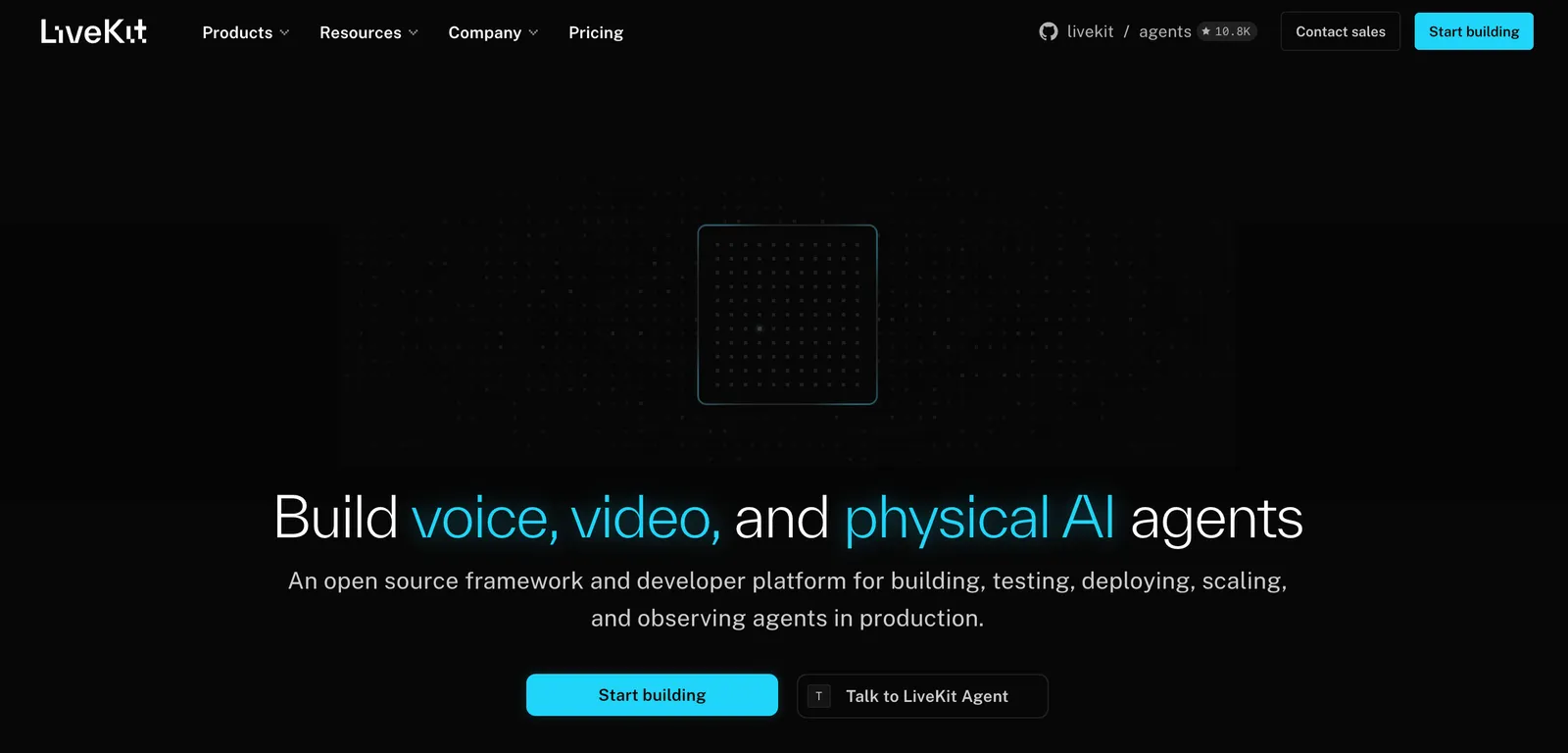
Best for: engineering teams that want open-source real-time infrastructure, self-hosted or managed.
Key features:
- Open-source media transport and room infrastructure
- Agents framework for voice pipelines, with telephony over SIP
- Scale tier supports up to 600 concurrent sessions
Limits:
- Self-hosting means you own telephony, latency tuning, and reliability engineering
- You still need a carrier and a SIP trunk for every call
Pricing: free to self-host; Ship from $50 per month and Scale from $500 per month, with SIP at $0.003 to $0.004 per minute (LiveKit pricing page, September 2026).
Choose LiveKit if you want open-source real-time infrastructure and can carry the operational load, or want a managed host for it.
8. Pipecat: best free option
Pipecat is an open-source framework for building voice AI agents, with 15,300 GitHub stars and orchestration of 150-plus AI services. It builds the same pipeline architecture Vapi productizes, so choosing it means assembling the pipeline yourself with no platform fee.
Best for: developers who want to assemble the pipeline themselves from open-source parts.
Key features:
- BSD-2-Clause license, maintained by Daily and the community
- Transports for Daily, LiveKit, Vonage, WebSocket, and WhatsApp
- Full control over every pipeline component
Limits:
- You own all integration, hosting, and reliability work
- No managed platform, support SLA, or built-in compliance
Pricing: free and open-source; you host and operate it.
Choose Pipecat if you want the raw open-source pipeline and have the engineering depth to run it.
Vapi pricing and the cost-at-scale problem
Vapi's cost at scale is a committed platform minimum plus metered compliance: a $999 monthly Pro floor, $2,000 a month for HIPAA, and $10 per line for concurrency. Provider costs pass through at no markup, with rates itemized on the same page.
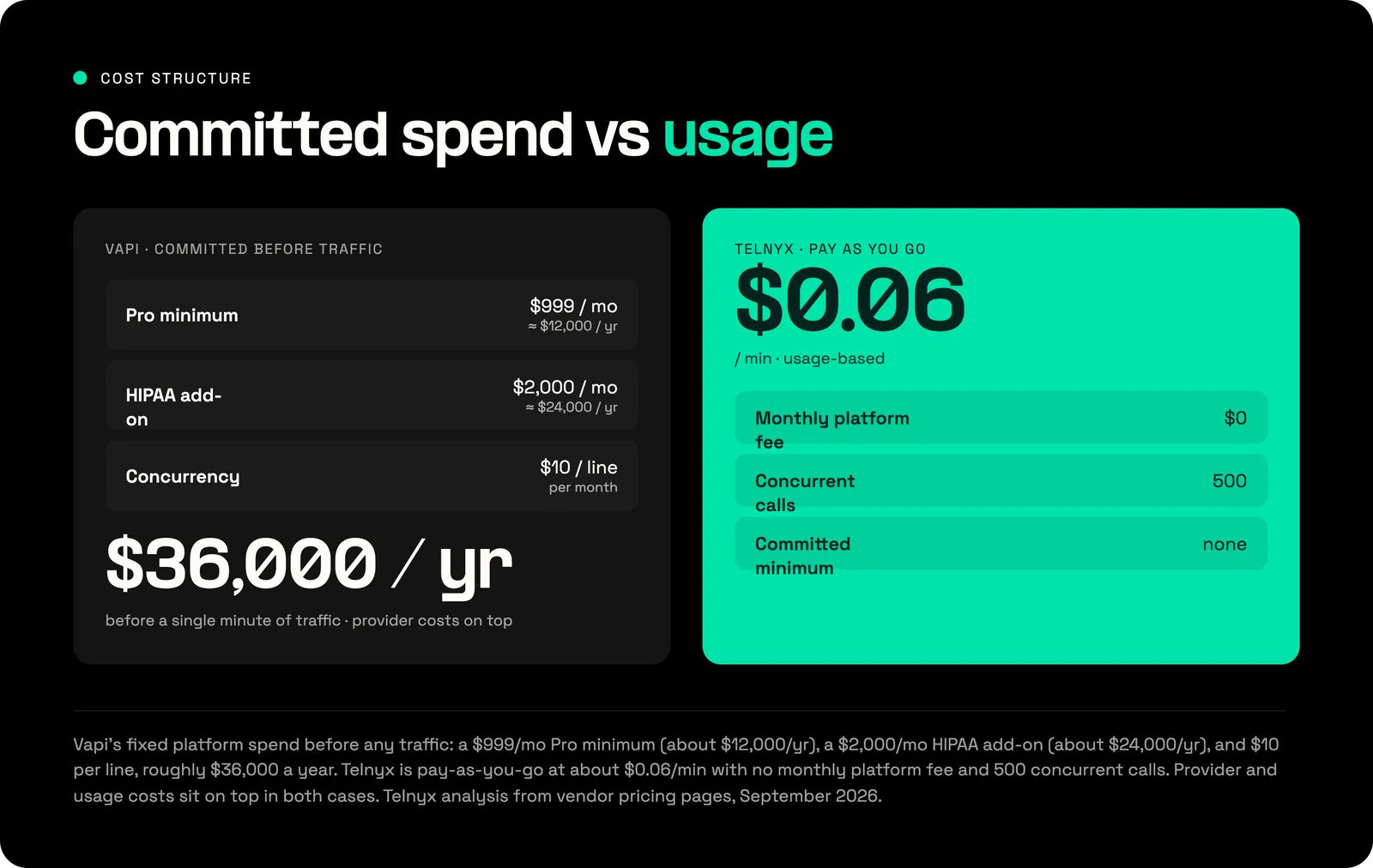
The sharper contrast is what a bundled, owned rate looks like against an assembled one.
- Telnyx, all-in: $0.05/min engine (orchestration, STT, and TTS bundled) plus about $0.006/min LLM on owned GPUs plus $0.0032/min telephony, near $0.06 per minute.
- Retell, cheapest viable config: $0.055/min infrastructure plus $0.015/min TTS plus the LLM plus $0.015/min telephony, about $0.087 per minute, roughly 45% above the Telnyx figure before any add-ons.
- Retell with common add-ons: knowledge base, denoising, guardrails, and PII removal push the floor to about $0.112 per minute.
- Bland: $0.14/min on Start or $0.12/min on Build plus a $299 monthly fee, roughly twice the Telnyx all-in rate.
 | "Model quality is a solved problem across several providers. The hard part is running those models at the edge, co-located with telephony, so the full chain, STT to inference to TTS to network delivery, stays on one infrastructure. Nobody else runs the full chain end-to-end. Vapi, Retell, Bland, they resell other people's TTS and STT, which means multiple vendors, multiple hops, compounded latency." Dr. Sonam Gupta, Developer Advocate, Telnyx |
Which Vapi alternatives scale best for production and global teams?
This depends on network ownership. On a rented, multi-vendor stack, every new region adds a carrier hop and a jurisdiction, so latency and billing get worse as volume and coverage grow.
LiveKit and Pipecat scale as far as you engineer them. You run the autoscaling, the failover, and the carrier relationships yourself, so there is no ceiling, and no safety net either.
Retell, Synthflow, and Bland scale inside their own product, but they resell telephony, so global reach and call quality depend on the carrier they rent. ElevenLabs Agents has a hard cap: 40 concurrent calls, even on the $990 monthly plan.
Telnyx owns the network and holds carrier licenses in 30-plus countries, so a new region adds capacity without adding a carrier hop. You get 500 concurrent calls pay-as-you-go and inference co-located across 20+ points of presence.
Which Vapi alternatives are best for developers and custom voice flows?
The Vapi alternatives suited to custom voice flows expose the pipeline as code: Pipecat and LiveKit, which you host, and Telnyx, whose APIs run on its own network. Vapi's strength is composability: you assemble the providers yourself.
Pipecat and LiveKit give the most control. Pipecat is the open-source framework for building the pipeline component by component; LiveKit is the real-time media layer and SDKs. You write and host the stack.
Retell and Synthflow are no-code first. Visual builders stand up an agent fast at the cost of programmatic depth, which shows the moment a flow needs custom logic.
Telnyx exposes a full API on an owned network: the Voice API and Call Control for call logic, WebRTC SDKs for JavaScript, iOS, Android, and Flutter, and Telnyx Inference as an OpenAI-compatible model endpoint.
How to migrate from Vapi to Telnyx
Migrating from Vapi is two jobs: move the telephony to Telnyx, and rebuild the agent on a Telnyx runtime.
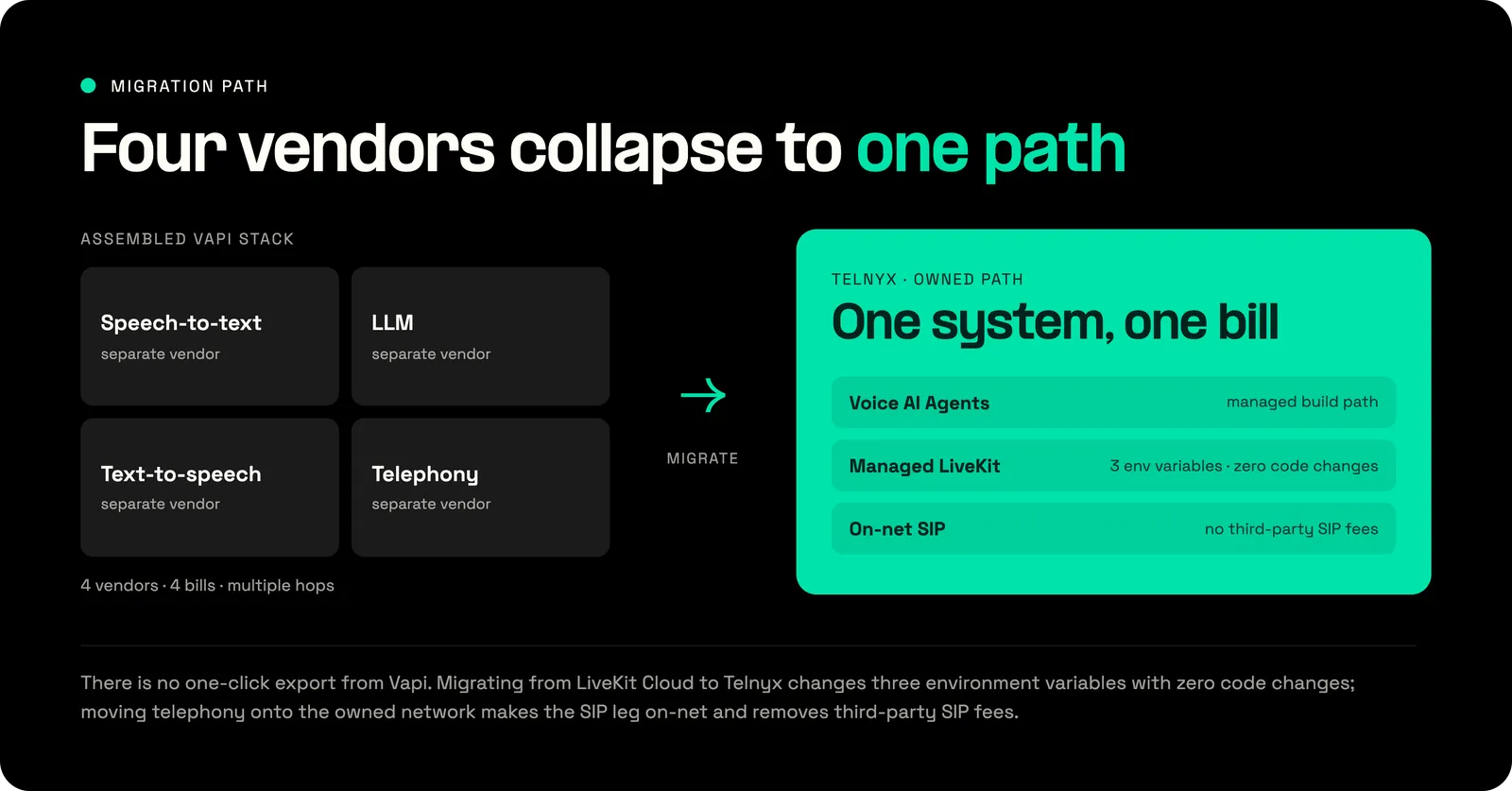
Start with the telephony. Port your existing numbers or buy new ones, then point them at Telnyx over SIP or Call Control.
The calls now run on Telnyx's own network, so the SIP leg is on-net and the pass-through carrier fees you paid to route through a third party go away.
Then choose a runtime, and this is where the effort splits. For a managed agent, rebuild on Telnyx Voice AI Agents. For the open-source model, deploy on Telnyx's managed LiveKit, where you ship your agent code, and Telnyx runs the containers, scaling, SIP, and inference.
That open-source path is the easy one if you are already on LiveKit. Moving from LiveKit Cloud to Telnyx is three environment variables and zero code changes: your agent code, SDK calls, CLI commands, and dispatch rules all stay as they are.
You are repointing the same agent at a network that owns the carrier layer and co-locates the inference, not rewriting it.
 Alex Cohen | Customer story: Hello Patient Hello Patient runs AI agents across voice, text, and web chat for healthcare workflows on Telnyx, with integrations into EHR, CRM, and practice management systems. "We're seeing more appointments being booked with fewer staff needed to run call centers and traditional phone lines." More than 5 million patient conversations powered in under two years. |
When Vapi is still the right choice
Vapi is a strong product, and switching is not always the answer. If your priority is composing a custom pipeline from specific providers, Vapi's bring-your-own-stack model is built for that. Provider costs pass through at cost, so you pay no markup for that flexibility.
Vapi also fits teams still in the experiment stage. At low volume, the committed platform minimum stays manageable, and you get to a first call fast. Its testing and observability tooling is mature, and developers who want to swap models freely will value it.
The case for moving strengthens as volume grows, latency matters more, and the committed minimum plus metered compliance becomes a fixed cost you carry whether or not you use it.
Build voice AI on infrastructure you own
Speech-to-text, text-to-speech, the model, and the carrier network on one platform and one contract, at sub-200ms latency, with nothing to stitch together.
Book a callFAQs
What is the best open-source Vapi alternative?
LiveKit and Pipecat are the best open-source Vapi alternatives. LiveKit is an open-source real-time media backend with an Agents framework. Pipecat is a BSD-2-Clause framework that builds the same pipeline architecture Vapi productizes, with no platform fee. Both require you to host the stack and own the telephony. LiveKit also runs managed on Telnyx, with SIP and inference handled.
What is the best Vapi alternative for voice AI at scale?
Telnyx is the best Vapi alternative for voice AI at scale because it owns the edge compute, voice AI platform, and carrier network the call runs on. Vapi orchestrates third-party providers instead, so each call crosses external hops and the platform fee carries a committed minimum. Retell and Synthflow fit no-code and managed workflows; Bland fits compliance-heavy deployments.
Which Vapi alternative scales best for production and global teams?
Telnyx scales best for global production because each new region adds capability on its own network, not another vendor hop. Multi-vendor stacks get worse as they expand, since every new market adds latency and another jurisdiction. Telnyx runs 20+ points of presence with co-located inference, so performance holds as coverage grows, and pay-as-you-go supports 500 concurrent calls.
Which Vapi alternative has the lowest latency?
Telnyx has the lowest published latency of the platforms compared here, with round-trip time under 200 milliseconds, near the quarter-second human conversational baseline. Vapi publishes sub-600ms. Bland publishes a vendor-reported p50 of 380 milliseconds but does not own the carrier layer. The gap is architectural: inference runs co-located with the agent and the call never leaves the Telnyx network.
What is the best Vapi alternative for developers building custom voice flows?
Telnyx is the best Vapi alternative for developers who want programmable control, with Call Control, SIP, and SDKs on owned infrastructure. Pipecat fits if you want an open-source framework and will build the pipeline yourself. Vapi does composability well, so the question is whether you keep assembling and hosting providers or move to one platform that owns the stack.
Which Vapi alternative handles barge-in and interruptions best?
Owned-network and self-hosted platforms handle barge-in more consistently than multi-vendor stacks, because the audio path is shorter. Barge-in quality depends on latency and turn-taking, and each vendor hop delays the interrupt. Telnyx runs the whole audio path on its own network, so the interrupt resolves inside its published round-trip time rather than across vendor boundaries.
How much does Vapi cost, and why does it get expensive at scale?
Vapi passes provider costs through at no markup; the fixed platform spend is what gets expensive at scale. The Pro tier has a $999-per-month minimum, about $12,000 a year. HIPAA adds $2,000 per month, another $24,000 a year. Concurrency is $10 per line per month. A regulated team therefore commits about $36,000 a year before traffic and per-line charges.
Is there a free or cheaper Vapi alternative?
LiveKit and Pipecat are free Vapi alternatives; you pay only for the infrastructure you host them on. Among managed platforms, compare total cost once you add provider bills, concurrency, and compliance. Telnyx's bundled rate is about $0.06 per minute all-in, easier to forecast than an assembled stack that starts near $0.087 and climbs with add-ons.
Which Vapi alternatives support SIP trunking and SOC 2 or HIPAA compliance?
Telnyx supports SIP trunking on its owned network and ships SOC 2 Type II, HIPAA, PCI DSS Compliant, ISO 27001, and GDPR with EU-deployed infrastructure. Bland offers SOC 2 Type II, HIPAA, GDPR, and PCI DSS with on-premise deployment on Enterprise plans. On Vapi, HIPAA is a paid monthly add-on, and SLA and SSO sit on the Premier tier.
Share on Social
Osman is the Global AEO/SEO Lead at Telnyx, helping make voice AI and communications products clearer for builders. With almost a decade of experience in SEO, he previously led growth at Windscribe and Enzuzo, shipping and scaling organic programs that reached millions.


